

Your opening moves set the tone for everything that follows. Most beginners rush into attacks without a plan, which leaves their position weak and their king exposed.
At Chess Gaja, we’ve seen thousands of young players transform their games by mastering solid opening concepts. The three principles in this post-controlling the center, developing pieces methodically, and protecting your king-form the foundation that separates winning players from those who struggle.
Control the Center Early
Why the Center Squares Matter Most
The four central squares—d4, e4, d5, and e5—control more of the board than any other real estate in chess. After 1.d4, developing your knight to f3 controls e5 and defends your d4 pawn. Advancing your c-pawn to c4 challenges Black’s d5 pawn and opens pathways for your queen. This is pure mathematics.
When you control the center early, your pieces gain instant mobility. Your opponent’s pieces get squeezed into tight spaces, and your attacking chances multiply.
Most beginners ignore this concept. They move edge pawns or bring their queen out too early. This wastes valuable time and leaves the center undefended. Winning youth players across the USA, UAE, and Singapore share one habit. They control and reinforce the center from move one. Your main goal is to plant a piece on a central square and defend it firmly.
How to Plant Your Pieces in the Center Without Wasting Moves
The cleanest way to control the center is pushing 1.e4 or 1.d4 as White. Professional databases show these two moves account for the vast majority of all master games.
After 1.e4, your knight belongs on f3. This develops a minor piece while supporting your e-pawn. After 1.d4, developing your knight to f3 controls e5 and defends d4. Advancing your c-pawn to c4 challenges Black’s d5 pawn and opens pathways for your queen.
The key rule is simple: move each piece once during the opening phase. Moving a single knight three times wastes critical tempo while your opponent develops four separate pieces. This hands your opponent better piece coordination and central dominance before move 12.
Against Black’s responses, stay patient. If Black plays 1…d5 against your 1.e4 (the Scandinavian Defense), you can capture with 2.exd5 or support your pawn with 2.d3 to maintain tension. If Black plays 1…c5 against your 1.d4 (the Old Benoni Defense), you can capture with 2.dxc5, support your center with 2.Nf3 or 2.e3, or push ahead with 2.d5 to gain a direct space advantage. The worst mistake is to grab material on the edges while ignoring what happens in the center. A beginner who captures a flank pawn on the edge while leaving their central pawn on d4 or e4 undefended will quickly lose central control and face a losing position by move 20.
The Three Mistakes That Cost Beginner Players
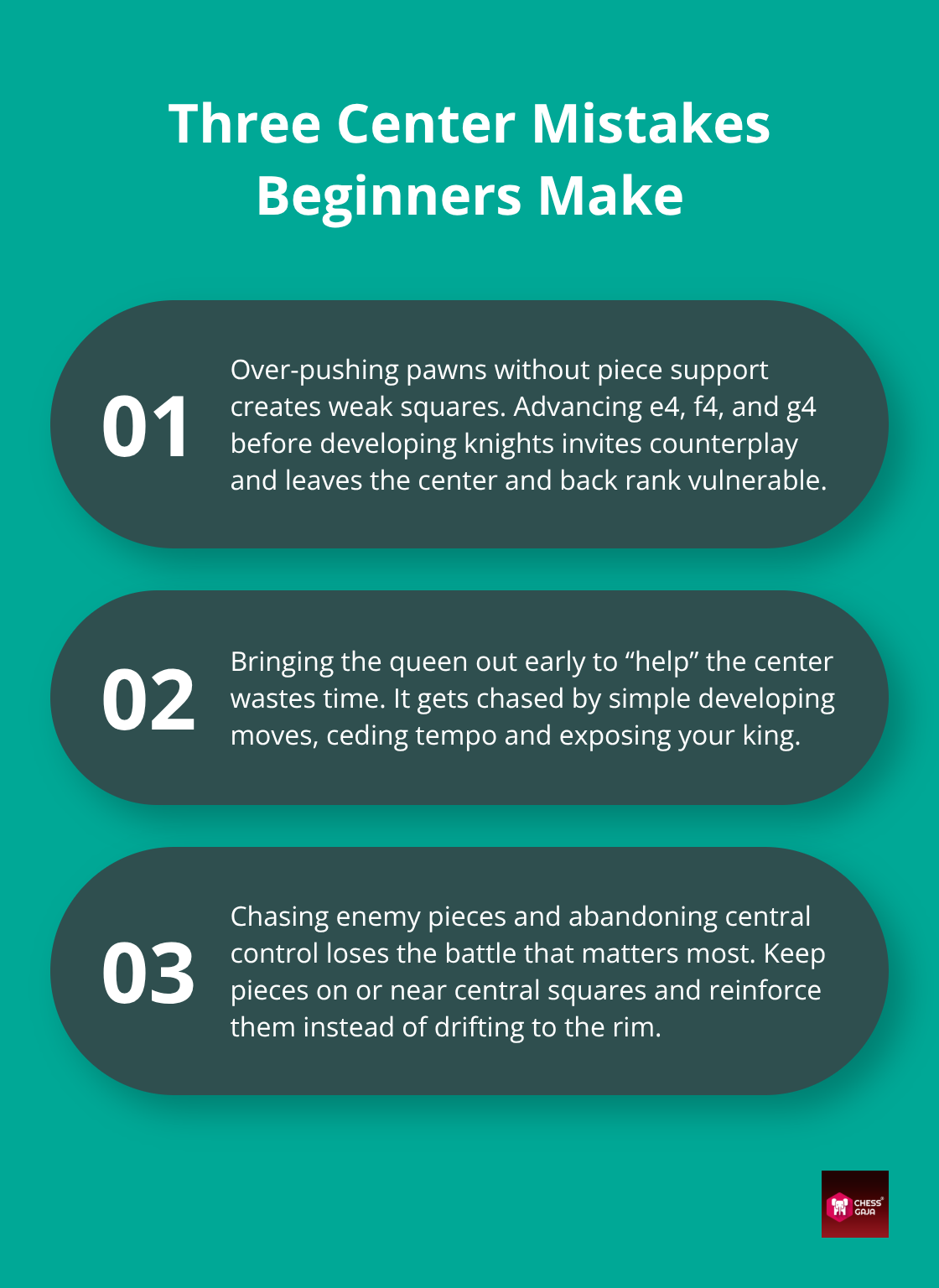
Young players in youth tournaments repeatedly make three classic center errors. First, they push too many pawns forward without piece support (like playing e4, f4, and g4 before developing a knight). This creates positional weaknesses that stronger opponents exploit.
Second, they bring out the queen early. A queen brought out early to e4 or h5 gets easily chased away by minor pieces like …Nc6 or …Nf6, wasting critical tempo and exposing your position. Third, they abandon central control to chase minor pieces. Retreating a knight on d4 to a safer central square like f3 is far better than sending it to the rim.
The center is the foundation of your whole position. Ask yourself one question before every move: Does this move strengthen my center control? That single habit transforms results within weeks. Mastering this concept sets up your next critical opening phase: engaging in strategic piece development with purpose.
Develop Your Pieces With Purpose and Order
The sequence of developing your pieces separates 1200-rated players from those stuck at 800. Beginners often treat development like a simple checklist. In reality, your move order determines whether your pieces work together or clash.
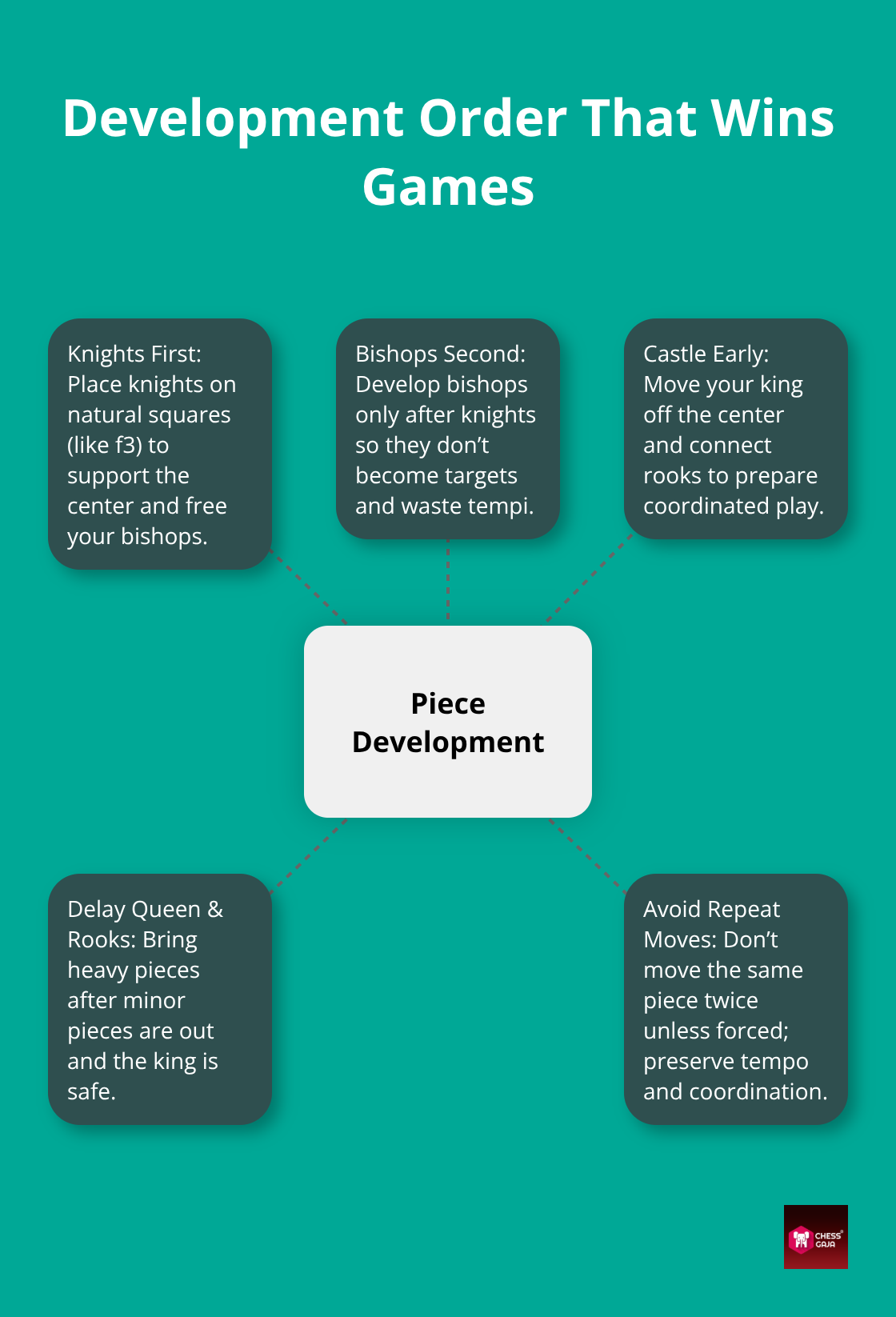
As a baseline rule, develop your knights before your bishops. Knights have fewer optimal squares (usually f3/c3 or f6/c6). Bishops often wait until the pawn structure settles before choosing their best diagonal.
Developing a knight to f3 on move 2 does three things: it develops a piece, controls central squares, and prepares early castling.
Developing a bishop to c4 without securing central control allows Black to counter with …d5, gaining space while forcing your bishop to move again.
Follow this simple hierarchy: knights first, bishops second, queen and rooks last. A student in Dubai applied this exact sequence and jumped 150 rating points in three months.
When you move a bishop to c4 early without control of the d5 square, Black can play …d5 or …b5 to attack it, forcing your bishop to move again. You have now wasted precious tempo on the same piece while Black gains space and equalizes the position smoothly.
Castle Early to Protect Your King
Castling is the only move in chess where you move two pieces at once, and it serves two essential purposes that beginners ignore. First, it removes your king from the center, where it is vulnerable to tactics and checks. Second, it connects your rooks so they can support each other and control open files. A student in Singapore who castled on move 6 consistently outplayed opponents who castled on move 15. The difference is concrete: by move 6 or 7, White’s king sits safely on g1 after kingside castling, the rooks are connected, and pieces coordinate smoothly toward the middlegame. A king still on e1 at move 10 is a liability. Any check or pin disrupts your position, forces you to respond instead of attack, and eats away at your tempo advantage.
Kingside vs. Queenside: Which Direction Wins
The timing of castling depends on your position. If Black has not yet attacked your center or kingside, kingside castling (castling short, which moves White’s king to g1) is almost always correct. It gets your king to safety faster and protects the vulnerable f2 square behind a solid pawn shield. Queenside castling requires much more caution. If you castle long on move 7 as White, your opponent can launch a fast pawn storm on your king with moves like …a5 and …b5. It works well when you have a space advantage and plan to attack on the kingside, but it exposes your king to a counterattack if Black pushes pawns toward your queenside. A practical guideline: castle kingside unless your opening plan explicitly demands queenside castling and you have concrete compensation.
The Hidden Cost of Repeating Moves
Moving the same piece twice in the opening is a habit that costs games. Spending four moves to shuffle one knight means your opponent develops four distinct pieces. This creates a severe positional disadvantage before the middlegame even begins.
Moving a piece twice is only acceptable when you are forced to defend it. For example, retreat if your knight is directly attacked. Otherwise, focus entirely on new piece development.
A student in New Jersey tracked this metric in his games. He discovered that unnecessary second moves cost him an average of 25 rating points per game. Once he eliminated those wasted moves, his rating jumped 80 points in two months. Before moving any piece a second time, check your opponent’s development. If they have more active pieces than you, develop an unnmoved piece instead.
When Piece Order Breaks Down
Occasionally, you must break the knight-before-bishop rule. If your knight on f3 is hit early by an advancing pawn like …e4, you must spend a move repositioning it before continuing your bishop development. If your opponent creates an immediate threat in the center or pins a key piece, you may need to develop your bishop earlier to relieve the pressure. These exceptions exist, but they remain exceptions. The students who win consistently at youth tournaments in the USA, UAE, and Singapore all share one habit: they follow the standard development sequence unless their opponent forces them to deviate. Once you master piece order and castle early to protect your king, your position naturally supports the final critical phase of the opening: protecting your king from the tactical threats that emerge as both sides complete their development and transition into the middlegame.
King Safety Determines Who Wins Early
Your king is the most valuable piece on the board, yet most beginners treat it like a secondary concern during the opening. A king stuck in the center at move 8 while your opponent has completed development is not a minor disadvantage-it is a loss waiting to happen. The difference between a student who castles on move 6 and one who castles on move 15 is measurable and brutal.
In youth tournaments across the USA, UAE, and Singapore, players who delay castling lose most of their games within 20 moves, often without realizing their exposed king was the root cause. Castling accomplishes two things simultaneously: it moves your king away from the center where tactics and checks devastate your position, and it connects your rooks so they can defend each other and control critical files. A player in Abu Dhabi who made securing his king a priority by move 6 to 8 jumped from 950 to 1200 rating in six months. The timing matters more than you think. If you have not castled within your first 10 moves, an active opponent will quickly exploit your central king.
Kingside Castling: Your Default Choice
Kingside castling (short castling) is almost always your best choice. Moving your king to g1 gets it to safety quickly. It protects the sensitive f2 square behind a strong pawn shield and secures your king on the flank.
Queenside castling requires much more caution. If you castle long on move 7, your opponent can launch a fast pawn storm on your king with moves like …a5 and …b5.
One of our students tracked his castling decisions across 40 games. Kingside castling yielded consistently higher win rates, while queenside castling proved riskier at the 1100–1300 rating level. Stick to kingside castling unless your specific opening system calls for long castling.
Why Premature Attacks Destroy Your Position
Premature attacks destroy beginner positions more than any other mistake. Trying to create threats before securing your king always backfires.
Consider a player who pushes 2.g4?! or an unsupported 2.f4 on move two against the Sicilian Defense (1.e4 c5). When Black counters with 2…d5!, the center opens up rapidly before White’s minor pieces are developed, exposing the white king.
This pattern repeats constantly in youth events. A player pushes flank pawns to attack, Black counters in the center, and White’s king becomes vulnerable. The rule is simple and non-negotiable: castle first, attack second.
The Winning Sequence: Development Before Aggression
With your king safe on g1 and rooks connected, you can safely launch an attack. However, if your king remains on e1, any counterattack forces you to defend instead.
Here is a metric to track: count your attacking moves before castling versus after castling. If a significant portion of attacks happen before castling, your opening strategy is backwards.
Winning youth players in Dubai, Toronto, and Singapore share one habit: they finish development before attacking. Once your king is secure, your attacks carry power without leaving weak spots behind.
Final Thoughts
The three solid opening concepts you have learned—controlling the center, developing pieces in order, and protecting your king—form the backbone of every strong opening played at the grandmaster level. These principles are not optional guidelines; they are the exact foundation that separates players who win consistently from those who struggle. When you control the central squares, your pieces gain essential mobility while your opponent’s position gets squeezed.
The opening transitions into the middlegame around moves 10 to 15. Your opening play directly determines whether you enter with an advantage or a defensive liability. Apply these concepts in your next games by picking one solid opening system as White (1.e4 or 1.d4) and clear main defenses as Black against both 1.e4 and 1.d4. Focus on controlling the center, developing your minor pieces, and securing your king by move 8 to 10.
At Chess Gaja, we coach students across 40+ countries. We help embed these principles into their games through structured coaching and personalized feedback. Book a Paid Starter Class with one of our FIDE-rated coaches today to receive professional guidance and a detailed skill evaluation that accelerates your opening mastery.