


Most junior players memorize opening moves without understanding why they matter. This approach leads to confusion when opponents deviate from theory, leaving young players without a real strategy.
At Chess Gaja, we’ve seen thousands of students break through this barrier by learning opening ideas for juniors based on core principles rather than endless variations. The right framework transforms opening play from rote memorization into confident decision-making.
Why Junior Players Hit a Wall with Opening Theory
The Memorization Trap
Most junior players memorize opening moves without understanding why each move matters. A student rated 1200 might spend weeks drilling the Ruy Lopez or Sicilian Defense, learning move sequences by heart. Then in a tournament, the opponent plays an unexpected sixth move, and the junior freezes. Without understanding the principles behind those opening moves, a single deviation feels like stepping off a cliff. Memorization creates brittle knowledge-it works only in exact positions the student has seen before.
Why Theory Fails in Real Games
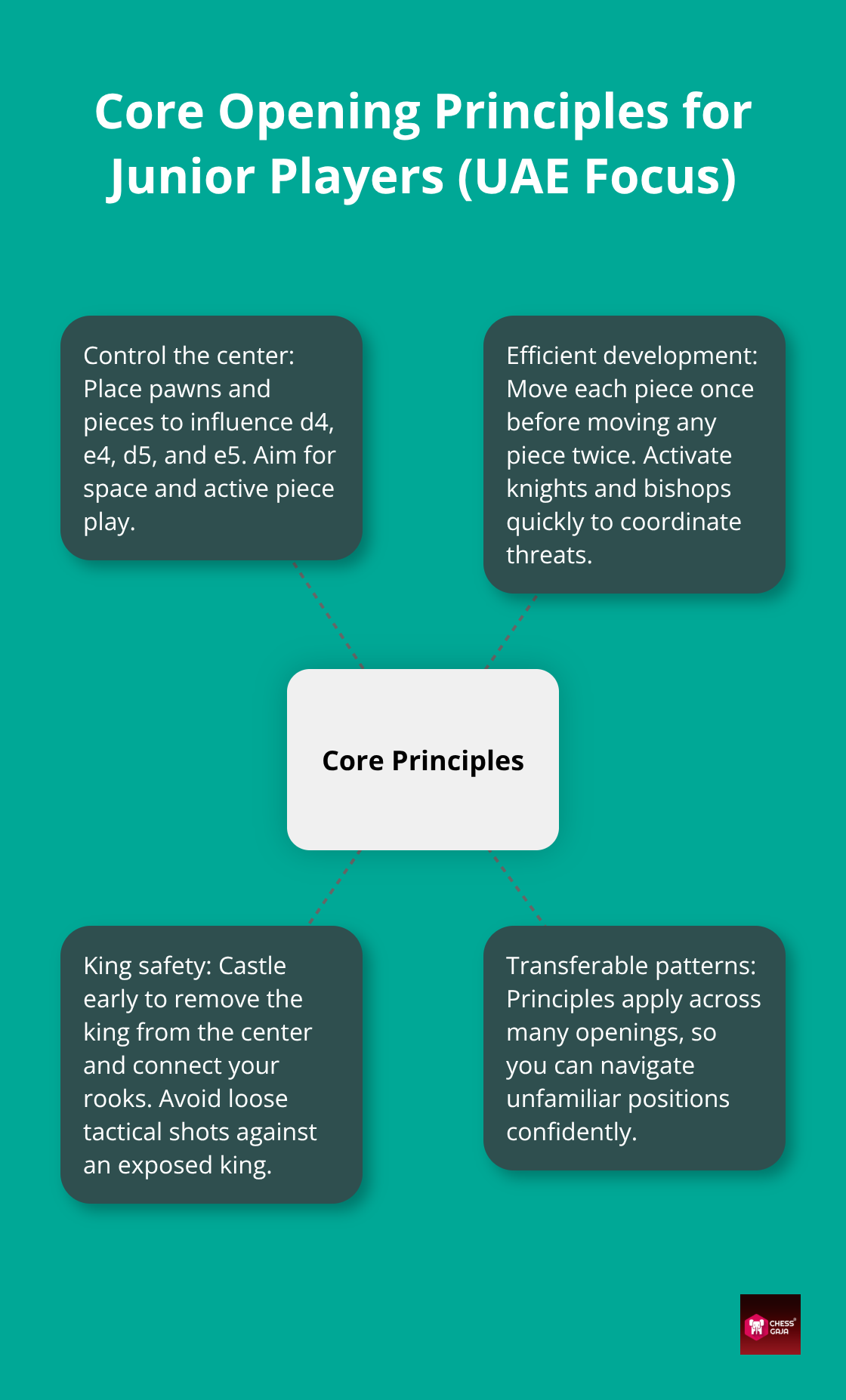
Juniors in the USA, UAE, and Singapore often encounter opening resources designed for players rated 2000 and above. These resources assume deep pattern recognition and the ability to evaluate complex middlegame positions. A junior rated 1400 cannot apply that level of analysis. Instead, juniors need opening ideas rooted in simple principles: control the center, develop pieces efficiently, and castle early.
The Italian Game teaches active piece play around the central d4 and e5 squares. This single principle transfers across hundreds of unfamiliar board setups. When a junior memorizes 12 moves of a specific variation, that knowledge applies to exactly one game situation. Research confirms that principle-based learning drives faster rating gains than pure memorization. Yet most junior resources still prioritize rigid move sequences.
The Real Cost of the Mismatch
The gap between what juniors learn and what they face in tournaments runs deep. A junior who relies on memorized lines lacks the mental tools to adapt when opponents deviate. This creates frustration, slower rating progress, and a false sense that opening play lies beyond their reach. Juniors feel lost when reality diverges from their prepared lines. Unfortunately, this situation happens far more often than players expect.
The solution lies not in memorizing more variations, but in building a foundation of opening principles that junior players can apply across thousands of positions. Once a junior understands why a move works, they can make sound decisions even when facing unfamiliar positions.
Three Principles That Actually Work in Junior Games
Center Control With Purpose
Center control means something different at 1200 than it does at 2400, and most junior resources ignore that gap. A junior player doesn’t need to understand backward pawns or weak squares—they need to recognize that controlling or placing pawns and pieces on d4, e4, d5, and e5 gives them control over the board. In the Italian Game, White plays 1.e4 e5 2.Nf3 Nc6 3.Bc4, establishing pressure on the center and preparing to fight for d4. That’s center control with purpose.
A 1300-rated junior recognizing this pattern adapts across dozens of openings. They make sound, confident decisions without relying on rote memory. White occupies e4, exerts pressure toward d5 and f7, and develops the knight to f3 and the bishop to c4. These moves serve one goal: controlling the center while activating pieces. Internalizing this pattern shifts focus from specific move sequences to position understanding.
Efficient Piece Development
Efficient piece development means moving each piece once before moving any piece twice during the opening. This rule prevents the trap that costs juniors rating points every week. A player rated 1400 might move the same knight three times in the first ten moves while leaving the bishop undeveloped on c1.
The Ruy Lopez shows how grandmasters apply this principle: White plays e4 e5 2. Nf3 Nc6 3. Bb5, developing two pieces in three moves while indirectly challenging Black’s central defender. Black faces the same standard: develop each piece efficiently, secure king safety, and coordinate them for the middlegame. A junior who follows this discipline gains a concrete advantage: more pieces fighting for control, fewer wasted moves, faster piece coordination.
King Safety First
King safety matters most in the opening. A king in the center is vulnerable to tactics and checks that junior players miss until it’s too late. Castling kingside (the most common choice) removes the king from the center and connects the rooks. A 1200-rated player who castles by move 10 will consistently outplay unprepared opponents. They focus on core principles rather than memorizing rigid opening variations.
The Sicilian Defense (1.e4 c5), the most popular response to 1.e4 worldwide, creates an asymmetrical center by fighting for the d4 square with a flank pawn, requiring Black to carefully balance dynamic piece play with timely king safety. The French Defense (1.e4 e6 2.d4 d5) challenges White’s center directly, often leading to locked pawn structures where strategic understanding matters more than move calculation. Junior players often misunderstand it because they memorize moves instead of learning the plan. Patient development and timely …c5 (or …f6) breaks navigate French Defense structures far better. Drilling move sequences simply cannot match true strategic understanding.
From Theory to Tournament Reality
The framework works because it’s portable-it applies whether your opponent plays the Slav Defense, the Caro-Kann, or an offbeat system. Once a junior masters these three principles, they stop being victims of memorization and start being architects of their own opening strategy. This shift from passive memorization to active principle-based thinking is exactly what separates juniors who stall at 1400 from juniors who break through to 1800 and beyond. The next step is learning how to recognize when your opponent deviates from standard theory and how to turn that deviation into a concrete advantage.
Applying Opening Ideas in Real Tournament Play
In tournament play, your carefully prepared opening lines matter far less than you think. A 1300-rated junior plays the Italian Game perfectly through five moves. Suddenly, the opponent introduces an unexpected deviation from standard theory. The junior freezes, having prepared for only one specific continuation. This moment defines whether a junior can actually play chess or simply execute memorized sequences. The truth is harsh: most juniors have no framework for handling deviations, so they make weak moves that squander their preparation advantage.
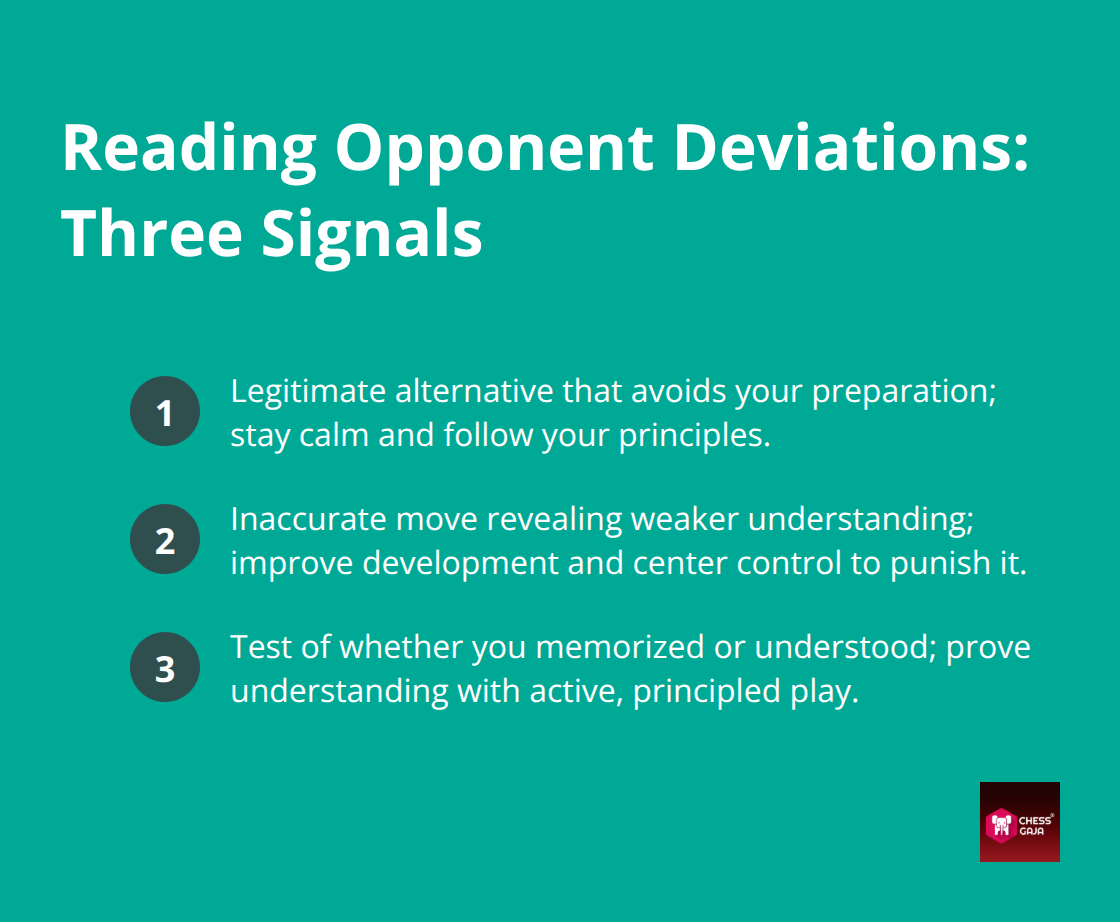
Learning to recognize deviations separates juniors who improve steadily from juniors who plateau at 1400. When your opponent deviates, they signal one of three things. First, they may be playing a legitimate alternative that sidesteps your preparation entirely. Second, they might be playing inaccurately because they don’t understand the position as deeply as you do. Third, they could be testing whether you understand the principles behind your opening or just memorized moves.
The distinction matters because it changes how you respond. If your opponent deviates into a position where your three core principles still apply-control the center, develop pieces efficiently, secure your king-then you already have a winning strategy. You don’t need to memorize a response; you apply the principles and gain an advantage through superior understanding. A junior who learns to recognize this pattern gains a concrete edge in tournament play. At major championships, principle-minded juniors outplay those relying strictly on memory. When prepared lines diverge, the player with sound principles adapts effortlessly. The junior with principles adapts. The junior without them scrambles.
Spotting the Moment Your Preparation Ends
The deviation arrives differently depending on your opening choice. In the Italian Game, if White plays 1. e4 e5 2. Nf3 Nc6 3. Bc4 and Black responds with something other than the main-line moves like Nf6 or Bc5, the deviation has begun. Stop searching your memory for prepared moves during an unexpected variation. Instead, evaluate Black’s piece placement and check their control over central squares. If Black has played carelessly and left the center weak, your next move should exploit that weakness through tactical or concrete piece play, not through memorized theory.
When playing or facing the Sicilian Defense, deviations often happen early (moves 2–4 in Open/Anti-Sicilians) or around moves eight to nine in complex main lines when one player chooses a quiet sideline to avoid sharp continuations. This is where many juniors make a critical error: they treat the sideline as an inferior choice and play passively, assuming their preparation advantage has disappeared. The opposite is true. A sideline often indicates your opponent prefers solid, strategic play over tactical complications. That’s information. Respond by pressing for an advantage using superior piece placement and center control. Do not try forcing wins through tactics your opponent actively avoids.
Converting Deviation Into a Real Advantage
A junior rated 1500 playing the Ruy Lopez against a 1450-rated opponent reaches a position where the opponent plays an unexpected move on move seven. The junior panics internally but then remembers: the three principles still apply. The junior checks: Is the center controlled? Are my pieces developed efficiently? Is my king safe? The answer to all three is yes for the junior; the opponent’s premature move wasted a tempo with a minor piece, leaving their king in the center and allowing White to comfortably complete development.
The junior plays a simple developing move that improves piece coordination and maintains central pressure. Three moves later, the opponent’s position has become cramped because they deviated without a clear plan. The junior didn’t need to remember a specific variation; they needed to recognize that their principles still applied and their opponent had abandoned them. This is the advantage that separates juniors who win consistently from juniors who win only when opponents cooperate with their preparation.
Practical tournament experience teaches this faster than any resource can. The U2000 Rapid Tournament format offers a low-stakes environment where juniors can test opening principles under time pressure without the weight of a major championship.
In rapid chess at 25 minutes plus increment, juniors face constant deviations because players have less time to follow main lines. A junior who has practiced applying principles rather than memorizing moves thrives in rapid chess. They make sound decisions quickly because they’re evaluating the position against three simple principles rather than searching memory for a specific sequence. That speed and confidence under time pressure translates directly to tournament results. A junior who improves opening understanding through principle-based study sees rating gains of 50 to 100 points within two months.
Building an Opening Repertoire That Actually Works
Most juniors choose too many openings and learn none of them deeply. A student rated 1200 might play five different responses to 1.e4, switching between the Sicilian, the French, and the Caro-Kann depending on mood or what they read the night before. Memorizing disconnected variations creates a fragmented knowledge base without underlying strategic themes. Consequently, juniors perform inconsistently without a coherent overall opening strategy.
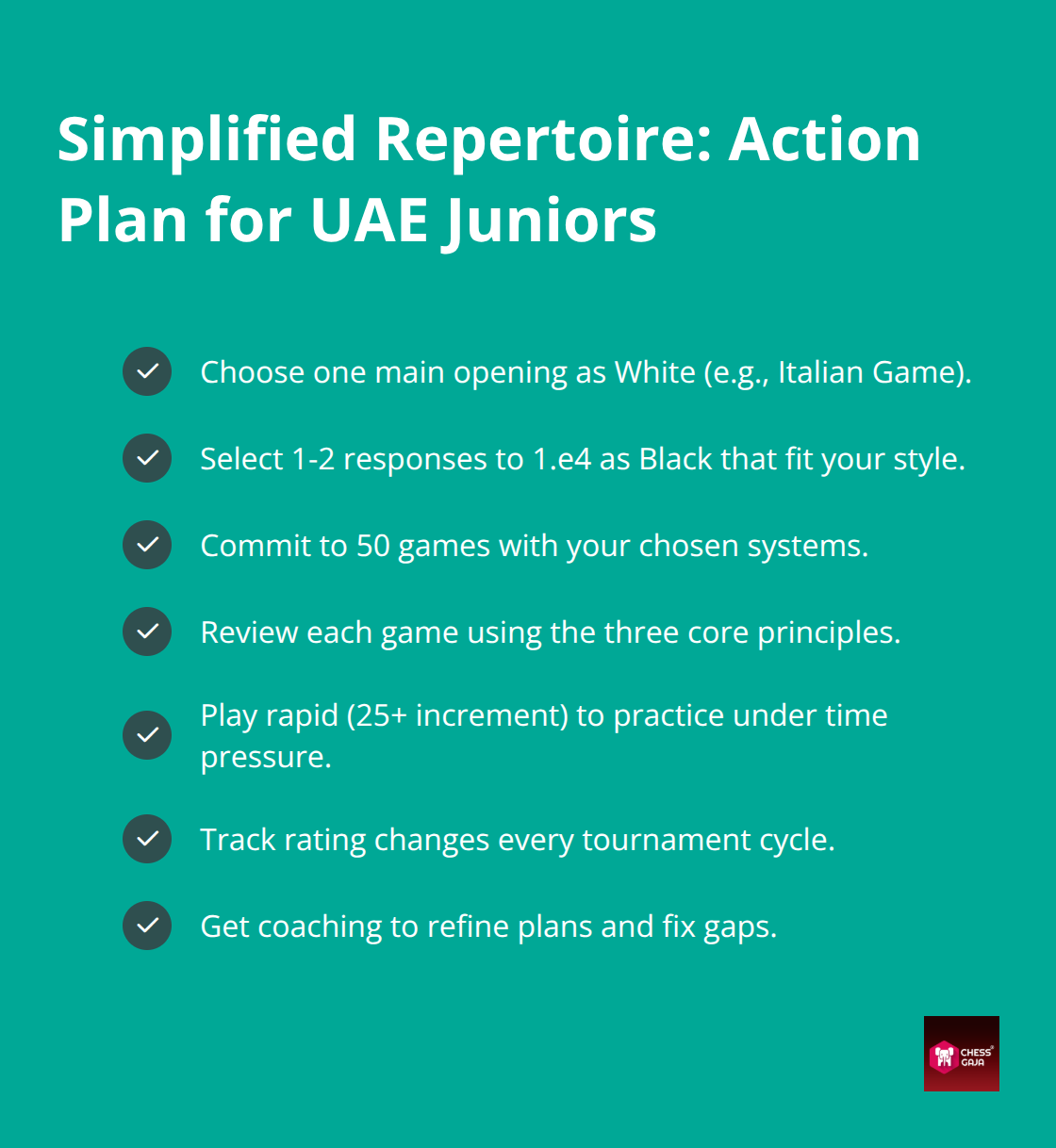
A simplified repertoire works dramatically better. Choose one primary opening for White, one solid response as Black against 1.e4, and one reliable setup as Black against 1.d4 (such as the King’s Indian, QGD, or Slav). The Italian Game serves as an excellent White repertoire for juniors because it teaches center control and active piece play without requiring extensive theoretical knowledge. As Black against 1.e4, choose either the Sicilian Defense if you want counterplay and asymmetrical positions, or the French Defense if you prefer solid, strategic positions with long-term plans. The choice depends on your playing style, not on what’s fashionable.
Playing 50 games with two focused openings builds true strategic mastery. Playing ten different systems across 50 games produces only shallow knowledge. That depth translates into confidence at the board. When you sit down and see your opponent’s first move, you know exactly what your opening plan is because you’ve practiced it hundreds of times. You recognize deviations instantly because you understand what your position should look like. You make sound decisions because you’re not consulting a mental database of variations; you’re applying principles you’ve internalized through repetition.
Proven Results Across Scholastic Circuits
Tournament results confirm this approach. Juniors at scholastic tournaments in Connecticut, New York, and California who maintain focused, simplified repertoires achieve faster rating gains than juniors who play a different opening each month. A junior with a simplified repertoire gains 30 to 50 rating points per tournament cycle because they’re playing chess, not roulette. They understand their positions, they recognize deviations, and they convert advantages through superior understanding. That’s how junior players who start at 1200 reach 1600 and beyond. The path forward requires consistent practice with a narrow set of openings, tournament exposure that tests your principles under pressure, and coaching that reinforces why each move matters rather than what move comes next.
Final Thoughts
Opening principles matter far more than memorized variations, and this foundation transforms how juniors approach competitive chess. The three core principles-center control with purpose, efficient piece development, and king safety-apply across hundreds of opening positions and give junior players the confidence to handle deviations in real tournament play. A simplified, focused repertoire deepens understanding far faster than constantly switching between multiple systems. Juniors who internalize these principles gain 50 to 100 rating points within two months of consistent tournament play because they make sound decisions based on understanding, not by searching their memory for specific moves.
Structured coaching accelerates this mastery dramatically. A coach who explains why each move matters rather than what move comes next builds the mental framework that transfers to positions juniors have never seen before. Our FIDE-rated coaches work with students across 40+ countries at Chess Gaja.
Our specialized junior curriculum builds strong opening understanding without overwhelming students with theory. Every student receives a personalized study plan tailored to their specific goals. Additionally, AI-powered session summaries ensure learning continues seamlessly between classes.
Your next step is clear: choose one opening for White, one response to 1.e4, and one setup against 1.d4 as Black, then commit to 50 games with those systems while focusing on the three principles. Tournament exposure tests your understanding under pressure and reveals gaps in your knowledge faster than any resource can. If you’re serious about breaking through your current rating stagnation, book a Paid Starter Class at Chess Gaja. Our coaches will evaluate your current opening understanding, identify which principles need reinforcement, and build a personalized development plan that fits your schedule and goals.