

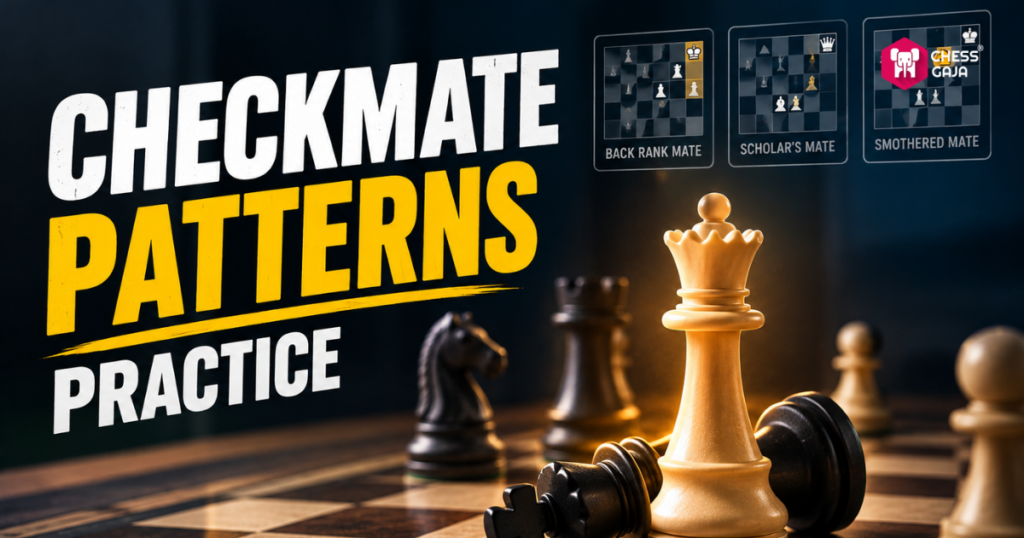
You’ve seen it happen in tournaments: a player misses checkmate in three moves and loses a winning position. The difference between victory and defeat often comes down to pattern recognition.
At Chess Gaja, we’ve coached thousands of players through checkmate patterns practice, and we know that spotting finishing blows is a learnable skill. This guide shows you exactly how to train your brain to see what others miss.
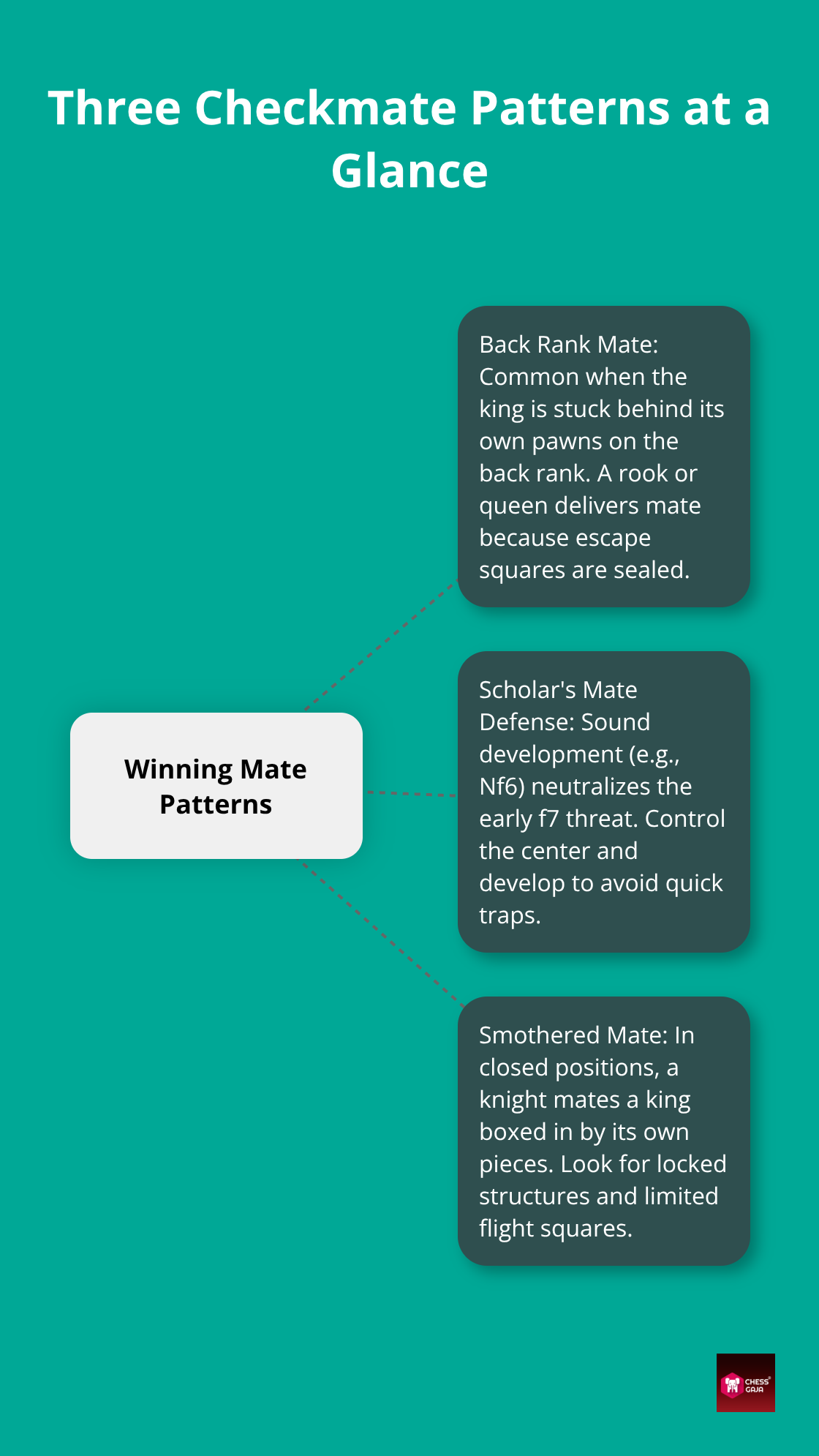
Three Checkmate Patterns That Win Real Games
Back Rank Mate: The Most Common Finishing Blow
Back rank mate appears in nearly one in three games below 1600 rating, according to analysis of Chess.com databases. This pattern happens when your opponent’s king sits on the back rank with pawns blocking escape squares, and you deliver mate with a rook or queen. A concrete example: your opponent castled kingside as Black, kept their pawns unmoved on f7, g7, and h7, and now their king on g8 has no flight squares. A single rook on the eighth rank delivers checkmate because the king cannot escape.
Most players lose to back rank mate not because they lack knowledge. Instead, they advance pawns around their king without calculating escape routes. Before you advance any pawn near your castled king, count how many squares your king can move to. If that number drops below two, you’re setting up a back rank weakness. In tournament play, this single pattern accounts for more rating points lost than almost any other tactic among intermediate players.
Scholar’s Mate: Defense Through Development
Scholar’s mate kills games in under five moves for beginners, but it only works because players ignore two basic principles: controlling the center and developing pieces. The trap follows a predictable sequence—White plays 1. e4 e5, develops the bishop to c4 targeting f7, and brings the queen to h5 or f3 to create a double attack on f7. Black loses because they ignore basic development and fail to guard the key weak point.
Here’s the actionable defense: if White plays 2. Qh5, defend your e5-pawn first with 2…Nc6. When White follows with 3. Bc4 targeting f7, play 3…g6 to attack the queen. After the queen retreats (such as to f3), play 4…Nf6 to block the queen’s attack on f7 and develop your knight to a central square. Solid development stops tactical traps cold.
Smothered Mate: Knights in Closed Positions
Smothered mate operates on a different principle entirely. This pattern requires your opponent’s king to be surrounded by their own pieces with no escape squares. A knight then delivers the finishing blow because knights jump over pieces (they cannot be blocked). The classic position features a castled king trapped on h8, boxed in by its own rook on f8 and pawns on f7, g7, and h7. White forces a classic smothered mate sequence by giving a double check with a knight on h6, then sacrificing the queen on g8 to force Black’s rook to block its own king on g8, allowing the knight on h6 to jump to f7 to deliver the final checkmate.
Smothered mate teaches you something critical: in closed positions where pieces pile up around the king, knights become devastatingly powerful. Watch for positions where your opponent has locked pieces together. That’s when a knight fork or knight mate becomes lethal. These three patterns form your foundation for finishing blows in tournament chess, and mastering them prepares you for the training methods that accelerate pattern recognition in real games.
Train Your Brain to Spot Finishing Blows Faster
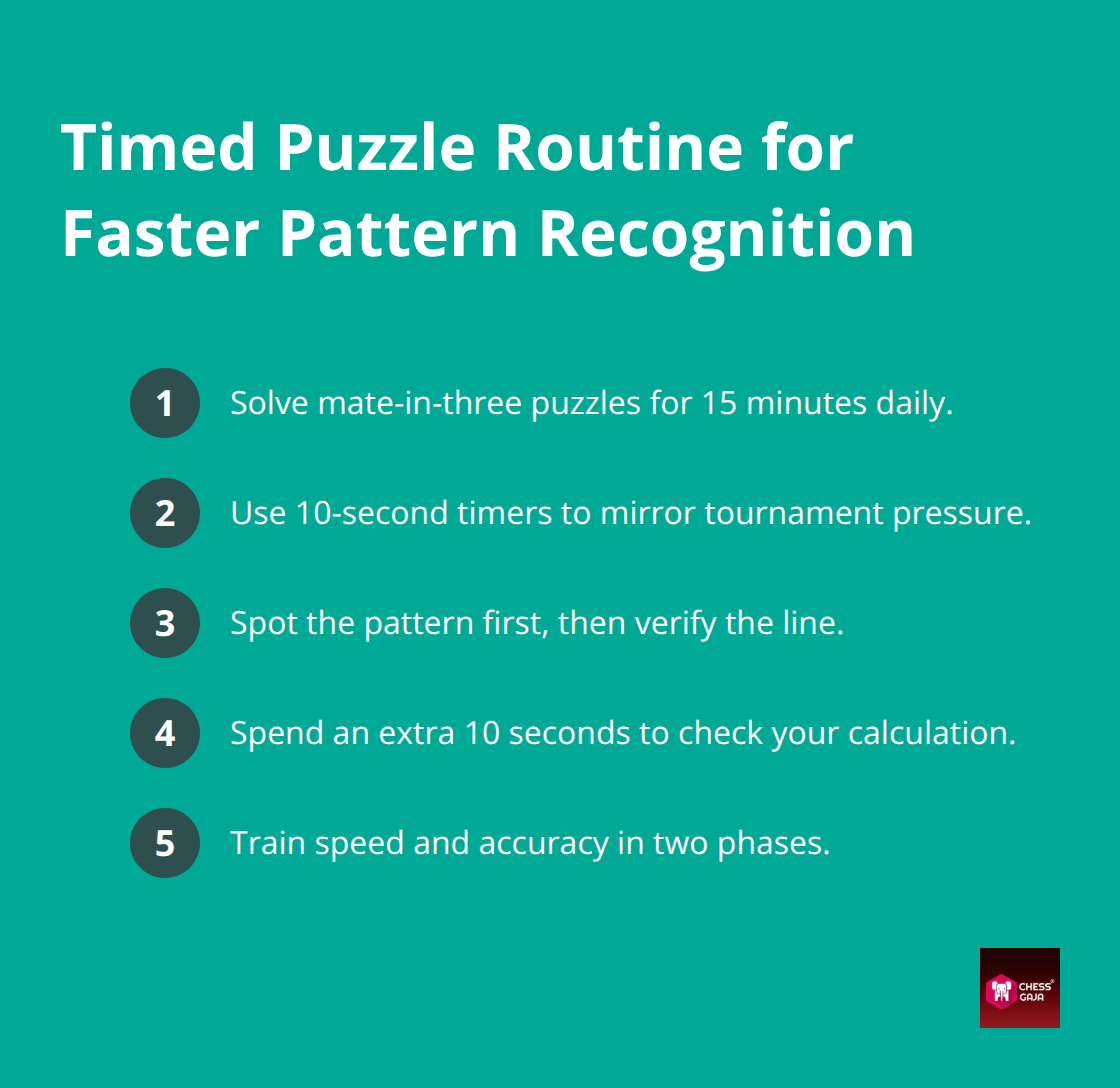
Solve Timed Puzzles to Build Pattern Speed
The gap between knowing back rank mate exists and spotting it in a real game under time pressure is enormous. Players who solve mate-in-three puzzles for just 15 minutes daily significantly improve their checkmate recognition speed within four weeks, based on progression data across multiple online platforms. The key is training with timed constraints that mirror tournament conditions. Start with Chess.com’s tactic trainer or Lichess puzzles set to a 10-second timer. Aim to spot the mating pattern quickly rather than seeking perfection on your first attempt. After you spot the mate, take another 10 seconds to verify your calculation. This dual-phase approach trains both speed and accuracy.
Most players skip verification and repeat the same tactical blindspots. Solve the same pattern repeatedly across different board positions until your brain recognizes it instantly, without conscious calculation. A back rank mate looks the same whether it appears on move 15 or move 40, but the position around it changes constantly. Your goal is to train pattern recognition that works across variation.
Study Tournament Games With Real Finishing Blows
Study annotated games from tournament databases where checkmate decided the outcome, particularly from players rated 1800–2200 in your region. Games from the US Chess Federation database or Singapore Chess Federation tournaments show real defensive mistakes that led to finishing blows. Read the annotations to understand why the winning player saw the mate when the losing player did not. Most importantly, pause before the mating move and calculate the mate yourself before reading ahead. This active calculation trains your brain far more effectively than passive reading.
Then practice spaced repetition (returning to the same positions one week later, then two weeks later, without reviewing your notes). If you spot the mate instantly on the second review, your pattern recognition has solidified. If you struggle, that pattern needs more focused puzzle work.
Target Your Weakest Patterns With Focused Training
Track which patterns you miss most frequently-whether back rank mates, knight forks, or quiet moves that set up the finish-and dedicate extra puzzle sessions to those specific motifs. A player who misses smothered mates regularly should solve 20 smothered mate puzzles weekly, not continue general puzzle training. This targeted approach exposes the gaps in your pattern library and fills them systematically. The players who improve fastest are those who identify their specific weaknesses and attack them with precision rather than hoping general practice will eventually cover everything.
Your pattern recognition sharpens fastest when you concentrate on the motifs that currently escape your vision. Once you master these three core patterns and train your brain to spot them under pressure, you’re ready to learn how common mistakes during tournament play prevent even skilled players from converting their advantages into checkmate.
Common Mistakes Players Make When Missing Checkmate Opportunities
Quiet Moves Disappear When You Hunt for Checks
Most players who miss checkmate opportunities aren’t weak tacticians-they’re fast calculators fixated on the wrong moves. In positions where mate exists in three moves, they spot checks and captures instantly but overlook the quiet move that actually sets up the finishing blow. A player at 1400 rating solves mate-in-three puzzles correctly nearly two-thirds of the time in training, yet in tournament games they convert finishing positions roughly one-third of the time. The gap isn’t calculation ability. It’s attention.
Your brain hunts for forcing moves-checks, captures, threats-because those moves demand immediate responses. Quiet moves feel passive, even when they’re deadly.
You push a rook to a square that doesn’t give check, and your mind rejects it as irrelevant because it produces no immediate threat. Meanwhile, your opponent’s king loses an escape square, and suddenly a quiet move transforms into a checkmate net on the next move.
Train Your Mind to Calculate Non-Checking Threats
This blindspot costs tournament players hundreds of rating points annually. The fix requires deliberate retraining. When you’re ahead materially and your opponent’s king looks vulnerable, force yourself to calculate quiet moves before checks.
Ask yourself: which non-checking move restricts the king’s movement the most? Look for candidate moves that cut off escape squares, and evaluate actions that set up an unstoppable mate threat on the next move.
Suppose Black’s king sits on g8 with limited mobility. Moving your rook from d1 to d7 (occupying the 7th rank) is often stronger than a routine check. It cuts off the king’s escape route along the 7th rank and creates an unstoppable checkmate threat on the 8th rank.
You’ll miss these patterns forever if you continue solving puzzles where you calculate all forcing moves first. Instead, solve puzzles where the solution begins with a quiet move. Spend 10 minutes daily on chess tactics puzzles where the first move doesn’t give check. Your pattern recognition will shift, and tournament results will follow immediately.
Checks Without Purpose Waste Your Attacking Tempo
A catastrophic mistake separates checking moves from actual mating threats. Giving a check feels productive because it forces an immediate response. By contrast, a true mating threat endangers the game’s outcome. But a check that doesn’t lead to mate is often a waste of tempo that allows your opponent to consolidate and defend. Players beneath 1600 rating average two to three useless checks per game-moves that accomplish nothing except burning clock time and revealing attacking intent. You check the king, your opponent moves, and suddenly the mating net you were building collapses because you’ve wasted a move.
The stronger approach demands patience. Before you check, ask yourself: does this check move my pieces closer to delivering checkmate? Does it cut off escape squares? Does it force the king into a worse position? If the answer is no, the check is a distraction. Study annotated games from the US Chess Federation database where strong players (2000+ rating) defeat weaker opponents. Notice how often the winning player delays checks to set up mating threats first. Strong grandmasters maneuver pieces into attacking positions and restrict the king’s mobility before delivering the checking sequence that leads to mate. Weaker players check constantly, and the game continues because checks without follow-up threats accomplish nothing.
In your next tournament game, evaluate every check before playing it. Unless a check is part of a calculated, forced winning sequence or checkmate net, giving empty checks only improves your opponent’s king position or wastes vital attacking tempo. Replace some of those checks with quiet moves that improve your pieces placement and restrict escape squares. Your win rate will increase immediately because you’ll stop wasting moves on empty threats.
Defensive Resources Collapse Your Mating Attack
The final mistake undermines everything else: failing to calculate your opponent’s defensive resources. You see a mating pattern, you calculate three moves ahead, and mate appears inevitable. Then your opponent plays a defensive move you didn’t expect, and the pattern collapses. This happens because you calculated the mating sequence assuming your opponent cooperates.
Real opponents fight. Defensive players sacrifice material to disrupt your attack, creating counterattacking threats that force you onto the back foot. Furthermore, finding moves that delay mate by even a single turn can throw off your entire calculation.
Anticipate Counter-Attacks and Defense
Before you commit to a mating attack, calculate your opponent’s three best defensive tries. Not the obvious ones—the best ones. Identify the response that causes your mating sequence the most damage, and look for defensive resources that buy time. A back rank mate pattern might look unstoppable until your opponent plays a desperate defensive move like retreating a queen to g8 to block the back rank and delay mate.
If you didn’t calculate that defensive resource, you miscalculated the position entirely. Players who master checkmate patterns but miss defensive calculations still lose games they should win. The solution is systematic: after you identify the mating pattern, spend equal effort testing your opponent’s best defensive responses for every attacking move you calculate.
Ask yourself what moves disrupt your plan. Which sacrifices create counterattacking chances? Look for quiet defensive moves that buy time. Only after you’ve tested your mating sequence against realistic defense should you commit to it.
Tournament players rated 1800 and above spend a significant portion of their calculation time analyzing opponent resources, while players below 1600 spend very little. That difference in focus explains rating gaps more accurately than any other single factor. In your next game, deliberately calculate opponent defense with equal weight to your attacking ideas. Your winning positions will convert to actual victories instead of slipping away because you missed what your opponent could do.
Final Thoughts
Checkmate patterns practice transforms how you finish games because it rewires your brain to recognize mating opportunities under tournament pressure. Players who train systematically with timed puzzles and study real tournament games convert winning positions into victories at noticeably higher rates than players who rely on general tactical training. The difference isn’t raw calculation ability-it’s pattern recognition speed and the confidence that comes from seeing the same finishing blow across dozens of positions.
Tournament players across the USA, UAE, and Singapore who master these core checkmate patterns report immediate rating gains within 4 to 6 weeks. More importantly, they stop losing games they should win because they spot quiet moves that set up finishing blows and calculate opponent defensive resources before committing to attacks. This mental discipline extends beyond the board and builds decision-making skills that transfer to academics, work, and strategic thinking in any domain.
At Chess Gaja, we train students across 40+ countries using a curriculum built by Grandmaster-led coaching and exclusively FIDE-rated coaches. Our coaches assess your current pattern recognition level, identify your specific weaknesses in finishing positions, and design a personalized training plan that accelerates your improvement through Chess Gaja’s Paid Starter Class for a professional skill evaluation.