

Most beginners struggle because they learn piece movements in isolation, without understanding how those moves connect to winning strategy. At Chess Gaja, we’ve coached thousands of students across 40+ countries, and we’ve seen that mastering chess for beginners fundamentals-the core skills covered in this post-transforms how quickly players gain confidence.
This guide breaks down exactly what you need to know to play strong chess from day one.
How Each Piece Moves and Why It Matters
Every piece on the board has a specific movement pattern. Understanding these patterns forms the foundation of playing strong chess. Beginners often learn how pieces move without connecting that knowledge to actual games.
Pawns advancing two squares, knights jumping in L-shapes, and bishops controlling diagonals are not just abstract rules. They are tools that determine whether you win material or leave your king vulnerable.
The difference between random play and purposeful play comes down to recognizing what each piece can and cannot do.
Understanding Pawns: The Underestimated Piece
Pawns are the pieces beginners underestimate most. A pawn moves forward one square, or two squares on its first move. It captures diagonally forward, never straight ahead.
This movement forms pawn chains that control essential board space. When a pawn reaches the far rank, it transforms into a queen through pawn promotion.
A passed pawn racing toward promotion forces your opponent to react immediately. Remember that pawns cannot move backward, making every advance a permanent commitment.
Knights, Bishops, and Rooks: The Tactical Pieces
Knights move in an L-shape: two squares in one direction, then one square perpendicular. This unique pattern lets knights jump over other pieces, making them ideal for tactical surprises. A central knight controls eight squares, whereas an edge knight controls far fewer.
Bishops move diagonally as far as they want until blocked. Each bishop stays on its starting color for the entire game. Working together, two bishops control both square colors and dominate the board.
Rooks move horizontally and vertically to control entire ranks and files. Place rooks on open files during the middlegame to attack enemy targets. In the endgame, an active rook behind a passed pawn easily decides the match.
The Queen and King: Power and Vulnerability
The queen combines rook and bishop movement, making her the most versatile piece. Never bring your queen out too early in the opening-it becomes a target for your opponent’s developing pieces. A queen on the back rank is often a wasted queen. The king moves one square in any direction. In the opening, your king is a liability. The king is fragile but essential. Lose your king, and you lose the game. This is why king safety must be your top priority in the opening, and why early castling is often the smartest move you can make. In the endgame, your king transforms into one of your strongest pieces because its activity directly contributes to pawn promotion and checkmate.
Piece Value and Strategic Importance
Pawns cannot move backward, so every pawn advance is permanent. Knights jump over obstacles to create unexpected threats. Bishops stay locked onto one color, controlling targeted diagonals. Rooks operate as heavy artillery across open files. The queen combines rook and bishop movement, making her the most flexible piece on the board. Master piece capabilities to win material and create threats. This also prevents leaving your king vulnerable. Castle early to tuck your king into safety. These aren’t abstract rules-they’re tools that directly shape how you play every position.
Now that you understand how each piece moves, the next step is learning the opening principles that transform these individual moves into a winning strategy.
Opening Principles That Win Games
The opening is not about memorizing 20 moves of theory. It’s about making three correct strategic decisions that set up your entire game. Most beginners fail in the opening because they treat it like a puzzle to solve rather than a framework to follow. Students applying opening principles reach a 1400 rating quickly. Those who ignore them usually stall around 1100. The three principles that separate confident beginners from frustrated ones are controlling the center, developing all your pieces before attacking, and keeping your king safe. These aren’t suggestions-they’re non-negotiable rules that determine whether you win or lose in the first 15 moves.
Control the Center Early
The center consists of four squares: d4, e4, d5, and e5. Control these squares to control the game. Beginners often push side pawns, which wastes time and surrenders central power.
Start with 1.e4 or 1.d4 to occupy the center right away. World champions like Bobby Fischer favored 1.e4 because it opens lines for the queen and bishop.
Controlling the center gives your pieces maximum mobility. Playing 1.e4 followed by Nf3 and Bc4 establishes strong central influence while developing your pieces. Side moves offer zero central control and invite defeat.
Develop Your Pieces Before You Attack
Development means placing knights and bishops onto active central squares. A knight on f3 or c3 controls vital central squares such as d4, e5, d5, and e4. A knight resting on g1 remains undeveloped and inactive.
Never bring your queen out too early. When you bring the queen out early, your opponent develops pieces while attacking her. You waste time moving the queen while your opponent builds a complete position.
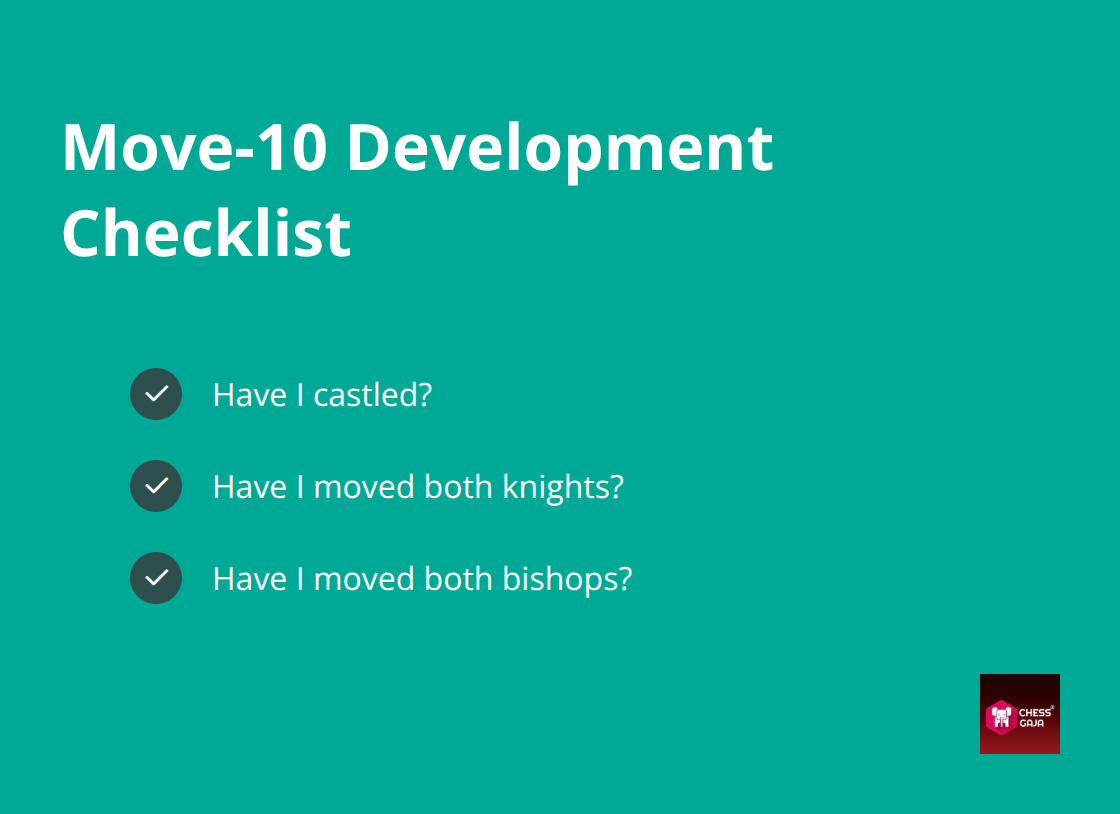
Develop knights before bishops and secure your king before attacking. By move 10, check if you have castled and developed both knights and bishops.
If you answer yes to all three, you’ve followed sound development principles and established a solid, playable position. If you answer no, you’ve fallen behind and your opponent will punish you.
Keep Your King Safe
Your king is the most important piece on the board. If your king gets checkmated, you lose immediately. Beginners often leave their king in the center for 10, 15, or even 20 moves because they’re focused on attacking. This is how they get mated in 15 moves (a pattern we see repeatedly in beginner games). The solution is simple: castle as early as possible, typically within the first 7 to 10 moves once your minor pieces are out. Castling moves your king to safety on the g-file or c-file, away from the center where it’s vulnerable. Castling also connects your rooks so they can protect each other and work together. After you castle, your king is tucked away and your rooks are active. This is the safest possible position for a beginner.
Never leave your king in the center past move 7. Avoid ignoring attacks on your king in hopes they vanish. Refrain from sacrificing material to attack if your own king remains exposed.
Ask yourself these questions before every move, and you’ll avoid the tactical disasters that plague beginners. King safety is not optional—it’s the difference between winning and losing. Two simple questions prevent the vast majority of beginner losses: Is my king safe? Can my opponent attack my king next move?
These three principles-center control, piece development, and king safety-form the foundation of every strong opening. Once you understand why these principles matter, you can recognize the tactical patterns that emerge when your opponent violates them. The next chapter shows you exactly which tactical shots beginners must know to punish mistakes and convert advantages into wins.
Tactical Patterns Every Beginner Must Know
Openings teach you how to position your pieces safely. Tactics teach you how to punish your opponent when they position theirs unsafely. A 1600-rated player spots undefended pieces instantly. They also capitalize when a piece is attacked twice or when the king lacks escape squares. A fork attacks two pieces at once, forcing your opponent to lose one. A pin traps a piece because moving it exposes a more valuable piece behind it. A skewer forces a valuable piece to move and captures the piece behind it.
These three tactics account for the vast majority of all tactical wins at the beginner level. The back rank-the row where your king sits-becomes a death trap when your king has no escape squares and a rook or queen can deliver checkmate. A beginner who learns to recognize these five patterns (fork, pin, skewer, back rank mate, and simple checkmate nets) and practices them for 30 minutes daily will spot tactical opportunities that others miss entirely. Studies from chess training platforms show that beginners who solve tactical puzzles regularly improve their rating, while those who skip tactics stall completely.
Knights, Bishops, and Rooks Create Tactical Threats
Knights create forks because they jump in unexpected directions. A central knight on d5 attacks eight squares simultaneously, creating devastating tactical threats when enemy pieces cluster together. Place a knight on d5 or e5 to force defenses your opponent cannot coordinate.
Bishops on long diagonals pin pieces along straight lines. If your bishop sits on g5 while an enemy knight on f6 shields their queen on d8, that knight is pinned and immobilized. Active diagonals create constant tactical headaches.
Rooks deliver back rank mates by controlling entire ranks. If an opponent’s king sits trapped on g8 behind pawns, a rook penetrating to d8 or e8 delivers immediate checkmate.
Back Rank Weakness Loses Games Instantly
The back rank is where beginners lose games they should draw or win. Your king castles to g8 behind its pawns, but an enemy rook penetrating to an undefended square on the 8th rank delivers checkmate in one move.
The fix is mechanical: after castling kingside, move your h-pawn from h7 to h6 at an appropriate moment. This creates a safe escape square without weakening your pawn shield.
When castling queenside, advance the a-pawn or b-pawn to prevent tactical tricks. Applying this single rule prevents losing five to ten games per year to back rank mates.
Simple Checkmate Patterns Win Endgames
Fundamental checkmate patterns can happen at any stage of the game—from early middlegame tactics like the smothered mate to late-game elementary mates like the ladder mate with two rooks. Focus on the four basic checkmate patterns: back rank mate, smothered mate, two rooks on the seventh rank, and the queen and king working together. Practice these patterns for ten minutes daily until you can set them up blindfolded. A beginner who knows these patterns spots checkmate three moves ahead instead of one move ahead, which is the difference between winning and drawing.
Final Thoughts
You now understand how pieces move, why opening principles matter, and which tactical patterns win games. These chess for beginners fundamentals form the complete foundation you need to play with confidence from your first move. The gap between knowing these concepts and applying them in real games is where most beginners stall.
At Chess Gaja, we’ve worked with 5,000+ students across 40+ countries, and we’ve seen that beginners who receive personalized feedback accelerate their progress dramatically. Our FIDE-rated coaches identify your specific weaknesses-whether that’s leaving your king exposed, moving pieces without purpose, or missing tactical shots-then build a study plan that targets those weaknesses with precision. The difference between a beginner who reaches 1400 rating in six months and one who stalls at 1100 is not talent; it’s accountability and expert guidance.
Your next step is booking a Paid Starter Class with Chess Gaja. A FIDE-rated coach will assess your understanding of piece movement, opening principles, and tactical recognition, then design a study plan tailored to your goals. Whether you’re preparing for your first tournament or simply want to play stronger chess, Chess Gaja accelerates your journey from beginner to confident player.