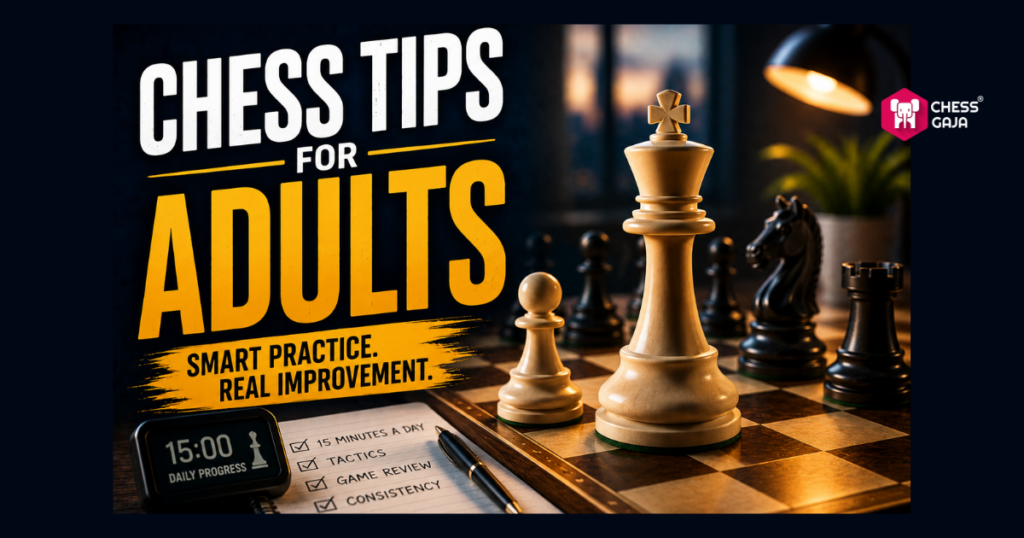
Adults often assume they’ve missed the window to learn chess seriously. The truth is different: you can build real skill in 15 minutes a day, and we at Chess Gaja have helped thousands of busy professionals do exactly that.
Chess tips for adults work best when they fit your life, not the other way around. This post shows you how.
What Really Stops Adults From Playing Chess
Adults face real obstacles, but most aren’t what you’d think. The biggest barrier isn’t age or talent—it’s the false belief that chess demands hours of daily study. A working professional in Dubai, a parent in Singapore, or an executive in New York all share the same constraint: fragmented time.
The truth is that structured, time-efficient practice beats unfocused cramming every time. Successful improvers don’t need to find extra hours—they simply redirect the time they already have. They study during morning coffee, solve three puzzles during lunch, or review a lesson before bed.
The Real Time Problem
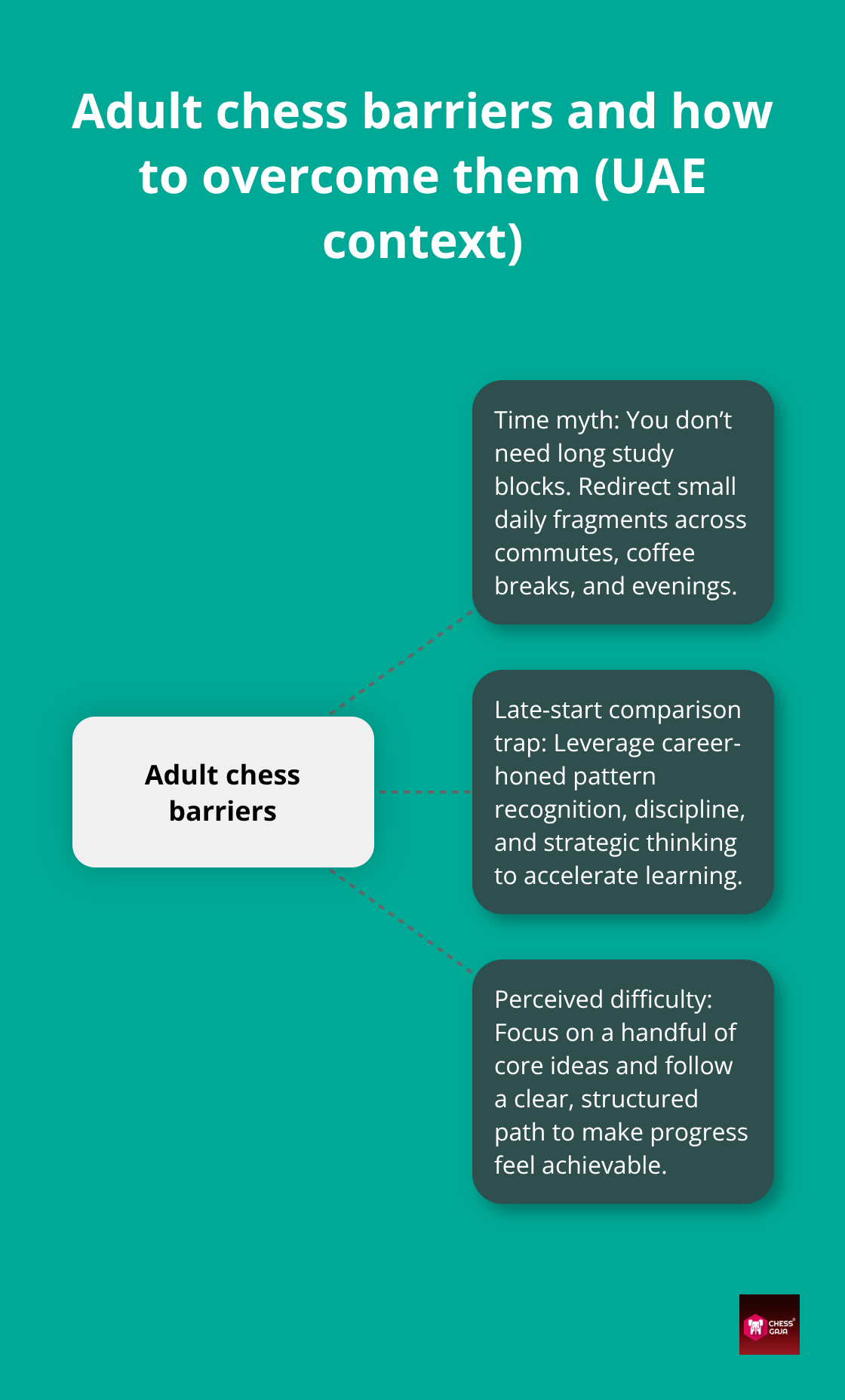
Many adults postpone chess because they believe they need a dedicated block of time. This myth collapses quickly once you start. A 15-minute session on a mobile app during your commute trains your tactical vision just as effectively as sitting at a board for an hour.
The UAE and Singapore chess communities show this pattern clearly: busy professionals participate in rapid tournaments on weeknights and weekends because focused 15-minute games respect their schedules while allowing enough time to think strategically. The shift from “I need to find time” to “I’ll use the time I have” separates those who start from those who actually continue.
Why Starting Later Feels Like a Disadvantage
Fear of starting too late haunts many adults. You compare yourself to someone who learned at age seven and assume you’ve lost the window. This comparison is flawed. A 35-year-old with developed analytical skills from their career often learns chess faster than a child because they understand patterns, calculation, and strategic thinking in ways a beginner cannot.
Adult learners across many countries have proven this pattern repeatedly: those with professional experience in fields like finance, law, or engineering advance rapidly by transferring mental habits to the board. Rather than skipping sessions, working professionals bring discipline and approach chess as a high-value skill worth developing.
The Misconception About Difficulty
Chess appears impossibly complex until you realize most games are won or lost on a handful of core ideas. Memorizing endless opening variations isn’t required. Nor do you need to calculate five moves deep into complex variations. Focus simply on checking piece safety, spotting basic checks and captures, and eliminating blunders. These skills are learnable in weeks, not years.
Adults often underestimate how quickly they’ll grasp these fundamentals because they view chess as an intimidating, abstract science. In reality, chess functions much like learning a language: you absorb patterns, build vocabulary through practice, and improve naturally through active use. With proper guidance and a structured curriculum, you master tactical patterns and win games within months. Without a clear path, chess feels overwhelming—with one, it feels entirely achievable.
Moving From Obstacles to Action
These three barriers-time, age, and perceived difficulty-stop most adults before they start. But they’re not insurmountable. What separates those who play from those who don’t is a shift in perspective.
First, stop waiting for the perfect moment and start using the small windows you have. Next, shift away from comparing yourself to childhood prodigies and measure progress against your past games. Most importantly, treat chess not as an impossible puzzle, but as a systematic, learnable skill. The next step is understanding what you actually need to learn and how to learn it efficiently.
How to Build Chess Practice Into Your Actual Week
Redirect Time, Don’t Create It
The moment you accept that 15 minutes beats zero minutes, everything changes. Adults who improve at chess don’t carve out dedicated study blocks-they redirect time they already spend inefficiently. Whether you are a professional in Abu Dhabi sipping morning coffee, a parent in Singapore waiting at soccer practice, or an executive in New York between meetings, those 15-minute gaps already exist. Used consistently, these daily fragments compound into real skill.
Tactical training apps available today are designed precisely for this reality. Lichess offers puzzle training where you can solve four or five tactical positions in a single short session, making dedicated tactical practice easily fit into a morning commute. Your phone becomes your training board. What matters is consistency. Adults who solve three tactical puzzles daily for six months develop pattern recognition that translates directly to better decision-making in actual games. This isn’t theoretical-the UAE tournament calendar for April 2026 shows rapid and blitz events scheduled on weeknights specifically because working professionals participate in them. These aren’t casual players; they’re serious competitors who’ve built sustainable practice routines.
Structure Beats Volume Every Time
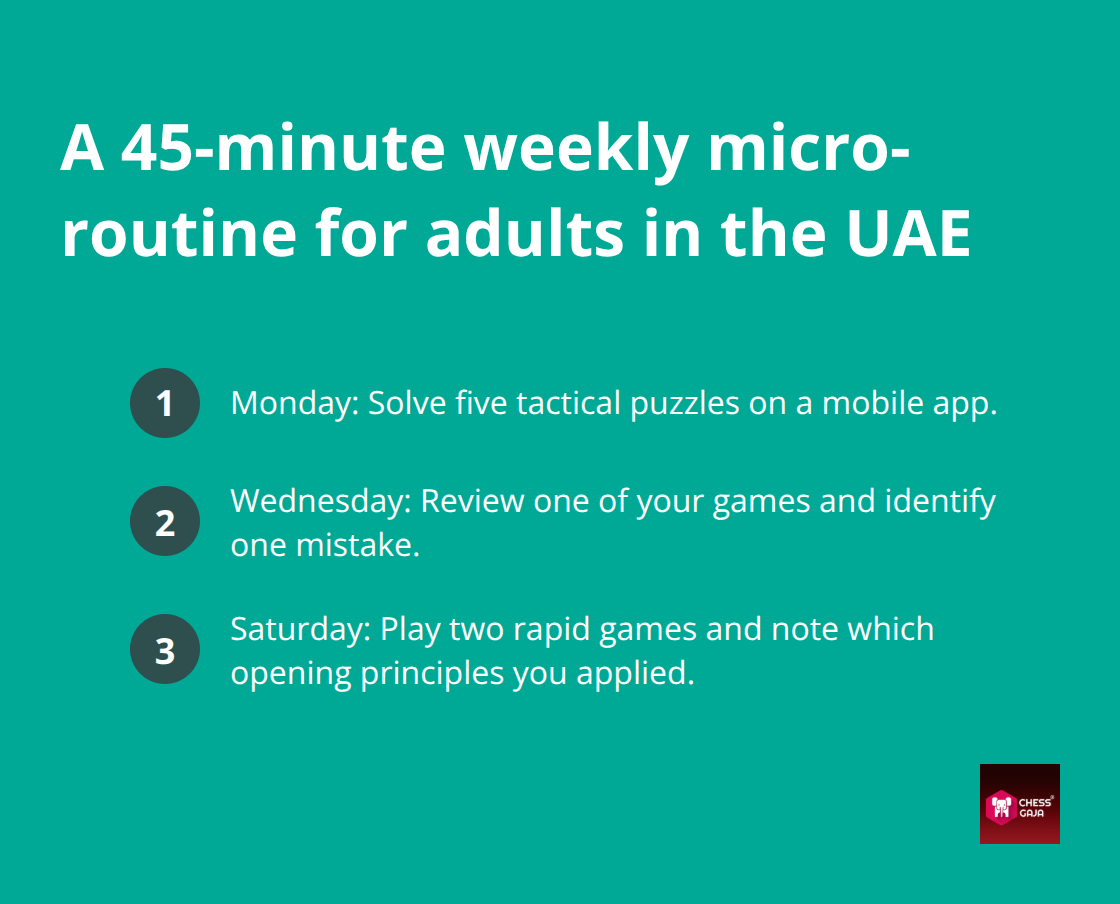
The structure matters more than the volume. A weekly routine with three focused 15-minute sessions beats a single unfocused two-hour session because your brain retains patterns through repetition, not duration. Here’s what this looks like in practice:
- Monday morning: Solve five tactical puzzles on a mobile app
- Thursday evening: Play two rapid games on Lichess and apply core opening principles
- Saturday afternoon: Review one of your recent games, identifying key mistakes and tactical misses
This simple framework takes under an hour total across your week, proving that targeted consistency yields measurable progress without consuming your schedule. Adults who follow this pattern build consistent rating growth within three months because they train the right skills in the right sequence. The mistake most beginners make is studying everything at once-openings, tactics, endgames, strategy. Adults with limited time can’t afford this scattered approach.
Focus on What Moves the Needle
Tactical patterns account for the majority of rating gains below 1600, and solving puzzles takes 15 minutes. Focus on tactics first. Once tactics become automatic, add opening principles. Once openings feel natural, study endgames. This progression respects both your schedule and how chess skill actually develops.
The psychological benefit is underrated: a completed 15-minute session feels like a win, building momentum. An incomplete two-hour study block feels like failure and kills motivation. Adults who sustain improvement choose consistency over ambition. The next step is understanding which specific concepts deliver the fastest results and how to apply them immediately in your games.
What Actually Wins Games for Adult Players
Tactics Decide Most Games Below 1600
Most adults waste time on openings because they assume that’s where games are decided. This assumption is backwards. A working professional playing a rapid game loses because they overlook a tactical combination like a knight fork on move 15, not because they failed to memorize twenty moves of opening theory on move 5. Tactical patterns account for the vast majority of rating gains below 1600, and this reality doesn’t change for adults-it accelerates their progress because they can focus narrowly on what matters.
Basic tactical motifs—like forks, pins, and back-rank weaknesses—appear in almost every game below 1400 rating. Learning to spot them takes dedicated practice, but missing them costs you games. You solve five puzzles daily for two weeks, and suddenly you stop missing tactical opportunities or leaving undefended pieces hanging. That’s measurable, immediate improvement.
Opening Principles Prevent Tactical Disasters
Opening principles come next because they keep your pieces safe and build active positions where your tactics can flourish, preventing early collapses. Establish control of the central squares (e4, d4, e5, d5) early with your center pawns. Develop your knights and bishops to active squares before starting an attack, and castle early to safeguard your king. These core principles eliminate most of the opening mistakes adults make.
A professional in Singapore playing Wednesday night rapids doesn’t need to memorize deep theoretical variations in the Sicilian Defense; they need to play sound moves that follow these principles and let their opponent make mistakes. Once you master these patterns and principles, you’ve built a foundation that supports everything else.
Endgame Fundamentals Complete Your Toolkit
Basic endgame fundamentals become your next priority once tactics and opening principles are solid. While many games below 1600 are decided in the middlegame, knowing essential checkmate techniques (such as King and Rook vs. King), king activity, and basic pawn endgames ensures you can cleanly convert a material advantage into a win.
Adults who follow this sequence—tactics first, then openings, then endgames—typically see steady gains in their chess rating points within three to four months because they focus on the skills that directly drive results. The mistake is treating all three as equally important from day one. They’re not. Prioritize tactical patterns and you’ll win games faster than players who spent six months memorizing opening variations.
Why This Order Works for Your Schedule
This progression respects both your limited time and how chess skill actually develops. Tactical training fits into 15-minute sessions on a mobile app. Opening principles require only conscious application during your games. Endgame study comes later when you actually need it (and when you have more experience to understand it). You don’t waste effort on skills you won’t use for months. Instead, you train what moves the needle immediately, build confidence through wins, and advance to the next level when you’re ready.
Final Thoughts
You’ve now seen why adults can learn chess quickly, how to fit practice into your actual schedule, and which skills deliver the fastest results. The missing piece is guidance. Chess tips for adults work best when someone experienced shows you exactly what to focus on and tracks your progress. A coach eliminates guesswork-instead of wondering whether you should study openings or tactics next, your coach tells you, and instead of solving random puzzles, your coach gives you puzzles matched to your current rating and weaknesses.
At Chess Gaja, we’ve helped thousands of students across 40+ countries build real chess skill around their busy lives. Every coach on our team is FIDE-rated, with experience training national champions. More importantly, the instructor who conducts your initial starter class continues with you throughout your journey to understand your specific patterns. Students receive a personalized study plan tailored to their rating and schedule, AI-powered summaries after every session, and access to monthly academy tournaments.
Working with a dedicated professional coach accelerates your progress by giving you structured feedback, immediate accountability, and a clear path forward. Book your paid starter class today to receive a comprehensive skill evaluation and your personalized roadmap.