
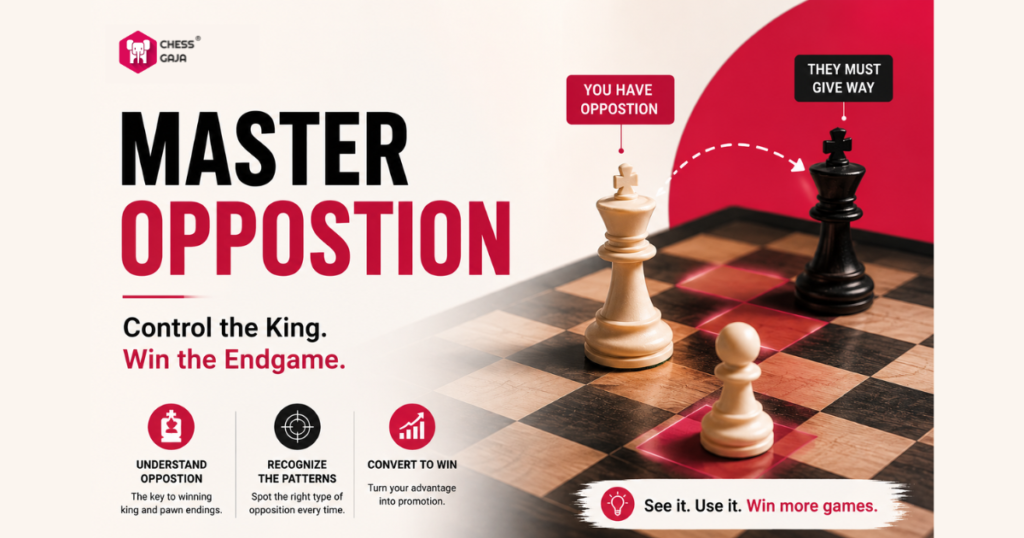
Endgames decide tournaments. King and pawn battles are crucial.
At Chess Gaja, players often lose winnable positions because they miss key opposition concepts. Thus, this guide breaks down how to control the board and win.
What Opposition Actually Does in Your Games
Opposition is a key weapon in endgames. It decides whether you win, draw, or lose. Furthermore, it is not abstract theory. Instead, it is a concrete battle for control.
When two kings face each other with one square between them, one king holds opposition. The king without opposition must give ground. This single advantage decides the match.
Opposition Wins Real Tournaments
Recently, junior players faced identical endgame scenarios. Opposition decided every match. In one UAE championship game, a player thought the position was equal, but the opponent understood opposition well.
That mistake cost the student a podium finish. These moments happen in every tournament.
Furthermore, opposition determines who controls key squares. When your king holds opposition, you can push your pawn while blocking your opponent.
If you lose opposition, promotion fails. The position collapses into a draw or loss. A single move makes all the difference.
How Opposition Works in Practice
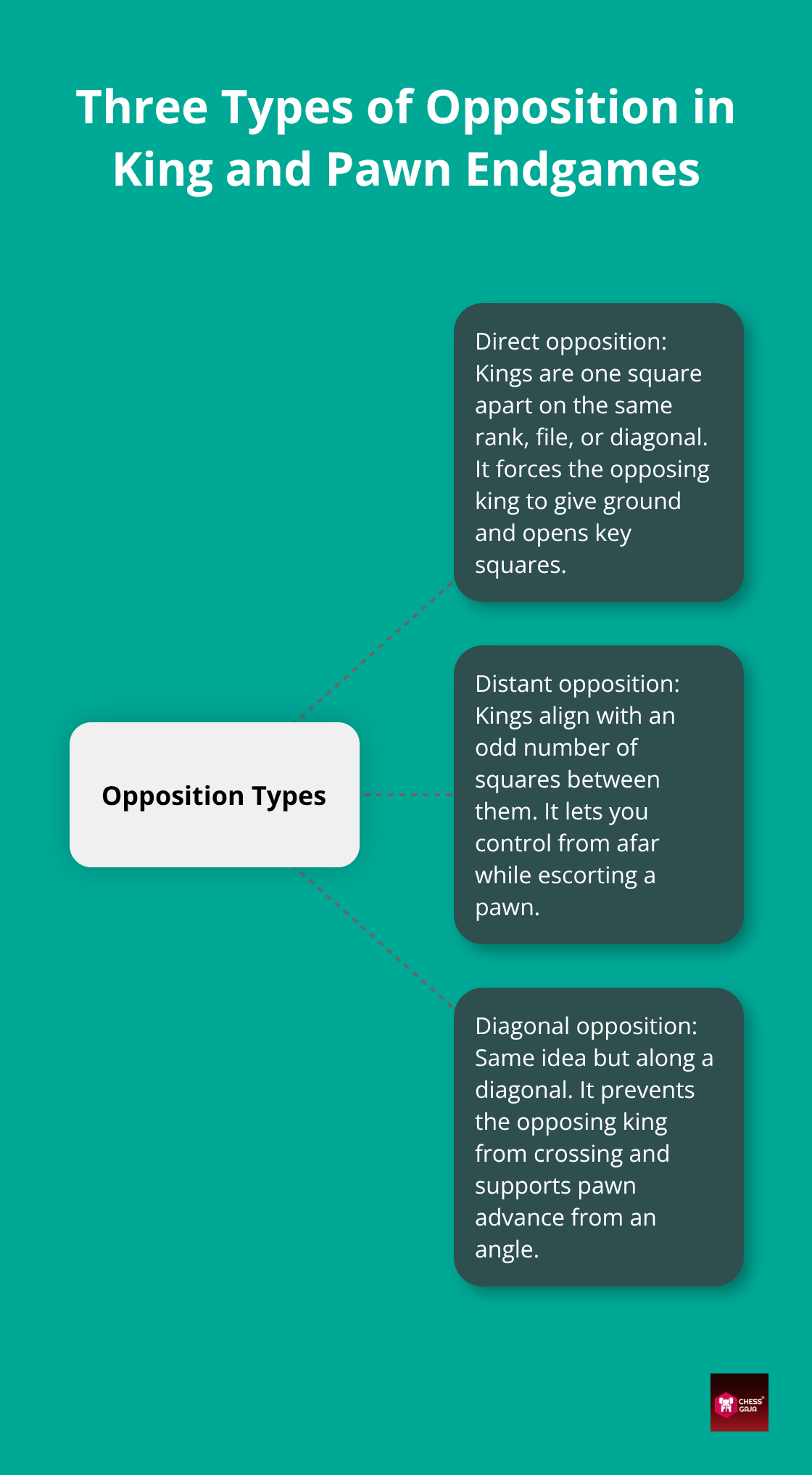
Direct opposition happens when kings stand one square apart on the same line. Your opponent must move first, giving you access to key squares.
Distant opposition occurs when an odd number of squares separate the kings. This gives you control from afar. It helps you escort your pawn safely.
Diagonal opposition follows the same principle but along a diagonal line.
The mechanics are straightforward. Specifically, opposition controls movement. Your opponent cannot advance their king toward your pawn. Nor can they block your king’s path to promotion. This is because they are forced to give ground first.
In the 2024 USA Youth Championship, a player won a key endgame. They moved their king to c5. This secured opposition against the king on c7. As a result, the black king moved away from defending b6 and d6. The white pawn then advanced unopposed.
Why Opposition Separates Winners from the Rest
Opposition is not about luck. The player who spots it first controls the endgame, while others drop winnable positions.
This rule applies to every junior tournament. Your next opponent will understand opposition. You must understand it better.
Which Opposition Type Wins Your Next Endgame
Direct Opposition: Your Most Reliable Weapon
Direct opposition is your most reliable weapon when you need immediate control.
Specifically, place your king one square away from the enemy king with an odd number of squares (one empty square) between them. They must move first and step back, opening the path for your pawn.
For example, a player in the 2025 UAE Junior Championship secured direct opposition. They moved the king from e4 to e5. The opponent’s king sat on e7. That single move created a one-square barrier. As a result, the black king retreated. This allowed white’s e-pawn to advance freely toward promotion.
Direct opposition works best when your pawn is advanced. You need to escort it home safely. Once established, your opponent cannot defend the promotion square.
Furthermore, they cannot block your pawn’s path because their king is locked in a losing position. Therefore, direct opposition should be your first choice when your pawn is close to promotion.
Distant Opposition: Control From Afar
Meanwhile, distant opposition gives you control without being adjacent to your opponent’s king.
Specifically, this matters greatly when pawns are far from the promotion zone.
Place your king on the same rank or file as the enemy king, ensuring an odd number of empty squares (3 or 5) separate them while making it your opponent’s turn to move.
This barrier works from a distance. A Singapore player won using distant opposition on the a-file. They locked out the enemy king. Then, they pushed a passed pawn up.
Diagonal Opposition in Tournament Play
Similarly, diagonal opposition operates like direct and distant opposition along a diagonal line. Indeed, it proves equally powerful in tournament play.
Your king and your opponent’s king sit on the same diagonal. Keep an odd number of squares between them. Consequently, this stops the enemy king from crossing the diagonal or advancing toward your pawn.
Diagonal opposition helps when your pawn sits on a light square while the enemy king stands on a dark square along the same diagonal. You maintain the opposition while your king supports the pawn from a different angle.
Recognizing Which Opposition Type Fits Your Position
Naturally, strong competitors know how to choose the right type of opposition for their position. For instance, if your pawn needs just a few moves to promote, use direct opposition.
If your pawn needs just a few moves to promote, use direct opposition.
If your kings are separated across the board, distant opposition allows you to control key entry points before stepping up into direct opposition.
Opposition is not just about your king’s current square. Instead, it controls where your opponent can move next. Masters think ahead.
Specifically, they ask a key question. Can the opponent reach the promotion square next? If yes, opposition is lost. If no, opposition is held.
This approach turns opposition into a concrete tool. Indeed, it wins junior tournament games globally. Next, you will learn how to convert opposition into actual victories.
Converting Opposition Into Winning Endgames
Opposition matters only when you convert it into a result. Junior players secure opposition perfectly. Then they waste it with slow, aimless moves. That lets their opponent equalize.
The real skill is not just finding opposition. Furthermore, you must weaponize it. You need to force your pawn toward promotion or trap the enemy king. Every single move must protect your advantage.
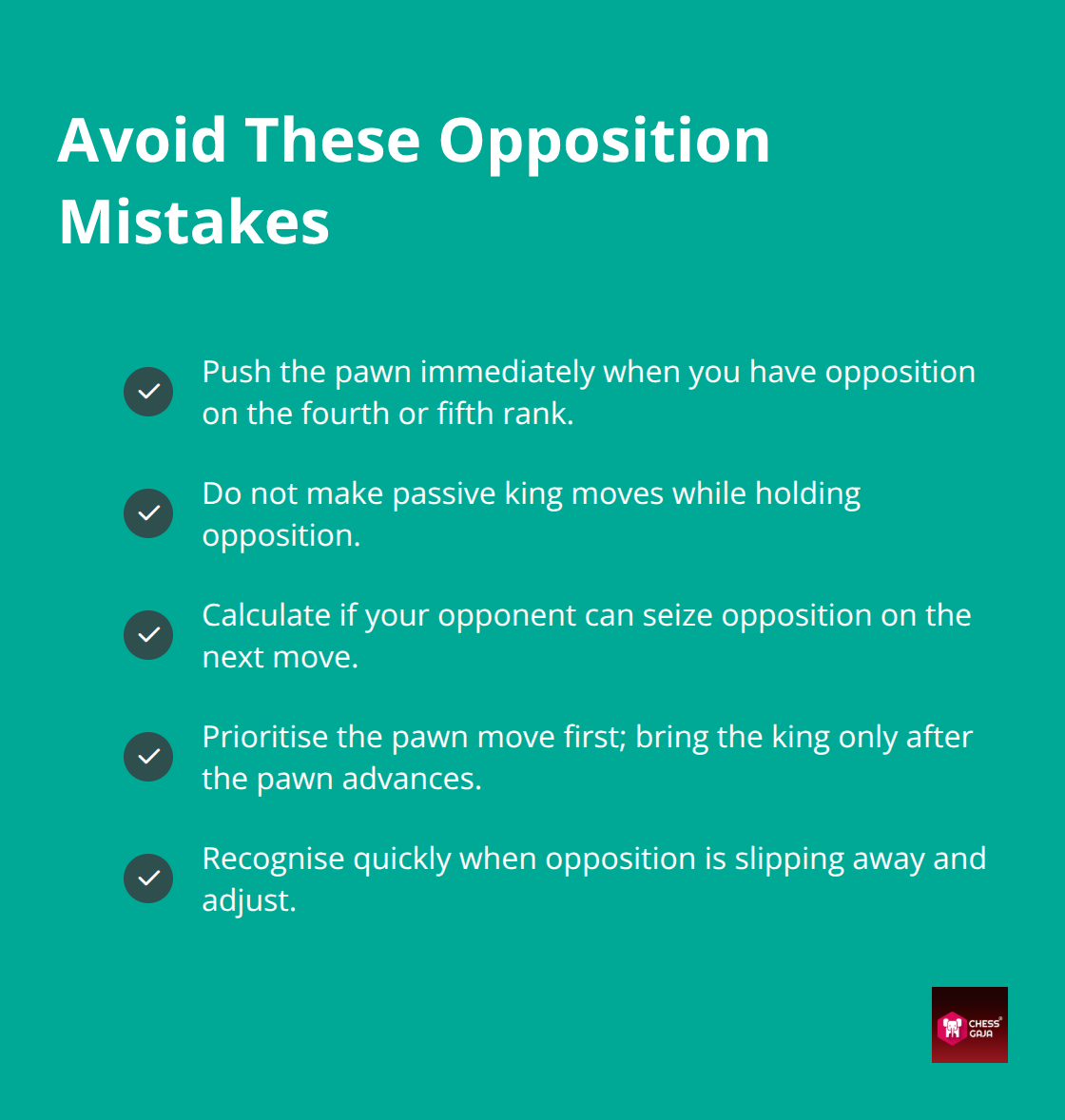
In a recent tournament, a player secured direct opposition with the White King on e4, Black King on e6, and a Pawn on e2 with Black to move. After Black played 1…Ke7, White incorrectly pushed 2. e4?, allowing Black to regain opposition with 2…Ke6! and force a draw. Instead, White should have outflanked with 2. Ke5!, keeping control of the key squares to escort the pawn homeIn 2024, a player held direct opposition with a white king on e4, a black king on e6, and a pawn on e3. However, the player moved sideways instead of pushing the pawn to gain space. That mistake squandered the tempo advantage.
The opponent quickly seized counterplay and turned the game around. Opposition without correct execution is completely worthless.
The Two Fatal Mistakes That Cost Tournament Points
Beginners make two main errors. First, they move passively. Second, they act like they have extra material and forget to fight for tempo.
Opposition gives your King the right to outflank and gain key squares. A common mistake is pushing the pawn immediately, which often gives the opposition right back to your opponent. Instead, use your King to step forward into the space your opponent vacated, leading the path for your pawn
The perfect moment to push is right now. Second, players often fail to notice when opposition slips away.
You must calculate whether your opponent can seize the opposition on the next turn.
Always ask: Can your opponent take the opposition next turn? If yes, your winning advantage might vanish.
Converting Opposition Into Pawn Promotion
Your pawn becomes unstoppable if you calculate the path correctly. For example, with the White King on e4, Black King on e6, and a Pawn on e3 (Black to move), Black must step aside (e.g., 1…Ke7). White then outflanks with 2. Ke5! rather than immediately pushing 2. e4?. By occupying e5 first, White controls the critical squares d6, e6, and f6, guaranteeing the pawn safely marches to promotion on e8.
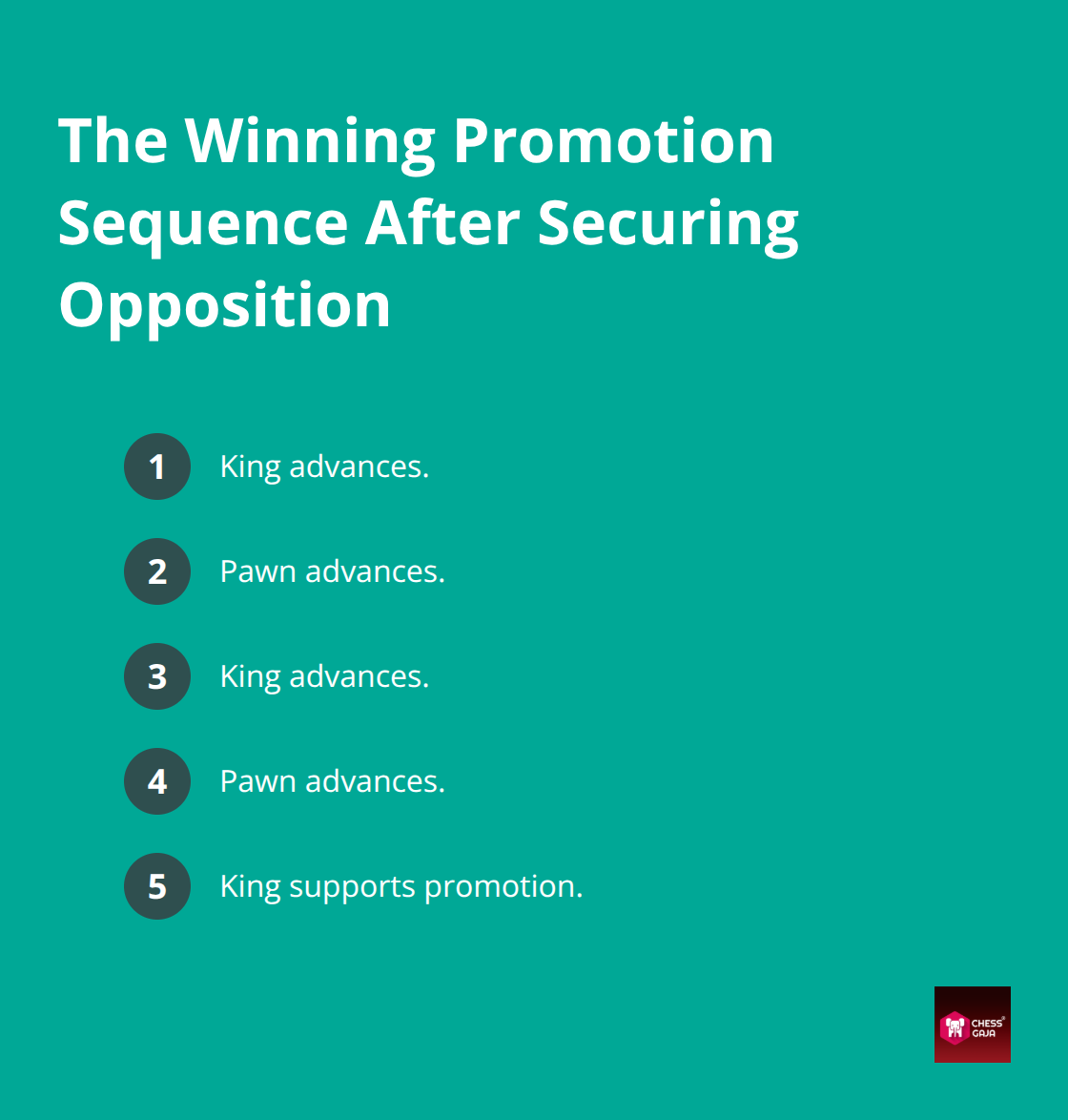
The winning sequence required only four more moves after securing opposition. Players who understand this do not hesitate. Instead, they push the pawn and count steps. They advance the king, push the pawn, and secure promotion.
Opposition turns into victory through relentless pawn advancement. You must also back your king on critical squares.
Beginners often overthink this process. They worry about distant passed pawns or tactical tricks.
In these endgames, those worries rarely matter. Instead, pawn speed decides everything. If your pawn promotes first, you win. Opposition ensures that outcome.
Why Tempo Decides Everything After Opposition
Opposition gives you one crucial advantage. It provides vital tempo. You can push your pawn forward while your opponent’s king remains blocked. If you waste that tempo, the opposition evaporates.
For example, in a recent tournament game, a player moved the king instead of advancing the pawn. The opponent seized opposition on the next turn. That turned a winning position into a draw.
Therefore, the lesson is clear. Step your pawn forward immediately on the fourth or fifth rank. Stop shuffling your king. Instead, cash in your space advantage and force your opponent to react.
Final Thoughts
Opposition is not just theory. It is a clear edge that separates tournament winners from the rest.
Consequently, these principles convert advantages into victories. Furthermore, junior players who master opposition gain an immediate edge. As a result, their opponents will no longer calculate randomly.
However, mastering endgame fundamentals requires more than reading a blog post. Indeed, it demands structured training with someone who understands both the theory and the psychology of tournament play.
At Chess Gaja, we train students globally. Additionally, our coaches use a proven curriculum. They will help you fix your endgame weaknesses. Specifically, they build a custom plan for you.
Finally, your next tournament is near. Thus, when opposition appears, recognize it. Then, convert it into a victory.