
Most beginner chess players hit a wall within their first few months. They know the rules but struggle to spot winning moves or understand why their positions fall apart.
At Chess Gaja, we’ve found that beginner friendly chess drills transform this frustration into real confidence. The right tactical patterns, practiced consistently, give you the tools to win games you’d otherwise lose.
Three Tactical Patterns That Win Games Immediately
Why Tactical Mastery Beats Opening Memorization
Tactical patterns are the fastest way to jump two rating categories in your first year. Most beginners waste months memorizing openings while missing free pieces in the middle of the board. Students who master these fundamental tactical patterns win significantly more games than those who memorize lines without understanding tactics.
The practical difference is execution speed. Forks take one move; pins take multiple moves to win material; skewers require your opponent to move first. In tournament play, you need to recognize these basic motifs in under 5 to 10 seconds so you can save your clock for deeper calculation.
Forks: The Knight’s Devastating Double Attack
A fork happens when one piece attacks two or more enemy pieces simultaneously. Your opponent loses material because they can only save one piece at a time. The knight fork is the most devastating because knights jump unpredictably.
Suppose your opponent has a King on e1 and a Rook on f3. Placing a Knight on d2 checks the King while attacking the Rook. The King must move, allowing you to capture the Rook. This single tactic wins material instantly and shifts the entire game in your favor.
Pins and Skewers: Immobilizing Your Opponent’s Pieces
Pins work differently: your piece immobilizes an opponent’s piece because moving it exposes a more valuable piece behind it. Imagine a Bishop on a1 pointing straight at a Rook on d4, with the enemy King on h8 behind it on the same diagonal. That Rook is absolutely pinned—it cannot legally move without exposing the King to check.
Skewers reverse the pin concept: you attack a high-value piece (like a King or Queen), forcing it to move and leaving a piece behind it vulnerable. For example, a Rook checking a King on e1 forces the King to step away, allowing your Rook to capture an undefended Queen sitting behind it on e8. Separately, keep an eye out for back-rank weaknesses: a single Rook landing on an opponent’s eighth rank can often deliver checkmate if their King is trapped behind its own pawns.
Building Pattern Recognition Through Daily Drills
The best drill is simple: solve 10 tactical puzzles daily, focusing on one pattern per session. Chess.com’s Tactics Trainer lets you filter by pattern type, and Lichess offers thematic puzzle sets where every puzzle contains a fork, pin, or skewer. After two weeks of 10-minute daily sessions, you’ll recognize these motifs instantly in real games.
Test yourself in 15-minute Rapid games. On critical turns—when pieces meet or opponents attack—pause briefly to scan for forks, pins, and back-rank threats. Write down every tactic you spot, even if you don’t play it. This trains your pattern recognition faster than passive puzzle solving. Students in Dubai and Singapore who committed to this routine improved rapidly. In contrast, beginners who relied solely on opening memorization progressed much slower.
Once you spot these patterns consistently, you’re ready to build the daily routines that transform tactical awareness into tournament wins.
Build Your Daily Drill Schedule That Actually Works
The gap between knowing tactical patterns and spotting them in real games comes down to one thing: consistent, focused practice. Beginners often fail due to unstructured practice. They jump aimlessly between puzzle platforms, opening lines, and endgames.
Students who follow a deliberate three-part daily routine improve rapidly faster than those who practice haphazardly. The routine takes just 30 minutes daily. You only need a board and access to free sites like Chess.com or Lichess.
Start with 10 Minutes of Pattern-Focused Puzzles
Your morning session should focus on tactical puzzles using a single pattern. If you practiced forks yesterday, focus exclusively on pins today, then skewers tomorrow. Rotating themes prevents your brain from guessing. It forces you to build true pattern recognition. Set a timer and try to solve 8–12 puzzles within the 10-minute window (giving you roughly 50 to 75 seconds per puzzle). This time pressure mirrors tournament conditions where you must identify threats quickly. Chess.com’s Tactics Trainer lets you filter by pattern, and Lichess’s thematic puzzles do the same without requiring a paid subscription.
Practice Opening Principles for 10 Minutes
Spend your second 10 minutes on opening principles specific to your chosen repertoire. In the Italian Game, practice 1.e4 e5 2.Nf3 Nc6 3.Bc4. Follow up with 4.c3 and 5.d4 to fight for the center, or play 4.d3 to develop safely. Don’t memorize these moves; instead, play them against a bot at beginner level and focus on achieving quick development and castling by move 8. The London System offers another beginner-friendly setup. White plays 1.d4, 2.Nf3, 3.Bf4, 4.e3, and 5.c3. This creates a rock-solid pyramid structure that protects b2 and works against almost any Black response. Practicing these opening principles for 10 minutes daily means you’ll play them confidently in real games without memorization anxiety.
Master Endgame Basics in Your Final 10 Minutes
Spend your last 10 minutes on endgame basics that actually appear in beginner games. Master King and Queen versus King, which teaches you how to deliver checkmate in under 20 moves. Then learn King and Rook versus King, a fundamental endgame you’ll encounter regularly. These two positions alone will win you games you’d otherwise draw or lose. Practice these endgames against a bot set to beginner difficulty, trying to checkmate consistently within your time control.
Real Results from This Three-Part Routine
Students across Dubai, Singapore, and the USA followed this 30-minute routine. Within four weeks, they stopped hanging pieces and began winning tournament games. The schedule balances three critical skills: tactics, openings, and basic endgames. It builds mastery without overwhelming your daily study time. Your next challenge is to test these drills in actual competition, where the pressure intensifies and your preparation meets real opponents.
How Beginner Students Actually Jump Rating Categories
The Dubai Model: Young Players Master Patterns First
The difference between students who improve rapidly and those who plateau comes down to one factor: they commit to a proven, structured routine. In Dubai, young students aged 8–14 who used the 30-minute daily drill schedule jumped two full rating categories within 12 weeks. One student improved from an unrated beginner to a 1,400 online rating by systematically rotating through tactical patterns. The progression was deliberate, not random.
Another Dubai student attending weekly tournaments at the Emirates Chess Club won their first tournament game after just six weeks of practice. These students didn’t try to memorize 20 opening lines or study deep endgames. Instead, they mastered forks, followed opening principles, and practiced basic checkmate patterns. Within three months, their tactical awareness became automatic and they stopped hanging pieces entirely.
Adult Learners in the USA: Consistency Beats Natural Talent
Adult learners in the USA face different challenges but respond to the same structured approach. A 45-year-old Texas player returned to chess after decades away. They followed the 30-minute daily routine and played two club games weekly. Within four months, they defeated an opponent rated 200 points higher. Shortly after, they won their second local tournament. The winning factor wasn’t natural talent; it was consistency. They solved 10 tactical puzzles daily without exception, played the London System in every White game to eliminate opening decision fatigue, and analyzed losses within 24 hours of playing them. This adult player proved that age and prior experience matter far less than commitment to a focused practice plan.
Singapore’s Competitive Edge: Monthly Tournaments Accelerate Growth
Students in Singapore report similar trajectories when they combine the drill schedule with monthly academy tournaments that provide immediate competitive testing grounds. One 12-year-old in Singapore participated in monthly tournaments after completing eight weeks of focused tactical training and secured a draw against a 1,200–1,400 rated player—a result that was out of reach before structured practice. The confidence boost from that single draw motivated them to continue the routine without external pressure. These aren’t exceptional cases; they’re the expected outcome when beginners follow a deliberate, focused practice plan instead of jumping randomly between platforms and techniques.
What Sets Fast Improvers Apart from Slow Ones
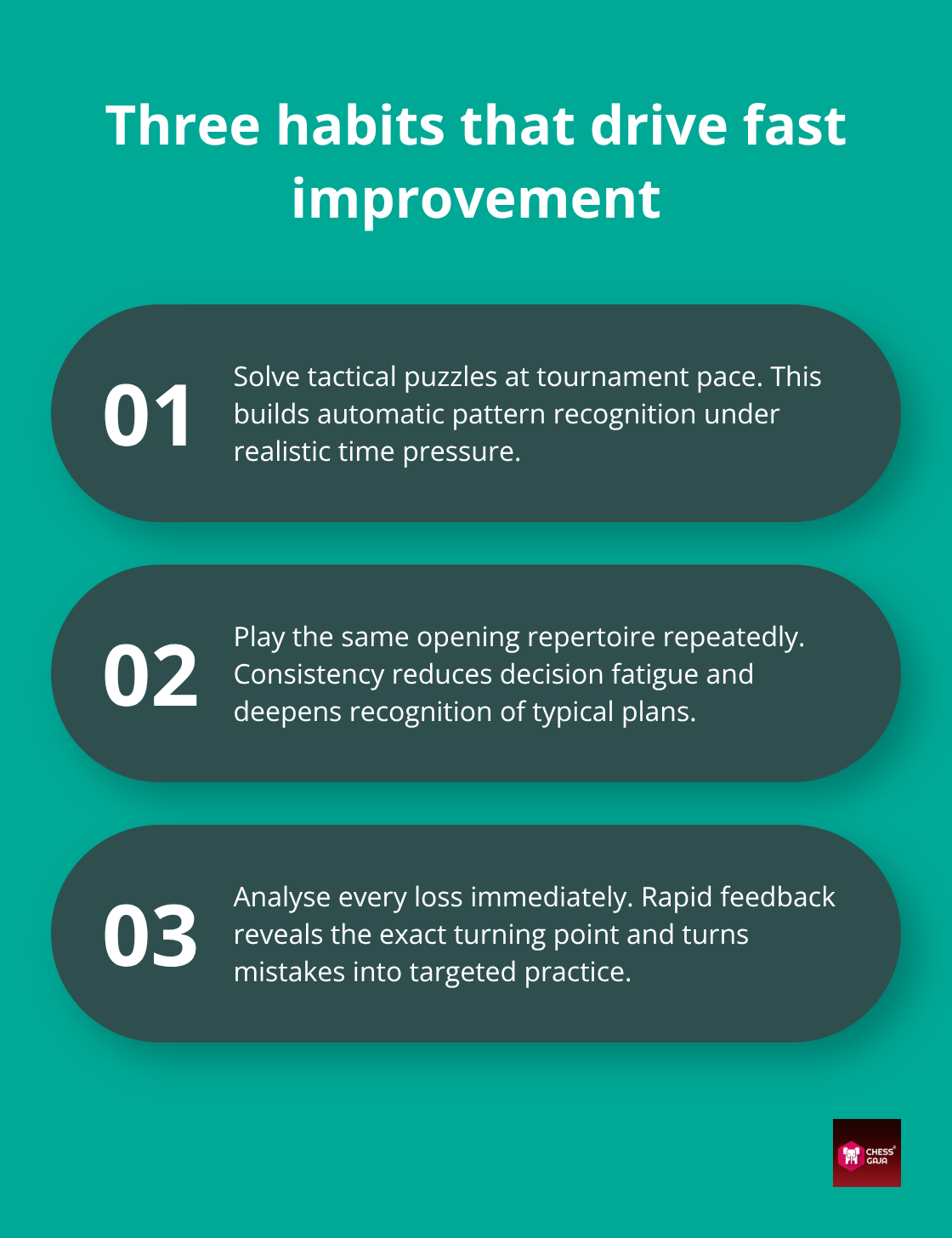
Fast improvers share three habits that slow improvers lack. First, they solve tactical puzzles at tournament pace rather than taking unlimited time. Second, they play the same opening repertoire repeatedly to build pattern recognition instead of experimenting with new lines constantly. Third, they analyze losses immediately after playing them, identifying the exact move where their position worsened.
Slow improvers often skip one or more of these steps, thinking that more variety or longer study sessions will accelerate progress. The data shows the opposite: narrow focus and consistent execution produce faster rating gains than scattered effort across many techniques.
The Confidence Multiplier Effect
One pattern emerges across all three regions: students who win their first tournament game or draw against a stronger opponent experience a confidence surge that sustains their practice without external motivation. The 12-year-old in Singapore didn’t need a parent pushing them to solve puzzles after that draw; they wanted to improve. The Texas adult didn’t need a coach reminding them to analyze games; they analyzed them voluntarily because they tasted tournament success. This psychological shift from external motivation to internal drive separates students who improve for a few months from those who build lasting chess habits.
Final Thoughts
The three-part daily routine you’ve learned-10 minutes of tactical puzzles, 10 minutes of opening principles, and 10 minutes of endgame basics-produces measurable results within weeks, not months. Students in Dubai, Singapore, and the USA who committed to this structure jumped rating categories, won their first tournament games, and built the confidence that sustains long-term improvement. Focused practice beats scattered effort every time.
What separates fast improvers from those who plateau is execution, and you now have the exact beginner friendly chess drills that work. These drills are not theoretical concepts. They are the exact techniques that transformed young players in Dubai and adult learners in Texas into tournament winners. These drills target the specific weaknesses that hold beginners back: hanging pieces, slow pattern recognition, and opening anxiety.
Professional coaching accelerates this progress beyond what solo practice can achieve. At Chess Gaja, we serve 5,000+ students across 40+ countries. Our FIDE-rated coaches deliver personalized feedback on your exact mistakes. You get a study plan tailored to your rating, plus monthly academy tournaments to test your skills against real opponents.
Book a Paid Starter Class today. Your Grandmaster-led coaching team will evaluate your game, identify your weaknesses, and build your custom roadmap to success.