Corporate leaders face constant pressure to make faster, smarter decisions with incomplete information. Chess teaches the exact mental frameworks needed to handle this reality.
At Chess Gaja, we’ve seen firsthand how corporate chess mindset development transforms how teams think strategically. This blog post shows you why leading companies are moving beyond traditional leadership training to adopt chess as a practical business tool.
How Chess Reshapes Decision-Making Under Real Business Pressure
Making Decisive Moves with Incomplete Information
Corporate leaders face constant pressure to act under tight deadlines and deep uncertainty. Chess is a game of perfect information on the board. However, human calculation limits force leaders to commit to moves under strict time controls without fully calculating every outcome. When a player has 10 seconds left on the clock, pattern recognition replaces endless calculation. The same applies to boardrooms where executives must commit to quarterly strategy, product launches, or market entries without perfect data.
Chess teaches the discipline of setting decision deadlines and honoring them. At the FIDE World Corporate Chess Championship in New York, competing teams from Greco, Morgan Stanley, Deloitte, and Google all demonstrated this principle: they moved decisively within time constraints rather than waiting for absolute certainty. A leader trained in chess stops seeking the perfect option and instead identifies the acceptable move that advances position within the available window.
Separating Strategy from Calculation
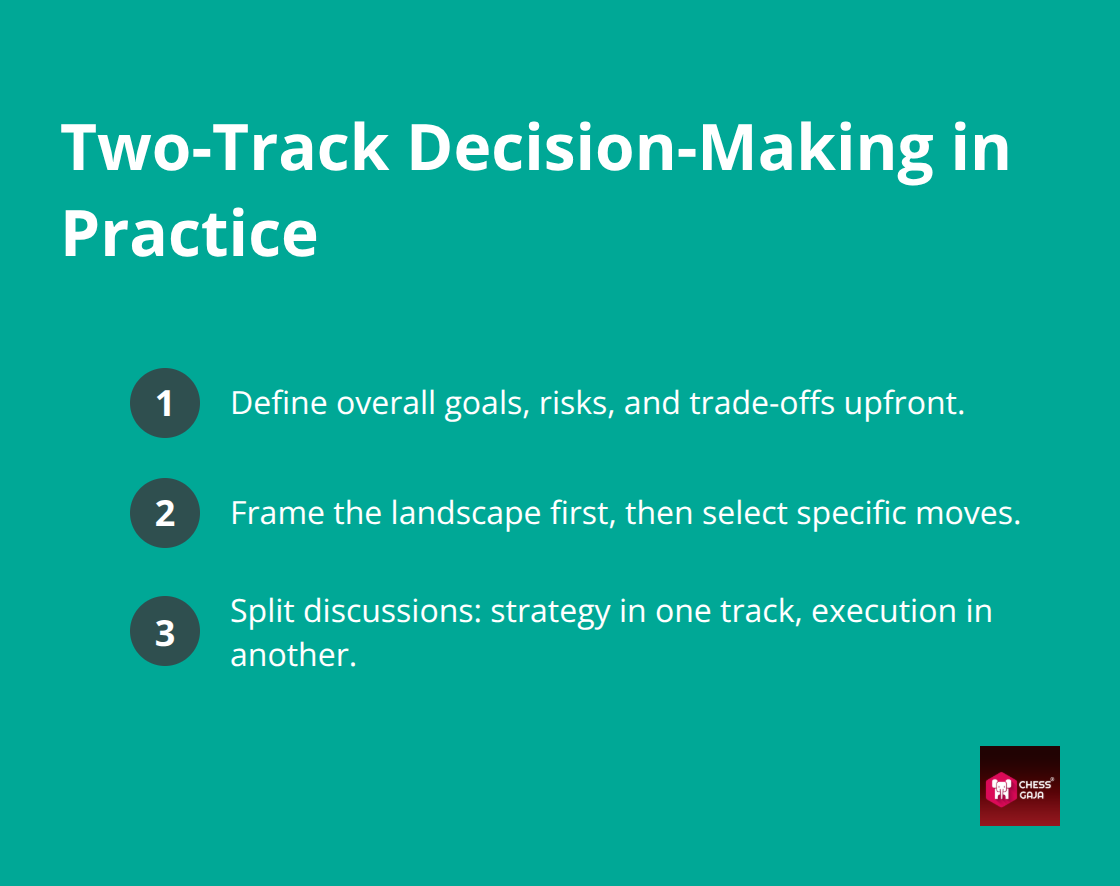
The skill of managing time and mental effort compounds over years. Grandmaster analysis shows how elite players verbalize their thought process during puzzle-solving. They first assess key positional features to generate candidate moves, then drill into deep calculation. Applied to business, this means separating macro-level strategy decisions from micro-level operational details.
When time is tight, effective leaders discuss overall goals, risks, and trade-offs first. Only after framing the landscape do they calculate specific moves. This two-track thinking model prevents analysis paralysis while maintaining rigor.
Corporate teams benefit from this separation: strategic planning sessions focus on broad positioning, while execution meetings focus on specific tactical moves.
Pattern Recognition as a Competitive Edge
Pattern recognition separates amateurs from masters in both chess and business. Top players recognize recurring structural patterns across thousands of games. This allows them to make instant decisions that would take ordinary players minutes to calculate. In corporate settings, pattern recognition translates to spotting recurring market dynamics, competitor behaviors, and customer signals before they become obvious.
A leader trained through chess study develops the ability to forecast competitor moves by identifying patterns in market signals, industry announcements, and shifting consumer preferences. This skill requires exposure to diverse scenarios and deliberate reflection. Kotov’s framework, outlined in Think Like a Grandmaster, emphasizes identifying candidate moves first before diving into deep calculation. Applied to business, this means mapping out key strategic alternatives before evaluating the execution details of any single plan.
Thinking Several Moves Ahead
The consequence evaluation skill embedded in chess prevents costly business mistakes. A player learns that every move carries downstream effects. A tactical move that wins material now might weaken long-term king safety or pawn structure later. This teaches professionals to think several moves ahead before committing resources.
Companies that adopt this approach build contingency plans and alternative moves for major decisions, staying agile when conditions change. Chess-trained leaders resist the shiny-object trap by maintaining focus on long-term positioning rather than chasing vanity metrics or isolated wins that don’t advance overall strategy. This mindset shift-from short-term wins to sustained competitive advantage-separates organizations that thrive from those that merely survive quarter to quarter.
The mental frameworks chess instills extend far beyond individual decision-making. Teams that operate with chess-trained leaders develop a shared language around strategic thinking, risk assessment, and long-term positioning. This shared understanding becomes the foundation for how organizations build resilience and mental toughness across their entire structure.
Building Resilience Through Competitive Experience
How Chess Develops Mental Toughness
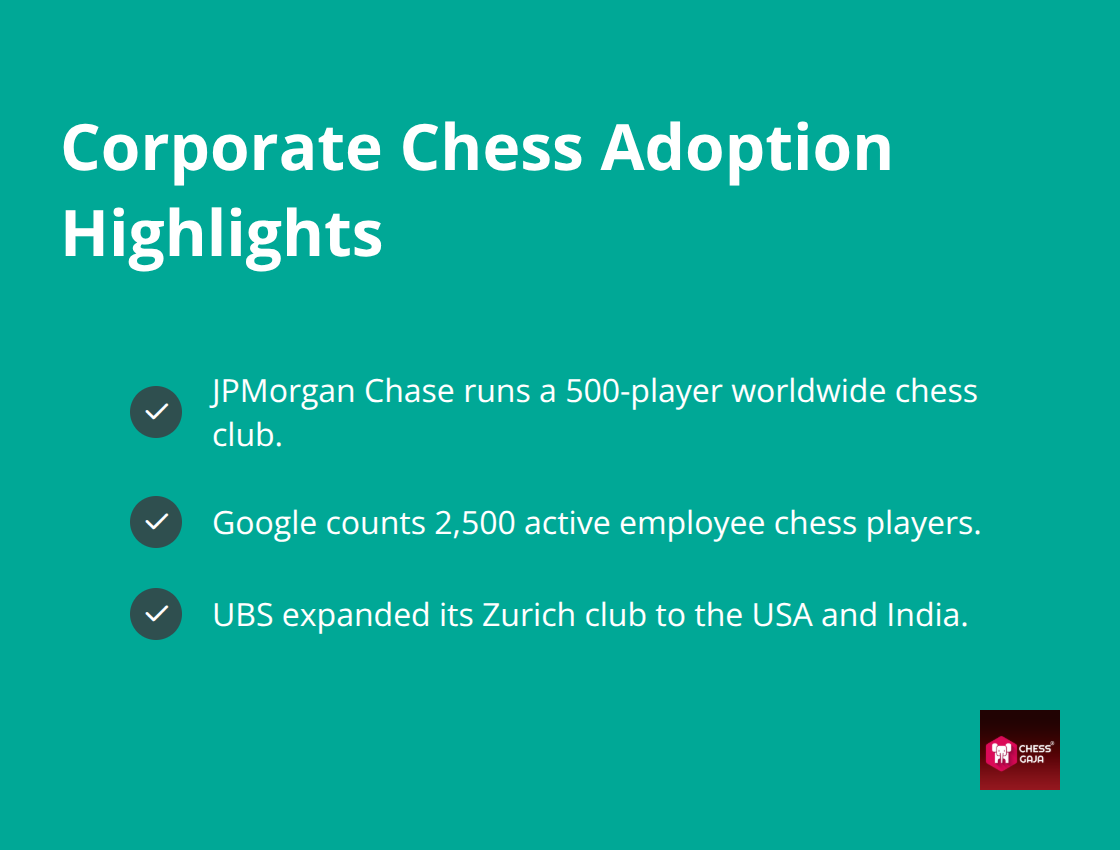
Chess-trained leaders develop mental toughness through repeated exposure to high-stakes decision-making and failure recovery. Unlike classroom simulations, chess demands immediate consequences for poor choices. A bad move loses material or position instantly. This immediate feedback loop trains professionals to stay composed when decisions backfire, analyze what went wrong, and adjust course without panic. JPMorgan Chase runs a worldwide 500-player chess club partly because the bank recognizes that employees who play chess develop the psychological resilience required for volatile markets and complex negotiations. Google hosts 2,500 active players, while UBS expanded its chess network from Zurich to the USA and India. These major institutions view chess as a practical resilience-building tool rather than a recreational activity.
Shared Language Around Risk and Strategy
Teams that integrate chess into leadership development report stronger communication around risk and uncertainty. When executives play chess together regularly, they develop a shared vocabulary for discussing strategic trade-offs, probability assessment, and contingency planning. A team member who plays chess understands what it means to sacrifice short-term advantage for long-term positioning. They recognize when a decision prioritizes speed over perfection, and they accept that acceptable moves executed quickly outperform perfect moves executed late. Teams from Morgan Stanley, Deloitte, and Google showcase this alignment during corporate tournaments. Their players execute moves confidently under tight clocks because their team culture normalizes rapid decision velocity. This shared understanding prevents the endless debate cycles that paralyze many corporate teams. When a leader trained in chess proposes a move, colleagues understand the reasoning framework behind it rather than viewing it as arbitrary or risky.
Measuring Real Performance Impact
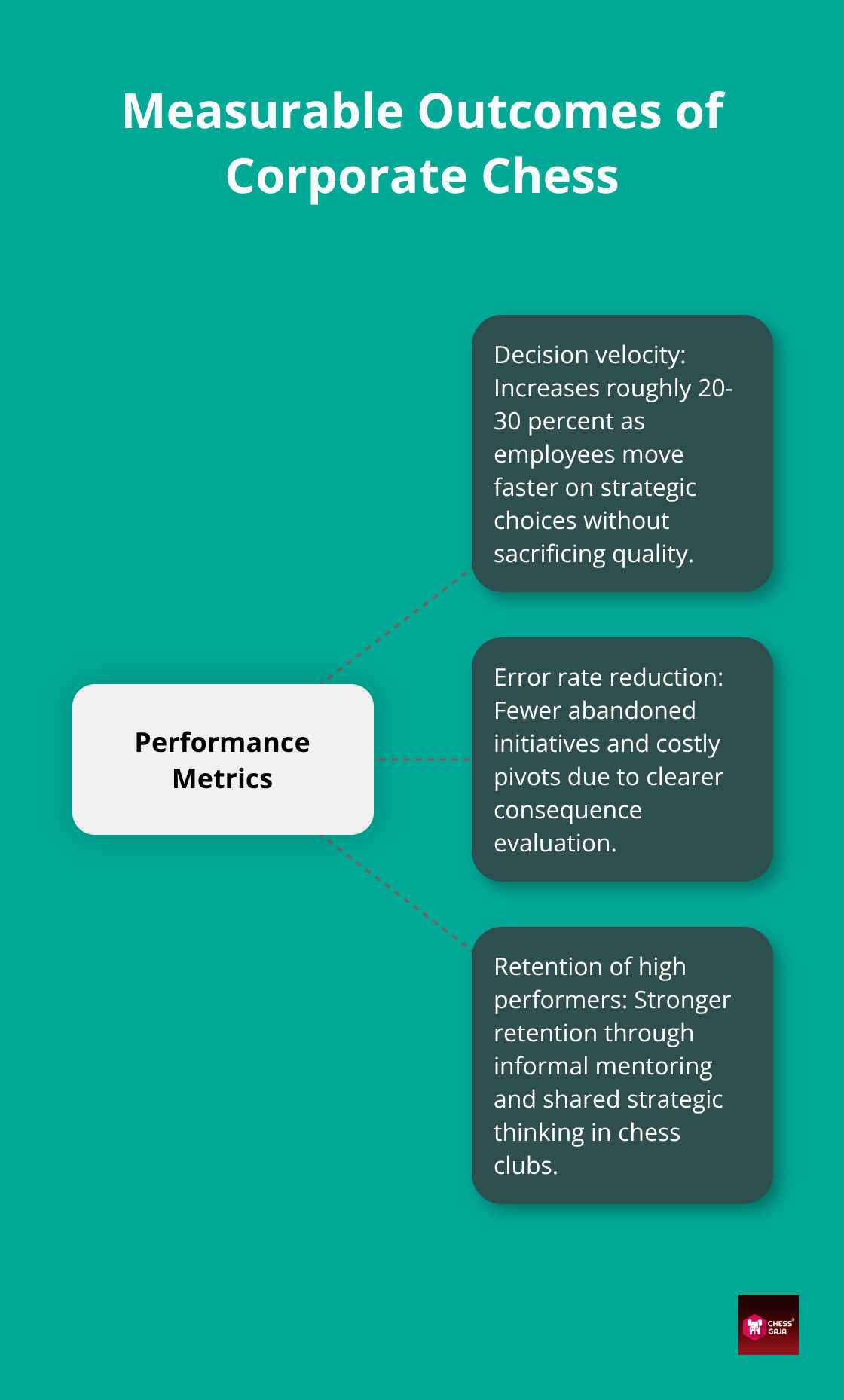
Companies measuring outcomes from chess programs track three concrete metrics: decision velocity, error rate reduction, and retention of high performers. Decision velocity improves because chess-trained employees move faster on strategic choices without sacrificing quality. Error rate reduction shows up in fewer costly pivots and abandoned initiatives. Teams with chess-trained leaders commit to fewer false starts because they think through consequences before committing resources. Retention of high performers strengthens because chess clubs create informal mentoring spaces where senior leaders share strategic thinking with emerging talent. The social component matters: employees stay longer at organizations where they develop intellectually alongside peers they respect.
Strategic Collaboration Through Physical Spaces
Physical chess sets, particularly large formats, transform how teams discuss strategy together. A life-sized board makes abstract strategic concepts tangible. Team members place pieces and discuss moves aloud, forcing articulation of reasoning that normally stays hidden in email threads or presentations. This transparency surfaces disagreements early. One team member might see a move as a positional weakness while another views it as a necessary sacrifice. A physical board forces that debate into the open before resources are committed. Post-game review becomes standard practice: teams analyze what worked, what failed, and why. This structured reflection builds organizational learning velocity far faster than post-mortems on failed initiatives alone. The physical act of moving pieces creates a shared experience that transcends typical strategy meetings, making abstract concepts concrete and memorable for everyone involved.
Why Companies Choose Chess Over Traditional Leadership Training
Cost-Effective Alternative to Expensive Programs
Corporate training budgets face relentless pressure to deliver measurable results without inflating headcount or extending timelines. Traditional leadership programs cost between $5,000 and $15,000 per participant for multi-day offsite workshops, often producing vague outcomes like improved communication or better decision-making. Chess programs operate at a fraction of this cost while generating concrete, trackable improvements in decision velocity and strategic thinking. A corporate chess club requires minimal infrastructure: a physical or digital board, a trained facilitator, and time allocated during work hours. Corporate chess programs scale horizontally within standard development budgets. They build strategic capability without requiring external consultants or expensive curriculum licenses.
Immediate Transfer to Business Decisions
Companies implementing chess skip the lag time between training and application. Employees play chess immediately and face real consequences for poor decisions within minutes. This compressed feedback loop transfers directly to boardroom behavior. When a player makes a tactical blunder or positional compromise in chess, the feedback loop is unforgiving. That immediate feedback shapes how leaders approach strategic risk and decision-making. That muscle memory of failure and recovery shapes how they approach quarterly strategy reviews or product roadmap decisions far more effectively than a facilitator explaining decision frameworks on a projector screen.
Validation from Global Corporate Competition
The evidence from major institutions validates this approach with specificity that other leadership tools cannot match. The 2025 FIDE World Corporate Chess Championship in Goa attracted Morgan Stanley, Deloitte, Microsoft, and UBS alongside emerging market firms, signaling that chess transcends industry silos and geography. These companies adopted chess because executives saw their teams make faster, more confident decisions after consistent play. Morgan Stanley’s strong performance, Deloitte’s competitive showing, and Microsoft and UBS placing among the top competitors demonstrate that chess creates measurable competitive advantage within organizations.
Measurable Performance Metrics
Companies track three concrete metrics after implementing chess: a significant increase in decision velocity as employees move faster on strategic choices without sacrificing quality, error rate reduction reflected in fewer abandoned initiatives and costly pivots, and strengthened retention of high performers fostered by informal mentoring spaces where senior leaders share strategic thinking with emerging talent. These metrics show up in promotion rates, internal mobility, and whether talented people stay or leave.
Institutions like UBS expanding their internal chess networks from Zurich to global offices in the USA and India highlights how major firms recognize the correlation between structured chess play, employee retention, and decision quality.
Chess as Core Infrastructure
Organizations serious about building strategic capacity in their leadership pipeline now treat chess not as a perk but as infrastructure, as fundamental to developing decision-makers as spreadsheet literacy or project management training. The presence of elite competitors at the world championship highlighted the competitive depth of corporate chess programs, but also proved that organizations at the highest levels engage with chess as a strategic tool. The expansion of chess programs across JPMorgan Chase, Google, and UBS signals that major institutions view chess as a practical tool for building organizational capability, not a recreational activity.
Final Thoughts
Corporate chess mindset development delivers measurable results that traditional leadership training cannot match. Companies like JPMorgan Chase, Google, Deloitte, and Morgan Stanley have moved beyond theory to implement chess as a core strategic thinking tool, tracking concrete improvements in decision velocity, error reduction, and retention of high performers. The 2025 FIDE World Corporate Chess Championship in Goa proved that chess transcends industry and geography, attracting elite competitors from finance, technology, and consulting who recognize chess as a practical business advantage.
Start by building a chess club within your organization and allocate time during work hours for regular play. Use physical or digital boards to make abstract strategy tangible for your teams, conduct post-game reviews to extract lessons that transfer directly to business decisions, and measure outcomes through decision speed and strategic quality. Treat chess not as a recreational perk but as infrastructure for developing your leadership pipeline.
If your organization lacks internal chess expertise, external guidance accelerates results. Chess Gaja specializes in corporate chess development, serving thousands of students across multiple countries with GM-led coaching from FIDE-rated instructors who combine competitive chess training with corporate applications. Chess Gaja delivers group executive sessions and personalized coaching. We provide the expertise that transforms chess study into measurable business performance.