
Adult chess improvement doesn’t follow the same path as learning in your teens. Your analytical mind and limited training time demand a different strategy-one built on efficiency and understanding, not rote memorization.
At Chess Gaja, we’ve worked with thousands of adult players who transformed their game by following a structured roadmap. This guide shows you exactly how.
Why Your Adult Brain Learns Chess Faster Than You Think
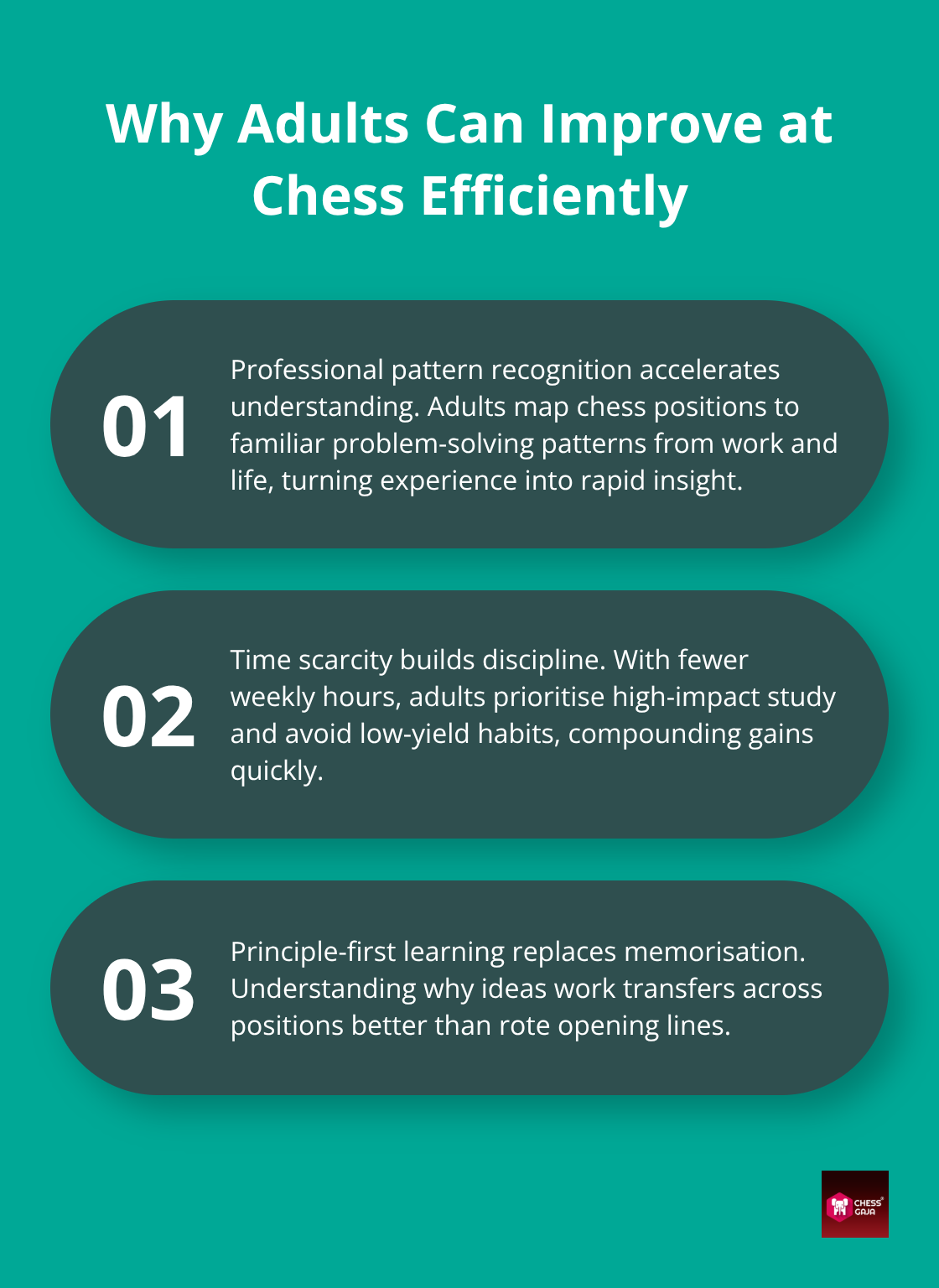
Pattern Recognition: Your Professional Advantage
Adult chess learners possess a decisive advantage. Your brain is wired for pattern recognition and analytical reasoning in ways children’s brains are not. When learning chess as an adult, you recognize structural patterns instantly. You have spent decades solving professional problems, managing complex decisions, and analyzing cause and effect.
This means you don’t need to memorize opening lines the way a ten-year-old does. Instead, you understand why a move works, how it exploits a weakness, and when the same principle applies to a completely different position. An adult beginner analyzing one master game for 90 minutes often learns more than a child playing ten casual games. You extract principles and build mental models rather than just accumulating raw experience.
Time Scarcity Forces Strategic Discipline
The real difference between adult and child learners is not intelligence-it’s available training hours. A serious young player might train 20 hours per week. You probably have 5 to 7 hours per week, if that. This forces you to train smarter, not harder.
Research on adult learning shows that deliberate practice beats passive study and casual play by a significant margin. If you spend focused time solving tactical puzzles with full concentration three times per week, you will improve faster than someone who plays numerous casual online games per day. This is why structured training plans work so well for adults: they eliminate wasted time and funnel your limited hours into activities that directly address your weaknesses.
Adults who achieve meaningful rating gains typically follow a clear weekly schedule-Monday and Wednesday for tactical drills, Thursday for game analysis, Saturday for a competitive game-rather than randomly jump between study methods. Because time is scarce, you must apply strict training discipline—focusing every available hour on deliberate practice rather than casual play—to compound measurable progress within months.
Understanding Principles Replaces Memorization
Children learn chess through imitation and repetition. Adults learn chess through understanding. When a coach tells a child to develop pieces before attacking, the child nods and tries to remember. A coach explains why undeveloped pieces cannot coordinate in the middlegame. They show how your opponent’s extra tempo controls key squares first. When you see how this principle applies across thousands of positions, something clicks.
You stop memorizing and start thinking.
This shift from memorization to comprehension is transformative. An adult player who understands that a weak back rank is dangerous will recognize back-rank tactics in positions they’ve never seen before. A child who memorized back-rank mate patterns might miss the threat entirely if the position looks slightly different.
An adult rated 1100 studying weak squares, outposts, and pawn structure will jump ahead faster than one memorizing 50 opening variations. Foundation matters more than volume. Your first 100 hours of structured training determine whether you progress steadily or plateau within months.
Your First 100 Hours: Where Tactical Foundation Meets Real Games
The first 100 hours of focused training separate players stuck at 1200 from those reaching 1600+. This is not about total time spent. It is about where that time goes. Deliberate practice in a structured sequence produces measurable rating gains within 8 to 12 weeks. Your job now is to allocate those hours with surgical precision.
Tactics: The Foundation That Stops Blunders
Start with tactics, not openings. Beginners under 1200 should dedicate the primary share of their study time to tactical puzzles, spending roughly 15 to 20 minutes daily across three sessions per week.
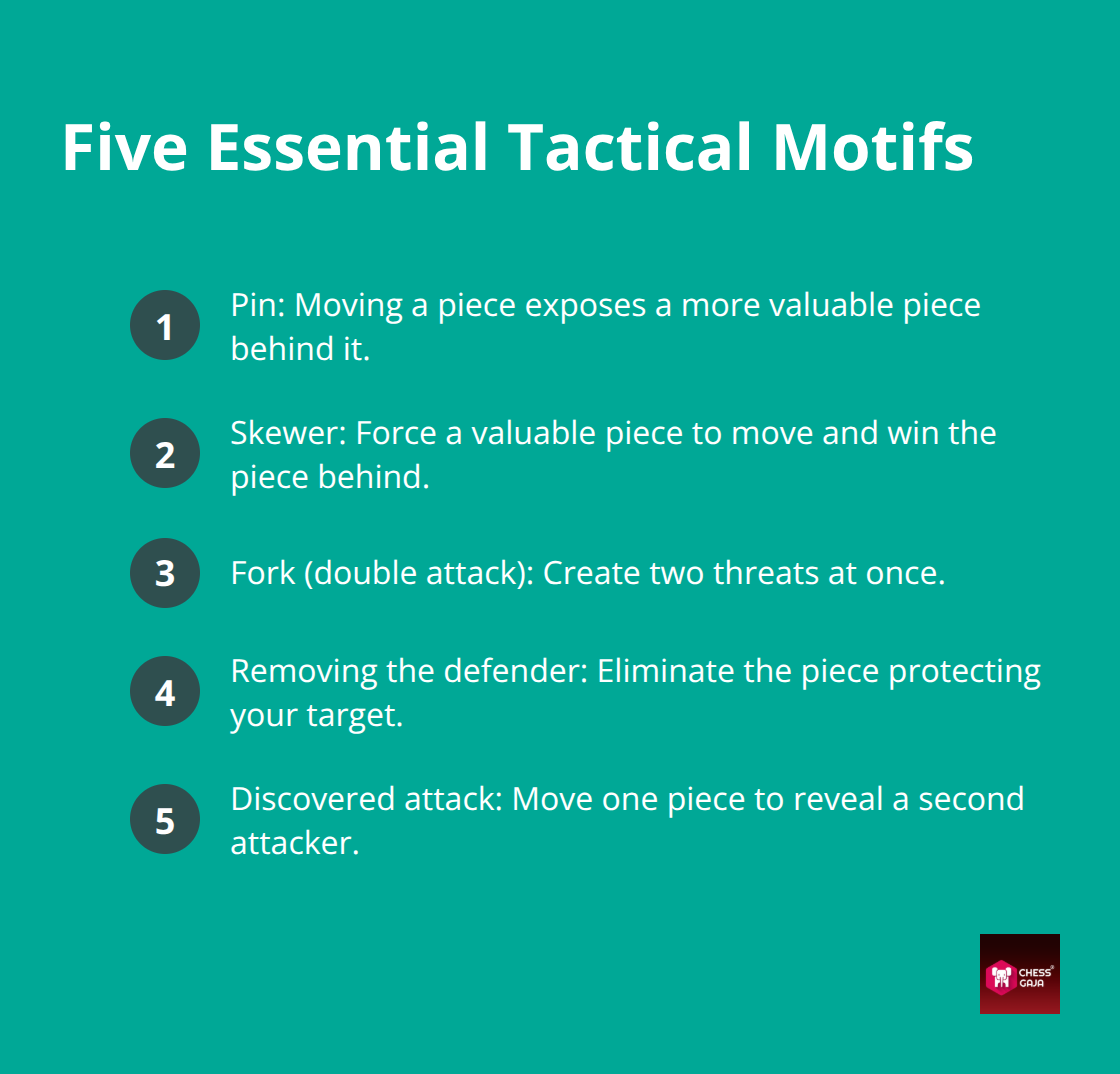
The five essential tactical motifs for beginners—pin, skewer, fork (double attack), back-rank weakness, and discovered attack—account for the vast majority of positions where material is lost.
A pin traps a piece that cannot move without exposing a more valuable piece behind it. A skewer targets two aligned pieces, forcing the more valuable (or equivalent) piece to move and exposing the piece behind it for capture. A fork creates two simultaneous threats your opponent cannot defend. A back-rank weakness exploits an unindented king trapped behind its own pawns, and a discovered attack reveals a hidden threat when you move an intervening piece out of the way.
Solve 10 to 15 tactical puzzles daily on platforms like Chess.com or Lichess. This trains your brain to spot these patterns automatically during real games-not busy work, but pattern recognition training that directly reduces blunders. Adult players who commit to 20 minutes of daily tactics report eliminating piece hangings within 3 to 4 weeks.
Classical Games: Building Your Mental Models
Study three to five annotated classical games from Grandmasters each month. Pick well-commented games where one side demonstrates a clear strategic idea—such as controlling weak squares, building an outpost, or exploiting a pawn structure weakness. Try to guess the GM’s move before reading the commentary to build your mental models.
Write down the key idea in one sentence. After you finish the game, set up the critical position and play it over again from memory. This active engagement builds mental models far faster than passive review. You internalize how strong players think, not just what moves they play.
Your Weekly Training Schedule: The Feedback Loop
Establish your weekly training schedule with non-negotiable slots. Monday and Thursday: 20-minute puzzle sessions. Wednesday: analyze one of your recent losses without an engine first (write down what you think went wrong). Saturday: one serious 15-minute rapid game where you apply what you studied that week. Sunday: a 30-minute session reviewing that game with an engine.
This creates a feedback loop where study directly informs play and play reveals gaps in your understanding. Track your progress on a spreadsheet: date, puzzle accuracy, games played, and your rating on Chess.com or Lichess. Visible progress compounds motivation.
Adult players typically gain 75 to 150 rating points within 12 to 16 weeks at this pace. You train skills that matter in real games, avoiding memorization you forget under pressure. Once your foundation is solid, you can move beyond simple pattern recognition into advanced decision-making frameworks.
From Pattern Spotting to Position Mastery
Once you crack the 1200 rating barrier, your brain stops recognizing positions as collections of tactical patterns and starts evaluating them as strategic decisions. This shift separates players who plateau from those who break through to 1600, 1800, and beyond. The intermediate player no longer asks “What tactic am I missing?” but instead asks “What is the best move given the pawn structure, piece placement, and my opponent’s weaknesses?” This requires a completely different training approach.
Your puzzle-solving speed will actually slow down at first, and that is healthy. Instead of snapping out answers in 30 seconds, you spend two minutes per puzzle analyzing why one move is superior to another, evaluating multiple candidate moves, and understanding the position deeply. Intermediate players rated 1200 to 1800 should shift their study focus primarily toward tactics and calculation alongside detailed game analysis, while reserving dedicated time for endgame fundamentals and opening principles. This rebalancing reflects your actual needs. You no longer need to build tactical pattern recognition; you need to build decision-making frameworks that work under time pressure.
Tournament Play Forces Real Decision-Making Under Pressure
Solving puzzles in isolation is not chess. Competitive tournament play is where your study either translates into results or exposes gaps in your understanding. Adult players in structured rapid or classical tournaments see faster rating gains than casual online players. Longer time controls force accurate decision-making under real stakes.
Aim to play one serious rapid (15+10 control) or classical tournament game every two weeks. After your game, spend 30 minutes analyzing it manually—writing down your candidate moves and identifying critical moments—before turning on the engine to verify your evaluation. This disciplined review process trains your intuition to match computer accuracy over time. This process trains your intuition to match computer evaluation, which is how strong players develop accurate judgment. Players who regularly analyze their games without an engine significantly reduce repeat strategic blunders within two months because you train decision-making frameworks at a higher level.
You learn to feel when a position is winning, drawn, or lost before calculation confirms it.
Coaching Identifies Your Specific Weakness
This is where most adult players fail. They study tactics, play games, analyze positions, and still improve slowly because they lack external feedback. A coach identifies the specific weakness causing your losses in minutes, whereas you might spend weeks chasing the wrong problems. If you lose games because you cannot convert winning endgames, but you spend three hours per week studying opening theory, you waste effort.
A professional coach analyzes 10 to 20 of your recent losses. They categorize them by type, such as tactical oversights, strategic misjudgments, or endgame failures. This targeted approach produces meaningful rating gains because you focus strictly on what matters for your game.
A student who loses games because of weak time management in the middlegame receives a different training plan than one who draws positions they should win because of endgame knowledge gaps. The coach’s role is to cut through the noise and point you toward the single problem that, once fixed, unlocks your next rating tier. Without this external perspective, you risk spinning your wheels on topics that sound important but do not address your actual bottleneck.
Final Thoughts
Rating gains of 75 to 150 points in your first 100 hours feel exciting, but the real test comes when you maintain that momentum for six months, a year, and beyond. Most adult players plateau because they abandon structure once initial progress slows, so you must treat chess training as a permanent part of your weekly routine, not a temporary project.
Your study allocation should shift as you advance: beginners dedicate most of their time to tactical drills, while intermediate players balance their schedule across tactics, in-depth game analysis, endgame study, and opening fundamentals. This balance prevents the common trap of memorizing openings you don’t understand or practicing tactics you can’t apply under pressure. Track your progress through serious rapid and classical ratings, not casual blitz games.
Structured training and personalized coaching accelerate your progress significantly. A professional coach pinpoints your specific weaknesses in minutes—saving you months of guesswork—and helps you build a custom roadmap for continuous growth. Book a Paid Starter Class with a Chess Gaja coach today for a complete evaluation of your game.