


Last month, a 10-year-old from Dubai won her first youth tournament by simply controlling the center and castling early. She didn’t have fancy tactics or memorized lines-she just followed three core opening principles for beginners that changed how she played.
At Chess Gaja, we’ve seen this pattern repeat across thousands of students in the USA, UAE, and Singapore. Master these fundamentals, and your entire game transforms.
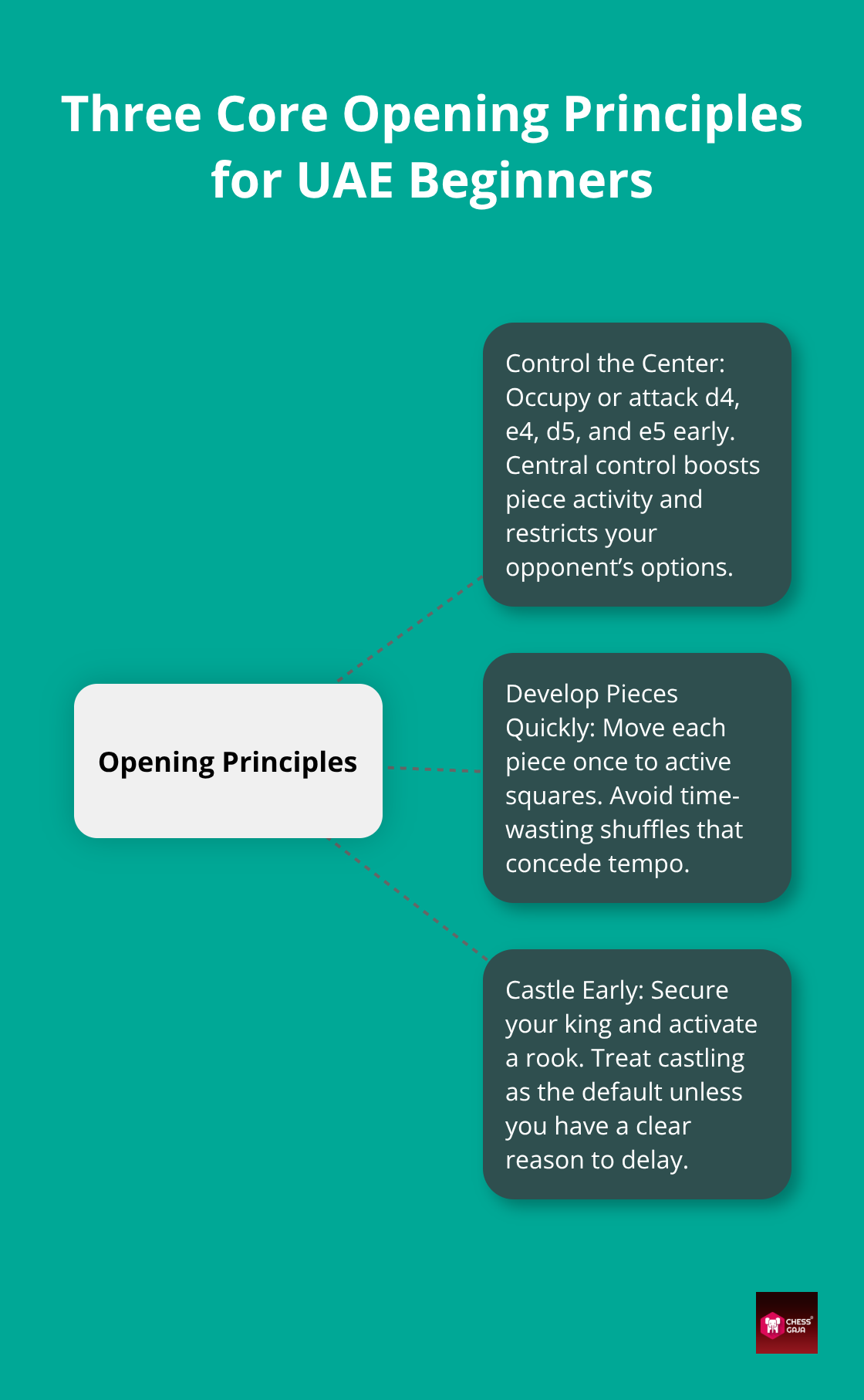
Control the Center
Why the Center Squares Matter Most
The four central squares—d4, e4, d5, e5—control more of the board than any other squares. A knight in the center on d4 attacks 8 squares, whereas a knight on the edge attacks as few as 2 to 4. As the saying goes, "A knight on the rim is dim!" This is geometry in action.
Occupying the center early gives your pieces influence over both flanks. In fact, our student from Dubai won her tournament by placing central pawns on moves one and two. Her opponent simply ran out of safe squares. Control the center, and you control your opponent's options.
How to Place Pieces on Central Squares
Your first move should push a center pawn to d4 or e4. Support that pawn with a piece on your next few moves. Place your knights on natural development squares like c3 and f3 (or c6 and f6 for Black) to control key central squares.
Place your bishops on active diagonals like c4 or b5 to exert central pressure, or on f4 and g5 to pin and restrict your opponent's defenders. Each piece you develop should either occupy a central square or control one, building central control as you mobilize your army.
Common Mistakes Beginners Make in the Center
Most beginners make two critical errors here. First, they push center pawns without a plan—leaving d4 or e4 vulnerable without piece support. Second, they abandon the center too early when challenged.
If your opponent plays e5 against your d4, don't panic. Either defend your pawn, push past to gain space, or capture to maintain central control. The center is worth fighting for because it gates your entire opening.
Once your pieces occupy strong central squares, your middlegame plans become clear: attack on the kingside, expand on the queenside, or launch a direct assault down open files. Without central control, you play reactively, always defending, never attacking. Place your center pawns on d4/e4 (or d5/e5 as Black) and your minor pieces on squares that control those four key central squares—doing so wins you half the opening battle.
Develop Your Pieces Quickly
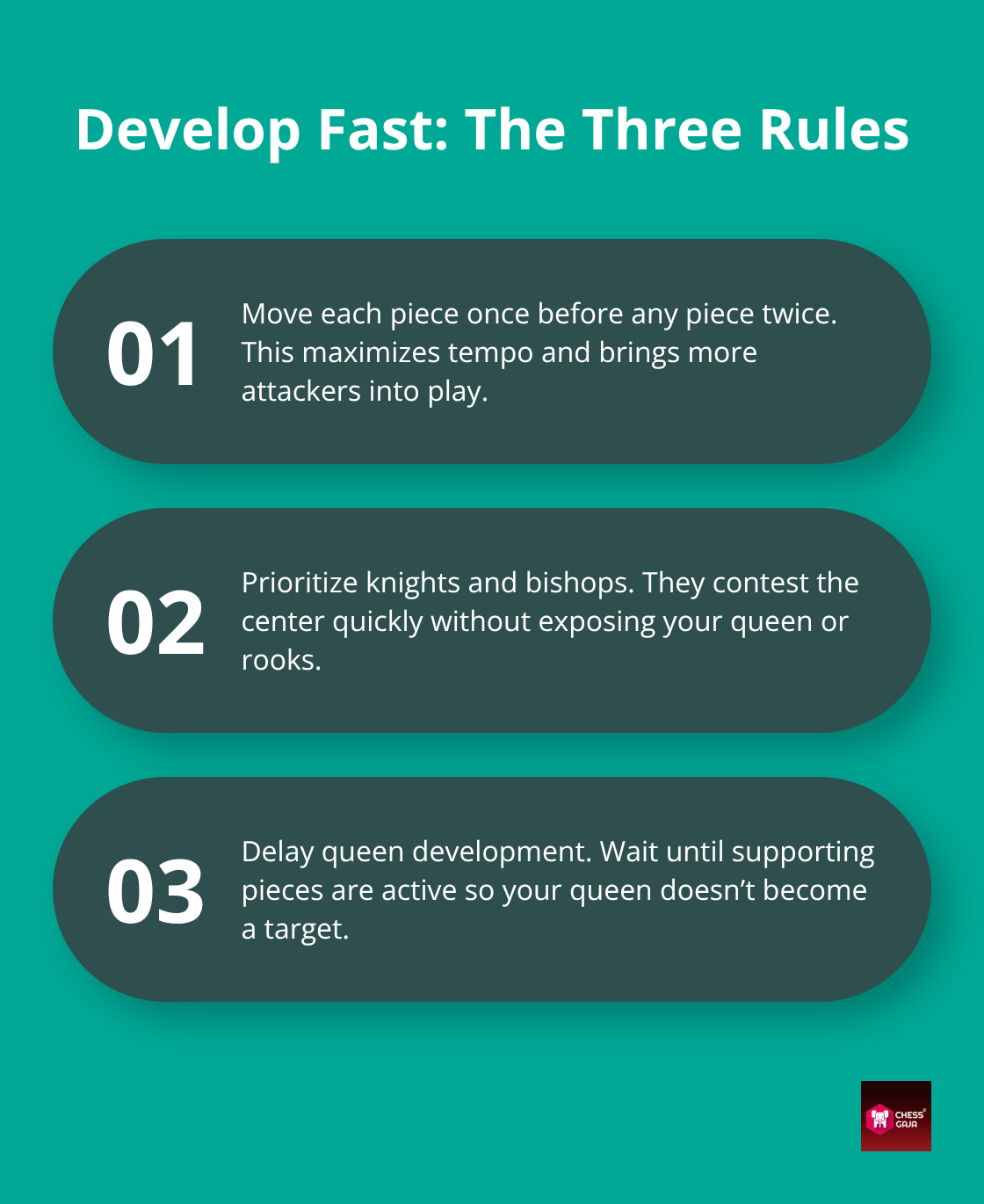
Move Each Piece Once Before Moving Any Twice
The 10-year-old student from Dubai didn't rush her pieces into battle. On moves three through eight, she developed her knights and bishops—each landing on a new square exactly once. Her opponent, meanwhile, shuffled pieces back and forth: knight to c6, then back to e7, then forward again to g6.
After move ten, the Dubai student had four pieces actively placed, while her opponent had moved only two pieces three times each. Tempo won the opening. Move every piece once before you move any piece twice, and you'll have more forces ready for the middlegame.
This isn’t a suggestion-it’s a rule that separates beginners who advance from those who stall.
Knights and Bishops Come Out First
Knights and bishops deserve priority over queens and rooks. Your knights belong on natural development squares like f3 and c3 (or f6 and c6 for Black) to control central squares without getting exposed. Bishops go to c4 or b5 to target central squares and the enemy king, to f4 to control long diagonals, or to g5 to pin key defenders.
These minor pieces activate quickly without exposing your most valuable assets. In contrast, moving your queen out early allows your opponent to develop minor pieces while attacking it, handing them free tempo at your expense
Why Queen Development Early Wastes Time
A queen brought out early to h5 might create immediate threats, but it quickly becomes a target for opponent minor pieces, forcing you to waste precious turns retreating it. Strong players keep queen moves modest until minor pieces are developed and castling is complete, stepping up just enough to connect the rooks and support central operations. This patience compounds. Your opponent sees your knights, bishops, and central rooks coordinating smoothly and realizes they’re already falling behind. They panic and make mistakes. You’ve won the opening without a single forcing move. The principle is simple: develop minor pieces first and keep the queen patient. Avoid moving the same piece twice until your minor pieces are out and your king is castled.
Connecting Your Pieces for Middlegame Power
Once your minor pieces occupy active squares, your rooks and queen gain purpose. A rook placed on an open file (a file with no pawns) penetrates deep into the opponent’s position along that file. When your queen develops behind or alongside that rook, your forces achieve maximum firepower. This coordination transforms your position from scattered pieces into a unified army. Your opponent faces threats on multiple fronts because every piece you’ve placed supports the others. The opening ends when your pieces work together toward a shared goal. That goal emerges naturally from the central squares you occupy. With your pieces developed and your center controlled, you’re ready to transition from opening to middlegame strategy.
King Safety and Castling
Why Your King Needs Protection Early
Your king exposed on the board becomes a target that loses games fast. Most beginners treat castling as a nice option to consider later, but this approach is backwards. Castling should happen early in almost every game you play.
Our 10-year-old student castled kingside early on move nine, tucking her king safely behind her pawns while bringing her rook to the central files.
Her opponent delayed castling until move fifteen, leaving their king trapped in the center on e8.
Castling accomplishes two key goals simultaneously: it tucks your king into safety and brings your rook toward the central files.
Kingside Castling: The Safer Default Choice
Kingside castling (moving your king to g1/g8 and rook to f1/f8) is the safer default choice. It requires fewer moves to set up than queenside castling and keeps your king compactly defended behind a solid pawn shield.
This move brings a sleeping rook out of the corner and places it closer to the central files to actively support your forces. The kingside remains your default choice until you reach intermediate play.
Queenside Castling: When to Avoid It
Queenside castling (king to c1, rook to d1) takes longer to setup because you must move your queen first. The king also ends up on c1, leaving the a2-pawn temporarily undefended.
This delay costs tempo because your opponent gains time to create threats while your king remains exposed compared to kingside castling.
When Castling Should Wait
Rare moments exist when you can delay castling, but these exceptions have strict conditions. If you launch a direct, forcing attack against an opponent's king, you might delay castling for a move to press your advantage.Additionally, if your opponent controls the file your king would cross, pause to neutralize immediate threats before executing your castle. In almost every beginner game, castling early solves your king safety problem instantly.
Transition to the Middlegame
The moment your minor pieces occupy active squares and your center stays secure, castle immediately. This single move shields your king from e-file tactical attacks, unblocks your rooks so they can connect, and activates a rook toward the central files. After castling, your focus shifts entirely to the middlegame: attacking your opponent’s weaknesses, defending your own pieces, and executing the plans that your opening preparation has set up.
Final Thoughts
Three principles shape every opening you’ll play: control the center, develop your pieces quickly, and protect your king through castling. Our young tournament winner didn’t memorize deep engine lines or study complex tactics. She simply placed her center pawns, developed her knights and bishops efficiently, and castled early. Her opponent faced a coordinated army while still shuffling pieces around the board, and the game was already decided in the opening.
Opening principles for beginners aren't optional extras—they directly determine your middlegame success. Controlling the center gives your pieces influence over both flanks while forcing your opponent into passive defense.
Rapid development without wasted tempo allows you to outnumber your opponent's active forces. Finally, early castling tucks your king away safely so your rooks can connect.
We at Chess Gaja have taught these fundamentals to over 5,000 students across 40+ countries. The results are consistent. Students who master center control and rapid development advance far faster than those relying on memorization. Your next step is to practice these principles in real games and track which games you won by controlling the center early and which games you lost by delaying castling. If you want personalized feedback on your opening decisions and a structured plan to accelerate your improvement, book a Paid Starter Class with Chess Gaja for a professional skill evaluation.