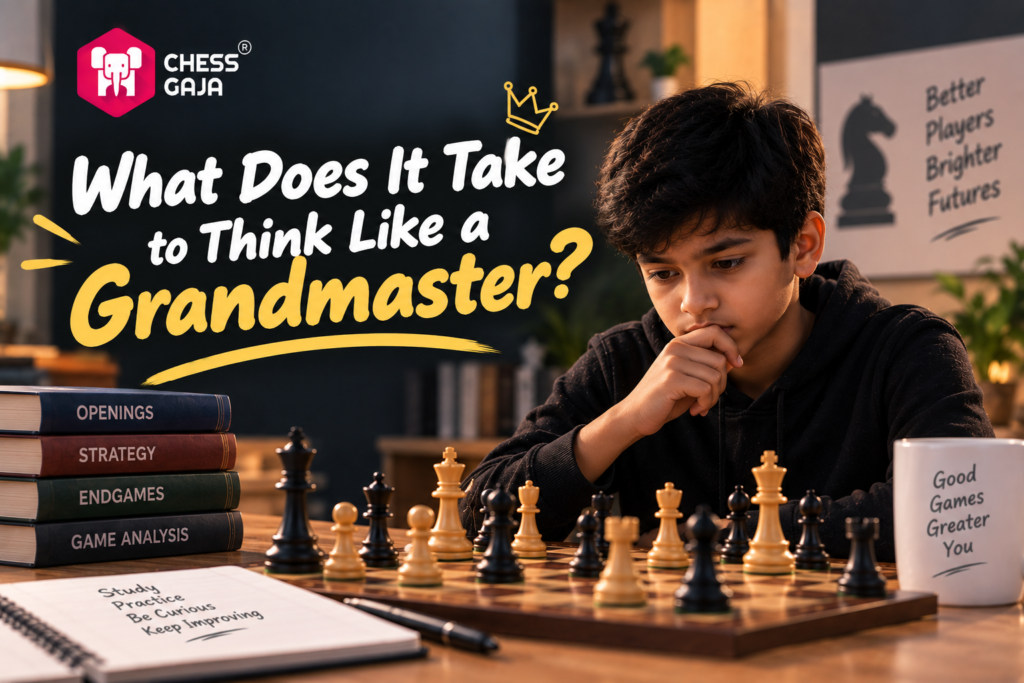
Most players plateau after mastering basic tactics and openings. The jump from intermediate to advanced chess requires a completely different approach to training and thinking.
At Chess Gaja, we’ve seen thousands of students transform their game by adopting GM level training insights that focus on strategic depth, mental resilience, and pattern recognition. This guide shows you exactly how grandmasters structure their practice and which mistakes are holding you back.
What Separates Grandmasters From Everyone Else
Grandmasters don’t win because they memorize more lines than you do. They win because they think differently about positions.
A 2600-rated Grandmaster devotes most study time to game analysis and pattern recognition. Endgame technique and opening preparation receive targeted, equal attention based on ChessBase’s training methodology. Most intermediate players flip this entirely, cramming openings while ignoring the positions where games are actually decided.
Strategic Depth Over Memorization
The strategic depth grandmasters develop comes from studying positions without engines first, forming their own evaluation, then comparing to engine analysis. This builds genuine understanding instead of memorization. When you analyze a middlegame position, write down what you think the best move is and why before touching an engine. This single habit accelerates your growth faster than memorizing 50 opening variations.
Mental Resilience Under Tournament Pressure
Tournament play reveals who has trained their mind and who hasn’t. Grandmasters develop what sports psychologists call tactical patience-the ability to slow down thinking when stakes rise, not speed up. In tournament play, higher-rated players demonstrate superior psychological conditioning. They make sharper decisions under pressure when facing critical positions. The difference wasn’t calculation ability; it was psychological conditioning.
Grandmasters practice with time controls that force real decision-making. Playing 3–5 classical or longer rapid games with thorough post-game review builds far more tournament resilience and deep calculation habits than high-volume blitz. Try playing one serious tournament game per month with complete post-game analysis within 48 hours. This builds the habit of learning from real pressure, not hypothetical scenarios.
Pattern Recognition That Works in Real Games
A grandmaster doesn’t calculate every move in a position. They recognize patterns instantly-tactical motifs, strategic structures, pawn formations that appear repeatedly across thousands of games. This recognition develops deliberately, not accidentally. The method is simple: study 10 complete games from a single grandmaster in your chosen openings, focusing on the middlegame plans, not the opening moves.
Then play games in those positions and notice which patterns repeat. When you encounter the same pawn structure three times in different games, you’re building recognition. Lichess offers massive free databases containing billions of user games. Use these master archives to find patterns matching your rating range and playing style. The grandmasters you admire didn’t start by analyzing 100 games per week. They built a foundation by understanding 10 games deeply, then expanded from there.
These three pillars-strategic depth, mental conditioning, and pattern mastery-form the foundation that separates intermediate players from those ready to compete at higher levels. The next section shows you how to structure your weekly practice routine to develop all three simultaneously, rather than treating them as separate skills.
How Grandmasters Structure Their Weekly Practice
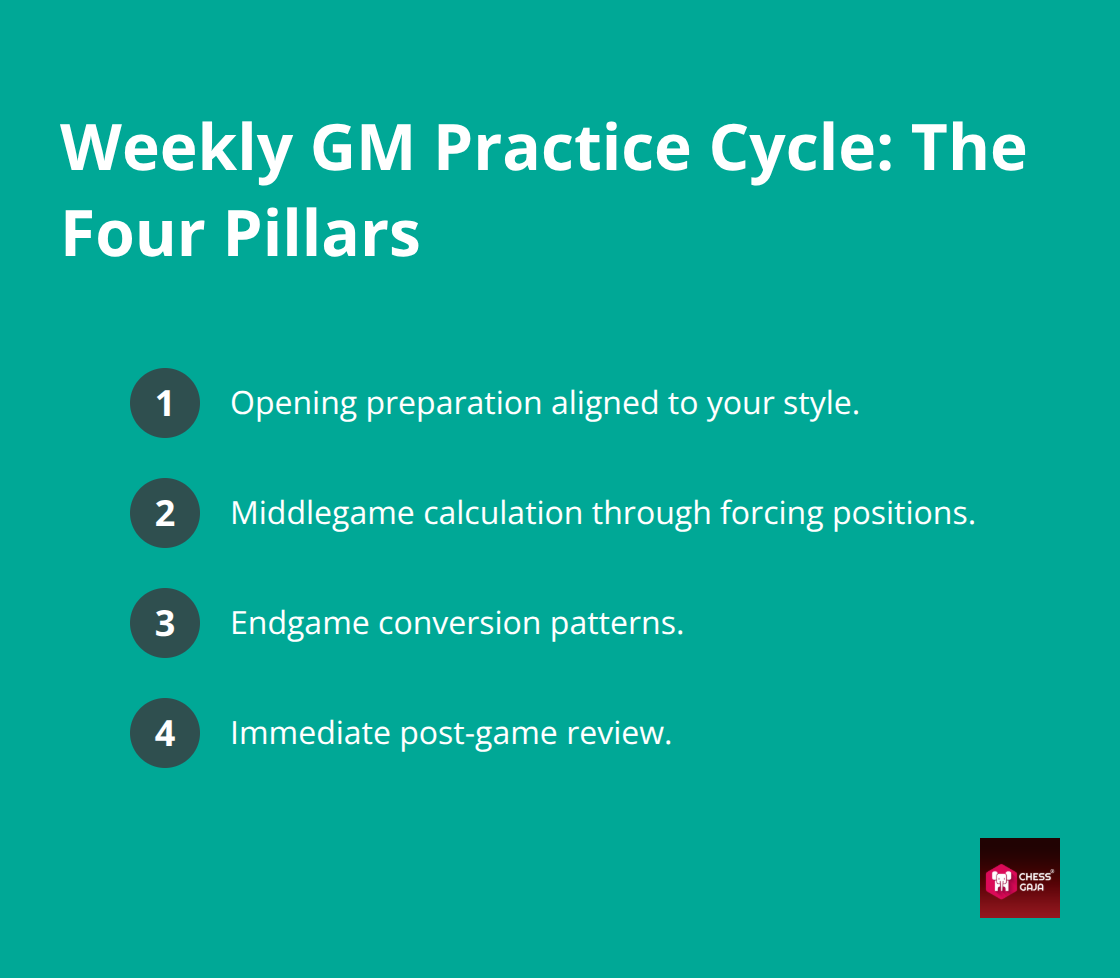
The difference between players who stagnate and those who break through lies entirely in how they organize their practice week. Grandmasters don’t study randomly or chase whatever feels interesting that day. They build a deliberate cycle that addresses four specific areas: opening preparation aligned to their style, middlegame calculation through forced positions, endgame conversion patterns, and immediate game review. This structure repeats weekly, which means each skill area receives consistent attention without overwhelming the schedule.
Most intermediate players fail here because they either cram everything into one session or bounce between random topics without rhythm. The compounding effect of focused weekly cycles beats sporadic intense study every single time.
Analyzing Your Games Before the Memory Fades
Your own games contain 10 times more learning value than studying grandmaster games because the mistakes are yours. The moment you finish a tournament game or serious online match, review it within 48 hours while the critical moments remain vivid in your memory. Open your game without an engine first and write down what you think happened at three turning points. Why did you play that move, what did you miss, and what was your opponent threatening?
Only after forming your own evaluation should you check the engine analysis. This approach builds genuine understanding instead of passively accepting what the engine says was best. Players who skip this step waste the vast majority of their learning opportunity. Set a firm rule: one serious game per week gets this full treatment. If you play in a tournament, analyze all games within one week. If you play online, pick your most instructive loss or closest win and analyze it deeply.
Building Endgame Skill Through Practical Positions
Endgame study separates players who convert advantages from those who throw them away. Most intermediate players ignore endgames entirely, losing drawn positions or missing winning techniques. Spend 15 minutes three times per week on endgame work, focusing on practical conversion patterns rather than obscure theoretical compositions. Study the endgames that appear in your openings. If you play the Ruy Lopez, focus on its signature pawn structures like the Exchange Variation’s 4-vs-3 kingside majority. If you play the French Defense, study bad-bishop vs. good-knight endgames and c-file control. This targeted approach connects directly to positions you’ll actually face.
Work through one practical endgame position per session. Calculate candidate moves manually and write down your evaluation for both sides. Only after completing your independent breakdown should you verify key moves against an engine. This trains your calculation in positions where every move matters and there is minimal tactical noise. Players who maintain this habit report immediate rating gains because they stop blundering won endgames.
Puzzle Training That Builds Real Calculation Strength
Solving 50 random tactics puzzles teaches you nothing except pattern matching on isolated positions. Real puzzle training means solving positions from your actual games or master games in your opening system. Try solving 10–12 targeted puzzles daily matching your personal tactical weaknesses identified during game analysis. To simulate real games, alternate between themed pattern recognition and mixed calculation sets where the tactical theme is hidden. Spend 20 minutes on these targeted sets rather than 60 minutes on random puzzles.
Write down your full calculated variation—including opponent defenses—before checking the answer. If your accuracy drops, focus on simplifying candidate move selection rather than guessing quick tactical shots. Once you consistently master a theme, move to harder variations of that same position structure. This progression method beats jumping randomly between difficulty levels because it builds unshakeable pattern recognition under pressure.
Connecting Your Weekly Cycle to Tournament Performance
These four practice areas-game analysis, endgame work, puzzle training, and opening preparation-form a complete system only when you execute them on a consistent weekly schedule. The rhythm matters more than the intensity. A player who commits 3 to 4 hours per week to structured, deliberate practice will consistently outperform someone who logs 10 hours of unorganized blitz and random puzzle solving. Your next step involves taking this weekly framework and testing it against real tournament conditions, where the pressure reveals which habits actually stick and which ones crumble under stress.
Three Fatal Mistakes Holding Back Advancing Players
Most intermediate players fail not because they lack talent, but because they make three systematic errors that compound over months. These mistakes appear across all rating levels and regions-from scholastic tournaments in the USA to competitive clubs in Dubai and Singapore. Understanding what holds you back is the first step toward breaking through.
Mistake One: Abandoning Endgame Study
The first mistake is abandoning endgame study entirely. Players climb from 1000 to 1800 rating by learning tactics, then hit a wall because they cannot convert advantages into wins. FIDE training data shows that players rated 1600–1800 frequently miss winning endgame positions due to a lack of technique, whereas players rated 2200+ reliably convert the exact same positions. The gap isn’t calculation ability-it’s knowledge.
When you reach 1600 rating, you must spend 45 minutes weekly on practical endgames tied directly to your opening repertoire. If you play the Sicilian Defense, study asymmetrical endgame structures—such as White’s kingside majority vs. Black’s central pawn mass or opposite-colored bishop transitions—that naturally flow from your specific variation. Stop treating endgames as optional material and start treating them as the foundation that converts your middlegame advantages into actual wins. This single shift transforms how you finish games.
Mistake Two: Playing Without Analysis
The second mistake is playing too many games without analysis. A tournament player who plays 10 rapid games per week but analyzes zero of them learns almost nothing. Games become muscle memory practice, not learning opportunities. Players who play three serious games per week and analyze all three advance twice as fast as players who play ten games without review.
Your brain needs a specific feedback loop: play a position, make a decision, see the outcome, and understand the logic behind it. Without that cycle, your pattern recognition stagnates. Set a hard rule this month: every serious game gets 30 minutes of analysis within 48 hours. If you play a weekend tournament, dedicate 30 to 45 minutes per game over the following week to review critical decision points.
Mistake Three: Ignoring Your Personal Weaknesses
The third mistake is passively memorizing grandmaster games without identifying how master-level decision-making applies to your own play. You review brilliant attacks, yet ignore the subtle calculation errors and positional oversights that cause your own losses. Your own losses contain the exact patterns you need to fix. When you lose a game, your job is to identify the single worst move you made and understand why you made it (was it calculation error, pattern blindness, or time pressure panic?).
Then build a dedicated puzzle set focused exclusively on that tactical motif, working through positions of increasing complexity until you spot the pattern effortlessly in fast calculations. A player in Singapore who spent two months fixing a removal-of-defender weakness rose 150 rating points because she stopped losing the same way repeatedly. Stop studying random grandmaster games and start obsessing over your personal mistake patterns. These three changes-endgame focus, game analysis discipline, and personal weakness correction-separate players who break through 1800 from those who plateau forever.
Final Thoughts
The gap between intermediate players and those competing at advanced levels closes fastest when a coach who has walked that path themselves provides structured guidance. GM level training insights only stick when someone actively competing at the highest levels identifies patterns in your play that you cannot see yourself. At Chess Gaja, our FIDE-rated coaches have trained seven national champions, and our curriculum was developed by GM Priyadharshan Kannappan to address the exact weaknesses that hold back advancing players across 40+ countries.
Your coach diagnoses whether your rating plateau stems from weak endgame technique, time management, or opening choices. This discovery takes weeks alone, but takes only hours with expert guidance. Whether you compete in scholastic events in the USA, clubs in Dubai, or tournaments in Singapore, personalized instruction accelerates your development. Targeted feedback spots weaknesses faster than self-study alone. Transformation happens when structured practice meets honest game analysis. Consistent feedback from an expert ties the entire process together.
Book a Paid Starter Class with Chess Gaja to receive a professional skill evaluation from one of our FIDE-rated coaches. Your coach will assess your current level, identify your primary development areas, and design a personalized study plan that addresses exactly what’s holding you back. This diagnostic process has helped thousands of students break through rating plateaus. It builds gains players once thought impossible.