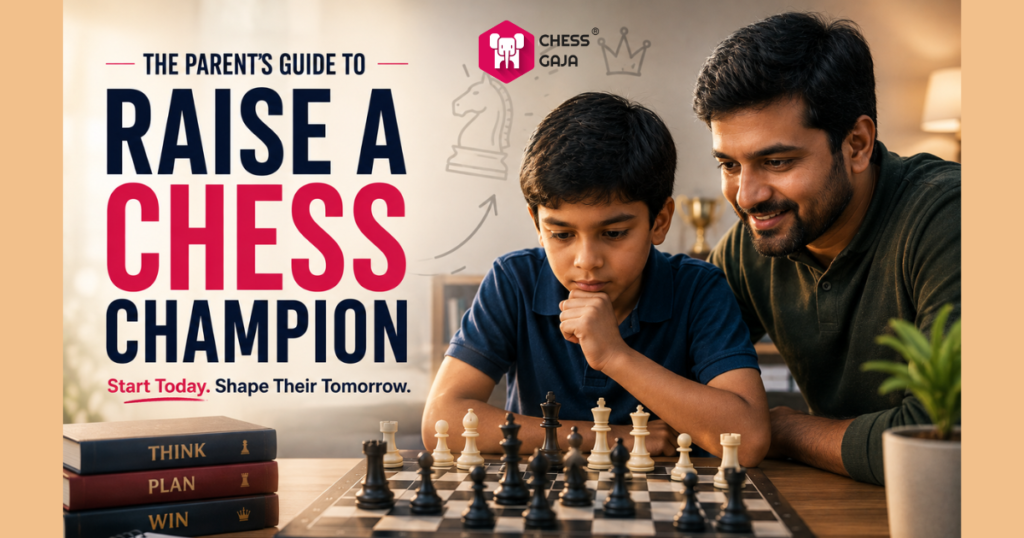
Your child’s chess journey starts with the right guidance. At Chess Gaja, we’ve helped thousands of young players build confidence and sharpen their minds through structured learning.
This parents guide to child chess covers everything you need to know-from finding the right coach to supporting practice at home. We’ll show you exactly how to set your child up for success.
How Chess Trains Your Child’s Mind
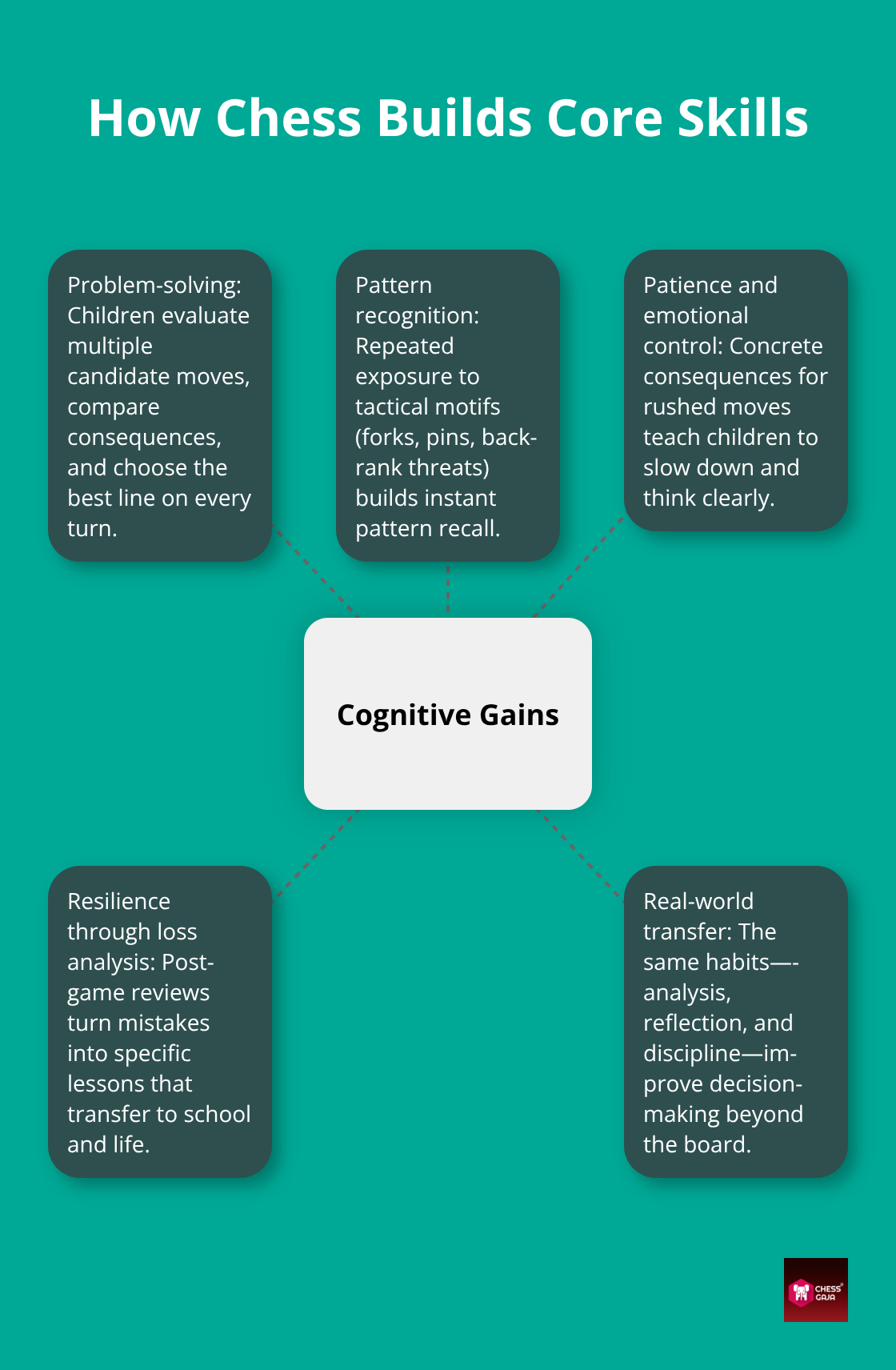
Chess is not a game of guessing. A study of 774 Romanian parents in Frontiers in Psychology found that 55.8% linked chess to strong thinking skills. In fact, these results back this up. When your child plays chess, they see a board with many possible moves. So, they must weigh each choice and pick the best path. This is pure problem-solving, and it happens on every move. For instance, math homework asks a child to solve one problem and move on. However, chess asks for this same thinking again and again, all game long.
Over time, these small decisions change how your child handles problems in life.
Problem-Solving Through Repeated Analysis
A student in Dubai went from struggling with basic tactics to spotting three-move combinations in eight weeks. That jump came from solving hundreds of puzzles. Each one forced them to spot threats, find chances, and think two or three moves ahead. This is not just theory. Your child builds pattern recognition by seeing the same threats again and again. When they see a back-rank weakness, they know the danger right away. When they see a knight fork forming, they spot it fast. Guided teaching builds this skill faster than random play does.
Patience Emerges from Consequences
The emotional payoff matters more than most parents know. In the same study, parents rated their child’s ability to feel good emotions at 4.38 out of 5. They rated the ability to beat bad emotions at 4.20. Chess teaches this directly. A child who makes a careless move and loses a piece feels it right away. There is no hiding from that result. This builds accountability faster than any lecture. Over months of steady play, children stop rushing. They learn to slow down, think through options, and wait before they attack.
A Singapore student trained for six months on calculation and planning before the 2025 National U11 Championship. When she faced a tough opponent, that training turned pressure into focus. She placed in the top rankings. Patience grows because chess has no shortcuts. Your child cannot win on luck alone. They must think clearly. That means slowing down.
Competitive Resilience Through Loss Analysis
Every loss in chess is a lesson, not a failure. This mindset shift separates kids who grow from those who quit. Coaches who have trained Olympiad teams see this pattern often. Children who study their losses improve much faster than those who avoid them. For example, one UAE student rose from 1325 to 2260 FIDE rating over three years. She did this by reviewing every loss with her coach and finding exactly where her plan went wrong. That habit of self-reflection carries over to school and life. Your child learns that difficulty is information, not defeat.
With structured coaching from FIDE-rated instructors, your child builds real progress. The best programs treat every game as a data point for growth, not a judgment on your child. This changes how your child handles setbacks, both on and off the board.
Your child now understands how chess develops their mind. The next step is finding the right coach and program to guide this development-one that matches your child’s current level and learning style.
How to Choose a Chess Coach That Accelerates Your Child’s Growth
Finding the right coach makes the difference between a child who plays chess casually and one who develops real skill. The wrong coach wastes time and money; the right one compounds your child’s improvement month after month.
Verify Formal Credentials and Track Record
Start by asking whether the coach holds FIDE ratings. FIDE-rated instructors have demonstrated competency through international standards, not just local reputation. A FIDE-rated coach knows how to teach progression across rating levels, from beginner through tournament play. When selecting a coaching team, look for academies where 100% of coaches hold FIDE credentials. These coaches should also have trained national champions across multiple countries. That track record tells you the coach knows how to identify talent, structure learning, and accelerate growth.
Ask any academy whether the same coach continues working with your child after the initial assessment. Also ask whether you rotate through different instructors. Continuity matters enormously. For example, a coach who teaches your child for months understands their learning patterns, weak spots, and confidence level. So, they adjust explanations based on what works for that specific child. In contrast, rotating coaches waste the first few sessions of each new relationship rebuilding that context.
Evaluate Program Structure and Assessment
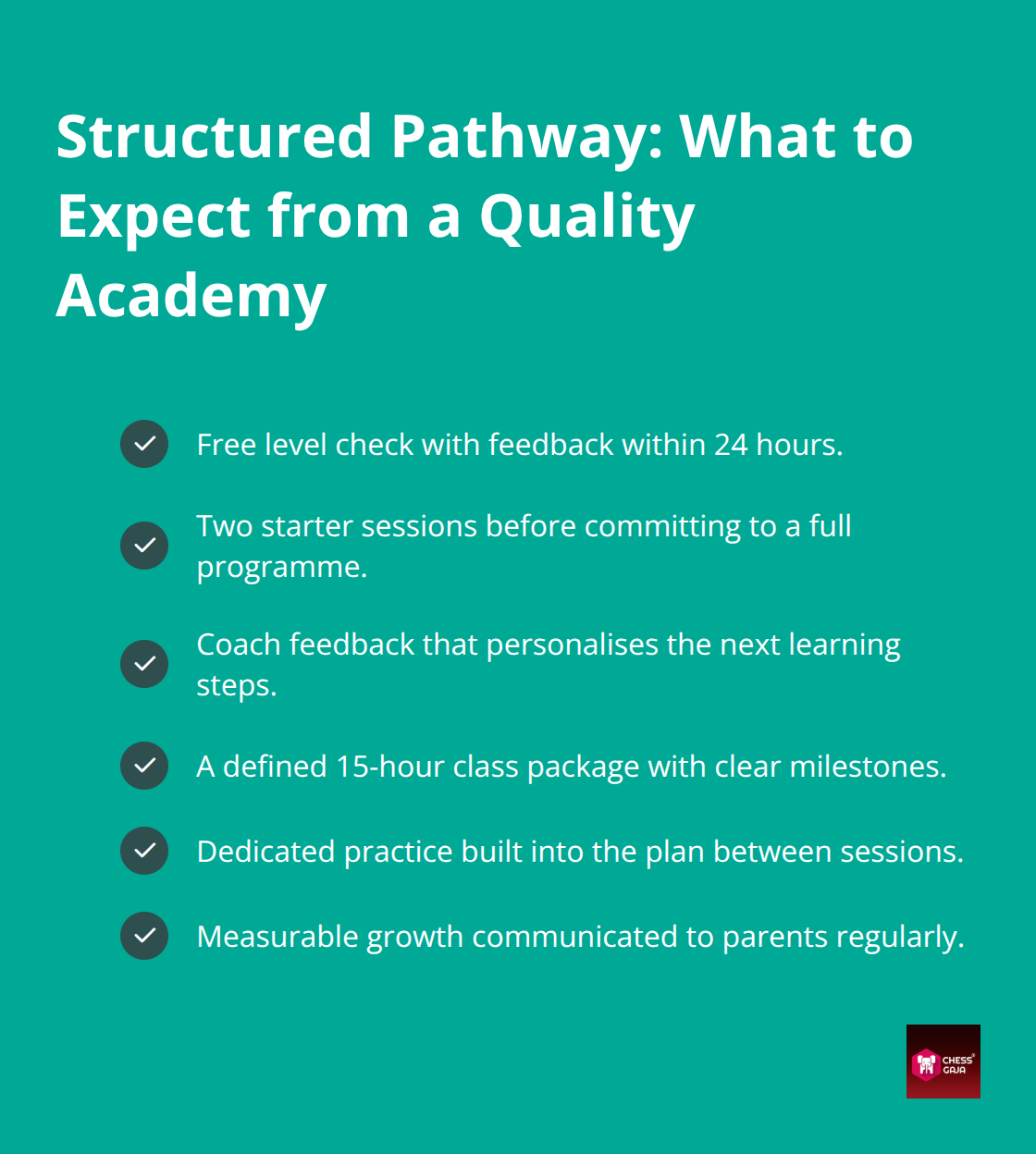
A quality academy provides a clear progression path, not random lessons. Ask whether they offer a free level check or starter class before you commit to a full program. This assessment takes 24 hours to provide feedback. It gives you confidence that the coach has actually assessed your child, not made assumptions. After the starter sessions, the academy should outline exactly what your child will learn over the next 3 to 6 months, with specific milestones. A structured pathway removes guesswork: free level check, two starter sessions, coach feedback, a 15-hour class package, dedicated practice, and measurable growth. You know what to expect and when.
Choose Between Online and In-Person Learning
Online versus in-person matters less than coaching quality and consistency. Online coaching works excellently if the program uses live interaction, active participation, and immediate feedback. Avoid pre-recorded videos. Recording classes helps your child review sessions later. This accelerates learning because it reinforces patterns. Look for academies that provide AI-powered summaries, quizzes, and revision notes after each session. These tools reduce the time needed to retain what was taught.
Class size matters significantly. A group capped at 12 students allows the coach to answer individual questions and adjust pace for different learners. Larger groups force the coach to teach to the middle, leaving advanced students bored and struggling students lost.
Access to Tournament Experience
Evaluate the academy’s tournament access carefully. A student preparing for the 2025 National U11 Championship in Singapore benefited from structured practice combined with academy tournaments that simulated competitive conditions. This combination of training and low-stakes tournament play built the confidence and calculation skills needed for placement in top rankings. Therefore, ask whether the academy offers tournaments, how frequently, and whether participation is optional or expected.
The right coach and program structure set your child up for consistent progress. The next step is understanding how to support that progress at home through structured practice and the right tools.
How to Build a Practice Routine That Actually Works
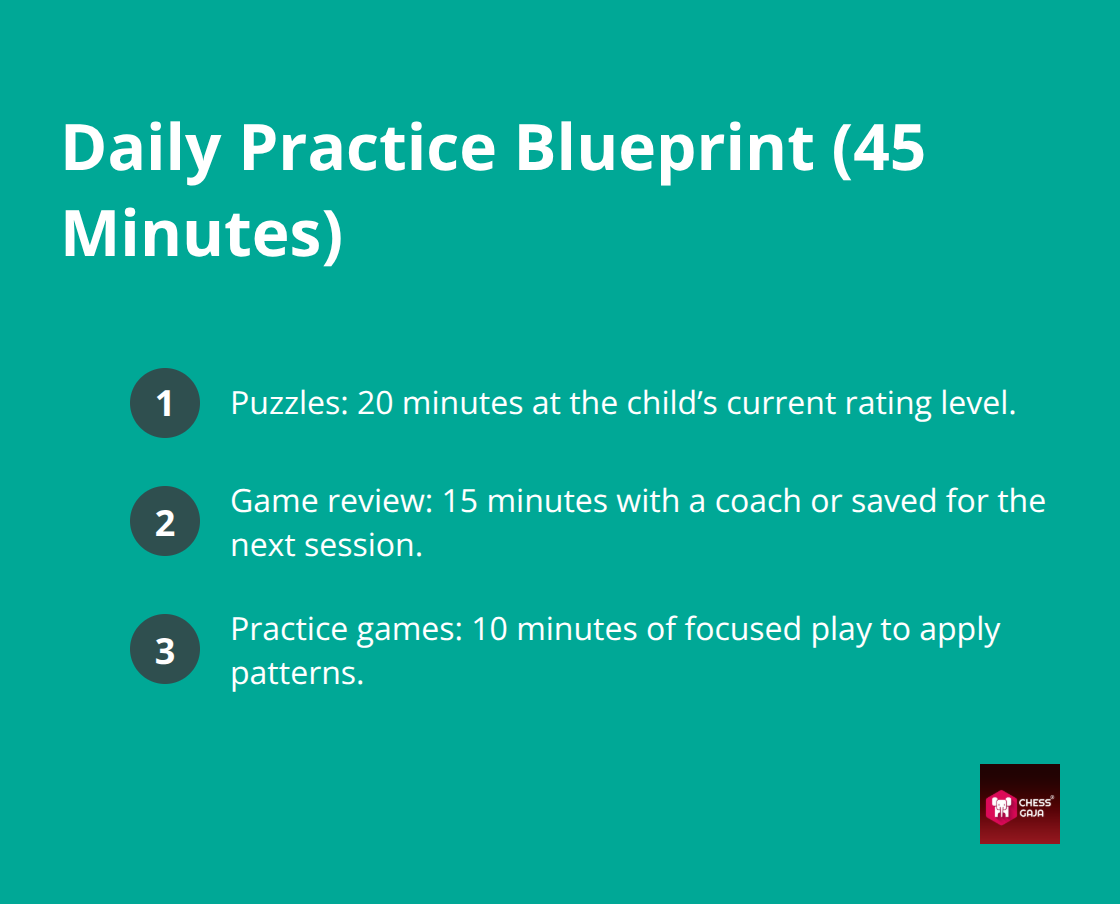
Home practice determines whether your child’s coaching translates into real improvement or stalls. A student in the UAE rose 400 rating points in one year. Her parents structured 45 minutes of daily practice around three specific components: puzzle solving for 20 minutes, game review for 15 minutes, and playing practice games for 10 minutes. Without that routine, the weekly coaching session would have faded from memory by the next week. The structure matters more than the total hours.
A child practicing 45 minutes daily with clear focus outpaces a child playing casually for three hours on weekends. Your role as a parent is not to teach chess. That is your coach’s job. Instead, enforce consistency. Set a specific time each day when practice happens. Morning before school works for some families; evening after homework works for others. The time matters less than the consistency. Your child’s brain builds chess intuition through repetition, and repetition requires a schedule.
Puzzle Training Builds Pattern Fluency Faster Than Games Alone
Chess puzzles are the fastest way to train your child’s pattern recognition in chess. A puzzle is a position where finding the right move solves the problem. This is usually a checkmate, winning material, or a decisive advantage. Sometimes the puzzle requires a forced sequence of moves. Your child should solve puzzles at their current rating level. Avoid harder puzzles that cause frustration. If your child is rated 800, puzzles should be rated 700 to 900. This keeps the difficulty challenging but achievable.
Many parents make the mistake of giving their children puzzle books that are too hard, which builds frustration rather than fluency. Platforms like Lichess offer free puzzles rated to your child’s strength, and the feedback is instant. Your child solves a puzzle, gets immediate confirmation of correctness, and moves to the next one. Over weeks, patterns that seemed confusing become automatic. A Singapore student preparing for the National U11 Championship solved 25 puzzles daily for four months. When she faced tournament positions, her tactical reflexes were sharp because she had trained thousands of similar patterns.
Game Review Separates Serious Players From Casual Ones
Every game your child plays should be reviewed with their coach or, if that is not possible, saved for the coach to review in the next session. This is non-negotiable. A loss without analysis is a wasted learning opportunity. A win without analysis misses the chance to identify whether your child won through good play or luck. During review, the coach points out the critical moment where your child’s analysis broke down. Was it an opening move that left your child in a worse position? A tactical miss in the middlegame? A calculation error in the endgame? The specificity matters. Your child should know exactly what to study next.
A student from Dubai improved from struggling with endgames to winning endgame positions within three months. Every loss in an endgame was reviewed to identify the exact principle your child had missed. Without that review, your child would have played the same endgame mistake repeatedly. Every class recorded for later review helps your child reinforce explanations, and AI-powered summaries highlight exactly what was taught. This means your child has a reference point for what to practice between sessions.
Balancing Chess With Everything Else Your Child Does
Chess should enhance your child’s life, not dominate it. The key is treating chess practice like any other structured activity like homework, sports, or music lessons. Your child should have one primary activity they excel at. Chess can be that activity. But it should not eliminate time for friends, physical activity, or creative pursuits.
A child who practices chess 45 minutes daily, attends one group class per week, and competes in one academy tournament per month has a robust chess routine without overcommitment. That schedule leaves room for school, sports, and family time.
Families with the most sustainable progress treat chess as a long-term path, not a sprint. One student trained consistently for six months before a tournament. Another crammed intensively for two months before the same event. The first performed better. Consistency builds skill. Intensity builds burnout. Set realistic expectations with your child. The goal in year one is simple: build a solid foundation and develop genuine interest in the game. The goal is not to become a national champion at age ten. That mindset prevents pressure-induced anxiety and keeps chess enjoyable. When your child feels pressure to win rather than curiosity to improve, performance drops and motivation collapses.
Final Thoughts
Your child’s chess development follows a predictable arc. This happens when the right structure guides the process. A student in Dubai moved from struggling with tactics to spotting three-move combinations within eight weeks. The Singapore student who competed in the 2025 National U11 Championship trained for six months before tournament play. Both produced measurable results. Structured academy programs speed up this timeline compared to casual play. Continuity of coaching, guided practice with immediate feedback, and tournament experience in a supportive setting boost your child’s growth month after month.
Three factors separate rapid progress from stalled development. First, your coach stays consistent. They adjust explanations to match your child’s learning style. Second, practice happens through puzzles and game review, not random play. Finally, your child competes in monthly academy tournaments before external competitions. When your child works with the same coach over months, that coach spots weak spots before they become habits. This builds genuine competitive confidence. Also, recorded lessons with AI-powered summaries and revision tools help your child retain patterns faster. As a result, your child knows exactly what to study next.
At Chess Gaja, we serve 5,000+ students across 40+ countries, including the UAE, USA, and Singapore, with 100% FIDE-rated coaches who have trained national champions. This parents guide to child chess works because it combines your role at home with expert coaching that personalizes each student’s study plan. Book a Starter Class with us today to identify your child’s current level, learning style, and exact next steps through a two-session assessment with detailed coach feedback within 24 hours.