

This USCF rated prep plan for adults is built for chess players in the USA, UAE, and Singapore who often feel lost when starting their USCF rated journey. You might wonder where to begin, what rating to expect, or how to prepare for your first tournament.
This roadmap is written by Grandmaster Priyadharshan Kannappan, founder of Chess Gaja, who has guided thousands of adult players through this exact situation using coaching principles applied across 40+ countries. It shows you the concrete steps to build a strong foundation and compete with confidence.
How Your USCF Rating Works in This Prep Plan
The USCF rating system began in 1950. It uses the Elo rating formula. It turns your chess performance into a number that predicts results against other players. When you play a rated game, the system compares your result to your expected score. Score better than expected, and your rating rises. Score worse, and it falls. After your first tournament, you get a provisional rating. This rating swings a lot during your first 25 games as the system learns your true strength.
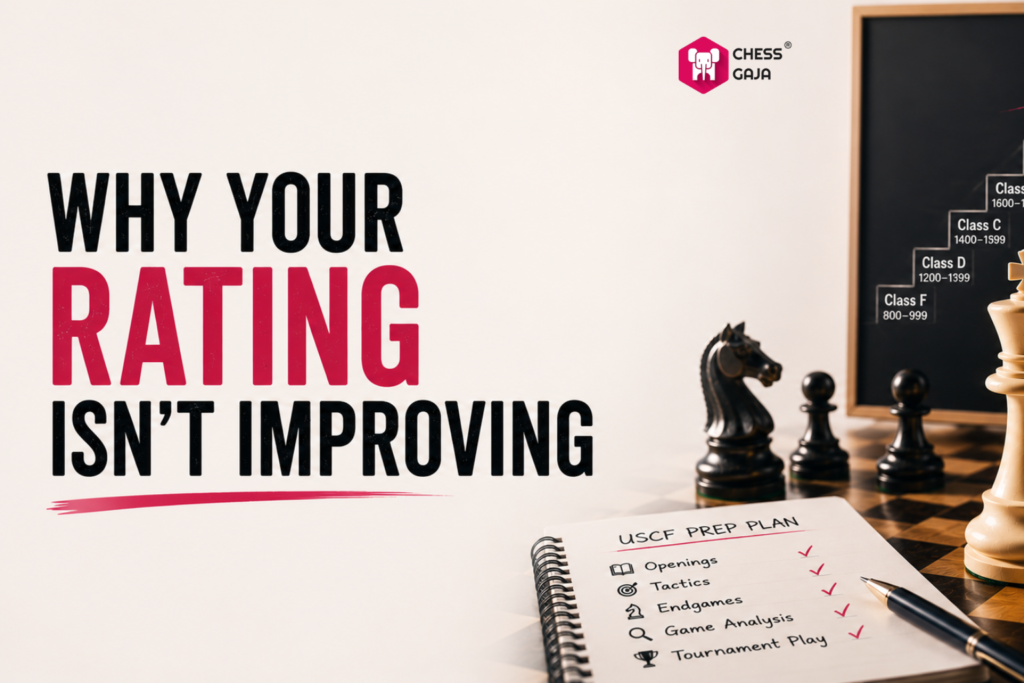
The rating brackets range from Class F (800–999) up to Senior Master (2400+). Intermediate classes include Class E (1000-1199), Class D (1200-1399), Class C (1400-1599), Class B (1600-1799), Class A (1800-1999), Expert (2000-2199), and National Master (2200-2399). Most adult beginners start somewhere between 800 and 1100 USCF. This varies widely depending on your chess background and playing style.
Your Starting Rating Depends on Where You Come From
If you play on Chess.com or Lichess, expect a lower USCF rating. Chess.com blitz and rapid ratings often run 100–150 points higher than USCF classical ratings, though this varies by player. OTB chess also demands different skills: you manage a physical clock, face real opponents across a table, and cannot rely on the split-second instincts that online play rewards.
If your Chess.com blitz rating is 1200, expect your first USCF rating between 1050 and 1100. This gap frustrates many online players. But it reflects a different game with different pressures, not weakness. Your first USCF rating is your performance rating, based on how you actually scored in your opening games. Once you play 25 rated games, your provisional status ends and your rating stabilizes. It still adjusts as you play more tournaments.
What Adults Actually Misunderstand About Their Own Progress
The biggest misconception is that your rating should climb steadily upward. Adult players often expect linear improvement. But the reality is messier. Your first 25 games will show dramatic swings. You might jump 150 points after a good tournament, then drop 80 points in your next event. This is not failure; it is the system calibrating. Many adults see these wild swings as proof they are not improving. In fact, the volatility just means the system has not locked in on your true strength yet.
Another false belief is that you need natural talent to reach Class A or Expert level. This is wrong. Instead, rating progress at adult levels depends on consistent tournament play, targeted study of your weaknesses, and learning from losses. For example, an adult who plays 40–50 rated games a year, honestly analyzes losses, and works to eliminate blunders will reach Expert (2000+) within three to five years. Talent matters far less than structure and repetition.
A third misconception is that your online rating should transfer directly to USCF. This leads adults to enter tournaments expecting their Chess.com rating as a starting point. When reality hits and their provisional rating comes in 200 points lower, they quit. The adults who succeed accept the conversion gap. They play their first10–15 tournaments with curiosity rather than ego, and use their actual USCF results to guide their training.
The Real Path Forward for Adult Players
Your provisional period is not a weakness-it is an opportunity. These first 25 games teach you how OTB chess actually feels and expose your real strengths and weaknesses. Many adults rush through this phase, frustrated by the rating swings, but the players who thrive treat it as a learning laboratory.
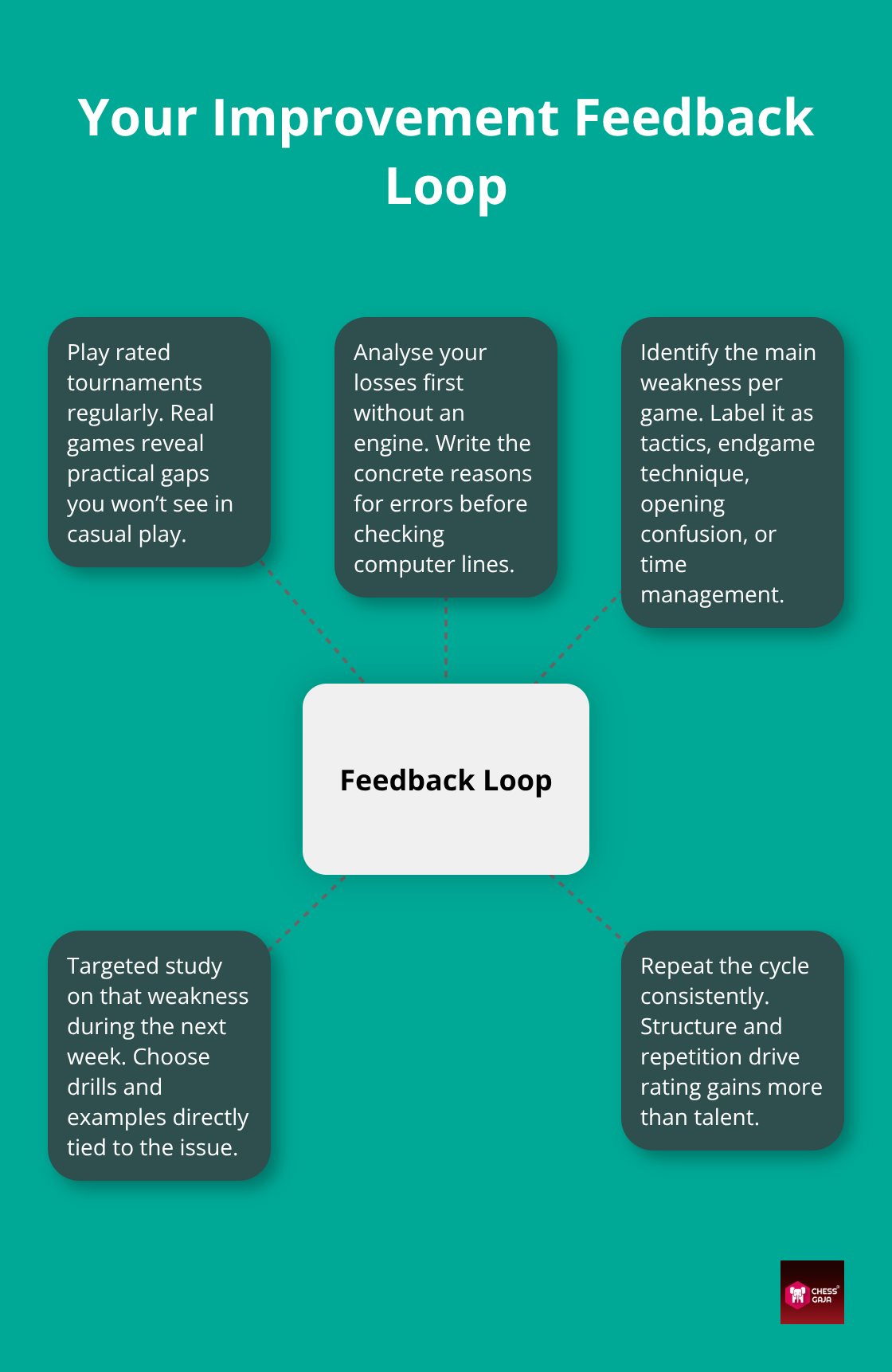
Each tournament result tells you something concrete about where to focus your study. If you lose consistently to tactical attacks, your training shifts toward puzzle work. Struggling in endgames points you toward endgame fundamentals, while time-management mistakes call for clock practice in training games. This feedback loop-play, analyze, identify weakness, study, repeat-is what separates adults who stall at 1400 from those who reach 2000+. The structure matters more than the talent.
How to Train: The Core Skills for Your USCF Rated Prep Plan
Your USCF rating climbs only when you play better chess in tournaments. Training without direction wastes months. Adults who structure their preparation around three concrete areas—openings, tactics, and endgames—progress far more efficiently than those who study randomly. The difference is not talent; it is strategy.
Opening Preparation: Less Theory, More Recognition
Your opening preparation should consume only a small fraction of your study time, yet many adults spend the vast majority of their time studying deep theory they will never use. Instead, focus on learning 8–12 solid opening moves in 2–3 lines per color. If you play 1.e4 as White, choose one main line like the Italian Game or Ruy Lopez, learn the first 12–15 moves against Black’s main responses, and stop.
Do not memorize move 20. Tournament opponents below Expert level rarely punish you for shallow opening knowledge; they lose to tactical oversights and poor middlegame planning. Once you reach Class A (1800+), deepen your openings incrementally. Until then, play your openings consistently enough to recognize positions, then shift your mental energy to calculation and pattern recognition. This is where rating gains accelerate.
Tactical Pattern Recognition: The Fastest Path to Rating Gains for Your USCF Rated Prep Plan
Tactical pattern recognition is essential for tournament success. Solve puzzles for 20–30 minutes daily, but solve them correctly, not quickly. Set a timer for three minutes per puzzle, write down your answer before checking, and analyze why you missed it if you did. Use puzzle databases like Chess.com’s Puzzles feature or Lichess Puzzles at your rating level (not Puzzle Rush or Puzzle Storm, which reward speed and guessing over calculation); solving puzzles two levels below your rating teaches you nothing.
. Solve at your actual playing strength or slightly above. Many adults treat puzzles as a warmup; instead, treat them as your primary tactical training. An adult who solves 500 rated puzzles per month at their level will eliminate blunders that cost 50–100 rating points annually.
Endgame Fundamentals: Converting Advantages Into Wins in Your USCF Rated Prep Plan
Your endgame knowledge determines whether you convert advantages into wins. Most adults below Expert level lose drawn endgames or draw winning ones because they never studied basic positions. Spend 15–20 minutes three times per week on endgame fundamentals. Learn King and Pawn versus King first, then Rook and Pawn versus Rook, then basic Queen endgames.
Your Weekly Training Schedule: The Core of Any USCF Rated Prep Plan
Structure your weekly training around these three pillars: Monday and Wednesday, 30 minutes of opening review (reviewing your own games and learning your chosen lines); Tuesday, Thursday, and Saturday, 25 minutes of tactical puzzles at your rating; and Sunday, 20 minutes of endgame study. This totals roughly 2.5 hours per week-realistic for working adults-and addresses the three areas that account for the majority of rating movement.
Track which endgames cost you games, which tactical patterns trip you up, and which opening positions confuse you. After each tournament, annotate your losses and identify the phase where you lost: opening (rare), middlegame tactics (common), endgame technique (very common), or time management (extremely common).
Use this feedback to adjust your training focus. If you lost two games to tactics you should have seen, increase puzzle time. If you drew a winning endgame, study that endgame type next week. This feedback loop transforms your training from generic to targeted, and targeted training moves ratings faster than any other factor. Once you understand how to train, the next step is preparing yourself mentally and logistically for your first tournament experience.
Your First Tournament: What Actually Matters in Your USCF Rated Prep Plan
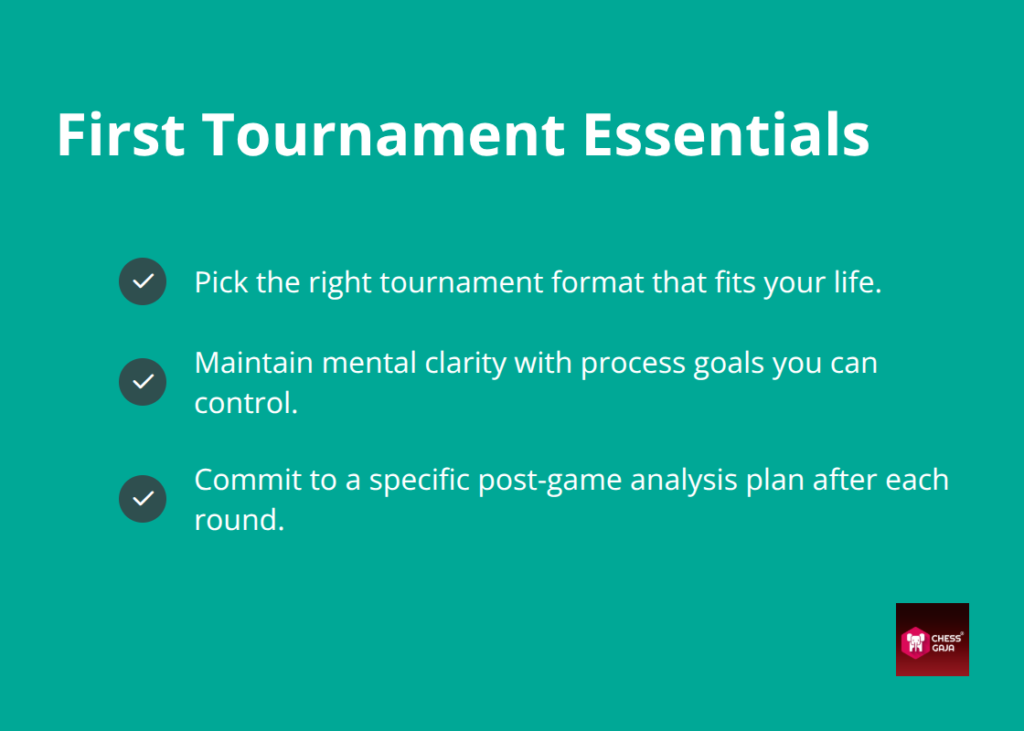
This USCF rated prep plan treats your first tournament as a critical milestone. Your first USCF tournament feels intimidating, but the reality is simpler than you think. Most adult players overthink the experience and focus on the wrong details. You do not need perfect opening preparation or flawless technique. You need three concrete things: the right tournament format, mental clarity about what you are trying to accomplish, and a specific plan for analyzing your games afterward. Adults who nail these three elements gain 50–100 rating points in their first tournament cycle, while those who wing it often stall or quit.
Pick the Tournament Format for This USCF Rated Prep Plan
This section of the USCF rated prep plan covers tournament format selection.
Not all USCF tournaments are the same. Your first tournament should be a weekend Swiss tournament in a standard time control, ideally 40/90 with a 30-second increment (40/90; +30) or G/60 (Game in 60 minutes). Do not start with blitz or quick chess tournaments. Quick chess (under USCF rules, 10 to 29 minutes per player) reduces enough time pressure to expose calculation errors, but it still favors players with prior OTB experience.
Standard time control gives you the breathing room to think, make decent moves, and actually learn something from your games. A typical weekend Swiss tournament runs Friday evening through Sunday, with 4–5 rounds spread across the weekend. This format is ideal because you play multiple opponents at your level, gain meaningful rating points from each game, and have time between rounds to recover mentally.
Avoid round-robin tournaments for your first event; they are smaller, fewer games, and often have unusual time controls. Find a local tournament through the USCF website by searching your state and city. Most urban areas in the USA, UAE, and Singapore have at least one tournament per month.
Register for the section that matches your provisional rating estimate. If you have no USCF rating yet, register for the Unrated section or the lowest available section. Do not try to game the system by entering a lower section to win easily; that is sandbagging, it violates USCF rules, and organizers catch and penalize it. Enter the section where you honestly belong, play your games, and accept whatever rating you receive.
Before the Tournament: Mental Clarity Beats Preparation in Your USCF Rated Prep Plan
The week before your tournament, stop learning new openings. Your goal is not to play perfectly; your goal is to gather data about your actual strength and identify what to study next. Adults who treat their first tournament as a pass-or-fail exam stress themselves into blunders. Adults who treat it as a diagnostic tool play better chess.
On the morning of your first game, write down three realistic goals: play three games without losing on time, play three games where you calculate the main tactical variation before moving, and play three games where you analyze your own loss immediately after, before checking any engine. These are achievable, measurable, and focused on your behavior, not your results. You cannot control whether you win; you can control whether you calculate before moving.
During the tournament, eat something substantial before each round, not sugary snacks. Chess demands mental and physical stamina similar to physical exercise the same mental and physical preparation. Eat a sandwich, fruit, and water 90 minutes before each game. Arrive 15 minutes early, set up your board, and sit quietly for five minutes before your opponent arrives.
Do not chat with other players about how nervous you are; that amplifies anxiety. Skip reviewing your previous game while waiting, since that creates mental carryover. Sit, breathe, and prepare your mind for one game at a time.
After Each Game: The Analysis That Actually Improves Your Rating (USCF Rated Prep Plan)
Immediately after your game ends, write down three moments that stand out: one proud move, one regret, and one confusing position. Do this while the game is fresh, before you talk to anyone or check an engine. This forces you to think critically about your own play before the computer tells you what to think.
That evening, pull up your game in Chess.com or Lichess. Turn off the engine evaluation and replay the game move bymove. Stop at each of your three moments and ask yourself: what was I trying to do, and did it work? Only answer these questions before you turn on the engine.
When the engine shows were wrong, write down the concrete reason:
was it
- tactical blow you missed?
- positional principle you ignored?
- clock management mistake?
This distinction matters. A missed tactic means more puzzles next week. A bad positional decision means studying middlegame principles. A clock-management error means practicing time management in training games. Track these patterns across all your tournament games. After your fourth or fifth tournament game, you will see patterns: maybe you consistently hang pieces in the opening, or you make time trouble mistakes, or you struggle in rook endgames. That pattern tells you exactly what to study. This is the feedback loop that moves ratings. Analyzing your losses this way, every single tournament, builds steady progress toward Expert level over 3–5 years.
Your Next Move in This USCF Rated Prep Plan
Your USCF rated prep plan succeeds when you stop treating rating progress as a distant goal. Start treating it as a system you control. The adults who reach Expert level do not have special talent. Instead, they follow the structure here. They understand how ratings work, and they train with purpose around openings, tactics, and endgames. Every loss gets analyzed to find what to study next. This feedback loop repeats across every tournament. Over time, their rating shows real, sustained improvement.
Register for a USCF membership through the official website, then find a local weekend Swiss tournament in your area. Enter the section that matches your honest playing strength. From there, your provisional rating adjusts quickly based on actual results, and your first 25 games teach you exactly where to focus your training next.
Breaking through to 1800, 2000, and beyond requires playing with intention, analyzing with honesty, and adjusting your training based on concrete feedback from your games. If you want expert guidance on your USCF rated prep plan from day one, book a Paid Starter Class with Chess Gaja for a professional skill evaluation. Your first move toward Expert level starts now. This is what a complete USCF rated prep plan looks like in practice.