
Over six months, a 12-year-old student from Dubai raised her rating by 180 points. Her breakthrough didn’t come from endlessly playing fast games online—it came from solving structured, motif-based puzzle sets every day.
At Chess Gaja, we’ve seen this pattern repeat across thousands of students. Tactical fluency doesn’t come from talent alone. It comes from deliberate, organized practice. This practice trains your brain to spot winning moves faster.
How Tactical Patterns Train Your Brain to Win
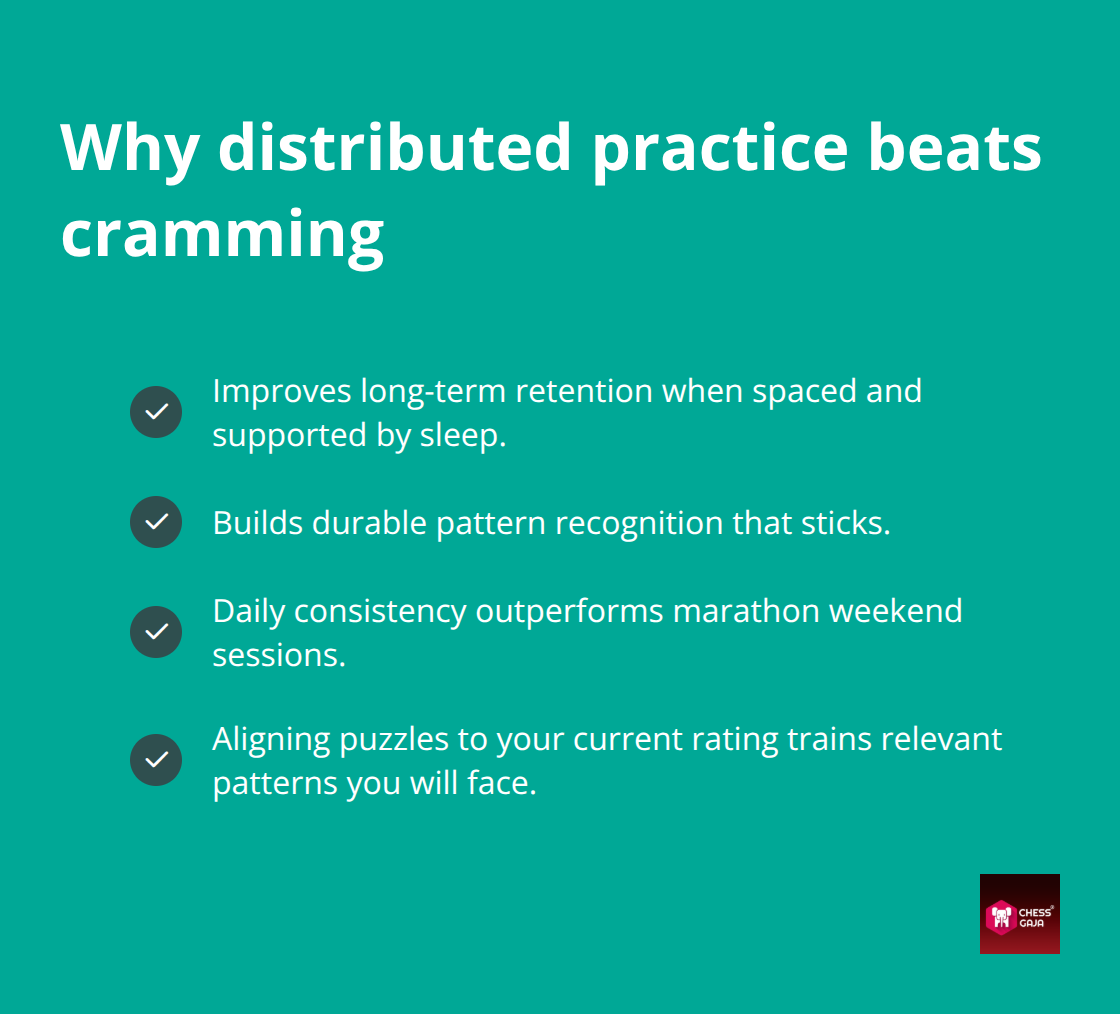
Pattern recognition forms the foundation of tactical strength. Structured puzzle sets train this skill through repeated exposure to common motifs. Solving 10 to 15 puzzles daily helps your brain quickly spot forks, pins, skewers, and discovered attacks. You will spot sharp candidate moves right away. From there, you can calculate specific lines with confidence. The Dubai student did not gain 180 points by calculating faster. Instead, she grew faster at spotting key patterns that matter.
Educational research confirms this approach. In fact, sleep and spaced practice improve memory far more than cramming. Solve a few puzzles each morning, and let your brain process them overnight. As a result, you build long-lasting pattern recognition. Daily habits beat long weekend sessions every time. Therefore, match your puzzle set to your rating so you can train for your next game.
Speed Matters Less Than Accuracy in Real Games
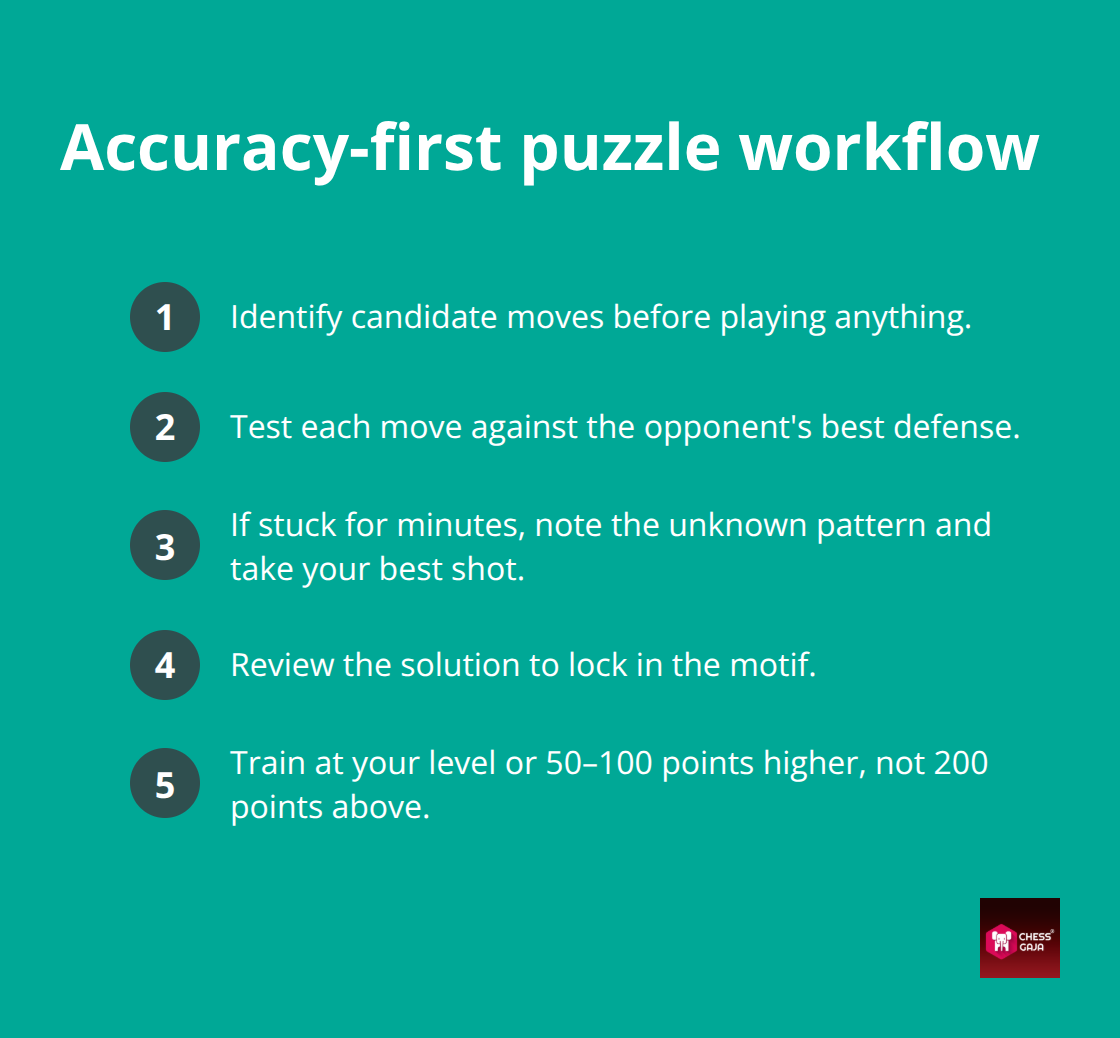
Games reward precision over raw speed, especially for young or new players. Most scholastic games end well before time runs out. Players who rush through puzzles often play the same way in real games. They lose. Start by identifying candidate moves. Prioritize forcing lines like checks, captures, and threats. Then, calculate variations to verify your opponent’s best defense.
Chess.com’s daily puzzle feature and Chessable’s Puzzle Connect both let you filter by difficulty and revisit puzzles you’ve missed. This approach lets you shore up specific weaknesses instead of grinding random positions.
From Puzzle Board to Tournament Table Using Structured Puzzle Sets
Solving puzzle sets directly improves your tournament results. Players who practice 15 to 20 minutes daily gain rating points faster. Playing games without studying tactics leads to slower progress. Puzzles isolate tactical moves without opening errors or time trouble.
Once you learn these tactics, you will spot them quickly in real games. Tournament rules bring extra pressure that normal practice lacks. To prepare, try solving under time limits. A clock set to 30 seconds per puzzle helps match real game stress. Track your accuracy and speed every week to spot weaknesses. If your accuracy falls below 70 percent, stay at that level before advancing.
This data-driven approach prevents the common mistake of jumping to harder puzzles before mastery. The next step involves building a consistent daily routine. This routine should fit your schedule and keep your tactical training on track.
Building Your Daily Structured Puzzle Sets Routine
Most players fail at puzzle training not because they lack talent, but because they lack a system. Solving puzzles randomly whenever you feel like it produces zero results. Thousands of students show the same pattern. Daily structured practice yields fast results. Commit to 15 to 20 minutes of puzzle work each morning. This helps you improve two to three times faster than playing games without analysis. The 12-year-old from Dubai didn’t stumble into a 180-point improvement by accident. She followed a specific routine.
Pick a Time and Protect It
Start by picking a time slot that works every single day. Morning works best because your mind is fresh and your brain processes the patterns overnight while you sleep. Set that time in your calendar and treat it like a tournament game you cannot miss.
A standard tactical position takes 2 to 5 minutes of focused calculation. Solving 3 to 5 positions per session provides roughly 15 minutes of dedicated calculation practice.
Alternatively, Chessable’s Puzzle Connect lets you batch similar positions together. This trains deeper pattern recognition because your brain connects related ideas instead of jumping between unrelated motifs. The key is consistency over intensity. Ten minutes every morning beats 90 minutes once a week.
Match Puzzles to Your Current Strength with Structured Puzzle Sets
Selecting the right difficulty level separates productive training from wasted time. If you’re rated 1200 on Chess.com, a puzzle rated 1400 isn’t productive training. You’ll spend 8 minutes stuck before giving up.
A puzzle rated 1250 to 1350 sits in the sweet spot. It’s hard enough to stretch your thinking, yet easy enough to solve with focused calculation. Chessable and Chess.com both let you filter by rating, so use that filter ruthlessly. Track your solve rate on each difficulty band using these structured puzzle sets. If you’re below 70 percent accuracy on 1350-rated puzzles, stay there for another week instead of climbing. Rating growth compounds when you master each level, not when you skip ahead and fail repeatedly.
Some players make the mistake of solving only their favorite puzzle types (for example, focusing only on knight forks while ignoring back-rank mate threats or defensive tactics). Resist that temptation. Tactical fluency needs broad practice. Work on forks, pins, and skewers. Practice discovered attacks, quiet setup moves, and defense too. Rotate through different motif families each week so your pattern library expands evenly.
Measure Progress With Three Simple Metrics for Structured Puzzle Sets
Track three metrics: solve rate, accuracy, and speed. First, after two weeks at a given difficulty level, your solve rate should climb from 60 percent to 75 percent. Your average time per puzzle should drop from 90 seconds to 60 seconds. That’s progress. When both metrics plateau, move up one difficulty band. Speed matters only as a secondary indicator. Accuracy always comes first. A player who solves 1400-rated puzzles in 2 minutes with 65 percent accuracy is not ready to advance. A player who solves them in 90 seconds with 80 percent accuracy is ready.
Maintain a simple spreadsheet: date, difficulty level, number of puzzles, solve rate, average time. Review it every two weeks. This removes guesswork and emotion from the decision to advance or stay put. Many players feel bored staying at the same level. They rush upward, then crash when difficulty spikes.
Patience here translates directly to tournament results. The data will tell you when you’re ready.
Once you establish this routine and track your progress, the next step involves understanding what happens when puzzles don’t go as planned. You’ll learn how to turn those missed positions into your greatest learning opportunities.
The Three Habits That Derail Puzzle Progress
Most players sabotage their own improvement without realizing it. The first habit is solving puzzles at maximum speed without verification. A player spots a potential knight fork and plays it instantly. In a real game, unverified tactics often fail. Your opponent may hit back with a zwischenzug—an in-between check or threat. This refutes your line and loses material. Puzzles solved without checking train you to spot moves, but not to calculate their consequences. The correct workflow is simple: spot a candidate move, then verify it against your opponent’s toughest defenses before you commit.
Slow Down to Build Accuracy First
Set a minimum time per puzzle-try 60 to 90 seconds even on lower-rated positions. Use Chess.com or Chessable and force yourself to analyze before submitting. If you solve a puzzle in 12 seconds, you’re not training; you’re guessing. Your solve rate will drop when you slow down. That’s exactly what should happen. You’re catching errors before they cost you games. Speed comes later, after accuracy is locked in.
Review Missed Puzzles to Eliminate Blind Spots
Many players ignore puzzles they get wrong. They miss a puzzle, move on, and never fix the mistake. That weak spot remains. Tools like Chessable and Chess.com let you re-try failed puzzles and group similar tactics together.
Set aside 15 minutes each week to review past mistakes. Specifically, focus on why you missed the solution. Did you overlook a quiet move? Did you miss the opponent’s defense? Write down your answers to fix these blind spots fast. In fact, studies show that reviewing missed positions over time leads to far better retention than massed practice.
Connect Puzzle Training to Tournament Conditions
The third habit is treating puzzles as isolated drills. You solve 1400-rated puzzles with ease. Yet, you struggle in actual tournament games. This happens because standard puzzles remove opening errors, time pressure, and stress. The fix is occasional timed solving. Set a chess clock for 30 seconds per puzzle and work through 10 to 15 positions under time. Although your accuracy will plummet initially, that mirrors tournament conditions. As a result, after two weeks of timed sessions, your tournament performance jumps.
Finally, post-game analysis closes the gap. After your next tournament game, set up the position where you made a tactical mistake and solve it as a puzzle. Therefore, this bridges the gap between abstract training and real competition. Link your puzzles directly to tournament games to convert learned patterns into rating points far faster.
Final Thoughts
The Dubai student’s 180-point rating jump was no accident. She solved structured puzzle sets daily. She tracked her stats and linked her practice directly to real games. As a result, tactical fluency translates into tournament wins. Specifically, structured training sharpens your visual patterns and calculation habits. Solve 15 to 20 minutes of puzzles daily at the right level. In fact, this helps your rating grow two to three times faster than playing without analysis.
Moreover, the benefits compound over months and years. Dedicated players maintain their growth over time. Consequently, pattern recognition becomes automatic. Stop searching blindly for tactics. First, spot candidate forks and pins right away. Then, focus on double-checking them. Ultimately, fast calculation under pressure sets top players apart.
Structured puzzle training isolates essential skills. It removes distractions and gives quick feedback on every move. However, tournament games bring opening errors and clock pressure. Puzzles eliminate those obstacles so you can focus entirely on tactics.
Chess Gaja pairs structured practice with top FIDE-rated coaches. We create custom puzzle plans based on your rating and goals.