
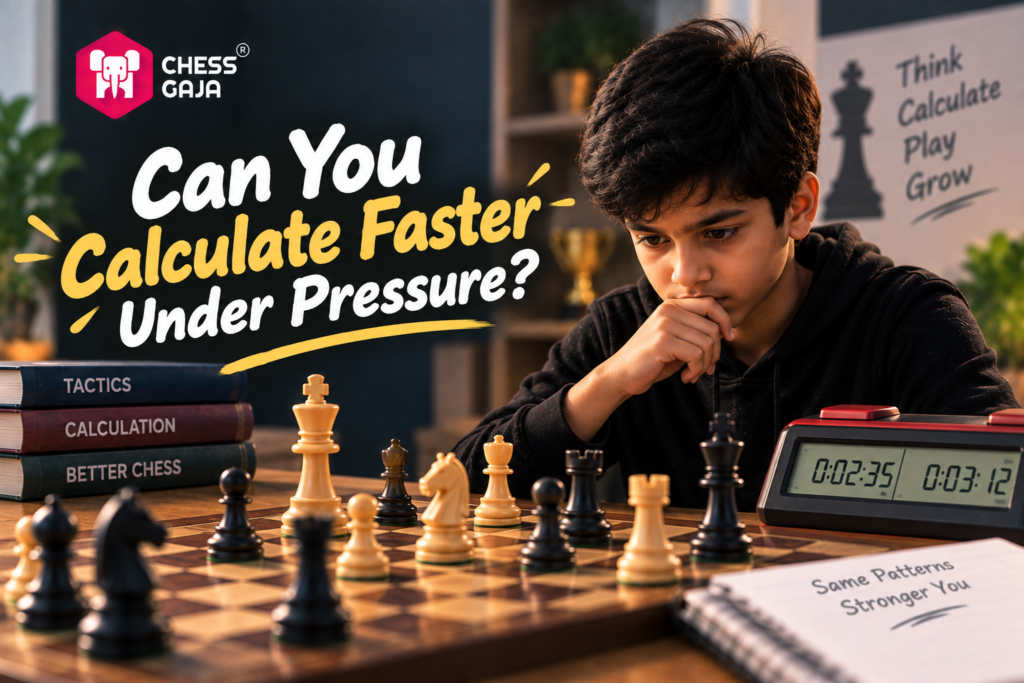
Picture a young chess player from Singapore sitting across from an opponent in a rapid tournament. With just minutes on the clock, they spot a fork three moves ahead-and win the game. That’s the power of tactical calculation drills.
At Chess Gaja, we’ve seen firsthand how players who master calculation under time pressure dominate their competition. The difference between winning and losing comes down to speed and accuracy. You must spot threats and opportunities quickly when the clock is ticking.
Why Speed Decides Tournament Outcomes
The Clock Punishes Hesitation
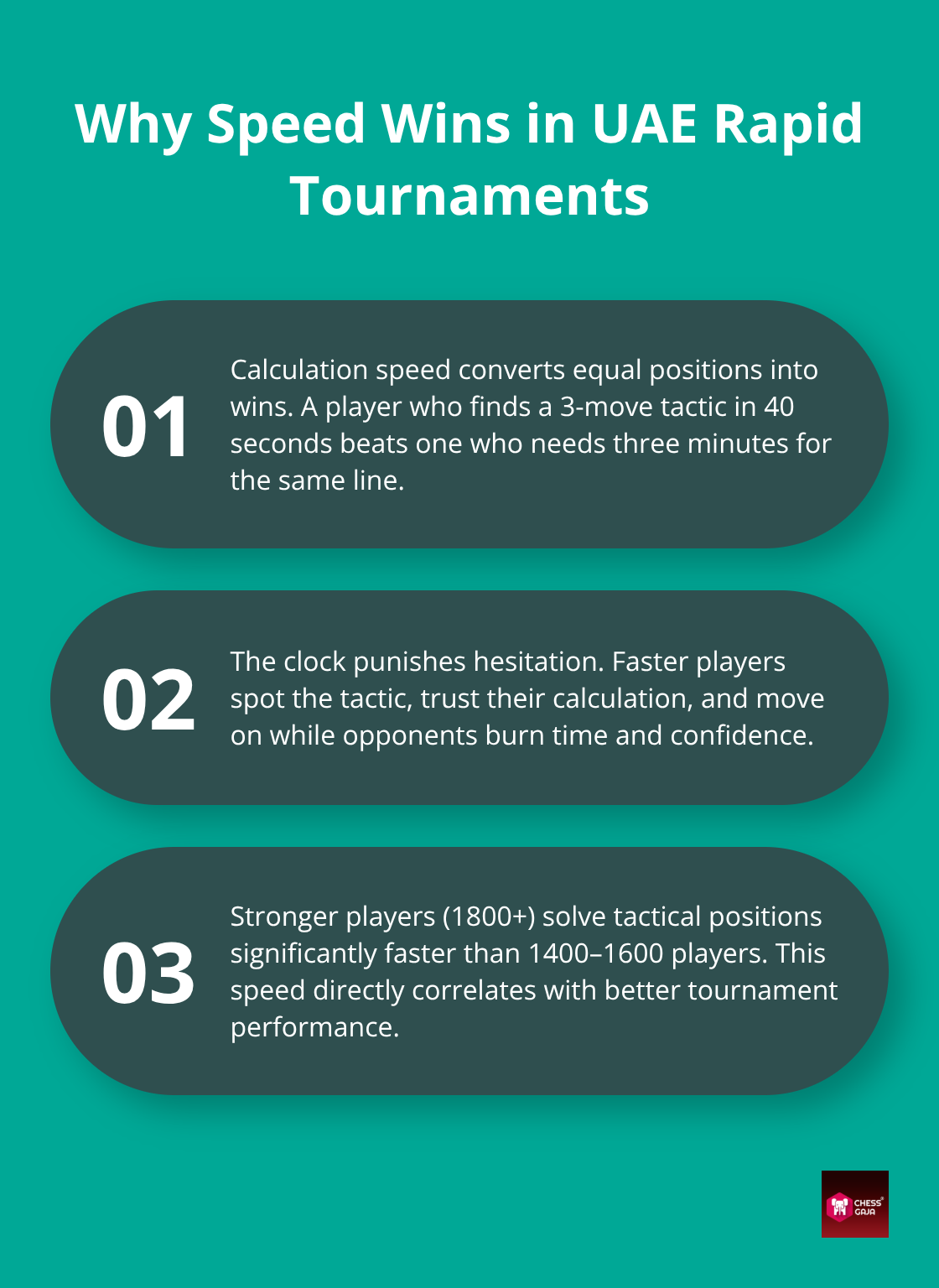
In rapid tournaments across the USA, UAE, and Singapore, the player with faster calculation wins more often than not. This is not opinion-it is measurable fact. A young player from Dubai who calculates three moves ahead in 40 seconds beats an opponent who needs three minutes for the same depth. The clock punishes hesitation.
Research into competitive chess shows that players rated 1800+ solve tactical positions significantly faster than players rated 1400–1600, and this speed directly correlates with tournament performance. The intermediate player sees the winning move eventually. The advanced player sees it in seconds and moves on.
How the Gap Compounds Across Tournaments
This difference compounds across 9 rounds of a tournament. One player gains 200 rating points in a year through superior calculation; another stalls at the same level because calculation speed never improved. The separation between intermediate and advanced players happens in positions where multiple candidate moves exist and time is scarce. An intermediate player might spend two minutes evaluating a fork, a pin, and a defensive resource. An advanced player evaluates all three in 30 seconds because pattern recognition becomes automatic.
Automation Through Structured Drills
This automation comes from tactical calculation drills-the same drills that top chess academies worldwide use to develop young talent. Students who commit to timed puzzle practice show measurable rating gains within 8–12 weeks. A 10-year-old from Singapore who practices 15 minutes daily of timed tactical puzzles typically gains 100–150 rating points in their first three months of structured training. The player who calculates faster under pressure does not just win more games-they advance faster through the rating bands, qualify for stronger tournaments, and build confidence that carries into every match they play.
Now that you understand why speed matters, the next step is learning which tactical patterns you must recognize instantly to capitalize on time-pressure advantages.
Core Tactical Patterns You Must Recognize Instantly
Forks, Pins, and Skewers in Rapid Sequences
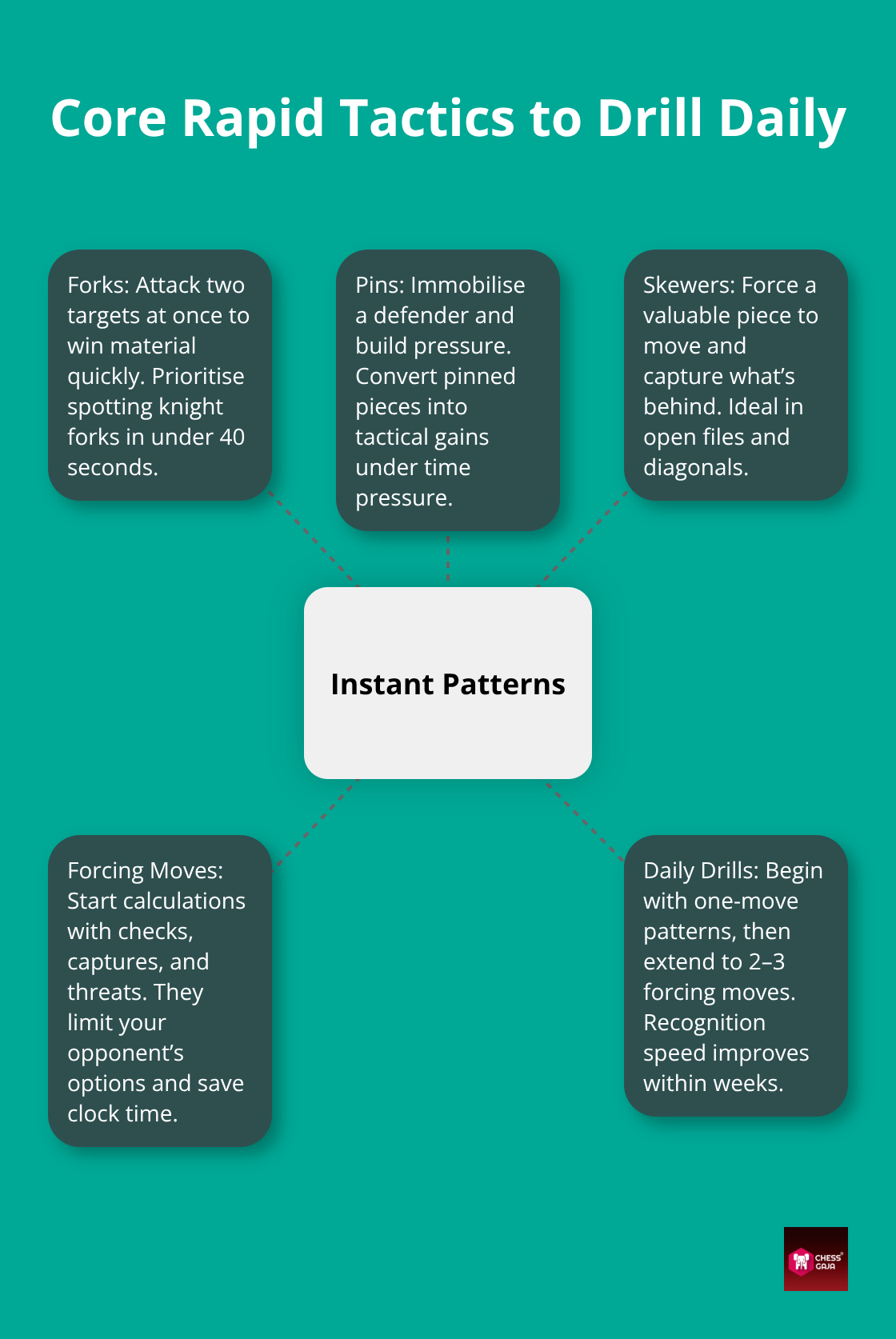
Forks, pins, and skewers dominate rapid tournaments because they force immediate material gain or decisive positional advantage. A fork attacks two pieces at once. A pin immobilizes a piece, while a skewer forces a key piece to move and exposes another target behind it. In timed play, you must spot these patterns in under 40 seconds because hesitation costs you clock time and confidence. The player from the UAE who recognizes a knight fork in three moves wins material before their opponent realizes the threat exists. The intermediate player calculates the same position but takes two minutes, burning precious time and creating psychological pressure.
Players who drill these three patterns daily show faster pattern recognition within weeks. Start with positions where one of these patterns appears on the board in the next move. Then progress to positions where the pattern emerges after two or three forcing moves. A forcing move is a check, a capture, or a threat that your opponent must answer immediately.
When you practice spotting tactics initiated by forcing moves—such as a check setting up a double attack—your brain learns to calculate forced variations effortlessly. This pattern linkage is what separates fast calculation from slow hesitation.
Sacrifices That Open Lines and Expose the King
Sacrifices that expose the king demand a different calculation approach because you must evaluate compensation beyond material count. A sacrifice removes a defender, opens a line, or weakens the king’s position in exchange for an attack. The student from Singapore who calculates a rook sacrifice in the middlegame must verify that the resulting attack delivers checkmate or wins material back within 3–4 moves. If the calculation extends beyond that depth, the sacrifice is too risky under time pressure. You cannot afford to calculate every variation when the clock runs down.
The best players under pressure calculate forcing lines, verify the result is positive, and play. A 15-minute rapid game gives you roughly 20 to 30 seconds per move on average. Spending three minutes on a single move burns a significant portion of your total clock and severely penalizes you later. Train yourself to calculate three forcing moves ahead, verify the position is better for you, and play. This discipline is the difference between winning and losing on time while the board position remains equal.
Defensive Calculations to Spot Counterattacks
Defensive calculations are equally critical because they force you to spot your opponent’s threats before they execute them. A counterattack often neutralizes an attack faster than passive defense. If your opponent launches a kingside assault, you might ignore it and launch a back-rank threat that forces them to defend first. This switch in initiative wins time on the clock and psychological advantage in the game.
The strongest defenders under pressure do not calculate every variation to completion. Instead, they identify forcing moves that create immediate threats (checks, captures, or attacks on undefended pieces), evaluate whether those moves improve their position, and execute. This approach keeps you ahead of the clock while your opponent falls behind. The next step is learning how to structure your daily drills so that these patterns become automatic responses rather than conscious calculations.
Build Your Drill Routine to Match Tournament Conditions
Most players practice puzzles in isolation without connecting the drills to real game time limits. A student from Dubai solves 20 untimed puzzles in a training session and learns pattern recognition, but when they sit down for a rapid tournament with a 25-minute clock, their brain freezes. The patterns exist, but the speed does not. This is why structured calculation drills work in three distinct phases that mirror actual tournament time controls.
Phase One: Untimed Position Evaluation
Start with untimed puzzle sets where you evaluate 5 to 8 positions without a clock. Focus entirely on calculation accuracy rather than rushing to make the first move you see. Most players spot a candidate move and play it instantly. Instead, calculate the full forcing line and ask yourself: what is the exact evaluation after your final move? Does your opponent face a forced material loss, or do they have defensive resources that extend the fight? A 10-year-old from Singapore who practices this evaluation habit gains the ability to calculate consequences rather than just spot tactics. This foundation matters more than speed at this stage.
Phase Two: Timed 3-Minute Drills
Once you consistently evaluate positions correctly in untimed mode, shift to timed 3-minute sets where you solve 5 positions with a 3-minute window total, roughly 36 seconds per puzzle. This tempo matches the average time you have per move in a 15-minute rapid game. Solve accurately, but also note how many puzzles you complete and your overall accuracy. Focus on consistently solving most positions correctly before moving to the next phase.
After two weeks of 3-minute drills, your brain adapts to the faster pace without sacrificing evaluation quality.
Phase Three: Compressed 1-Minute Formats
Move to 1-minute formats where you solve a set of 5 positions in 60 seconds flat—giving you roughly 10 to 12 seconds per puzzle. This compressed format forces you to identify forcing moves (checks, captures, threats) in 3–4 seconds, verify the primary line in 5–6 seconds, and make your decision. This rapid tempo builds instinctual pattern recognition for severe time scrambles. Track your metrics: how many puzzles you solve per session, your accuracy rate, and your average solve time per position. A student who averages 36 seconds per puzzle in 3-minute drills should target 10–12 seconds per puzzle in 1-minute drills. If your accuracy drops noticeably in timed mode, you are moving too fast. Slow down and rebuild accuracy before pushing speed again.
Phase Four: Real-Game Application in Blitz and Rapid Games
The final and most critical phase applies these drills directly to fast-paced competitive play. Play blitz games at 3+2 or 5+3 (5 minutes with a 3-second increment). These fast time controls force quick decisions under pressure while your opponent responds in real time. This differs fundamentally from solving puzzles because you face unpredictable positions, time pressure that accelerates as the game progresses, and psychological pressure from your opponent. After playing a blitz game, analyze three critical positions where you made quick decisions. Did you calculate correctly, or did you miss a tactic your opponent exploited? A student from the USA who plays blitz games and analyzes critical positions will see measurable rating gains because the drills translate directly to match conditions.
Why Structure Matters More Than Volume
The structure matters more than the volume. Playing 50 fast blitz games on auto-pilot without analysis teaches nothing. Playing 5 blitz games with rigorous analysis of critical positions teaches calculation under pressure, the exact skill that wins tournaments. Each phase builds on the previous one, and skipping steps creates gaps in your calculation foundation. A player who jumps straight to 1-minute puzzles without mastering position evaluation in untimed mode will sacrifice accuracy for speed-a trade that costs rating points in real games.
Final Thoughts
The path from intermediate to advanced chess player runs through consistent tactical calculation drills. A student from Singapore who practices 15 minutes daily for eight weeks will see measurable rating gains because pattern recognition becomes automatic, not conscious. Your brain learns to spot forks, pins, and defensive resources in seconds rather than minutes, and this speed compounds across tournaments.
Professional coaching accelerates this development significantly. We at Chess Gaja work with 5,000+ students across 40+ countries, and our FIDE-rated coaches have trained seven national champions. When you receive personalized feedback on your calculation habits, you eliminate gaps that self-study often misses-a coach identifies whether you calculate too slowly because you evaluate too many candidate moves, or whether you calculate too fast and miss defensive resources.
If you are ready to sharpen your calculation under pressure and build the skills that separate intermediate from advanced players, book a Paid Starter Class with Chess Gaja for a professional skill evaluation. Your coach will assess your current calculation speed, identify your tactical blind spots, and design a personalized study plan that accelerates your improvement. The clock rewards speed.