
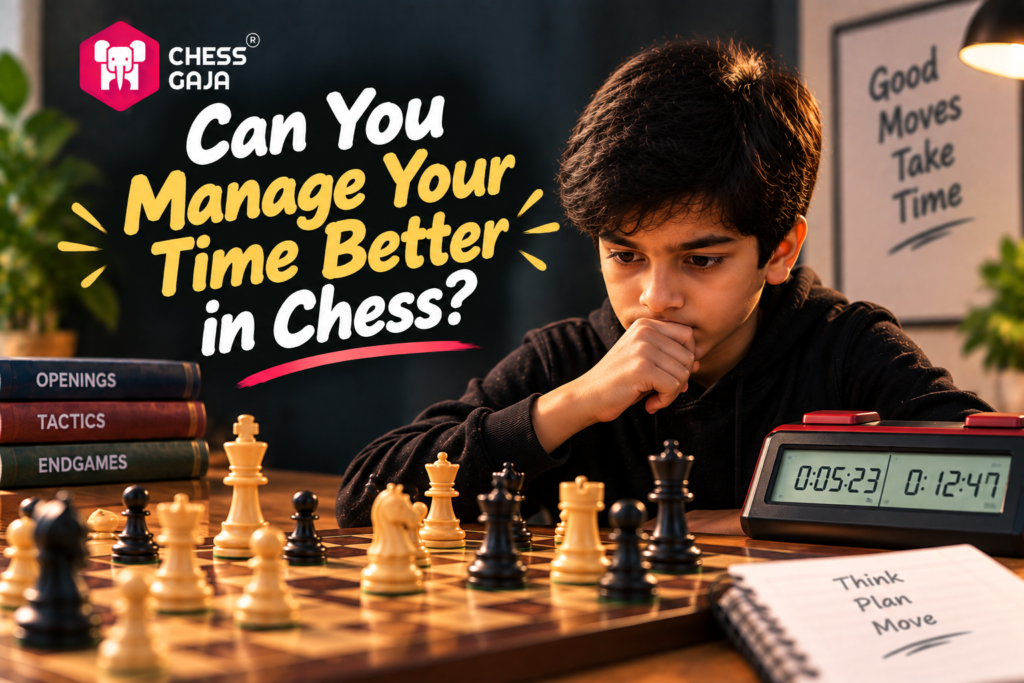
You’ve watched a promising student lose a tournament game not because of weak tactics, but because they ran out of time. At Chess Gaja, we see this pattern constantly-beginners sacrifice winning positions by moving too fast or thinking too long on the wrong moves.
Clock management practice separates tournament winners from the rest. The players who master time allocation win more games, even when their opponents have stronger tactical skills.
How Time Controls Shape Your Moves
Every time control demands a different mindset. 15-minute rapid games force you to recognize patterns instantly, while 90-minute classical games reward deep calculation. Beginners who fail to adjust their thinking pace to match the clock lose games they should win.
In a G/20 rapid event, spending five minutes on move four means you’ll scramble through the endgame with seconds left. In a G/90 classical game, the same five minutes might be perfectly reasonable if the position demands it. The mistake most beginners make is treating every move the same way, regardless of time available or position complexity.
Blitz and rapid formats punish overthinking on routine moves. Tournament data from US Chess events shows that players in quick chess formats flag or lose on time significantly more often than in classical formats, even when their tactical strength is identical. The reason is simple: they haven’t trained their clock awareness. Stronger players in rapid chess finish the opening in about 8–12 minutes, leaving 8–12 minutes for the middlegame and endgame. Beginners, by contrast, often spend 15 minutes thinking through move 10, then face severe time pressure for the next 20 moves.
Allocating Time Across Different Formats
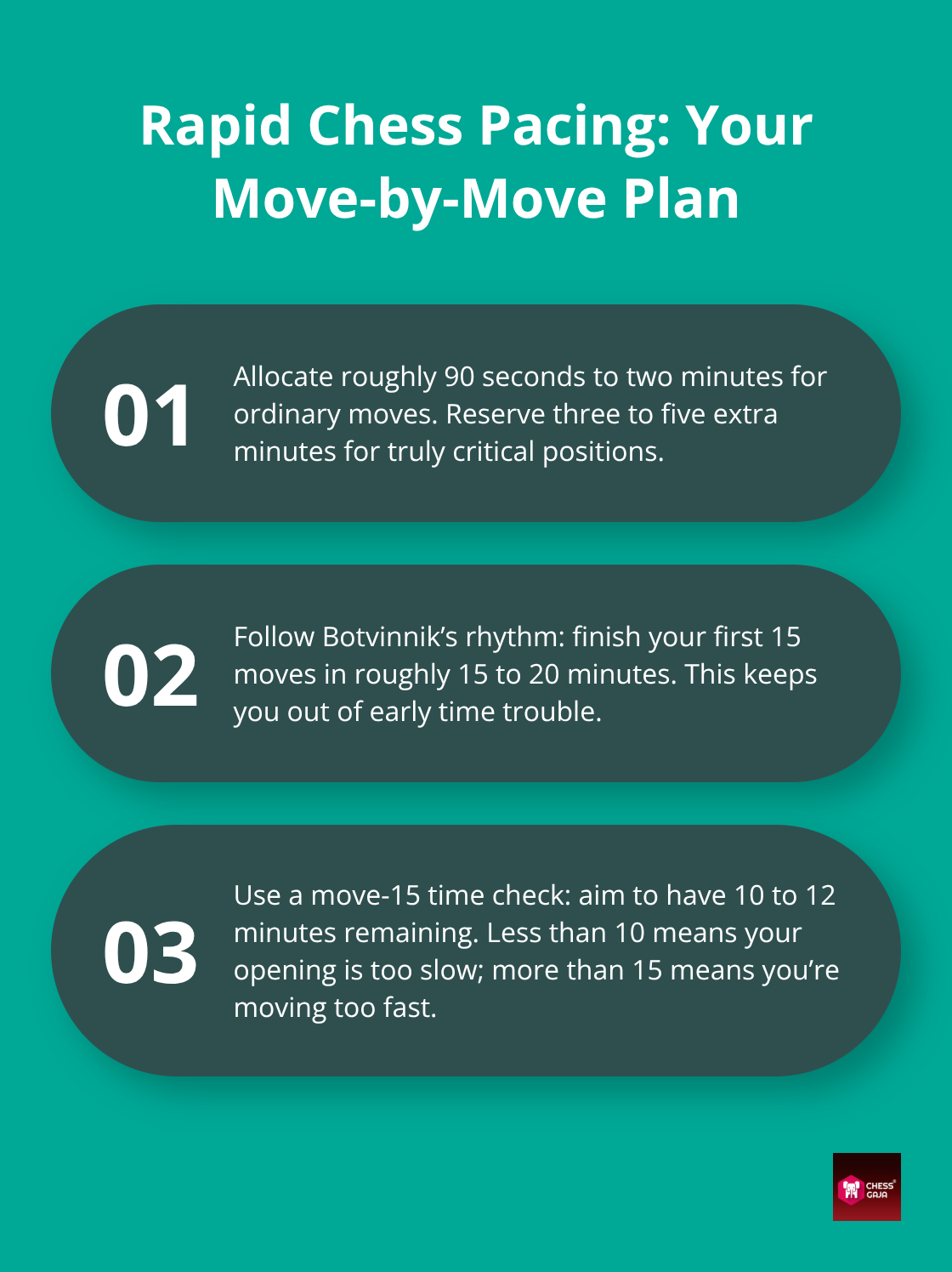
Classical chess allows deep calculation, but introduces a trap: assuming time is endless. Grandmaster Viswanathan Anand demonstrated that the key to managing increment-based time is moving steadily when no danger exists, preserving time for sharp tactical moments. When playing G/25 rapid, spend 15 to 30 seconds on routine moves, while saving 2 to 4 extra minutes for critical decision points. For classical chess, Patriarch of Soviet Chess Mikhail Botvinnik famously advised spending no more than 30 minutes on the first 15 moves to preserve time for the middlegame.
Under standard classical controls (like 90 minutes for 40 moves), this keeps you on tempo, ensuring you save your deep calculation for critical middlegame moments. The faster the format, the more you must rely on pattern recognition rather than deep calculation. In blitz, a candidate move that looks reasonable usually is reasonable. In classical chess, you have the luxury to calculate long forcing lines and evaluate subtle positional details before committing.
Where Beginners Waste Time
The opening is where most young players hemorrhage minutes. They calculate variations that don’t matter because they’re following a line they half-remember rather than understanding why it’s good. A beginner will spend seven minutes deciding between two moves that lead to identical positions, then panic when move 25 arrives with the clock at 8 minutes. The solution is building a solid opening repertoire-three or four reliable lines as White and two or three as Black-and trusting it. This isn’t about memorizing 20 moves; it’s about learning the key ideas in your chosen openings so you can play the first 10-12 moves in under five minutes.
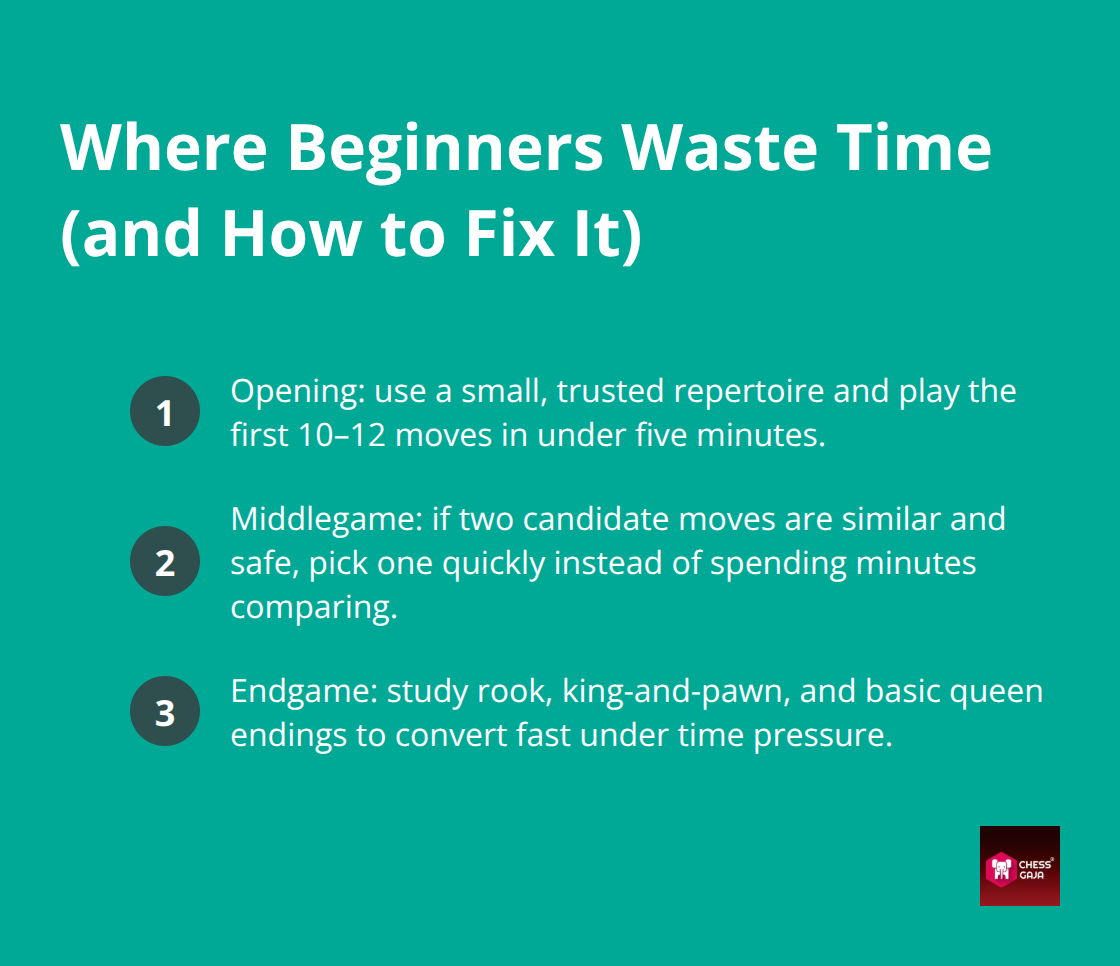
Middlegames introduce a second major time drain: calculating unnecessarily deep. If two candidate moves are similar in value, pick one and make your move. Spending six minutes comparing a move that wins by 0.3 points to one that wins by 0.5 points is a losing trade in rapid chess. Endgames represent the third critical leak. Many beginners reach a winning position with two minutes left, then lose under clock pressure. Studying theoretical endgames—rook endings, king-and-pawn endings, basic queen endings—allows you to convert quickly when time is short.
Building Clock Discipline in Practice
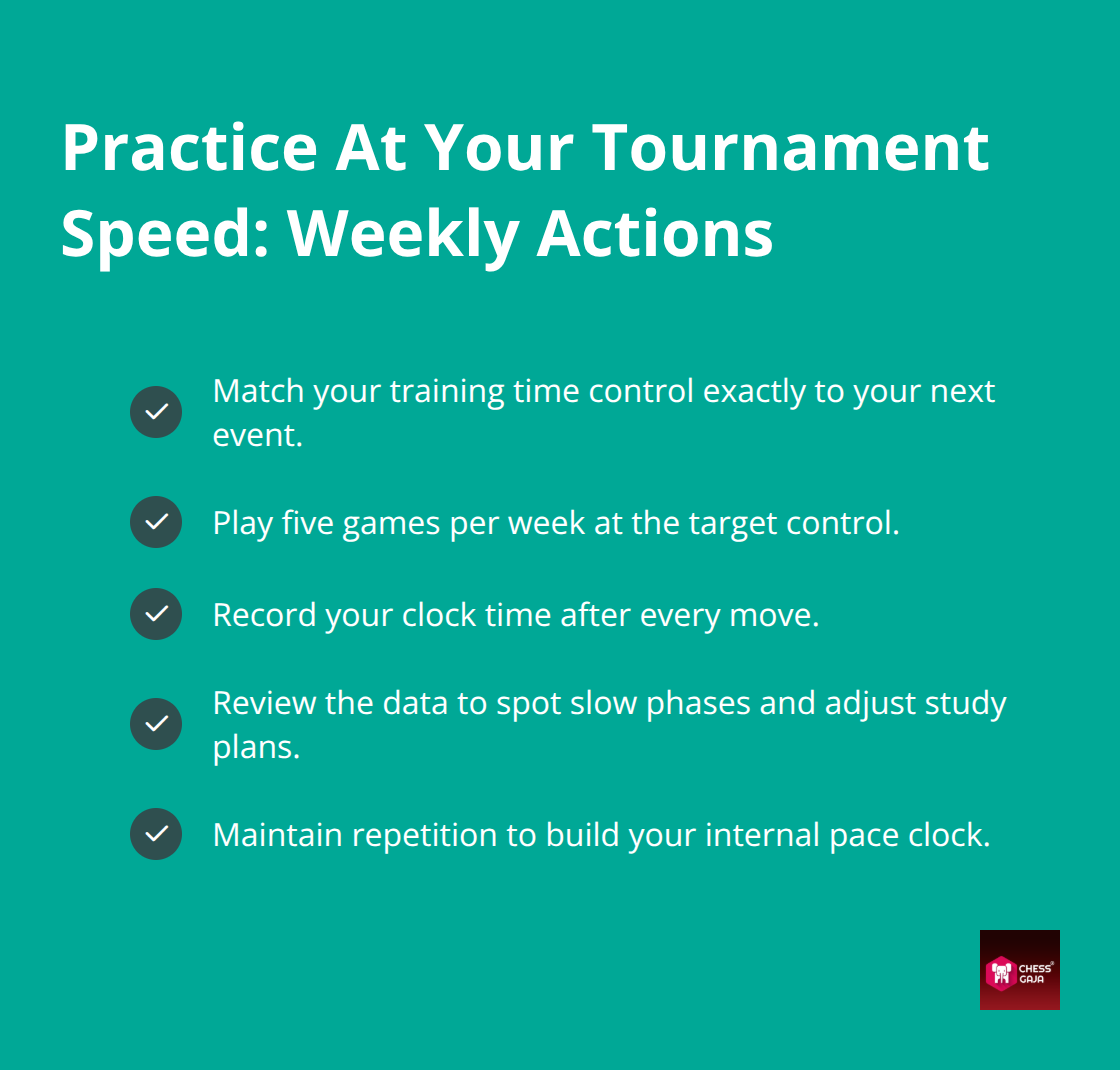
Building clock awareness requires practicing at the exact time control you will face in tournaments. If your next event is G/25, play ten practice games at G/25 rather than G/90. Developing a natural sense of pace requires direct repetition at that specific speed. Log your time per move after each game to analyze your timing patterns: are you lagging in the opening, middlegame, or endgame? Most players discover they spend too much time in one phase and rush through another. Online platforms like Chess.com or Lichess make it easy to review where clock spikes happen so you can adjust your preparation accordingly.
Setting a per-move awareness rule during training serves as a practical drill: cap yourself at 60 to 90 seconds per move in rapid and no more than 5 to 10 seconds per move in blitz over 5–10 test games. This habit builds muscle memory so your mind instinctively knows the rhythm at tournament speed. Glancing at your clock after every move works across all formats—not staring, just a quick check. Performing this fast check prevents the shock of finding three minutes left with ten moves remaining, allowing you to continuously adjust your pace throughout the game.
From Practice Pace to Tournament Performance
Your training rhythm must match your tournament reality. A student preparing for a scholastic quad-format event (three rounds in one session) needs to practice not just individual games but back-to-back rapid rounds with minimal rest between them. This simulates the mental fatigue and time pressure that appear in real competition. The quad format tests whether you can maintain your pacing discipline across multiple games when your energy dips. Students who train this way arrive at tournaments with confidence because they’ve already experienced the exact conditions they’ll face. Your next step is understanding how different tournament formats demand different clock strategies-and how to prepare for each one.
Building Your Training Rhythm
Train at Competition Pace
Matching your training speed to your target tournament format is essential. For instance, if an upcoming event uses G/25, set your practice games strictly to G/25 rather than G/90 or blitz. Developing an accurate internal clock requires direct repetition at competition speed.
Swapping slow time controls for realistic tournament speeds solves pacing anxiety within two weeks. Start with one straightforward drill: complete five games weekly at your target time control while logging your remaining clock time after every move.
Diagnose Your Clock Leaks
Are you spending 90 seconds on move three, then rushing through moves 15–25 with 10 seconds each? Your opening preparation is the culprit. If you are solid until move 30 but collapse in the endgame, incomplete theoretical knowledge is usually to blame. Tracking real numbers from actual games is the only way to make an accurate diagnosis. These metrics highlight precisely where your clock management fails. For example, a student in Dubai preparing for a regional rapid tournament tracked their games and found they spent 4 minutes on moves 8–12, leaving just 8 minutes for the final 20 moves. Restructuring their opening study to play faster eliminated those endgame scrambles within three weeks.
The Three-Step Progression Method
The second layer relies on incremental progression. Start with 10–15 training games one step above your target time control. If aiming for G/25, begin with G/45. This setup gives you mental space to focus on decision quality without the shock of rapid play.
Once five games are complete, drop to your target control. After completing five more games, move one notch lower to G/20 or G/15 to prove your pace works under tighter conditions. The entire process spans three weeks and produces measurable improvement, with each phase reinforcing your internal clock without overwhelming your mind.
Scenario-Based Training for Real Tournaments
Scenario-based training provides the third component. Setting specific constraints across training games builds essential adaptability under clock pressure.
Begin your opening phase by capping time at five minutes maximum across the first 10–12 moves before resuming standard decision pacing. If you are practicing per-move limits, keep your maximum time capped strictly at 90 seconds per move. You can also train mid-game adjustments by allocating 15 minutes to reach move 20 before evaluating position complexity and shifting your tempo.
Adjusting these parameters builds essential mental flexibility. Real tournaments demand constant adjustment—sharp middlegames might require seven or eight minutes on a key move, while quiet endgames allow for 20-second responses. Direct scenario drills teach your mind to instantly recognize when a position demands calculation and when pattern recognition is enough.
After three weeks of this structured progression, your tournament performance shifts noticeably because your clock awareness is no longer theoretical—it’s muscle memory. The next step is understanding how different tournament formats demand different clock strategies, and how to prepare for each one.
How Different Tournament Formats Demand Different Clock Strategies
Blitz Chess: Speed Over Calculation
Blitz chess (G/3 and G/5) tests pattern recognition under extreme pressure, not calculation ability. You cannot think three moves deep in three minutes. Your opening must become automatic, your tactical patterns must surface instantly, and your decision speed must transform into muscle memory. A student in Singapore training for a national blitz qualifier watched their rating jump 120 points in two months after switching from classical training to blitz-specific drills. They stopped trying to calculate and started trusting their pattern knowledge instead.
In blitz, if a move looks reasonable within five seconds, it almost always is. Hesitation is your real enemy. Students who pause for 30 seconds on move eight in a three-minute game have already lost. The practical strategy is to force decisions within 3 to 5 seconds on routine moves. Aim to keep your average time under 5 seconds across the whole game. This breaks the overthinking habit and trains your mind to operate at blitz speed.
Rapid Chess: The Balance Between Speed and Depth
Rapid chess (G/20 and G/25) requires a completely different approach than blitz. You have enough time to calculate, but not enough time to calculate everything. A student in Dubai preparing for a regional rapid tournament should allocate roughly 15 to 30 seconds for ordinary moves, while reserving two to four extra minutes for critical moments like the transition from opening to middlegame or when responding to a sharp tactical threat. The mistake rapid players make is spending five minutes on move three because time is available. This creates a false sense of security and guarantees severe time pressure by move 25.
Rapid events require an opening phase that is far crispier than in classical chess to preserve a working clock bank for the complex middlegame ahead.
For G/25 rapid, aim to reach move 15 with roughly 12 to 15 minutes remaining on your clock. A practical test is to play ten rapid games and track your time at move 15. Finishing move 15 with under 8 minutes left means your opening phase is taking too long. Conversely, holding more than 20 minutes indicates you are moving too fast and likely missing key tactical details. Aiming for 12 to 15 minutes at move 15 gives you a solid foundation for the complex decisions ahead.
Once you hit that rhythm through repeated practice, your rapid results stabilize because you’re no longer scrambling late-game.
Classical Chess: Knowledge Replaces Calculation
Classical chess (such as G/90 with a delay or increment) punishes the opposite mistake: players assume time is abundant and waste it on positions that don’t matter. Grandmaster Viswanathan Anand’s approach to increment-based chess shows the principle clearly. In positions with no immediate tactical danger, move steadily. Doing so preserves your time bank for sharp moments.
In classical tournaments, many beginners spend 15 minutes on move eight, then another 20 minutes on move 22. Suddenly, time pressure hits by move 35 despite a huge starting clock. When preparing for classical events, practice G/90 games at a steady pace. Allocate two to four minutes per move on standard decisions, while reserving 8 to 12 minutes for critical tactical turns.
Converting Endgame Advantages Under Clock Pressure
The endgame is where classical time management shows its true value. Players who master theoretical rook endgames convert winning positions in two to three minutes. They finish smoothly even under severe clock pressure.
Without this foundation, you must calculate every move from scratch. This habit frequently leads to flagging in won positions. To fix this, study ten theoretical endgames first. Then, play five classical games applying that knowledge directly. Ultimately, classical chess tests your ability to recognize when deep calculation is necessary and when endgame knowledge is enough.
Clock Mastery Transforms Your Results
Clock management practice transforms tournament results faster than any other single skill. One student in Singapore who spent three weeks practicing at G/25 pace stopped flagging and consistently finished games with 5 minutes to spare. Similarly, another student in Dubai restructured their opening routine using clock tracking and gained over 100 rating points in two months. These outcomes happen consistently because beginners align their training with tournament reality instead of treating the clock as an afterthought.
Begin by identifying your primary tournament format so you can build discipline at that specific speed. Log your decision timing to pinpoint where minutes leak during games. Adopting this three-step progression trains your internal pace clock naturally without mental fatigue. Within three weeks of deliberate practice, clock awareness becomes fully automatic.
At Chess Gaja, our FIDE-rated coaches work with students across 40+ countries to transform their tournament performance through structured, data-driven training. Booking a Paid Starter Class allows a professional coach to evaluate your clock habits, spot your specific leaks, and create a customized practice plan tailored to your tournament goals and time zone.