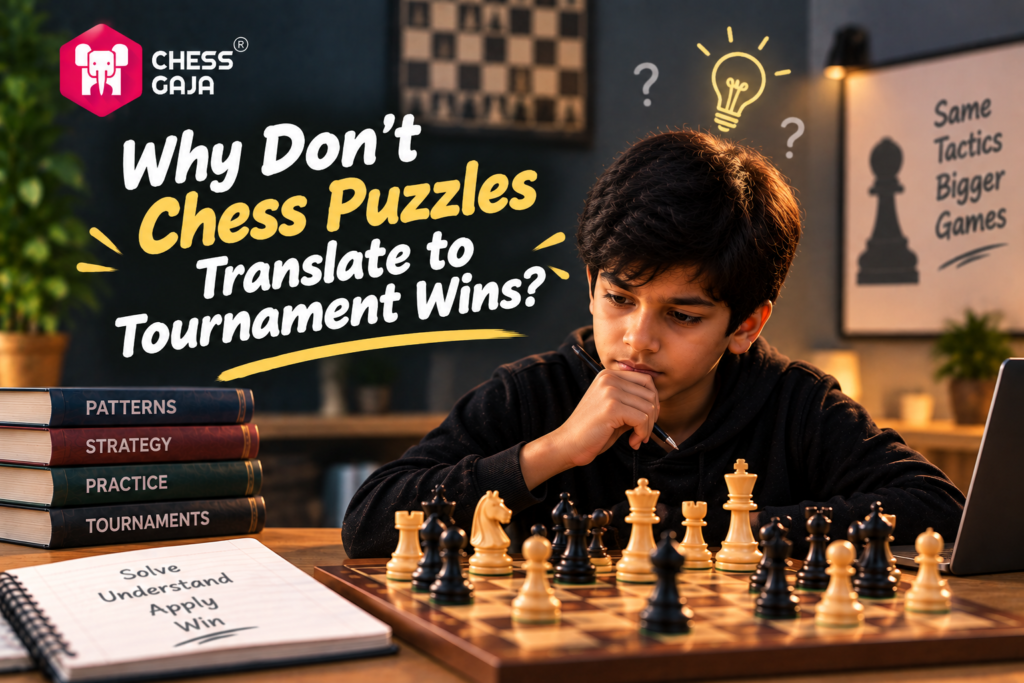
You solve puzzles every day, but your tournament results haven’t improved. That’s because most players train puzzles without any real system.
At Chess Gaja, we’ve seen this pattern hundreds of times. Structured puzzle training is what separates players who memorize tactics from players who actually win games.
Why Puzzle Training Alone Doesn’t Win Games
You solve 50 puzzles a week and your rating climbs steadily online. Then you enter a tournament and miss tactics you’ve seen a hundred times. This is not a weakness in your tactical knowledge—it’s a breakdown in transfer. Most players train puzzles in isolation, treating them as separate from real chess. They solve a position where the tactic is already visible, the board is clean, and there’s no time pressure distorting their thinking.
In a tournament game, you face the opposite. Tactics hide inside complex positions, emerge over multiple moves, and demand accuracy when your heart is racing. Research on deliberate practice shows that isolated skill training without context fails to transfer to performance. A player with a high puzzle rating can still miss a basic fork in a tournament position because they never trained pattern recognition under live play conditions. The gap exists because standard puzzles strip away position assessment, opponent threat evaluation, and time management.
Where Most Players Go Wrong
Players typically follow one of two broken approaches. Some grind puzzles mechanically, solving as many as possible without reviewing mistakes or understanding underlying patterns. Others chase higher puzzle ratings without connecting those ratings to their actual tournament performance. Neither approach builds the skill that matters: recognizing when a tactic exists in a position before you calculate it.
Take two players analyzing the exact same pin motif. A player who has trained thousands of similar positions spots it in three seconds. Another player might take 20 seconds calculating the same line. The first player wins on speed and confidence. The difference is pattern recognition trained through volume and repetition—but volume alone is worthless without structure. You need to solve puzzles that match your tournament position types. Structured puzzle training means you audit your failures, group them by tactical theme, and return to those themes until recognition becomes automatic. This requires intentional design, not random puzzle grinding.
How Structured Training Changes Results
A structured approach to puzzle training rests on three measurable changes. First, focus on positions that reflect your actual games. If you play classical games where long-term compensation matters, spending most of your training time on mate-in-two puzzles wastes energy on patterns that rarely appear in your games. Instead, split your focus primarily between defensive puzzles (positions where you must find the only move to hold) and winning positions with multiple candidate moves (where calculation depth matters), reserving a smaller portion of time for pure tactical wins.
Second, track your performance by tactical theme-forks, skewers, back-rank weakness, discovered attacks-and identify which themes you consistently underperform on. If your back-rank pattern recognition is significantly weaker than your fork recognition, spend twice as much time on back-rank puzzles until both reach a solid standard.
Third, progress your difficulty in small increments tied to your actual rating, not arbitrary jumps. A player rated 1600 who jumps to 2200-rated puzzles trains panic and guessing, not pattern recognition. Climbing from 1600 to 1700 puzzles, then 1750, then 1800 over weeks builds genuine recognition speed.
The Real-World Impact of Structure
Players who implement this structure consistently report tournament rating gains within months because their puzzle work finally translates to the board. The transformation happens not because they solve more puzzles, but because they solve the right puzzles in the right order, with deliberate attention to their specific weaknesses. This is where the next pillar of effective training enters the picture: understanding which position types actually appear in your games and how to master the tactical themes that matter most.
The Three Pillars That Actually Work
Effective puzzle training rests on three measurable, actionable pillars that separate players who improve from those who plateau.
Pillar One: Accuracy Over Speed
The first pillar pairs speed with accuracy-not speed alone. A player solving 100 puzzles per week with low accuracy wastes time on guessing and pattern misfire. Instead, target high accuracy on your current rating level before advancing. This means solving fewer puzzles but with genuine understanding.
Accuracy builds pattern recognition faster than volume. When you solve a puzzle correctly, your brain encodes the position’s underlying structure. When you guess, you encode noise.
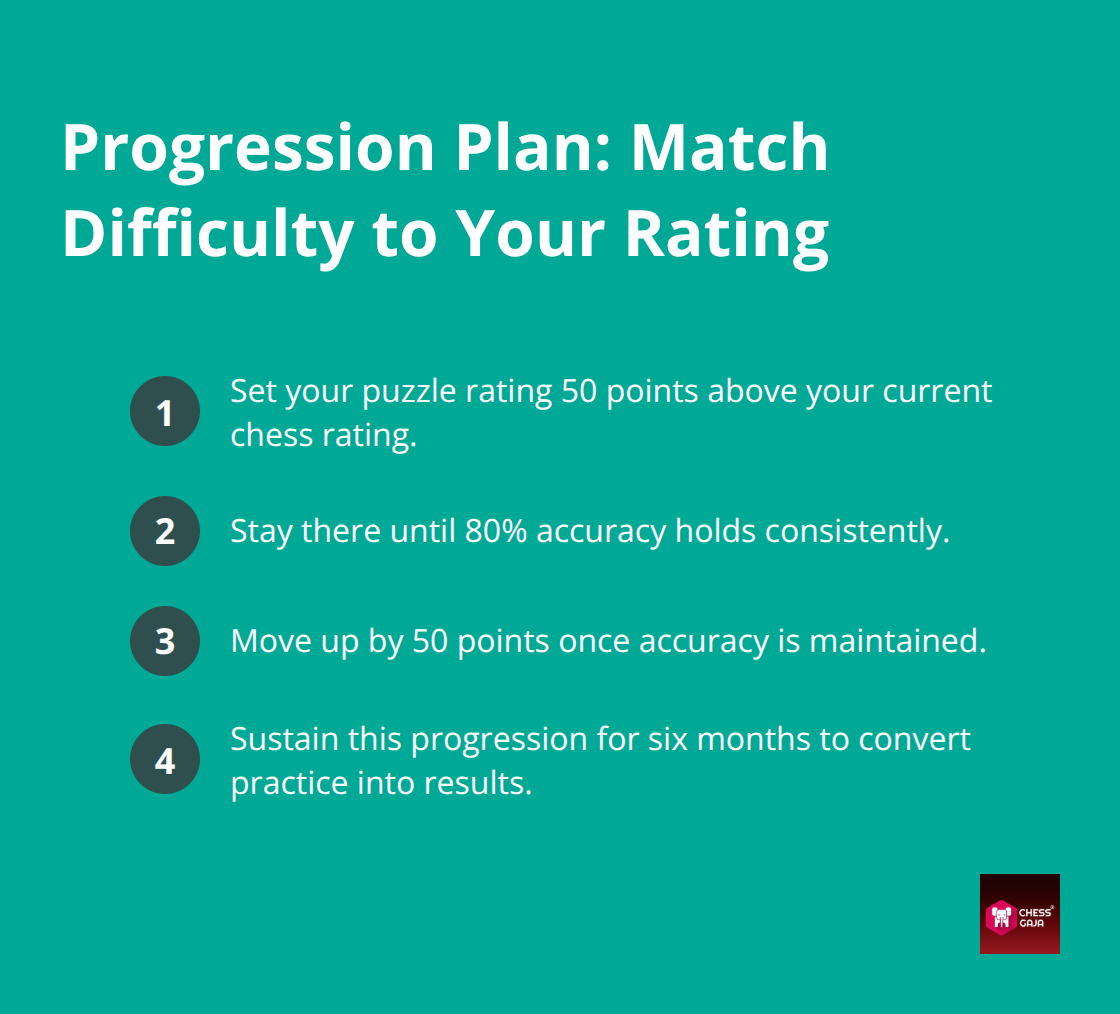
A practical approach works like this: spend the first two weeks at your current rating solving 15–20 puzzles daily until you hit high accuracy consistently. Only then move up in small increments of 25 to 50 rating points. This pace feels slow, but it prevents the false confidence that comes from solving too many puzzles too quickly. Chess.com’s Custom Puzzles feature lets you filter by rating and retry failed positions, which directly addresses accuracy over speed.
Pillar Two: Position Type Diversity
The second pillar demands position type diversity. Most players solve only standard winning-move puzzles, which trains one narrow skill: spotting the tactic when a tactic exists. Real games demand three distinct position types. Winning positions require you to calculate multiple candidate moves and pick the strongest continuation-these train depth. Defensive positions force you to find the one move that holds while all others lose-these train threat recognition under pressure. Mixed positions combine dynamic equalizing moves and positional tactics-these train your overall calculation evaluation.
A practical split works best: balance your time primarily between winning positions and defensive puzzles, with a smaller focus on mixed or positional puzzles. Using platforms like Chessable or Chess.com’s custom puzzle databases allows you to revisit mistakes organized by theme and position type, creating a feedback loop that standard puzzle grinding never achieves.
Pillar Three: Progressive Difficulty Matched to Your Rating
The third pillar is progressive difficulty calibrated to your actual rating, not arbitrary jumps. A player rated 1400 who jumps to 1900-rated puzzles trains panic, not pattern recognition. Small increments work better. Target puzzle difficulty bands in 50-to-100 point steps above your current baseline, spending 1 to 2 weeks at each target level to allow your brain to consolidate patterns before increasing the complexity.
Many platforms make this easy: set your custom puzzle difficulty slightly above your current puzzle rating baseline (rather than your overall chess rating, which is typically much lower than your puzzle rating) and stay there until consistent accuracy holds. Then advance the puzzle difficulty by another small margin. Over six months, this disciplined climb produces tournament results because every puzzle solved reinforces patterns you will actually face in games.
How the Three Pillars Work Together
These three pillars work together in ways that matter. Accuracy without position diversity trains you to spot only obvious tactics. Diversity without progressive difficulty overwhelms your learning capacity. Progressive difficulty without accuracy creates false confidence in a higher rating. A player who implements all three typically sees measurable tournament rating gains within six months because puzzle work finally translates to board performance.
The structure matters more than the hours invested. But structure alone means nothing if you cannot recognize when these patterns appear under the pressure and complexity of real tournament play. That’s where the next challenge emerges: taking what you’ve learned in isolation and applying it when your opponent fights back, time pressure mounts, and the position hides its tactics beneath layers of strategic noise.
How to Spot Tactics When Your Opponent Fights Back
The gap between puzzle solving and tournament play narrows dramatically when you train pattern recognition under conditions that mirror real games. A puzzle presents a clean position where the tactic is already waiting.
In contrast, a tournament game hides tactics inside positions where multiple threats compete for your attention. Your opponent has defensive resources, and time pressure distorts your calculation. The difference is not theoretical—it is measurable. Players who train pattern recognition exclusively in puzzle positions often freeze in games because they never learned to spot tactical opportunities independently.
Two Skills, Not One
You must train two distinct skills in parallel: the ability to scan a position and recognize that a tactical opportunity is present, and the ability to calculate the line accurately once you’ve spotted it. Most players conflate these skills, assuming that solving puzzles automatically teaches pattern recognition. It does not. A puzzle tells you a tactic exists. A real game forces you to notice that a tactic exists without being told. The solution is deliberate, game-based practice combined with structured puzzle review.
After each tournament game, identify positions where you missed key tactics. Document the specific pattern, such as a back-rank mate or a pinned piece. Next, spend a week solving 10–15 puzzles focused exclusively on that motif. Train until you spot the pattern within 15 to 30 seconds without second-guessing.
This closed-loop approach connects abstract puzzle patterns directly to your mistakes. For instance, consider a player in Singapore who misses a back-rank mate in a tournament. Solving five focused back-rank puzzles daily for two weeks yields faster progress than solving fifty random puzzles over a month.
Recognition Speed Under Pressure
Tournament time controls introduce a second critical variable: recognition speed under pressure. A 90-minute classical game allows deep calculation. Still, pattern recognition matters because you cannot calculate every move. Blitz games demand spotting tactics in seconds. This requires your brain to encode patterns so deeply that recognition becomes automatic.
The way to train this is counterintuitive-you must first solve puzzles slowly without time pressure, building accuracy and understanding, then gradually reduce time constraints as accuracy solidifies. Once you reach high accuracy at your rating level with unlimited time, introduce a three-minute limit per puzzle. Your accuracy will drop, but this mimics the cognitive load of tournament play where calculation happens under mental fatigue and time scarcity. After two weeks of solving under three-minute limits, challenge yourself with 60-to-90 second limits for rapid training, or 15-to-30 second limits to test pure blitz pattern recognition. This progression trains your brain to spot motifs even under severe time scarcity. Players who skip this progression often report that their puzzle rating is 200 points higher than their tournament rating-a direct indicator that pattern recognition has not yet transferred to live play.
Post-Game Analysis: The Missing Link
Post-game analysis is where puzzle training finally connects to real results. Within 48 hours of a tournament game, set up the position on a board and replay the game move by move. Stop when you reach a key error—like a missed tactic or a miscalculated line. Spend five minutes analyzing the board without moving any pieces. Ask yourself: what pattern did I fail to notice? Was it a pin I overlooked? A weak square I didn’t recognize? A candidate move I dismissed too quickly? Document this specific failure.
Then filter your puzzle database by the specific tactical motif you missed (such as a knight fork, pinned defender, or weak back rank) and solve 15–20 puzzles focused exclusively on that theme. This method works because it creates accountability-you cannot hide from a missed tactic in your own game, and you cannot improve pattern recognition by avoiding the positions where you failed. A student from Abu Dhabi who played in the Dubai Chess Championship and missed a knight fork will improve measurably faster by solving 20 knight-fork puzzles than by grinding 200 random puzzles. The specificity matters more than volume.
Final Thoughts
Structured puzzle training closes the gap between isolated skill practice and tournament performance. You now understand why random puzzle grinding fails, how accuracy, position diversity, and progressive difficulty create measurable results, and how to connect puzzle patterns to the positions where you actually miss tactics. The framework is clear, and the question is whether you will implement it.
Building a training plan that works means starting with your current rating and committing to the progression outlined in this article. Spend two weeks at your current puzzle rating until accuracy reaches a high standard, mix your position types across winning positions, defensive puzzles, and mixed positions, and identify the specific pattern you missed after each tournament game, then solve 15–20 puzzles focused on that theme within 48 hours. This approach demands consistency, but it is not complicated.
The difference between players who improve and players who plateau is structure, not talent or hours invested. A player in the USA solving 20 targeted puzzles daily will gain 100 rating points faster than someone solving 100 random puzzles weekly without a system. The exact same principle applies whether you play in Singapore, the UAE, or anywhere else.
Chess Gaja offers personalized online chess coaching where a FIDE-rated coach evaluates your games, identifies your tactical blind spots, and builds a Grandmaster-designed training routine tailored to your tournament ambitions.