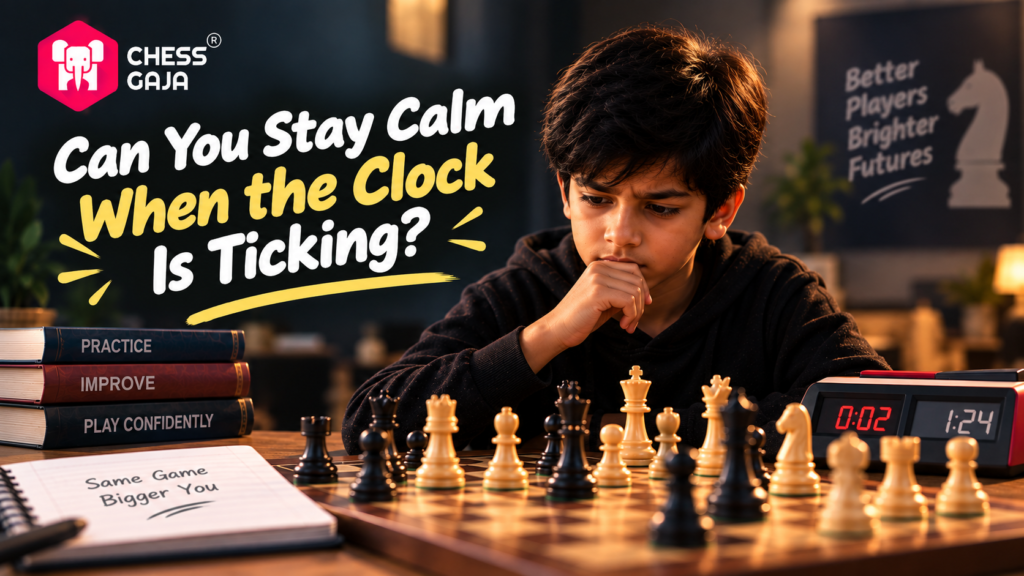
You’re running out of time in a tournament game, and suddenly your moves become sloppy. Your rating drops because of preventable mistakes made under pressure.
At Chess Gaja, we’ve seen this pattern repeatedly with students across the USA, UAE, and Singapore. Clock management practice drills aren’t optional-they’re the difference between winning and losing when seconds matter most.
The Real Cost of Poor Time Management
Time Pressure Destroys Your Rating
Time pressure doesn’t just make you uncomfortable-it systematically destroys your rating. Research from elite chess academies shows that players struggling with clock management lose 50–150 rating points annually. They drop these points simply by making preventable errors in the final minutes. A tournament player with a 1600 rating facing a 20-minute game will drop moves they’d never play with a full clock, converting winning positions into draws or losses. This pattern repeats across the USA, UAE, and Singapore. The most common tournament complaint isn’t a lack of tactical knowledge. Players simply run out of time before finding the right move.
Mental fatigue amplifies mistakes in the Final Minutes
Mental fatigue amplifies this problem significantly. After 30–40 minutes of intense calculation, your brain’s decision-making capacity declines sharply. Studies on chess cognition show that move quality drops in the final third of a game when time is scarce, even for experienced players. A position that took you 5 minutes to evaluate correctly earlier in the game suddenly feels impossible to assess in 30 seconds. You start making shortcuts, trusting intuition over calculation, and those shortcuts fail under pressure. Elite players don’t escape mental fatigue—they train their calculation speed so that critical decisions require less energy over a long game.
Professional Players Prioritize Clock Work Over Theory
Here’s what separates strong players from the rest: professional players prioritize clock management in preparation, not opening theory or tactical puzzles. This isn’t because they lack chess knowledge; it’s because they understand that brilliant analysis means nothing if you flag before move 40. A Grandmaster preparing for a classical tournament will spend weeks simulating time pressure. They practice endgames under five minutes on the clock and drill critical 90-second decisions. They’re not memorizing lines-they’re building automaticity so that sound moves emerge without lengthy deliberation. This is exactly what separates tournament players who improve steadily from those who plateau.
Clock Management Drills Produce Measurable Results Fast
If you’re spending nearly all of your chess time solving puzzles and studying openings while ignoring clock work, you’re ignoring the single biggest factor that determines whether your preparation translates into actual wins. The good news: clock management drills are learnable skills that improve measurably within weeks, not years. You don’t need to become a Grandmaster to play confidently under pressure-you need structured, repetitive exposure to time-constrained positions that matter. The drills we outline next will show you exactly how to build this exposure into your training routine, starting today.
Three Drills That Build Real Tournament Confidence
The Increment Sprint: Speed Without Catastrophe
Start with the increment sprint if you want measurable improvement within two weeks. Play games with a 3+2 time control-three minutes on your clock plus two seconds added after each move. This format forces you to make moves quickly while the increment cushions catastrophic time losses on single critical positions. Play ten games weekly in this format on Lichess or Chess.com, focusing on maintaining a steady rhythm of 5–10 seconds per move, spending up to 20–30 seconds only on critical decision points.
Track which openings trap you into time trouble. If you consistently lose time in the first 15 moves, your opening knowledge has gaps-study the specific lines you faced rather than memorizing new theory. If time drains in the middlegame, you are likely struggling with candidate move selection and positional pattern recognition. Focus your drills on pawn structure plans, piece activity, and standard tactical motifs. The Increment Sprint works because failure is immediate and public; you either flag or you don’t, making the feedback undeniable.
The Endgame Rush: Winning Without Calculation Paralysis
The endgame rush drill targets the most dangerous phase for clock casualties. Set up five random endgame positions with only 90 seconds remaining on your clock, then play them against a computer set to master level (or 2000+ strength) or a strong training partner. You’re not trying to win brilliantly; you’re practicing moves that don’t lose. Most players waste endgame time calculating variations they’ll never play, so this drill teaches you to recognize when a position is won or drawn and execute the winning plan without excessive verification. Try to complete each endgame in under 60 seconds while maintaining accuracy. Run this drill twice weekly for four weeks and your panic response to low-clock situations will drop significantly.
The Tournament Simulation: Playing Under Real Match Conditions
Simulate actual tournament conditions by scheduling one over-the-board classical training game monthly against a sparring partner, using a physical chess clock to mirror real match conditions. After each tournament simulation, pinpoint the specific move decisions where your clock usage spiked and evaluate whether the extra calculation time actually improved your move quality. This post-game analysis reveals your specific weakness, allowing you to target the correct drill in subsequent weeks rather than wasting effort on problems you don’t actually have.
The patterns you uncover through these three drills expose exactly where your clock management breaks down-and that clarity is what separates players who improve from those who repeat the same mistakes tournament after tournament.
How Chess Gaja Integrates Clock Training Into Every Session
Real-Time Clock Pattern Tracking During Lessons
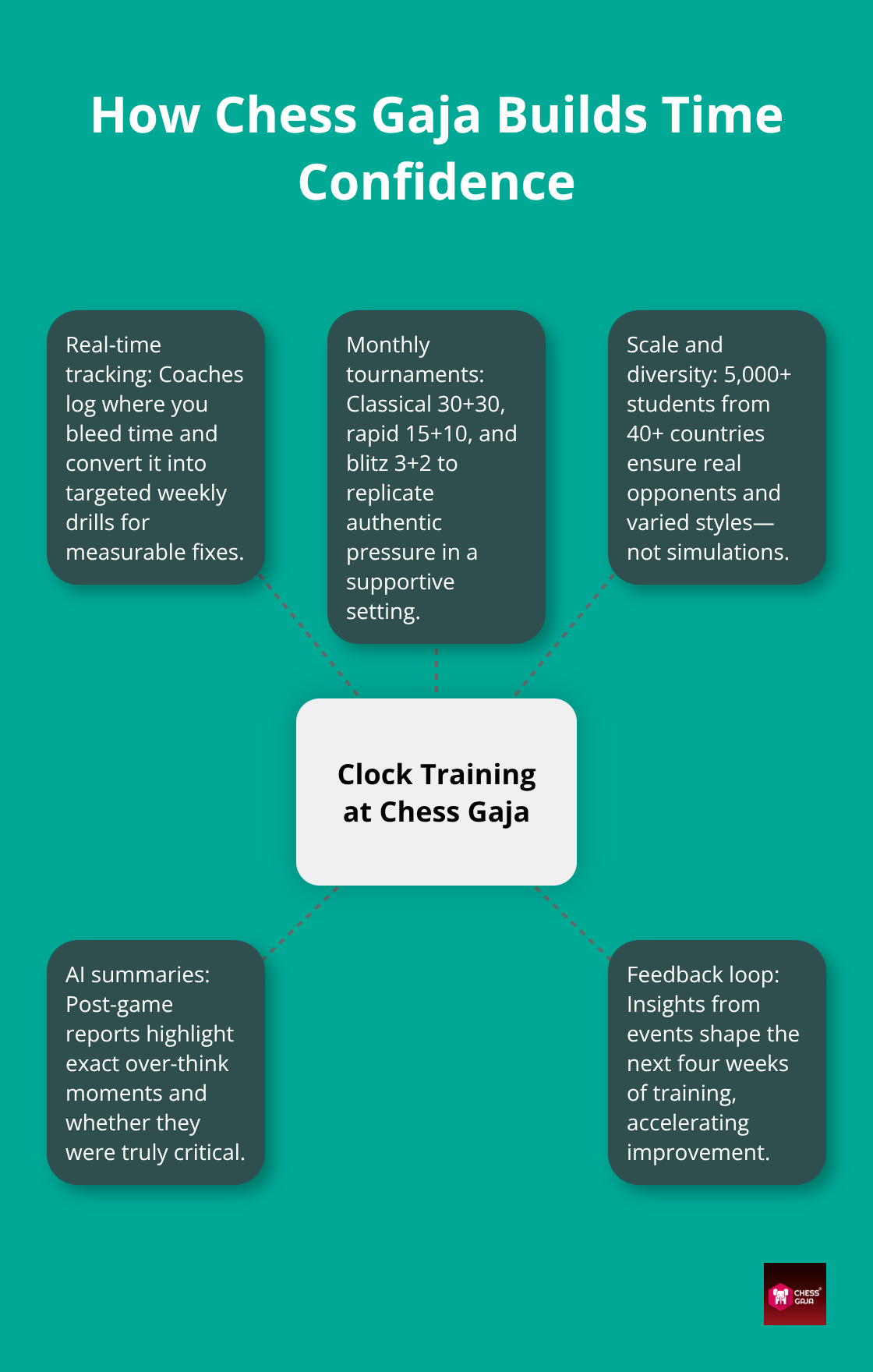
Chess Gaja coaches monitor your clock patterns in real time during every lesson, identifying exactly where you lose time. If you spend 8 minutes on move 12, a coach diagnoses the root cause immediately. You may be missing opening patterns, overthinking simple positions, or lacking confidence in your preparation. This isn’t theoretical feedback-it’s specific, actionable data that gets logged and referenced in your next session. That diagnosis becomes your targeted drill for the week, transforming vague time-management problems into concrete, solvable challenges.
Monthly Academy Tournaments Build Genuine Pressure
Clock training transforms from classroom practice into real tournament pressure through our monthly academy tournaments. These events happen in a supportive environment, featuring authentic competitive formats ranging from 30+30 classical sections to 15+10 rapid and 3+2 blitz brackets. Over 5,000 students across 40+ countries participate in these monthly events. They compete in dedicated time-control sections suited to their specific rating goals.
After each tournament game, coaches review your clock decisions using AI-powered summaries, which highlight the exact moves where you spent excessive time and whether those moves were actually critical.
AI Summaries Expose Your Clock Weaknesses
A student might spend 18 minutes on a single move in the middlegame, then flag in an easily winning endgame-the AI summary shows this pattern instantly. Coaches design your next four weeks of training around endgame speed and middlegame triage based on this concrete evidence. Students who participate in three consecutive monthly tournaments show measurable improvements under pressure. They compete regularly while the same coaches observe and adjust their approach each month. Tournament play and targeted drill work form a powerful feedback loop. This combination creates rapid skill development that isolated practice cannot match.
Final Thoughts
Clock management practice drills work because they force your brain to make sound decisions under genuine pressure, not theoretical conditions. The three drills outlined earlier build automaticity through repetition. These include the Increment Sprint, the Endgame Rush, and the Tournament Simulation. After four weeks of consistent practice, moves that once required lengthy deliberation become instinctive, and your clock stops controlling you.
Start with your weakest time control. Do you consistently lose games in rapid formats? Target that specific format instead of wasting weeks on blitz drills. This focused approach produces faster results than scattered practice across multiple time controls, and you’ll measure your improvement in actual tournament play within a month.
The difference between players who improve steadily and those who plateau often comes down to one factor: they practice under pressure conditions that mirror real tournaments.
Book a Starter Class with our experienced Grandmaster-led coaching team at Chess Gaja. A coach will evaluate your time-management patterns, identify specific weaknesses, and design a personalized four-week drill plan. You’ll receive a post-session AI summary highlighting your clock decision points. Additionally, your coach will provide a personalized study schedule with recommended resources.