Adults improving at chess often hit a frustrating wall. You’ve studied openings, memorized tactics, and logged hundreds of hours-yet your rating stalls. The problem isn’t effort; it’s precision.
At Chess Gaja, we’ve coached thousands of adult players through this exact challenge. The solution isn’t more study time. It’s targeted drills that expose your specific weaknesses and close them systematically.
Why Adults Struggle With Tactical Precision
Adults hit a precision wall because their brains developed differently than young players. A child who learns chess at age 6 builds pattern recognition through thousands of hours before their teenage years. Adults starting later or returning to the game must compress that learning into far less time, facing a unique neural challenge. Research from cognitive scientists shows that pattern recognition relies on myelin formation—the insulation around neural pathways that speeds up information processing. While myelination happens more naturally in children, adults can still build strong neural pathways through deliberate, focused repetition.
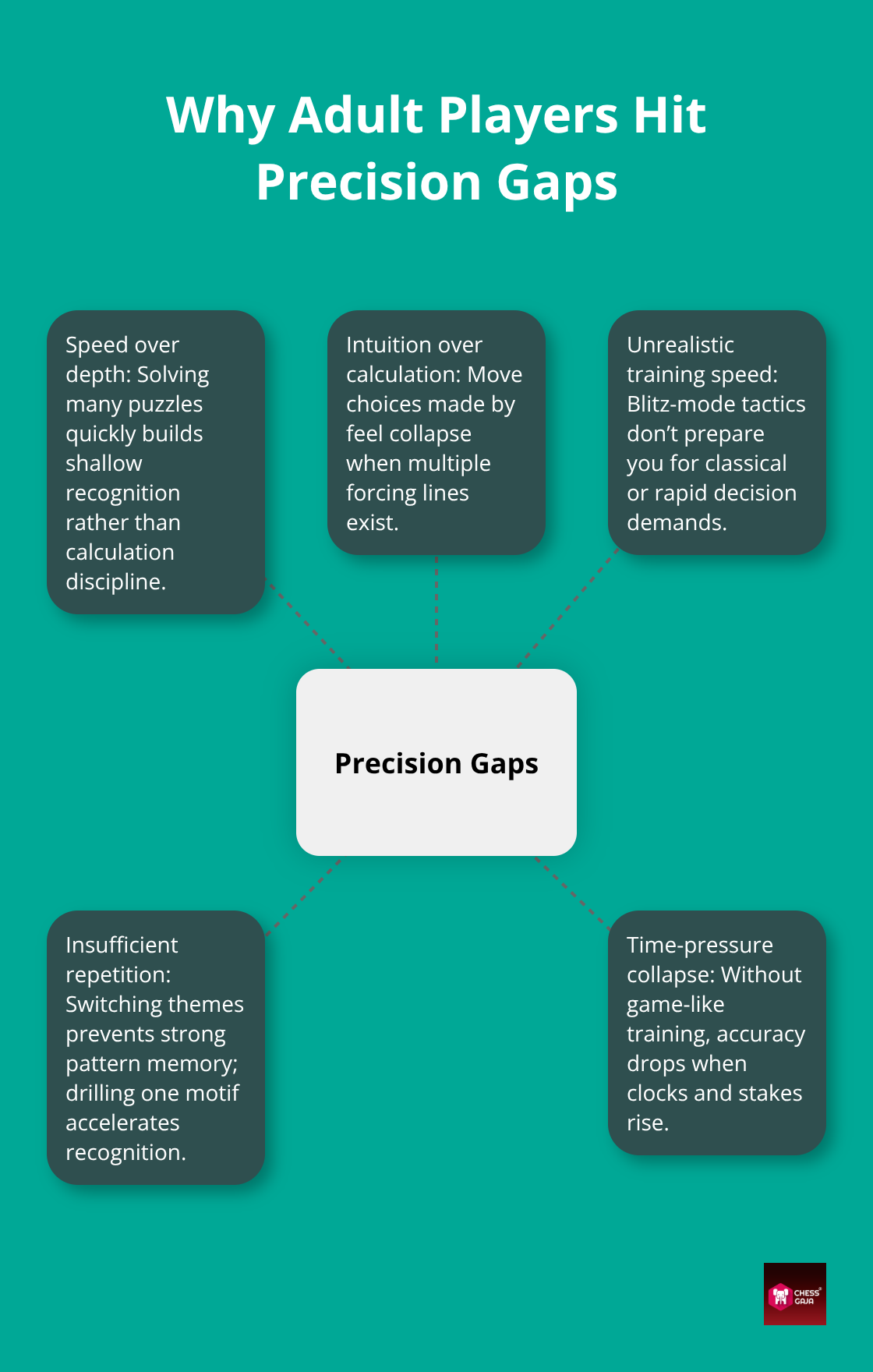
The core problem most adults face is solving tactics too fast without visualizing every candidate move. Relying on intuition fails when multiple forcing moves exist, and that weakness explodes under time pressure. A player who spent only 5 to 10 seconds guessing puzzle solutions in training suddenly faces a 15-minute game and freezes when calculating three or four moves deep. Thousands of adult players remain stuck at the 1400–1600 rating band because they train speed over depth—solving 50 puzzles in an hour, only to miss a basic fork in a real game. The gap isn’t talent; it’s method.
Why Young Players See Faster Than Adults
Young learners accumulate pattern memory through sheer volume and repetition across years. A 12-year-old who has solved 10,000 puzzles recognizes a knight fork in 1.5 seconds because their brain has seen that shape hundreds of times, whereas an adult who solved 2,000 puzzles over six months still hesitates.
The solution isn’t to solve more random puzzles—it’s to target your specific blind spots and replay those exact patterns until recognition becomes automatic. This is where most adults fail: bouncing between themes instead of grinding one motif. A player missing discovered attacks should solve 30–40 discovered attack puzzles in a single week, not scatter them across a month. Density and repetition matter far more than variety.
How Mid-Game Mistakes Reveal Your Real Weakness
Adults typically lose rating points not in the opening or endgame, but in moves 15–25 when they face unfamiliar positions. A player might play the first 10 moves correctly, then suddenly hang a piece or miss a back-rank threat. This isn’t bad luck-it’s a calculation failure disguised as a tactical miss. Game analysis reveals the pattern. A player might lose three games in a row to the same error: missing a queen check that forces a trade. That specific error should trigger two weeks of focused drill work on checks and forcing sequences, not a vague commitment to study more tactics.
We recommend pulling your last 20 losses from Chess.com or Lichess, finding the move where the evaluation dropped below -2, and asking one question: what forcing move did I miss? If you find three games lost to the same tactical motif, that motif becomes your priority for the next three weeks. Targeted drilling on your actual mistakes closes precision gaps faster than random puzzle training ever will.
The Path Forward: From Mistakes to Measurable Improvement
Your next step requires honest self-assessment. Pull your recent losses, identify the recurring tactical patterns you missed, and commit to a three-week focused drill cycle on that single motif. This approach transforms abstract frustration into concrete, actionable work. The players who break through the 1600 barrier don’t study more-they study smarter, targeting the exact weaknesses that cost them rating points in real games.
How to Find Your Precision Gaps and Fix Them
Analyze Your Losses Systematically
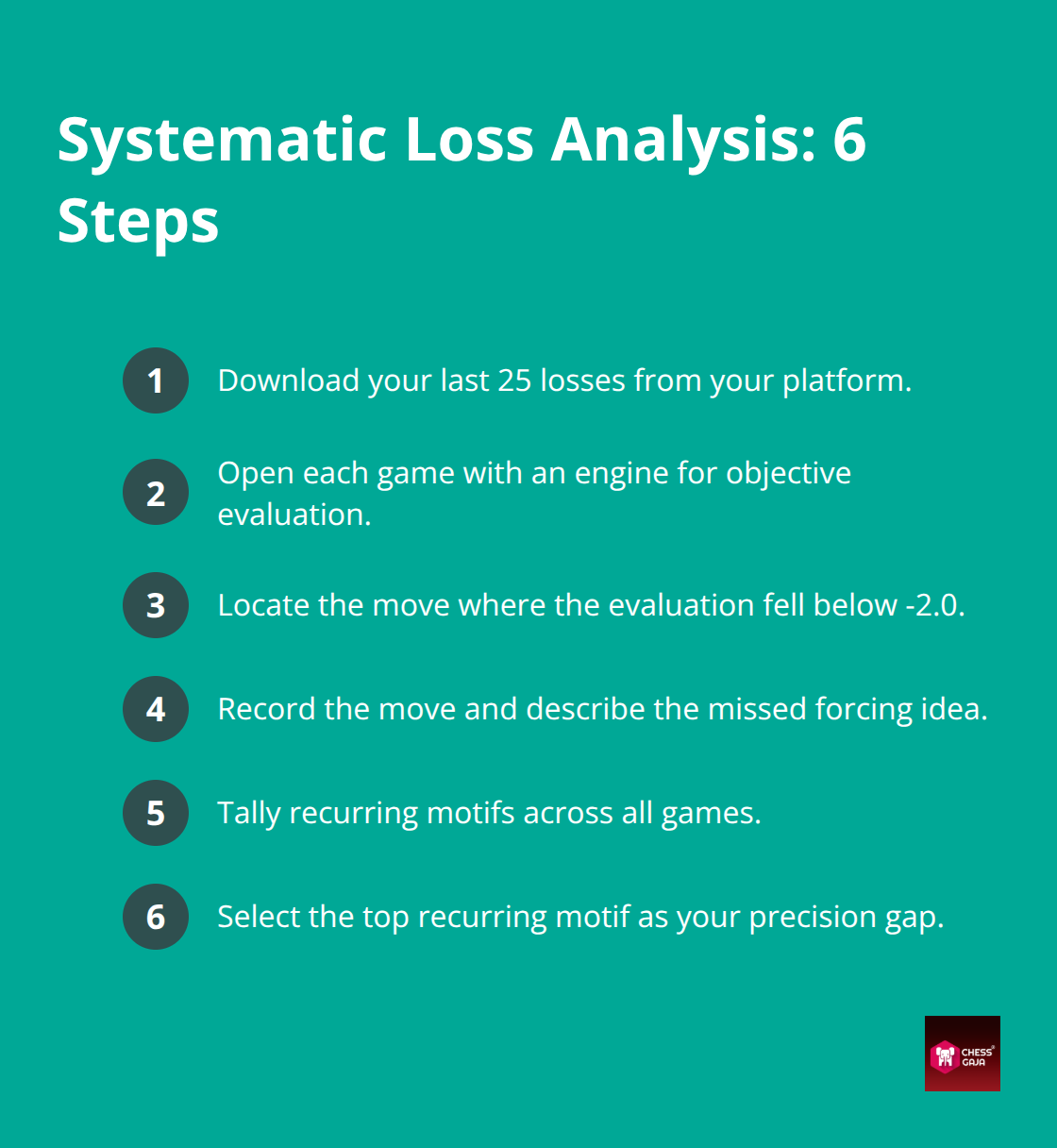
Most adults never actually analyze their losses properly. They play a game, lose, and move on to the next one without understanding why. This is the single biggest reason adult players plateau. The first step is brutal honesty: download your last 25 losses from Chess.com or Lichess and open each one in an engine. For each loss, find the critical moment where the evaluation dropped by 2.0 or more (a significant swing that usually represents losing a piece or a major tactical blunder). That move is your precision failure point. Write it down. Now look at the position before that move.
What forcing move did you miss? A check, a capture, a threat? Track this across all 25 games. Most adults discover they miss the same tactical pattern 4–7 times. That pattern is your precision gap.
Target Your Specific Weakness With Density
A player who loses three games to undefended pieces should not solve random puzzles for two weeks; they should solve 40–50 puzzles specifically about undefended pieces and hanging material. Density and repetition close gaps. Variety scatters effort. Once you identify your gap, build a drill routine that fits your actual schedule, not an imaginary ideal. Most adults fail because they commit to solving 100 puzzles per week, then quit after three days when life interferes. Instead, solve 6–8 puzzles daily on your specific weakness for 21 consecutive days. That’s roughly 15 minutes per session on platforms like Chess.com or Lichess, with theme filters set to your gap (forks, pins, discovered attacks, undefended pieces).
Pair Puzzle Work With Game Review
After 21 days, your brain has started building pattern recognition on that motif. Move to your second-most-common precision gap and repeat. A player who fixes one gap every three weeks will close four major gaps in 12 weeks and jump 100–150 rating points. This is measurable, concrete, and repeatable. Pair this with one non-engine game review per week where you analyze your own moves before checking the engine, forcing your brain to think critically. This combination of targeted puzzle work and deliberate game analysis is how adult players actually break through rating plateaus. The transformation happens not because you study harder, but because you study the exact positions that cost you games.
From Pattern Recognition to Measurable Gains
When you close your first precision gap, you’ll notice something shift in your games. Positions that once confused you become recognizable. A knight fork that cost you material three months ago now jumps out immediately. This isn’t magic-it’s myelin formation in action. Your brain has wired that pattern through repetition, and recognition speed accelerates.
The next step is to apply this same method to your second weakness, then your third. Each gap you close compounds your rating gains. Players who follow this approach systematically (not sporadically) report breaking through the 1600 barrier within 12–16 weeks. The key is consistency and specificity. Vague commitment to “study more tactics” fails. Concrete commitment to “solve 40 discovered attack puzzles in the next 21 days” succeeds.
Drills That Close Gaps in Real Time
The difference between a player stuck at 1500 and one climbing toward 1800 is not puzzle volume-it’s drill precision. A player solving 200 random puzzles per month makes minimal progress. A player solving 50 carefully selected puzzles on a single weakness every three weeks breaks through. Specificity beats quantity. Here’s how to build drills that actually move your rating.
Tactical Sequences on Your Identified Weakness
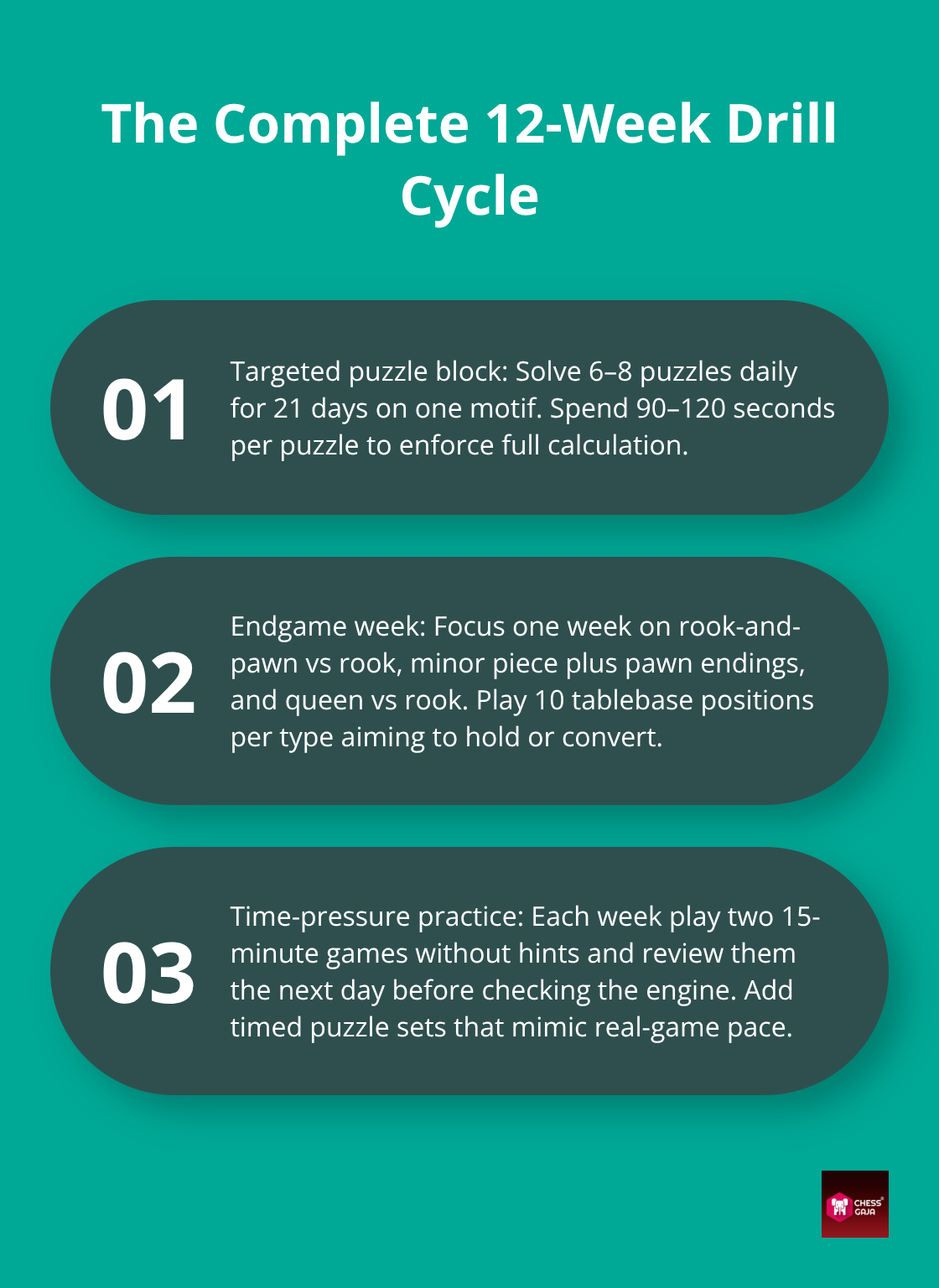
Start with tactical sequences on your identified weakness. If your analysis revealed you miss undefended pieces, don’t solve isolated puzzles about hanging material. Instead, solve sequences where the first move captures an undefended piece, then the second move involves a follow-up tactic. Chess.com and Lichess both allow theme filtering, so set your filter to your weakness and solve 6–8 puzzles daily for three consecutive weeks. Spend 90–120 seconds per puzzle, forcing yourself to calculate every candidate move before committing. This is slower than blitz puzzle training, but it’s the only speed that builds genuine calculation skill.
A study on deliberate practice by psychologist K. Anders Ericsson found that practice quality-not quantity-determines expertise development. Apply 90 seconds per puzzle on your weakness for 21 days, and you’ll see measurable recognition shifts in your games. After 21 days, move to your second weakness and repeat.
Endgame Precision Through Tablebase Drills
Endgame precision requires a different approach. Most adults study complex endgames and forget them immediately. Instead, focus on the three endgame structures that appear in the vast majority of practical games: rook and pawn versus rook, King and pawn endgames, and minor piece plus pawn endgames. Spend one week on each endgame using tablebases on Lichess. Play 10 theoretical positions from each endgame category using Lichess Tablebase or practice modules against Stockfish, training yourself to hold identical drawn structures and convert standard winning theoretical endgames flawlessly. The engine forces you to find the exact moves that matter.
A player who masters basic rook endgame technique saves dozens of rating points per year simply by defending drawn positions and converting winning advantages cleanly. This precision in simplified endgame positions compounds over time and separates players at the 1600 level from those stuck below it.
Time Management Drills Under Realistic Pressure
Time management drills sharpen decision-making under pressure. Most adults don’t train at the time controls where they play. If you play 15-minute games, never solve tactics in blitz mode. Instead, set a timer for 10 to 15 minutes and allocate yourself a strict 90 to 120 seconds per puzzle. Calculate all lines completely in your head before executing your first move. This mimics real game pressure. You’ll make mistakes you wouldn’t make in a 2-minute puzzle session, and those mistakes reveal your actual calculation ceiling.
After solving puzzles under time pressure, play three 15-minute games against human opponents online without engine assistance, and analyze your own moves the next day before checking the computer evaluations. This three-step cycle—timed puzzles, practical games, delayed review—builds the mental stamina to calculate accurately when it matters most. The pressure you face in this training directly transfers to your tournament and online games.
The Complete Drill Cycle for Measurable Gains
The players who report the biggest rating jumps combine all three approaches. They spend 21 days on targeted puzzle work for one weakness, complete one week of endgame tablebase drills, and play two 15-minute games per week under realistic time pressure. That’s roughly 2 to 2.5 hours of focused work per week, spread across four or five manageable 20-minute sessions. Over 12 weeks, this approach produces 80–120 rating points of measurable gain for most adult players between 1400 and 1700. The consistency of this method-not sporadic effort-determines whether you break through or plateau again.
Final Thoughts
The transformation from 1500 to 1700 happens through precision, not more study time. Adults improving at chess succeed when they stop solving random puzzles and start targeting the exact tactical patterns that cost them games. Your precision gaps are measurable, fixable, and the fastest path to rating gains.
Consistency beats intensity-fifteen minutes daily on your identified weakness outperforms two-hour cram sessions on random tactics. Your brain builds pattern recognition through repetition and density, not volume. When you solve 40 discovered attack puzzles in three weeks instead of scattering them across two months, recognition speed accelerates and transfers directly to your games.
At Chess Gaja, we guide adult players through this exact process with personalized drill routines and monthly game reviews. Book a Paid Starter Class with a FIDE-rated coach to analyze your recent games, identify your top three precision gaps, and design a 12-week drill plan tailored to your rating and goals.