
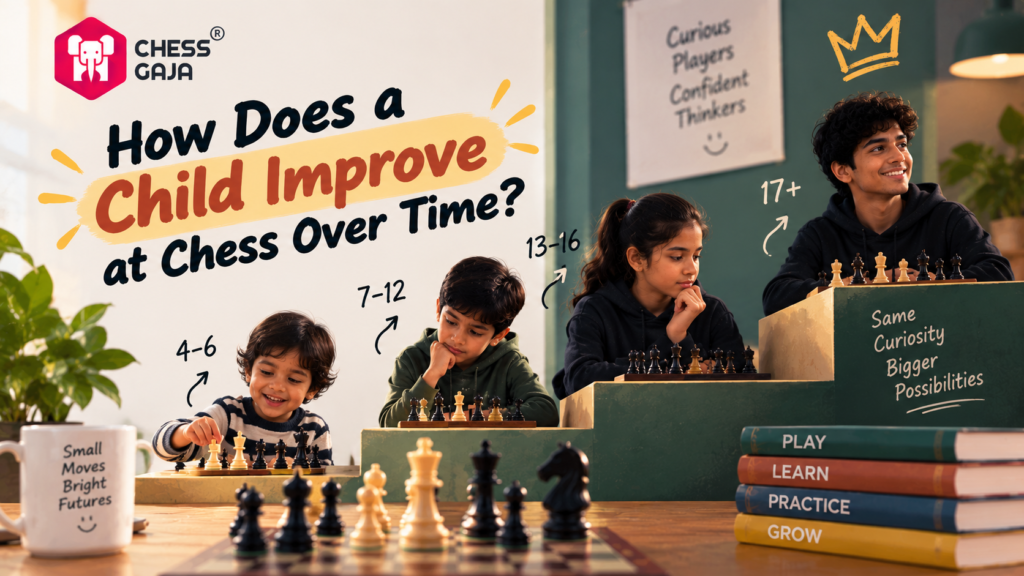
Your child’s chess progress doesn’t follow a straight line. Some kids master tactics at age eight while others need more time, and that’s completely normal.
We at Chess Gaja have coached thousands of young players across different age groups, and we’ve noticed clear patterns in how kids develop their chess skills. This kids chess improvement timeline shows you exactly what realistic growth looks like at each stage, from your four-year-old’s first moves to serious competitive play in the teenage years.
The Early Steps: What 4 to 6 Year Olds Actually Need
4 to 6-year-olds are not miniature adults playing chess. They build neural pathways for attention, spatial reasoning, and pattern recognition. These skills live inside the game but are not yet about winning points. A child sitting for 15 minutes to recall bishop moves achieves something real.
Research shows that short 10–15 minute sessions, repeated 3–4 times weekly, improve working memory within 8–12 weeks. The goal is not a high rating. Instead, it builds the mental foundation for future chess growth.
Where Most Parents Go Wrong With Young Learners
Parents often push opening names when four-year-olds are still learning how pawns move. Young brains do not absorb abstract rules through lectures.
Instead, kids learn through play repetition, immediate feedback, and celebrating small wins. A single game where a child captures three pieces teaches far more than ten minutes of formal instruction.
Players who make rapid progress at ages 7–12 usually played freely at ages 4–6. Forcing rigid puzzle training too early backfires because it feels like homework and dampens curiosity.
Building Real Skill: Play-Based Tactical Awareness
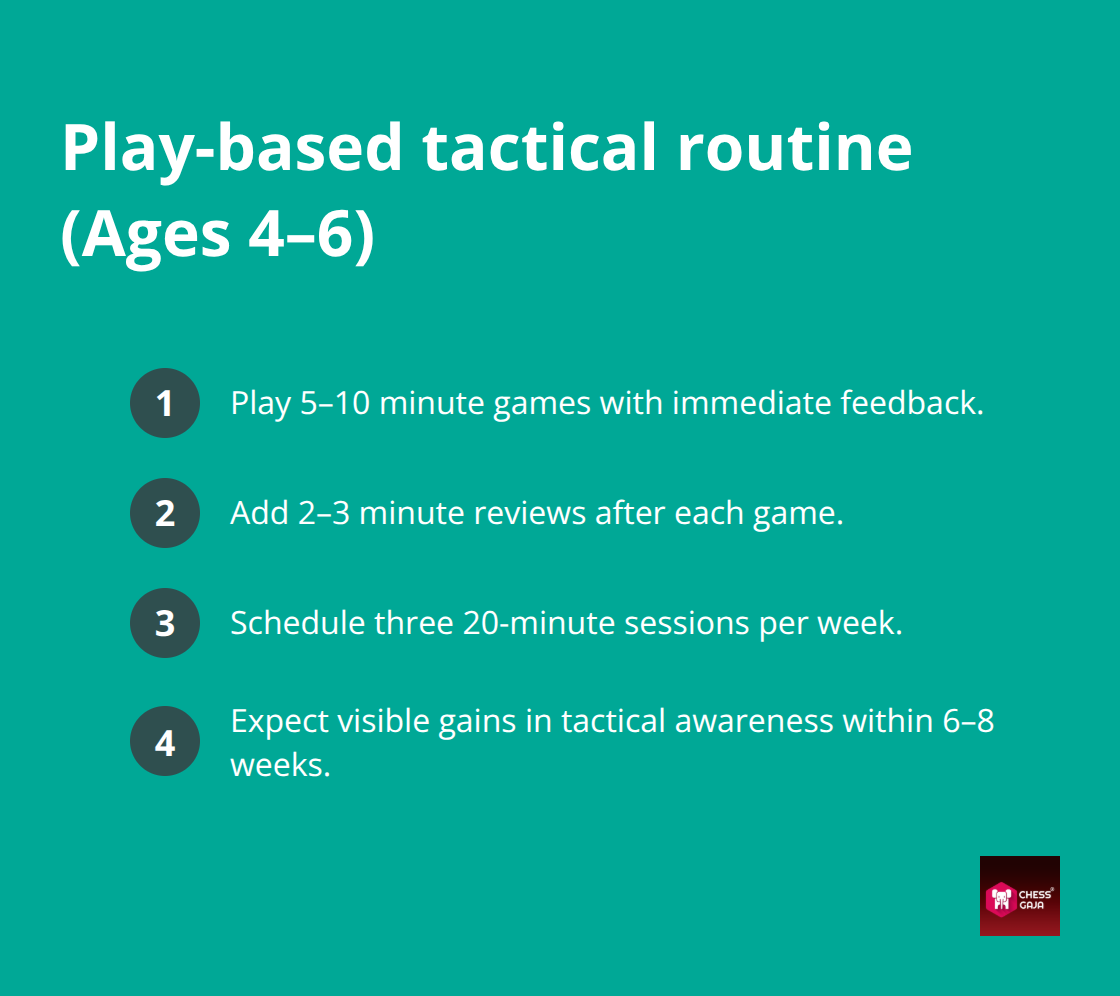
The practical foundation at this age is simple tactical vision: can your child spot when their piece is attacked? Can they see when they can capture an opponent’s piece? Developing fundamental tactical vision—spotting simple threats and immediate opportunities—is the bedrock of all early chess improvement. You build this through short, regular games with immediate feedback, not through tactics trainers or formal lessons. A parent or coach plays 5–10 minute games with a four or five year old, then spends 2–3 minutes reviewing why a piece was lost, and this trains the skill faster than any app.
Many parents in the USA, UAE, and Singapore now use age-appropriate platforms that offer kid-friendly games with built-in puzzle formats designed for younger attention spans, rather than forcing adult platforms onto young learners. The secret is consistency: three 20-minute sessions per week (including play and light review) will produce visible improvement in tactical awareness within 6–8 weeks. A child who can reliably spot when their queen is hanging has already crossed a major threshold.
Why Ratings Don’t Matter Yet
At this stage, a child’s rating is meaningless-online ratings for under-seven players reflect the strength of their local competition pool, not their absolute skill. What matters is whether they develop the habits: sitting down to play, thinking before moving, and accepting losses without meltdowns. These habits form the real foundation for the competitive years ahead. A child who resists frustration and returns to the board after a loss has learned something far more valuable than any opening line. This emotional resilience, built through play at ages 4–6, determines whether a young player thrives or burns out when they encounter serious competition later.
The Transition to Structured Learning
As your child approaches age seven, the shift from pure play to structured training becomes possible. Their attention span lengthens, their memory improves, and they start to understand why certain moves work better than others. This is when tactical puzzles, opening principles, and tournament play become realistic goals-not before. The children who excel in competitive chess at ages 8–10 are those who spent ages 4–6 playing freely, building confidence, and developing an instinctive feel for the board. They arrive at structured training with curiosity intact and a genuine love for the game, not a sense of obligation.
Ages 7–12: From Casual Play to Competitive Development
Ages seven through twelve mark the moment chess stops being play and becomes real development. Your child’s brain now holds multiple ideas at once, remembers opening principles across different games, and understands why a move was strategically weak, not just tactically bad. This window produces visible, measurable results with structured training. The shift from ages four to six is stark: where a younger child needs games and celebration, a seven year old sits with a chess coach for thirty minutes, reviews three of their own games, solves tactical puzzles, and walks away understanding exactly what to improve. Ratings start to reflect actual skill rather than just local competition strength, making the numbers on your child’s profile finally meaningful.
Realistic progress means gaining 100 to 150 rating points annually with structured training. However, progress varies based on play frequency and coaching quality.
A 7-year-old beginner training two to three times weekly should reach a 900 to 1000 rating within eighteen months. Consistent effort and monthly events make this milestone realistic.
Why Live Tournaments Drive Rapid Improvement
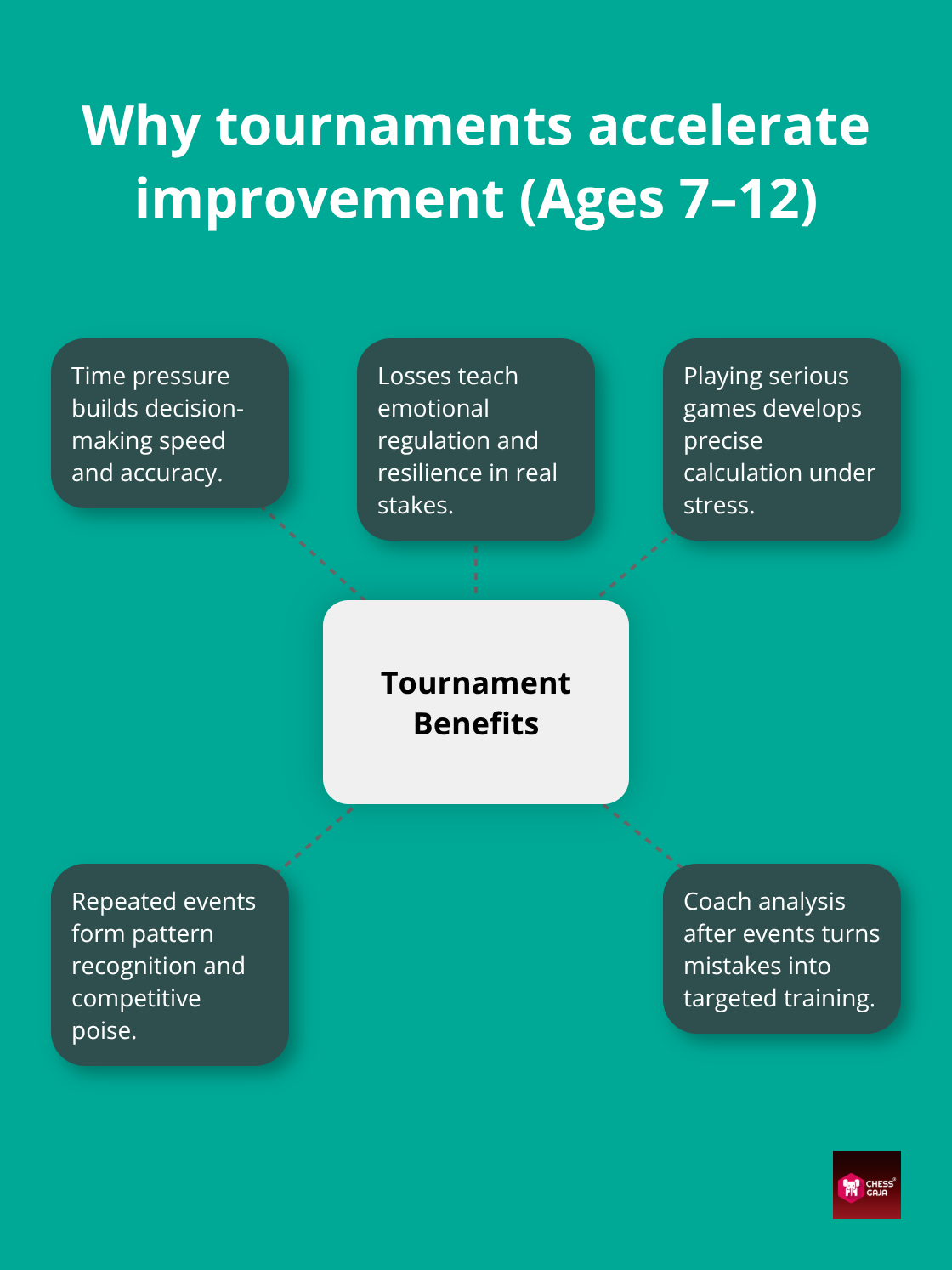
Live tournaments are essential for real growth. Playing under clock pressure teaches young players emotional resilience, focus, and accurate decision-making.
Experience builds competitive poise. In fact, five to ten live events teach pattern recognition better than fifty hours of casual online play. Consistent tournament participation paired with quality coaching remains the top predictor of long-term chess success.
Many parents hesitate to enter tournaments because they worry their child will lose, but losses in tournaments are where the real learning happens. Your child learns that losing is survivable, that mistakes can be analyzed and prevented next time, and that improvement is a process, not an overnight achievement.
Tournament Play Teaches What Coaching Cannot
Local scholastic tournaments run monthly across the USA, UAE, and Singapore. These events cater specifically to beginners with age divisions and balanced Swiss-system pairings. Start with one event per quarter for new players, then shift to monthly matches. Building emotional resilience in tournaments directly helps children absorb coaching lessons faster.
Your child will play their first rated tournament and lose. They may lose badly. This is not failure; it is the necessary first step. Children who delay playing in events until they “feel ready” often miss out on early experience; jumping into local tournaments early accelerates growth far faster than waiting for perfect preparation. The psychological shift from casual play to tournament chess is the single biggest leap from ages seven to twelve. Playing with a clock, knowing the rating changes based on this game, having strangers watching, managing the stress of a full day of competition-these experiences cannot be simulated. Your child’s coach prepares them for tournaments through mock games with a clock, post-game analysis of mistakes, and discussions about mental resilience, but the real learning happens when your child sits across from a stranger, the clock is running, and they have to make accurate decisions under pressure.
Finding Local Scholastic Tournaments
Regional federations make starting simple. The US Chess Federation runs year-round scholastic events, while the Dubai and Abu Dhabi Chess Clubs host monthly youth matches. Likewise, the Singapore Chess Federation offers beginner divisions.
Pick a low-pressure event within thirty minutes of home for your child’s debut. Keeping initial events local prevents unnecessary travel stress.
After three to five tournaments, calculation speed and emotional control jump visibly. Parents regularly notice this dramatic improvement once competitive play begins.
Tactical Training Becomes the Engine of Improvement
At this stage, tactical puzzles become essential daily practice, as seven-year-olds can process patterns without the frustration younger children feel. Aim to solve twenty to thirty puzzles three to four times per week.
Always focus on patterns missed in recent games rather than random puzzle apps—a dedicated coach will spot these recurring tactical flaws and assign targeted exercises to fix them directly.
Targeted Practice vs. Random Puzzles
For instance, if your child frequently hangs knight forks, spend two weeks drilling fork motifs. Likewise, clear up back-rank weaknesses with dedicated pattern sets. While random puzzle practice yields slow results, error-focused drilling creates rapid progress and visible rating gains within six weeks.
Keeping Early Opening Study Minimal
Opening study at this age should be minimal and focused. Your child needs one reliable setup as White and a simple, rule-based approach as Black against 1.e4 and 1.d4—three core setups are more than enough. A seven-year-old who tries to memorize five complex systems spreads their effort too thin. Instead, stick to the same core setups for three months so your child builds intuition and understands basic principles: controlling the center, developing pieces, and securing king safety.
Rating Growth Expectations and Milestone Benchmarks
A child starting around a 600 rating who engages in weekly coaching sessions and monthly tournament play typically reaches 800 within eight to twelve months, and breaks the 1000 threshold within eighteen months. These benchmarks assume consistent effort and quality instruction. A child who trains once per week or plays tournaments only twice per year will progress more slowly.
Playing monthly versus quarterly tournaments creates a dramatic difference over two years. Tailored coaching accelerates this timeline significantly. A coach who targets specific weaknesses and reviews tournament games helps students progress far faster than generic instruction.
At this stage, a coach’s primary role is to diagnose underlying execution flaws, track competitive trends, and build the mental resilience required for standard tournament play.
The Role of Consistency and Life Context
Progress at this age is rarely linear. Ratings reflect relative strength within a local competition pool, meaning your child’s skill can improve even during temporary rating plateaus. For a seven-to-twelve-year-old, long-term development requires patience and consistency rather than chasing quick rating surges.
Maintaining Engagement During Plateaus
Keeping chess enjoyable remains the primary goal during plateau periods. If your child resists puzzle solving, reframe practice around key moments from their own games or introduce light gamification to build momentum. Maintaining a personalized notebook of missed tactics ensures repeated exposure, which strengthens pattern recognition far better than forced repetitive drills.
As your child moves from casual play into serious competitive development, the foundation shifts from pure enjoyment to structured improvement. The next stage-ages thirteen and beyond-introduces endgame mastery, serious rating progression, and the mental resilience required for peak performance.
Ages 13+: Advanced Training and Peak Performance
At thirteen and beyond, your child’s chess transitions from tactical pattern recognition to strategic complexity and endgame precision. A 13-year-old who has trained seriously through ages seven to twelve now possesses the cognitive capacity to analyze complex middlegame positions, evaluate long-term pawn structures across fifteen to twenty moves, and execute technical endgames requiring precise, multi-step calculation. This is the stage where chess becomes genuinely difficult. A player rated 1200 at age twelve can reach 1600 to 1800 within two years with focused training, but only if the training shifts away from basic tactics and toward the skills that separate competitive players from casual ones.
Endgame Mastery as the Foundation for Serious Rating Growth
Endgame mastery is not optional at this level; it forms the foundation that prevents rating plateaus. A teen who studies only openings and middlegames will hit a ceiling around 1600 because they lose drawn positions and fail to convert winning endgames. The players who break through to 1800, 2000, and beyond treat endgame training as seriously as opening preparation. Teens who spend a significant share of their training time on endgames (rather than neglecting this phase) improve their rating by an additional 150 to 200 points over eighteen months compared to their peers. This is not theoretical; it is measurable and repeatable.
Most teenagers approach endgame study incorrectly by memorizing abstract textbook positions that rarely appear on their boards. Instead, endgame training should connect directly to your teen’s opening repertoire. For example, a Ruy Lopez player should focus on rook endings following central exchanges, asymmetric minor piece structures, and passed pawn creation. Spending six weeks mastering five to eight core endgame structures from their own openings allows players to execute them effortlessly under time pressure, reliably adding 50 to 100 rating points from endgame technique alone.
Strategic Complexity and Serious Tournament Competition
Between thirteen and sixteen, your teen’s chess understanding deepens from tactical calculation to strategic evaluation. A thirteen-year-old calculates whether a move wins material; a sixteen-year-old evaluates whether a move improves their pawn structure, king safety, and long-term piece activity. This shift is profound and cannot be rushed.
A teen who tries to play like a 2200-level player before they understand strategy will make moves that look good tactically but lose positionally. The solution is structured middlegame training that teaches your teen to evaluate positions without forcing a decision.
Take a position from a master game and pause after move fifteen or twenty. Ask your teen to write down candidate moves, a brief positional evaluation, and their plan. Next, compare their notes with the engine evaluation and game continuation.
Practicing 50 to 100 of these exercises builds positional intuition that generic puzzle solving cannot match. This deliberate training is essential for breaking through the 1800 rating mark.
Tournament Rhythms for Advanced Players
Tournament play serves as the primary engine for rating growth above 1200. Ambitious teens should target one classical or active event monthly while balancing school schedules, as regular competition builds unmatched composure and yields far more consistent growth than playing only once or twice a year.
High-level events exist worldwide—from US state championships to regional circuits hosted by the Dubai, Abu Dhabi, and Singapore Chess Federations. Additionally, playing up against opponents rated 100 to 200 points higher periodically accelerates development by showing players what master-level calculation and resourcefulness require.
Mental Resilience and Competitive Psychology
Rating plateaus rarely happen due to a lack of chess knowledge; instead, players struggle to execute under tournament pressure. A teen may evaluate complex positions perfectly at home, yet suffer blunders during a grueling multi-round tournament day due to fatigue and anxiety.
Building Psychological Stamina
Mental resilience is a trainable skill that frequently separates a 1500-rated player from an 1800 player. Coaches build this stamina by integrating weekly timed practice games and post-game loss reviews. In fact, playing fifty serious tournaments builds competitive resilience that five events simply cannot replicate.
Establishing a structured pre-game routine is equally vital. Simple habits like morning physical movement, a brief warm-up before round one, and short walks between rounds preserve energy. Staying in the playing hall all day without moving or hydrating degrades stamina by late rounds, whereas light meals and mental resets keep focus sharp for key moments.
Final Thoughts
Your child’s kids chess improvement timeline follows a clear pattern across ages four through sixteen, but the speed of progress depends entirely on structured coaching and consistent tournament participation.
A 4-year-old builds pattern recognition through play. A 7-year-old builds consistency to gain 200+ rating points in 18 months. Meanwhile, a 13-year-old breaks through plateaus by mastering endgames and competing seriously. The milestones are predictable when the right conditions exist.
Structured coaching accelerates this growth dramatically. Working with a coach who tailors puzzle training, analyzes games, and simulates match conditions helps students progress two to three times faster.
Tournament participation remains non-negotiable. Playing one live event monthly builds pattern recognition and composure that fifty hours of online play cannot match. Ultimately, tournament losses provide the exact roadmap needed to drive long-term mastery.
We at Chess Gaja serve thousands of students across forty countries, including the USA, UAE, and Singapore, and our coaches combine GM-led instruction with AI-powered tools and personalized study plans to build competitive experience.
Your next step is to book a Paid Starter Class with Chess Gaja for a professional skill evaluation. Our coaches will assess your child’s level, identify areas for growth, and create a personalized plan with realistic milestones.