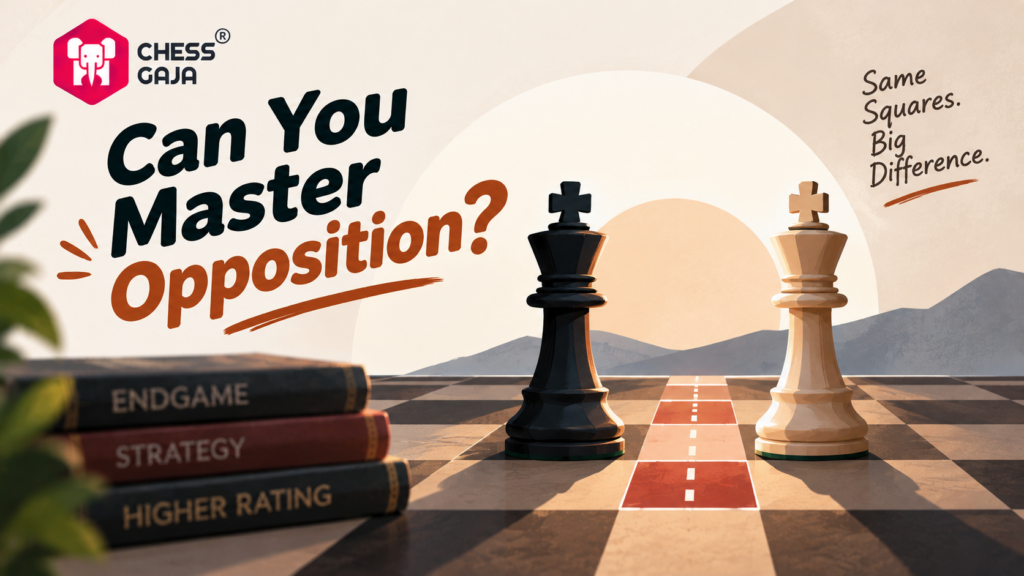
Most endgame positions come down to one thing: who controls the critical squares. Opposition principles fundamentals determine whether your king can stop your opponent’s pawns or push your own to victory.
At Chess Gaja, we’ve seen countless players lose winnable endgames because they didn’t recognize opposition patterns. This concept separates players who understand endgame precision from those who guess their way through.
What Opposition Actually Does in Your Endgames
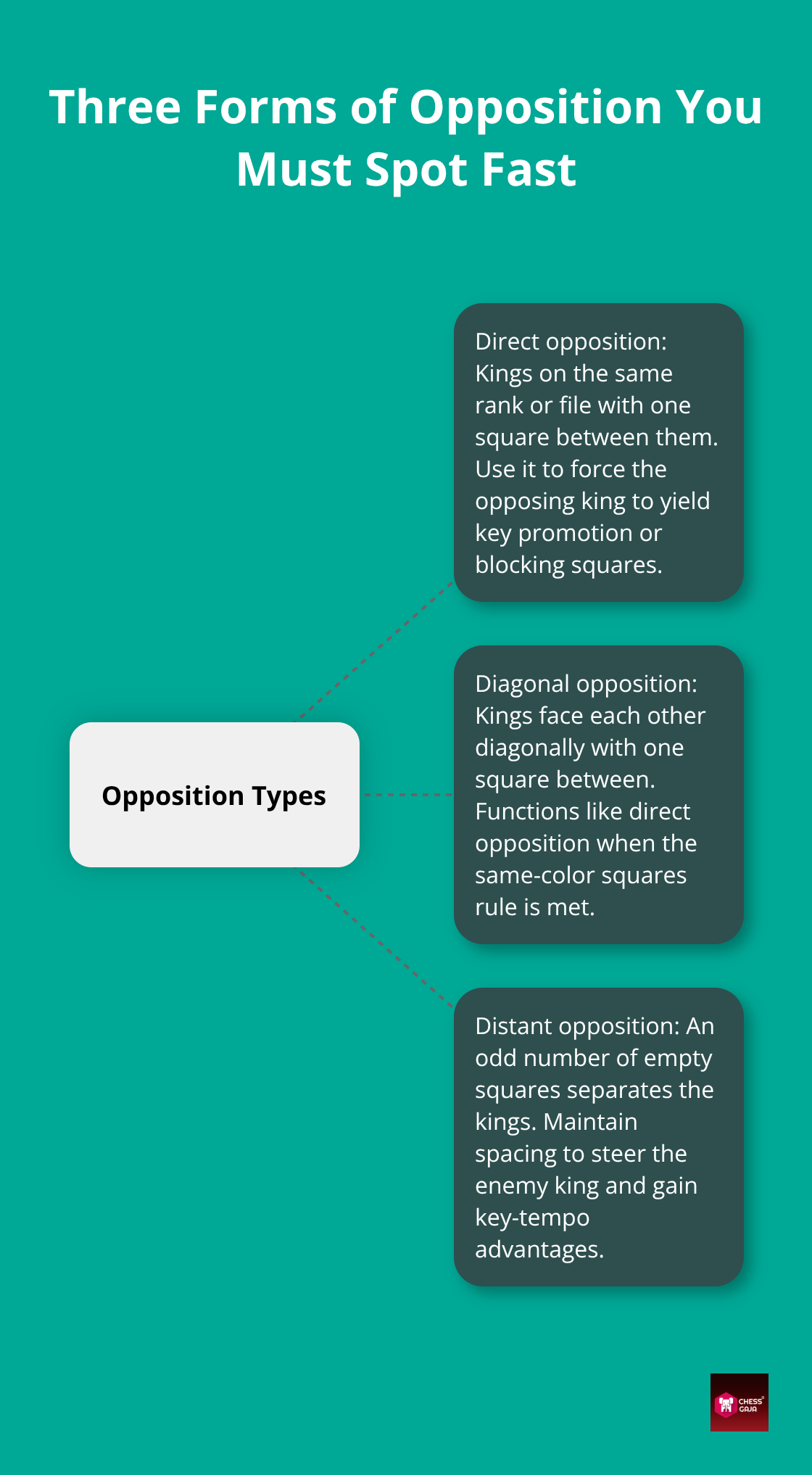
Opposition occurs when two kings face each other on the same rank, file, or diagonal. Separated by an odd number of squares, the player who does not have to move controls key territory. This is not an abstract concept—it directly determines whether you win, draw, or lose in king and pawn endgames. The side that has opposition forces the opponent’s king to yield ground, opening pathways to critical promotion squares or blocking passed pawns.
In practical terms, opposition is the difference between converting a winning position and letting your opponent slip away with a draw. Players who misunderstand opposition often surrender winnable positions. Those who recognize it early gain decisive advantages they rarely yield.
Opposition Comes in Three Forms
Direct opposition occurs when kings stand on the same rank or file with one square between them. This form is common and easy to spot. Diagonal opposition happens when kings occupy matching colors along a diagonal, separated by an odd square count. Distant opposition exists when kings are separated on the same rank or file by three or five empty squares. The key rule for opposition is that both kings must stand on squares of the same color. When an odd number of empty squares separates two kings on the same color, the player who does not have to move holds the opposition. If kings stand on opposite-color squares, an even number of squares separates them. Neither side holds opposition yet. The player to move can often step onto the matching color to claim control.
Why Tournament Players Get Opposition Wrong
Most players treat opposition as a memorization exercise—learn the patterns, apply them, move on. This approach fails under tournament time pressure. Opposition only matters when you understand its purpose. It forces your opponent away from key squares. This gives your king access to promotion territory or critical defensive positions. The player with opposition retains flexibility. The defender must retreat and give ground. This tempo advantage cascades through the remaining moves.
For example, if your opponent’s king sits on c7 and you step your king to c5, you claim direct opposition and force their king to step aside, opening the path to critical entry squares like d6 or b6. But if you miscalculate and step to d5 instead, your opponent takes direct opposition with Kc6, completely blocking your path and turning a clear win into a frustrating draw. Tournament players practice opposition daily through structured endgame puzzles. This builds the intuition to spot patterns instantly without conscious calculation.
How to Build Opposition Intuition Fast
The path forward requires consistent, targeted practice. Work through endgame positions where opposition decides the outcome-positions where one move wins and another draws or loses. Study real tournament games where opposition determined the result. Set up positions on your board and ask yourself: do these kings have opposition? Count the squares. Check the colors. Make the decision in under ten seconds. Repeat this process 50 times, then one hundred times. Your brain will start to recognize opposition patterns automatically, the same way you recognize a fork or a pin without thinking. This is how tournament players develop the precision that separates winners from those who slip into draws.
Spotting Opposition Patterns in Live Tournament Play
Direct Opposition in King and Pawn Endgames
Direct opposition in king and pawn endgames forms when two kings stand on the same rank or file with exactly one square between them. You will encounter this pattern repeatedly near promotion squares. Consider a classic endgame setup: White’s king sits on e5, Black’s king on e7, and White’s pawn rests on e4. If it is Black’s turn to move, White holds direct opposition. Black must move to either d7 or f7. This allows White’s king to outflank on the opposite side (d6 or f6) and escort the pawn to promotion. The moment you recognize this setup, your decision becomes clear: maintain the opposition and advance your pawns. Tournament players who practice this pattern develop the ability to spot it in under five seconds, even with time pressure at move 40.
The color rule applies here as well—both kings must occupy squares of the same color for opposition to be active. If they are on opposite colors, neither player currently holds opposition, meaning the player whose turn it is can often take control by moving onto a square that matches the opponent’s king’s color.
Distant Opposition Rules and Spacing
Distant opposition at greater distance occurs when an odd number of empty squares separate the kings on the same rank or file. This pattern matters more in tournament play than most players realize because it operates at greater distance and allows your king to maneuver while maintaining control. If White’s king sits on c1 and Black’s king on c7, there are five empty squares between them (c2, c3, c4, c5, c6). Both kings occupy dark squares separated by an odd distance. Therefore, the player who does not have to move holds distant opposition on the c-file. This gives White flexibility to move sideways toward key squares while Black cannot advance without losing ground.
Tournament players often miss distant opposition because they look for the direct, touching version and overlook the power of spacing. The practical advantage is that distant opposition lets you set up zugzwang—a position where your opponent must move and worsen their own position. In 2026 scholastic games across the USA and UAE, players converted draws into wins with distant opposition. They understood their opponent was forced to retreat and allow king penetration.
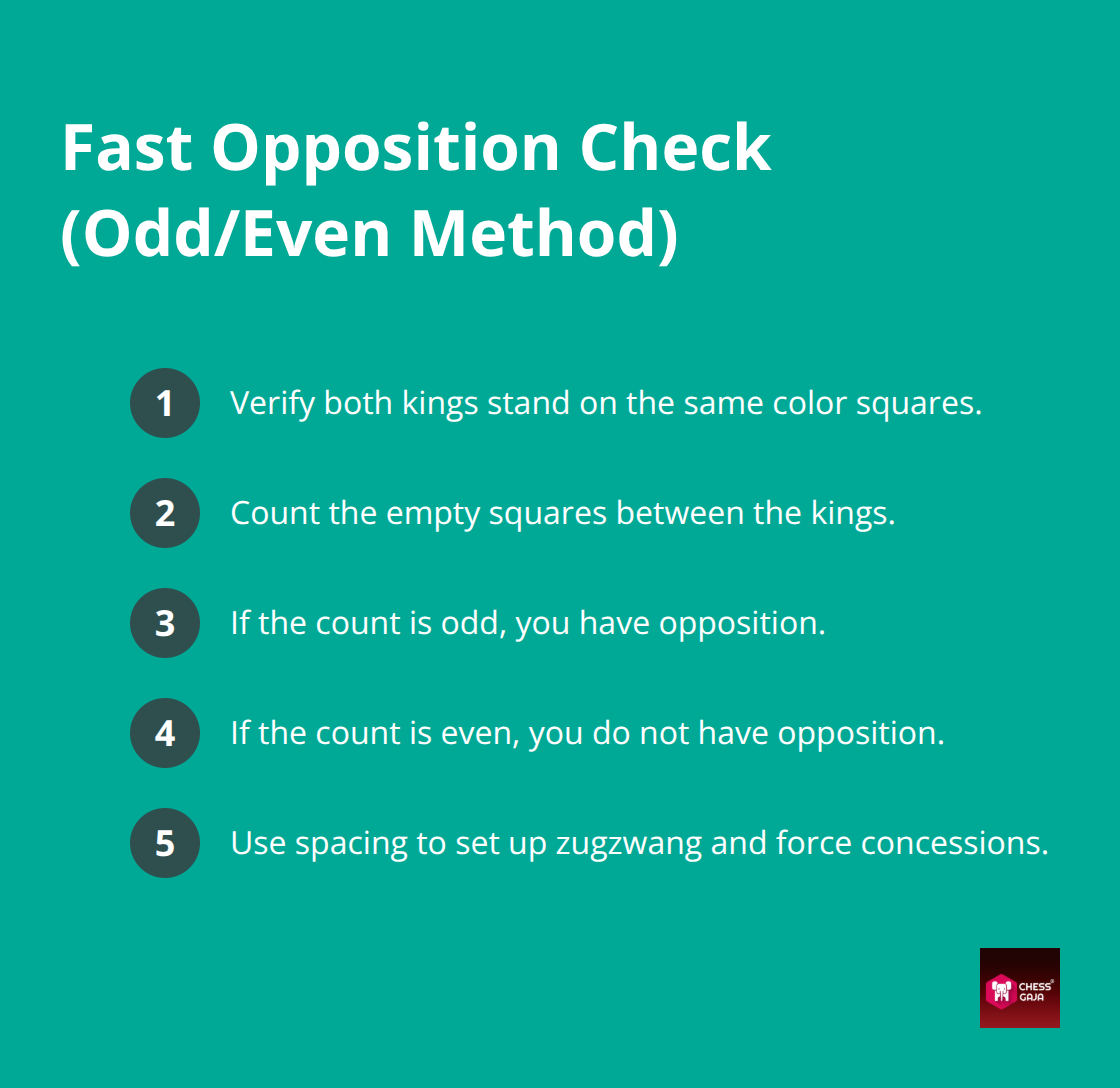
The counting method works: verify same color, count the squares between the kings, and check whose turn it is. An odd number of empty squares (1, 3, 5, or 7) means opposition is established, and whoever is not to move holds the advantage. An even number of squares means no one holds opposition yet, allowing the player to move to step forward or sideways and claim it.
Building Speed Alongside Precise Calculation
In tournament play, time controls are tight, but endgame accuracy requires both pattern recognition and verification. Regional championship players in Singapore or New York face tight time controls. Games often allow just 25 minutes total. When endgames arrive at move 35 or 40, you might have two to five minutes remaining. Recognizing opposition patterns instantly becomes the difference between confident, forcing moves and hesitant, second-guessed play.
The solution is pattern drilling: set up ten positions where opposition decides the game, spend thirty seconds on each, and identify whether opposition exists. Repeat this exercise daily for two weeks to internalize patterns. You will walk into tournament endgames seeing opposition as automatically as a fork or a pin. Players who skip this step rely on calculation under time pressure, which leads to blunders. Calculating from first principles burns precious clock time. Conversely, moving on pure impulse without checking key squares leads to costly blunders. The goal is to internalize opposition patterns instantly. This saves your remaining clock time for precise tactical calculation. This speed advantage compounds across multiple games in a tournament weekend.
Moving From Pattern Recognition to Tournament Application
The transition from recognizing opposition to applying it under pressure requires deliberate practice in realistic conditions. Set a chess clock to tournament time controls and solve endgame positions where opposition determines the outcome. Force yourself to make decisions within the time limit you will face in actual competition. This trains your pattern recognition to fire at tournament speed, not leisurely study speed. Competitive coaches emphasize a key rule: opposition becomes useful only when spotted quickly. You must see it faster than your opponent can calculate alternatives. Once you develop this speed, you enter tournament endgames with a decisive mental edge that your opponent cannot overcome through calculation alone.
Common Mistakes Players Make in King and Pawn Opposition
The most common opposition mistake happens between moves 38 and 42 in tournament games, right when fatigue sets in and players stop counting squares carefully. A player holds opposition, sees a tempting pawn push, and plays it without verifying they still control the critical squares afterward. The result: opposition vanishes, the opponent’s king penetrates, and what should have been a straightforward win becomes a scramble to hold a draw. In games from the 2026 scholastic circuit across the USA and UAE, players frequently lost opposition through careless moves when they held winning positions in the final moves. The pattern remains consistent. Players recognize opposition and make one correct move. However, they wrongly assume the advantage persists without rechecking. This assumption costs them games.
Opposition Is Not Permanent
Opposition does not remain static after you move. Every move you make either maintains it, transfers it to your opponent, or eliminates it entirely. After you move, your opponent has the option to move into opposition themselves. If you push your pawn forward without ensuring your king still controls the key squares, your opponent’s king can slip into opposition and block your progress. Tournament players at the Master level recount opposition after every single move in critical endgames, even when they are ahead on the clock. They know that one careless move erases the advantage they spent thirty moves building.
Opposition Without a Concrete Plan Fails
The second critical mistake is misunderstanding which opposition actually wins the position. A player gains opposition, feels confident, and assumes victory is automatic. But opposition only wins if you have a plan to convert it into concrete progress. In king and pawn endgames, opposition matters because it lets your king reach promotion squares or stops your opponent’s passed pawns. If you hold opposition but your pawn structure is weak, your opponent has no pawns to stop, or your king cannot reach meaningful squares, opposition alone does not win. Tournament players often fixate on holding opposition in positions that are already theoretically drawn, wasting time trying to force a win that isn’t there instead of adjusting to practical defensive or active plans.
After you gain opposition, ask yourself what it actually allows you to execute on the board. Can your king step forward to promote a pawn? Will it successfully halt the opponent’s passed pawn, or does it support your own advancing pawns? If the answer to all of these is no, opposition is merely decorative, not decisive. Expanding your repertoire beyond a single endgame technique helps you recognize when opposition truly matters and when it is merely a side effect of a position that was already winning or drawn.
Tempo and Zugzwang Determine Real Advantage
Tempo plays a hidden but decisive role in opposition positions. In critical endgames, the player who does not have to move controls the timing of events. If you hold opposition and the position is a zugzwang (where any move worsens your opponent’s position), then opposition wins because your opponent is forced to move and surrender ground. But if the position is not zugzwang, if your opponent can move and maintain equality or even improve their position, then opposition alone is not enough.
A player might hold opposition but fail to recognize that their opponent isn’t actually in zugzwang. If the defending king has safe sideways squares to retreat to without giving up key entry points, holding opposition provides only an illusion of control. When you analyze games where opposition decided the outcome, you learn to distinguish between opposition that forces a win and opposition that merely improves your chances. Opposition is a tool, not a guarantee. The tool only works if you understand what you are building with it.
Final Thoughts
Opposition principles fundamentals transform how you approach tournament endgames, and the path forward requires consistent pattern recognition under realistic time pressure. At Chess Gaja, our students across the USA, UAE, and Singapore accelerate their endgame results quickly. They drill opposition daily for two weeks before applying principles in real games.
Our curriculum is used by students in over 40+ countries. It combines pattern recognition with sharp calculation, helping players calculate efficiently under clock pressure without losing precision.
The students who see the fastest improvement commit to opposition drilling and stop guessing in critical positions. They recognize opposition patterns the way they spot forks or pins-automatically and without hesitation. This shift from uncertainty to confidence compounds across multiple tournaments and rating levels.
Your next step is to book a Paid Starter Class with Chess Gaja for a professional skill evaluation. Our FIDE-rated coaches will assess your current endgame understanding. We identify gaps in your opposition knowledge and build a personalized study plan to accelerate your tournament results.
Opposition mastery sits within reach, and the right coaching makes the difference between years of slow progress and rapid, measurable improvement. Your opponents calculate; you recognize and act. This speed advantage compounds across every endgame you face in competition.