

Middlegame positional play separates strong players from average ones. The difference lies in how you read the board, spot weaknesses, and build a winning strategy when the pressure is on.
At Chess Gaja, we’ve coached thousands of students through this exact challenge. This guide walks you through the concrete steps to sharpen your game plans and execute them with confidence.
Understanding Positional Imbalances in the Middlegame
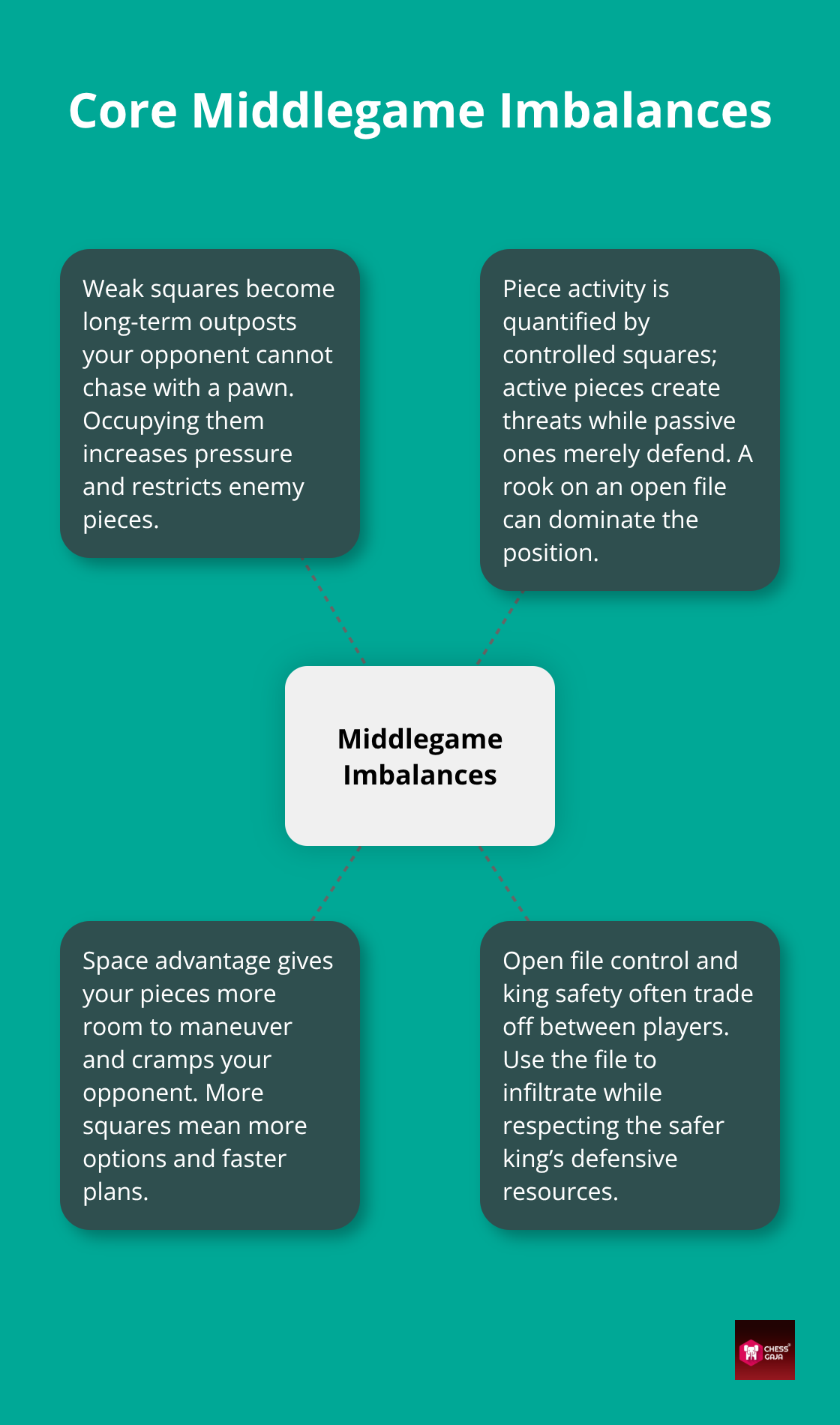
Every middlegame position contains imbalances. Space might favor one side, while piece coordination favors the other. Controlling an open file offers a direct path into the position, whereas a safer king provides long-term stability. These imbalances are not abstract concepts—they are concrete advantages you can spot and exploit.
The strongest players do not play chess by memorizing theory. Instead, top masters read the board, evaluate structural differences, and build a cohesive plan around them. Your job is to learn this skill so you can make decisions faster when the clock is ticking.
Recognizing Weak Squares and Pawn Structures
Start by looking at pawn structures. A weak square is any square your opponent cannot defend with a pawn. If your opponent has a backward pawn on d6, the d5 square in front of it becomes weak. Place a knight on d5 and it becomes almost permanent. In real games, weak squares matter because your pieces stay longer and exert more pressure.
Look for pawns that cannot move forward safely. For instance, a pawn on d6 restricted from advancing creates a backward pawn, turning the square directly in front of it into an outpost. If your opponent has no pawns on e6 or c6 to defend that key square, your knight gains a permanent foothold deep in their territory. Weak squares are real estate for your pieces.
A knight centralized on d5 controls 8 key squares simultaneously, putting direct pressure on critical points like f6, e7, c7, and b6 in enemy territory. Forcing a trade becomes your opponent’s only relief; otherwise, that piece sits there indefinitely to restrict their mobility.
Tournament players often miss weak squares by focusing strictly on immediate threats. Spotting these targets early becomes second nature when asking: where can my pieces sit that cannot be kicked out by a pawn?
Identifying Space Advantage and Piece Activity
Next, examine piece activity. Count how many squares each piece controls. A rook placed on a fully open file can control up to 14 squares across the board, whereas a rook trapped behind its own fixed pawns often controls as few as 2 or 3 squares. This difference is massive under time pressure because the active rook forces your opponent to react while the passive rook does nothing.
Many beginners count material and think that is the position. It is not. A position with equal material but one side having all active pieces and the other having passive pieces is completely different. If you have a rook active on the seventh rank while your opponent’s rook is passive on a8 defending weak pawns, your operational advantage is massive even if material is equal. Activity wins games.
Space advantage means you control more squares in the center and on your opponent’s side. If you have pawns established on d4, e4, and f4 while your opponent’s pawns are restricted to d6, e6, and f6, you control the central space. Your pieces have more room to maneuver. Your opponent’s pieces get cramped. This cramping effect is real-space advantage correlates strongly with winning chances when combined with piece activity.
Evaluating Imbalances to Guide Your Plan
Focus on piece mobility rather than just counting material. If your key pieces dominate central squares and open files while your opponent’s pieces are restricted to passive defense, you have a decisive positional advantage. This is why space matters-it gives your pieces more squares to occupy and more options to create threats.
The key is that space alone does not win. You must use it to activate your pieces further. Once you spot these imbalances (weak squares, piece activity, and space), you have the foundation to build a concrete plan. The next step is to assess your strengths against your opponent’s weaknesses and set realistic objectives that exploit what you have found.
Building Your Plan From Board Strengths
Now that you have spotted weak squares, piece activity, and space advantage, the next step is turning observation into action. This is where most players fail. They see the imbalance but build a vague plan like “improve my pieces” or “attack the king.” Under time pressure, vague plans collapse. You need a concrete objective tied directly to the imbalances you identified in the previous section.
Write Down Your Advantages and Weaknesses
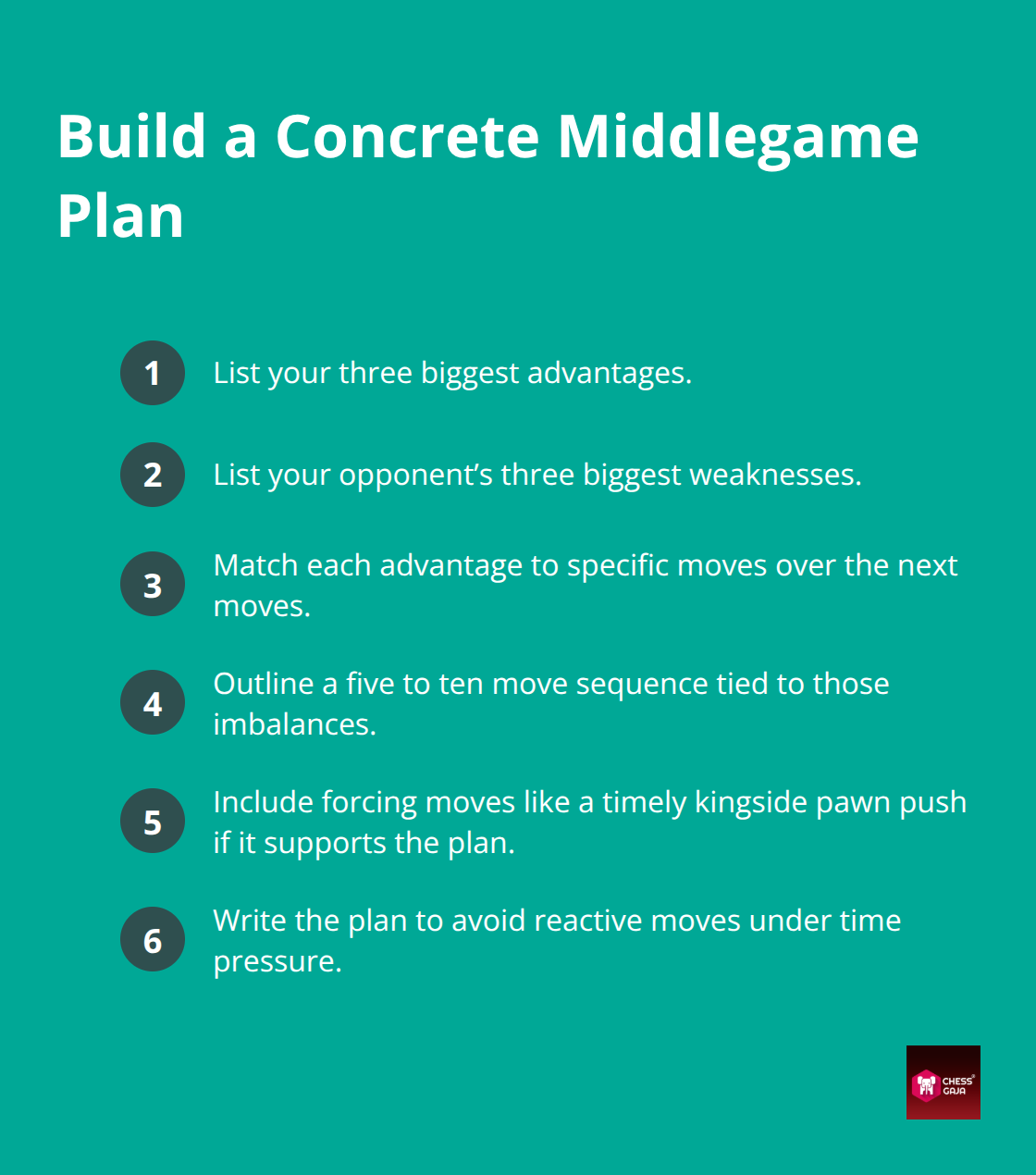
Start by mentally identifying your three biggest advantages and your opponent’s three biggest weaknesses. For instance, controlling the d-file while your opponent’s rook sits passively on a1 serves as advantage number one. Second, occupying a weak square on e5 where no pawn can defend it gives you advantage number two. Finally, an opponent’s king lacking escape squares on the kingside completes advantage three.
Now match these advantages to concrete moves over the next five to ten moves. Your plan might read like this: move one, activate the rook from c1 to the d-file to pressure the weak d6 pawn. Move two, maneuver the knight to e5 to occupy the weak square and threaten f7. Move three, push your kingside pawns to open lines toward the opponent’s king.
This specificity matters because under pressure your brain defaults to reactive moves rather than purposeful ones. Structuring this clear mental checklist forces you to think ahead before the clock pressure hits.
Prepare a Backup Plan Before Your Opponent Responds
Your opponent will not cooperate. The moment you start executing your plan, they will counterattack or defend the weak points you identified. This is normal and expected. Strong players prepare for this by identifying one backup plan before they move.
If your opponent trades off your active rook on the d-file, what do you do next? Do you shift the attack to the queenside where you have space? Do you pivot toward the kingside where their king lacks shelter? Decide this in advance.
Tournament players from the USA, UAE, and Singapore who train with structured coaching often practice this exact scenario in blitz games and rapid tournaments. They play rapid games weekly where they must adapt their plans mid-game, building the neural pathways needed to shift tactics without panic. Your backup plan does not need to be complicated. It needs to be thought through before you are under time pressure.
Execute With Conviction and Speed
The final piece is execution speed. Once you commit to your plan and your backup plan, move with conviction. Hesitation under time pressure leads to mistakes. If your plan is to occupy e5 with your knight and you have calculated that it is safe, play the move. Do not second-guess yourself for 30 seconds while the clock ticks. This requires practice. In tournament games, you face real time pressure where a single moment of doubt costs you seconds you cannot recover.
Many beginners avoid tournaments because they fear this pressure, but the only way to build comfort with it is to play. Start with local beginner sections in your area, progress to rated events as your confidence grows, and gradually move toward regional competitions.
Each tournament teaches you how your mind responds to pressure and where your decision-making breaks down. That feedback is invaluable and shapes how you will handle the final execution phase-recognizing when to push forward and when to consolidate your advantage.
How to Stay Sharp When the Clock is Running
The moment you sit down at a tournament board, your plan becomes secondary. Time pressure transforms decision-making. A move that takes 30 seconds in analysis takes 3 seconds in a real game. The difference between strong players and struggling ones is not their opening knowledge or endgame technique-it is their ability to execute concrete moves under time constraints without falling apart emotionally. Students repeatedly make the same mistake: they know what to do but panic when the clock ticks. This section teaches you how to stay composed and move faster without sacrificing accuracy.
Managing Your Clock Like a Resource
Treat time as a currency you spend on each move. In a standard 40-move game with 90 minutes, you have over 2 minutes per move on average. In a 10-minute rapid game, assuming a standard 40-move average, you have roughly 15 seconds per move. This math matters because it tells you exactly how much thinking time you can afford. Beginners often waste 5 minutes on move 5, then rush moves 20-30 because they panic. Strong players allocate time strategically based on the format: in rapid chess, they might spend 45 seconds on a critical move that decides the game, while saving simple recaptures for 5 to 10 seconds.
A student from Singapore who trained for the Age Group Championship in August 2026 reported that allocating time this way cut her blunders in half within three weeks. She stopped overthinking simple moves and saved seconds for positions where her plan faced threats. You can do the same. Before you move, ask: is this move critical to my plan or just routine? If routine, move in 10 seconds. If critical, take 45 seconds. Emotional control follows from this structure because you trust your moves faster and avoid second-guessing yourself.
Finding Moves Without Freezing
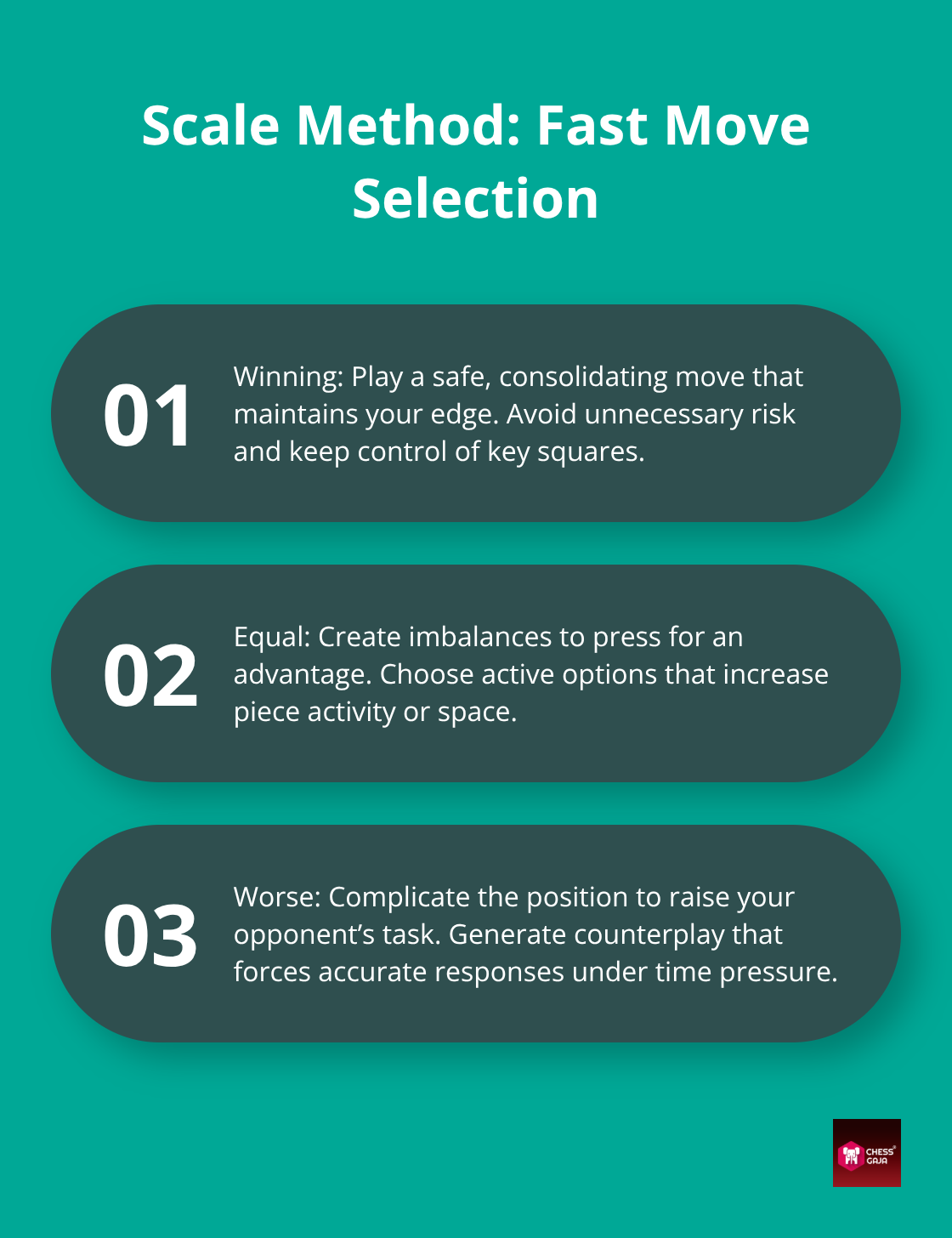
Analysis paralysis kills your clock. You see three candidate moves and spend two minutes evaluating all of them while the clock burns. Instead, use the Scale Method to evaluate positions fast. Ask yourself: am I winning, equal, or worse?
When winning, your job is to maintain control by playing a safe move that preserves your edge. When equal, push for an advantage by creating dynamic imbalances. Should you find yourself in a worse position, focus on complicating the game to force your opponent into accurate calculation under time pressure.
This framework eliminates paralysis because it narrows your choices to one category. A player from Dubai who competes in local rapid tournaments reported that using this filter reduced her decision time from 90 seconds to 20 seconds on most moves. She no longer evaluated every candidate move equally-she filtered first, then evaluated only the moves that matched her position type.
Apply this in your next rapid game: the moment you see the position, classify it as winning, equal, or worse. Then play the move type that fits. Your clock will thank you, and your accuracy will improve because you make decisions from a clear framework instead of emotional impulse.
Knowing When to Attack and When to Hold
The final execution decision is recognizing whether to push forward or consolidate. Many players attack when they should defend and defend when they should attack. The rule is simple: if your opponent has no counterplay and no active pieces, push your advantage. If your opponent has a rook on the seventh rank or a passed pawn moving toward promotion, consolidate first (trade pieces to reduce their attacking potential, then execute your plan).
Tournament players often fail here because they see one threat and panic instead of calculating the full position. When your checkmate sequence lands in 3 moves, it doesn’t matter if their pawn promotes in 3 moves—checkmate ends the game instantly, so attack.
Countering a pawn that promotes in two moves without facing direct checks requires pausing immediately to stop the pawn first. Fast 5-move checkmate sequences outweigh an opponent’s 8-move threat, giving you the green light to strike. Conversely, holding off a fast 5-move checkmate threat from your opponent demands immediate defense over your own 8-move attack. This counting method takes 10 seconds and saves entire games.
Final Thoughts
Middlegame positional play rests on three habits: spotting imbalances, building concrete plans, and executing under pressure without panic. Weak squares identified in the opening transform into permanent outposts for your pieces. Meanwhile, space advantages create the foundation for devastating attacks, while structured time management techniques keep your execution sharp when the clock ticks down.
Knowing these principles and applying them in real games are different things. The gap between understanding and execution closes only through consistent practice in tournament settings. Each game teaches you how your mind responds to pressure, where your calculation breaks down, and which decisions you make too slowly. Such direct feedback is irreplaceable and shapes your growth faster than any textbook ever could.
At Chess Gaja, our coaches work with students across the USA, UAE, and Singapore who encounter these exact hurdles. While many players understand positional concepts in theory, translating that knowledge into rated tournament games requires structured practice.
Book a Paid Starter Class for a professional skill evaluation, and your coach will assess your current rating, identify your biggest weaknesses in middlegame positions, and build a personalized study plan that bridges the gap between knowing and doing.