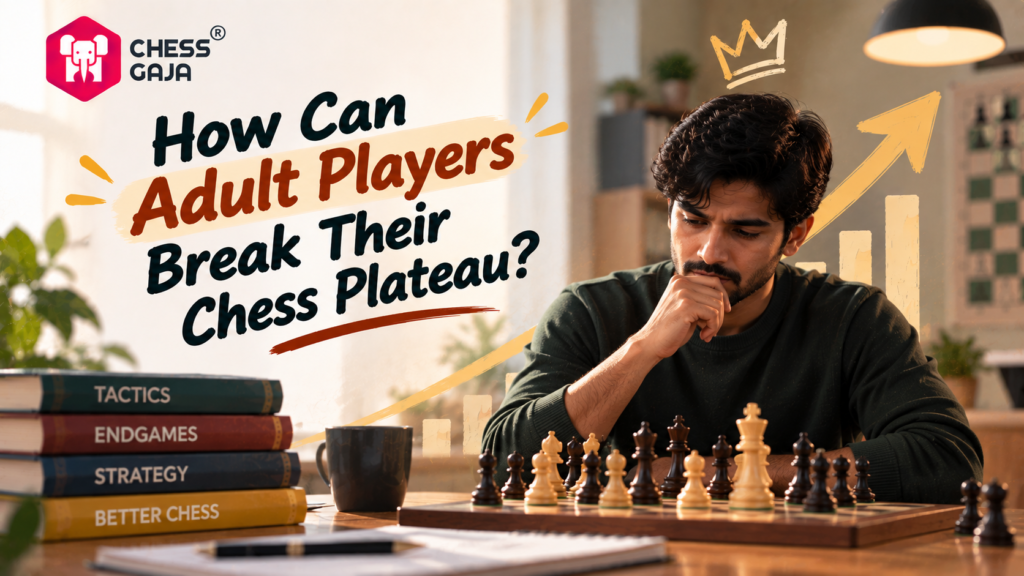
Adult chess players often hit a frustrating plateau. You have less time than younger players. Old habits hold you back, and without proper guidance, progress stalls.
We at Chess Gaja have worked with hundreds of adult learners who transformed their game through structured improvement. This post shows you exactly how to build a realistic adult chess improvement plan that delivers measurable rating gains.
Why Adult Chess Players Plateau
The Fragmentation Problem
Adult learners face three specific obstacles that younger players simply do not encounter. The first is fragmented practice time. Most adults can dedicate only 30 to 60 minutes per session, spread across irregular days. This inconsistency damages pattern recognition, which builds through repeated exposure to similar positions. Distributed practice with consistent spacing improves retention compared to irregular gaps. Many adults carry ingrained habits from years of casual play. They move pieces without calculation, play openings by feel, and avoid endgame study altogether. These habits run deep and actively interfere with improvement because they feel natural. Unlearning requires deliberate, uncomfortable practice that contradicts your instincts.
The Feedback Gap
Without external feedback, adults cannot identify which habits hold them back. You might play a position reasonably well and assume your approach works, when in reality a coach would spot a recurring strategic weakness that costs you games at higher levels. This blind spot persists because casual play rewards intuition over principle. A coach analyzes your games, spots patterns in your losses, and prescribes a study sequence that matches your specific gaps. Self-assessment rarely replaces professional evaluation. What feels like solid play often masks fundamental weaknesses that only emerge under tournament pressure.
The Structure Mismatch
The third barrier is the absence of personalized structure. Free online resources and YouTube lessons treat all players as one group, but a player rated 1200 needs entirely different priorities than a 1600-rated player. An adult at 1200 should focus ruthlessly on tactical vision and basic endgames, yet most self-taught players waste months on obscure opening variations. This misdirected effort creates frustration because you feel busy without seeing rating progress. A coach identifies your main weaknesses and prescribes study that matches your current level. The right structure (tailored to your rating and tournament schedule) transforms practice time into measurable gains rather than spinning through generic content that may not address your actual weaknesses.
How to Structure Your Daily Practice Without Wasting Time
The 45-Minute Daily Routine That Works
Most adult chess players fail not because they lack talent, but because they practice the wrong things in the wrong order. You have limited time, so every session must count. The path forward is simple: establish a consistent 45-minute daily routine, prioritize endgame fundamentals over opening memorization, and use tactical puzzles to sharpen your decision-making under time pressure.
Start with a non-negotiable 45-minute window each day. Consistent daily practice beats sporadic longer sessions. Repeated exposure helps your brain consolidate chess patterns much faster.
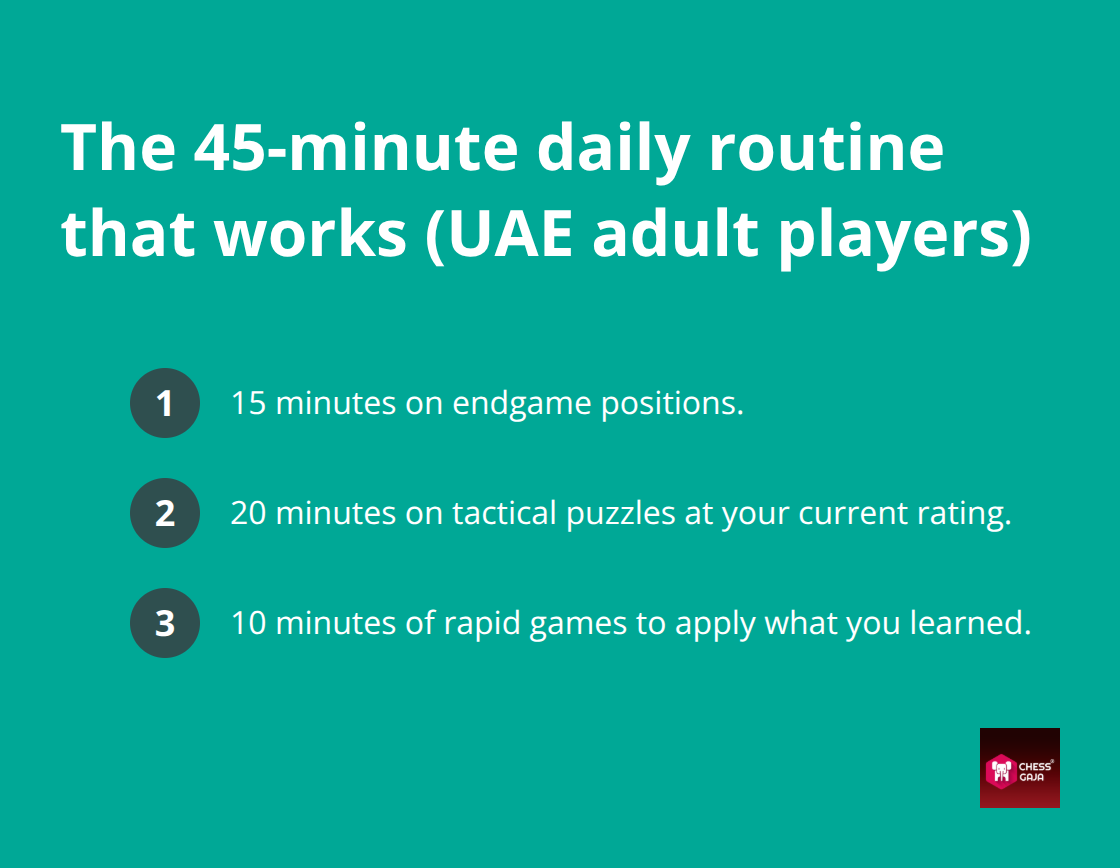
Divide your 45-minutes daily sessions into 3 segments targeted blocks:
- 10 minutes reviewing key positions
- 15 minutes on endgame fundamentals
- 20 minutes on calibrated tactical puzzles
This sequence matters because each segment builds on the previous one.
Adults who follow this routine report measurable rating improvement within 8 to 12 weeks. The key is consistency: 45 minutes every single day beats three 2-hour sessions per week because your pattern recognition strengthens through daily reinforcement, not volume.
Why Endgames Come First
Endgame mastery must come before opening study. Most adult players spend months learning the Sicilian Defense or the Ruy Lopez when they cannot correctly play a rook and pawn endgame. This is backwards. A player rated 1200 to 1600 wins games by superior endgame technique, not opening novelty.
Learn the fundamental endgames: king and pawn versus king, rook and pawn versus rook, and basic queen endgames. Work through these positions on a physical board or interactive analysis board first. Play through the key variations step-by-step, and only after understanding the winning or drawing technique should you practice calculating the lines mentally. This builds calculation strength that applies everywhere. While you only need basic opening principles (controlling the center, early piece development, and quick castling) to reach a solid middlegame, deep opening memorization should take a backseat until your endgame and tactical foundations are secure.
Tactical Puzzles at Your Exact Level
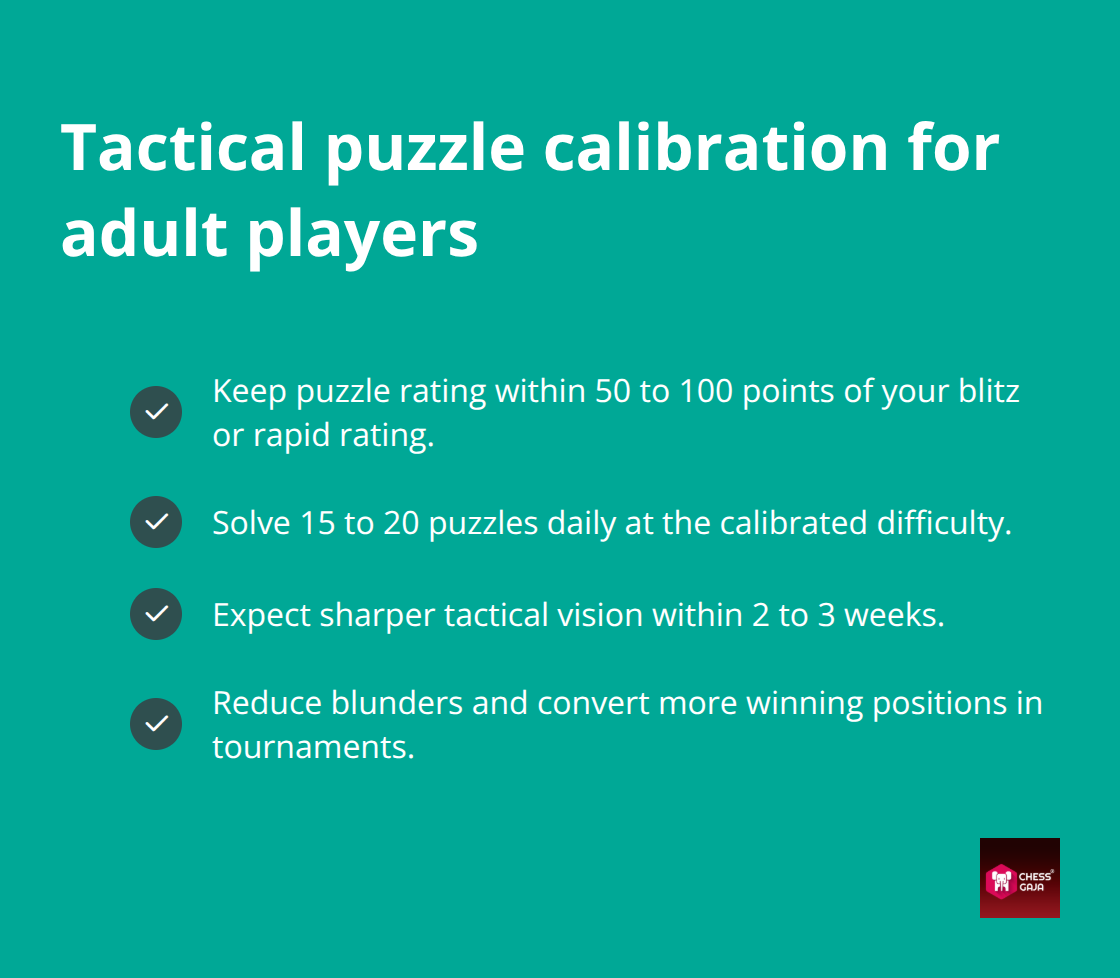
Tactical puzzle training must match your rating exactly. If you solve puzzles rated 300 points above your current rating, you build frustration and false confidence. If you solve puzzles 300 points below, you waste time on patterns you already know. Use Chess.com’s puzzle rating system strategically. Target puzzles rated 50 to 100 points above your current puzzle rating—not your rapid rating. Puzzle ratings scale differently than game ratings, so focusing on your puzzle benchmark ensures you stay in your optimal challenge zone.
Solve 15 to 20 puzzles daily at this calibrated difficulty. This trains your brain to spot tactical patterns in real games because you see the exact patterns that appear at your playing strength. Adults who maintain this discipline see their tactical vision sharpen within 2 to 3 weeks, and this directly translates to fewer blunders and more winning positions in tournament play.
Moving From Solo Practice to Coached Development
Your daily routine builds a solid foundation, but solo study has limits. You cannot identify your own blind spots because you lack the external perspective that separates casual improvement from competitive advancement. A coach analyzes your games, spots patterns in your losses, and prescribes a study sequence that matches your specific gaps. Structured coaching accelerates your progress beyond what practice alone can achieve.
Why Coaching Beats Solo Practice for Adult Players
The Blind Spot Problem
A coach’s first job is spotting what you cannot see about your own game. When you play alone, you develop blind spots that feel invisible because they match your existing habits. An adult rated 1400 might think their opening play is solid. However, a coach analyzing your games quickly spots recurring flaws. You might misplace a knight on move eight, waste tempo, or reach middlegames without a clear plan. These patterns repeat because you have never heard external feedback. A coach identifies the exact moves and positions where your game breaks down, then prescribes a targeted study sequence that addresses these gaps directly. This is not generic advice-it is surgical correction based on your actual play.
How Coaches Build Your Personalized Study Plan
A coach creates your personalized study plan in your first session. The coach reviews your recent games on Chess.com or Lichess, identifies your rating level and playing patterns, then builds a three-month study roadmap tailored to your strengths and weaknesses. If you are rated 1500 and tend to lose in the middlegame, your plan prioritizes tactical pattern recognition and position evaluation over opening preparation. If you are 1600 and struggle in endgames, your plan front-loads fundamental endgame positions before touching opening theory. This personalization matters because a generic curriculum wastes your limited time.
Setting Measurable Milestones
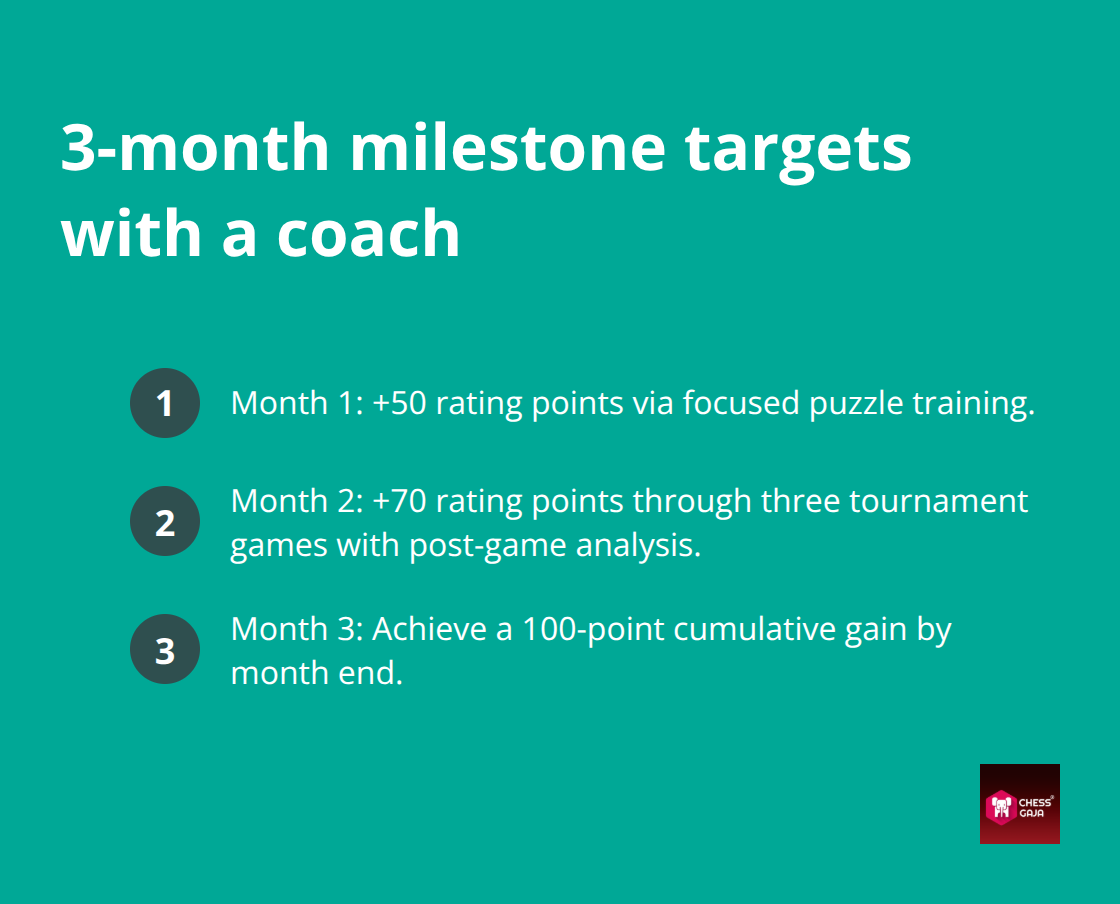
Your coach sets specific, measurable targets that keep you accountable. Target realistic, steady progress: aim for a 30- to 50-point rating gain over your first six to eight weeks of focused training, building toward a solid 100-point gain across a full 3- to 6-month cycle. Strategic growth in chess comes from consolidated understanding, not linear weekly jumps. These targets track progress month to month, not vaguely hoping improvement happens.
Coaches also recommend specific chess books, puzzle platforms calibrated to your rating, and tournament schedules that align with your study cycle (ensuring you play when your preparation peaks, not randomly).
The Acceleration Effect
Adults who work with a coach report significant rating gains because the coach eliminates wasted study time and focuses practice on what matters most for your specific rating level. This structured guidance transforms adult improvement from a scattered effort into a coordinated plan where every element-daily puzzles, endgame study, tournament play, and coach feedback-reinforces the same goals. The difference between self-assessment and professional evaluation is stark: what feels like solid play often masks fundamental weaknesses that only emerge under pressure in rated tournaments.
Final Thoughts
Adult chess improvement happens fastest when you pair consistent daily practice with professional coaching that identifies your specific weaknesses. Most adults see measurable rating gains within 8 to 12 weeks when they follow a structured routine and work with a coach who analyzes their games and prescribes targeted study. A 1200-rated player can realistically reach 1300 to 1350 in three months. Success requires disciplined puzzle training, basic endgame study, and regular tournament play.
Solo study plateaus because you cannot see your own blind spots-you practice what feels productive rather than what actually matters for your rating. A coach eliminates this guesswork by analyzing your games, identifying your specific weaknesses, and prescribing a study sequence that matches your current level. Adults working with a coach report 50 to 100 rating point gains per month in their first three months, compared to 10 to 20 points monthly for self-taught players.
Your next step is to book a Paid Starter Class with Chess Gaja for a professional skill evaluation. Your coach will review your recent games, identify your specific weaknesses, and build a three-month roadmap that delivers real rating gains. Stop spinning through generic content and start with a coach who knows exactly what your adult chess improvement plan needs.