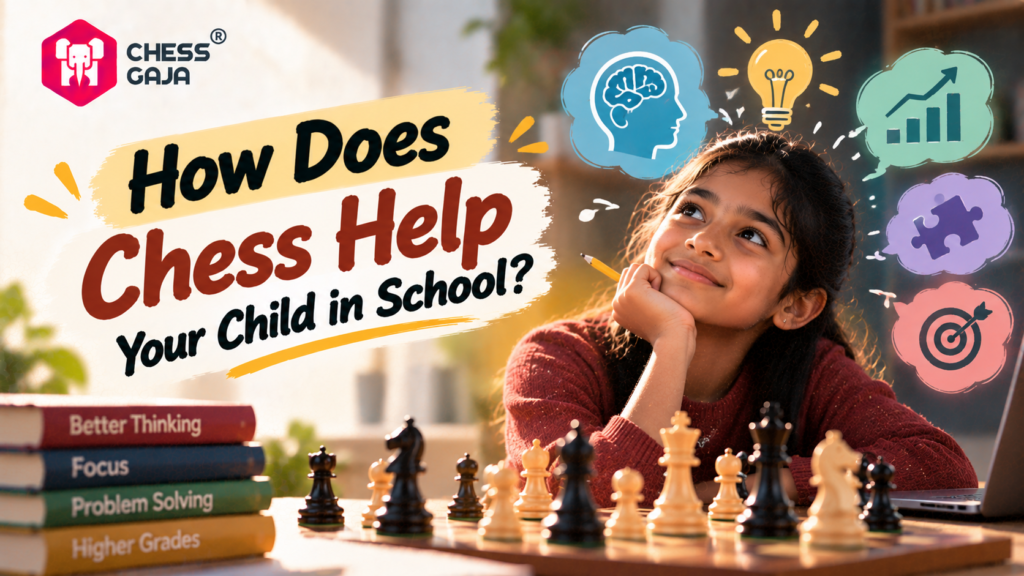
Last year, a 12-year-old from Dubai improved her math grades by two full letter grades after joining a chess club. Her parents noticed something shift-not just in her test scores, but in how she approached problems.
The cognitive benefits of chess extend far beyond the board. At Chess Gaja, we’ve seen thousands of young players develop sharper focus, faster decision-making, and stronger memory through structured play and coaching.
How Chess Sharpens Your Child’s Decision-Making
The moment a young player sits down at the board, their brain enters a state of high-demand problem-solving. Unlike textbook math, where the answer is fixed, chess demands real-time decisions with immediate consequences. A 10-year-old from Singapore improved her decision-making within six months of structured coaching after initially playing impulsive moves without thinking two steps ahead. Her coach taught her a systematic process: look for your opponent’s threats first, then identify your opportunities, then choose the move that accomplishes the most. This three-step framework became her mental habit both on and off the board.
Chess training improves working memory, attention, and decision-making. These exact cognitive skills transfer directly to how students handle exams, group projects, and complex school assignments.
When a young player evaluates multiple move options and weighs their consequences before committing, they develop inhibitory control (the ability to resist impulsive choices and think through outcomes). This isn’t theoretical; it’s measurable. Students in Grandmaster-led programs build this skill much faster. Their coaches model expert decision-making in real time, clearly showing why strong moves succeed and weak moves fail.
Recognizing Patterns Before Your Opponent Does
Pattern recognition separates casual players from serious ones. A chess position contains recurring structures-a fork (a single piece attacking two targets simultaneously), a pin (restricting a piece to protect a higher-value target or the King), a skewer, or a discovered attack (moving one piece to unleash an attack from another). Young players who study these patterns daily through puzzles and coached games internalize them visually. When they see a similar setup in a tournament game, they recognize the winning move instantly, without calculation.
A 14-year-old from Dubai raised his FIDE rating from 1,400 to 1,650 in 18 months. He combined daily puzzle drills with post-game analysis to sharpen both pattern recognition and calculation. He stopped playing randomly and started playing with purpose because his brain had absorbed hundreds of tactical patterns. Puzzle training works because it’s the fastest way to train your visual cortex to spot winning opportunities. The more patterns a young player sees, the faster their brain recognizes them in live games.
Learning to Analyze Why You Lost
Competitive players often skip the most valuable part of chess: post-game analysis. A 13-year-old from New York lost a tournament game and wanted to move on. However, her coach insisted on a 30-minute review to pinpoint the exact move where her winning position slipped. She realized she had missed a simple tactic her opponent had set up three moves earlier. The next week, facing a similar position, she spotted the trap immediately and won.
This reflective process-examining your own thinking and identifying where it broke down-is meta-cognition. It’s the skill that transforms losses into learning. Students who analyze their games with feedback from a rated coach improve significantly faster than those who play without review, because they’re not repeating the same mistakes. Every student benefits from structured game review, whether through a coach or through self-analysis tools that highlight critical moments.
Why Pressure Reveals Your True Skill Level
Tournament play exposes weaknesses that casual games hide. A young player might calculate perfectly in a relaxed setting but panic when the clock ticks down. Time pressure forces faster decisions, and faster decisions reveal whether a player truly understands positions or simply got lucky. The students who thrive under pressure are those who have trained their pattern recognition and decision-making processes until they become automatic. When your brain recognizes a pattern instantly, you don’t need extra time to think-you move with confidence.
This is why competitive experience matters. Tournament play teaches young minds to stay calm under high stakes. It helps them trust their training and execute strong moves even under pressure. The cognitive skills developed through chess-working memory, attention control, and rapid pattern recognition-all sharpen under the pressure of real competition. As your child’s decision-making improves and their pattern library grows, they’re ready to test these skills in tournament settings where the real learning accelerates.
How Chess Boosts School Performance
Students frequently see noticeable improvements in math grades after joining a chess program. Parents also observe a deeper shift: children stop rushing through problems and start approaching them methodically. This isn’t coincidence. Chess training directly enhances mathematical understanding and reading comprehension, because chess trains the exact cognitive processes that school demands. Learning to calculate move sequences requires strong mental discipline. Students apply this exact same focus when solving multi-step math problems or analyzing complex reading passages. Chess provides immediate feedback, as a bad move quickly loses material or the game. In contrast, schoolwork often feels abstract until test day.
Concentration and Focus Transform Academic Results
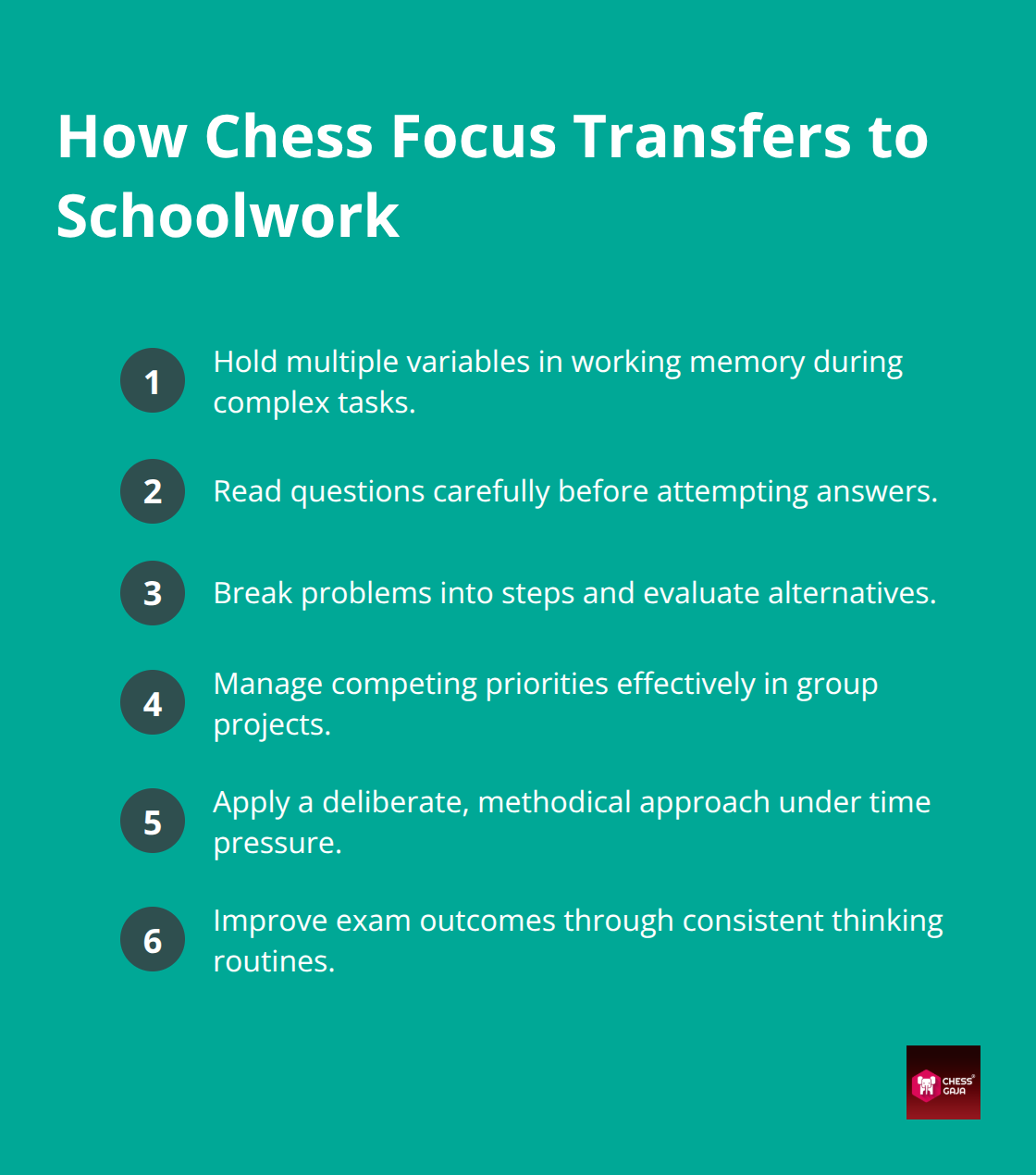
The real performance gain comes from improved concentration and focus, which chess develops faster than almost any other activity. Regular chess practice builds working memory. Students learn to hold multiple positions and threats in mind simultaneously, then evaluate options to find the best move. This exact skill transfers directly to tackling word problems, writing essays with multiple arguments, or managing a group project with competing priorities. A 12-year-old from London who initially rushed through exams without reading questions carefully began analyzing chess positions methodically under coaching. Within two months, his exam performance improved because he applied the same deliberate approach to test-taking.
Schools and parents often assume academic improvement requires more tutoring in the subject itself, but cognitive research shows that targeted chess cognitive training creates a foundation that lifts performance across all subjects.
Slowing Down Eliminates Careless Mistakes
Chess teaches students to slow down and think before acting, which directly combats the impulsivity that tanks academic performance. Students who train consistently show better time management, fewer careless mistakes, and stronger problem-solving when facing unfamiliar challenges. Chessboard habits transfer seamlessly to homework, tests, and real-world challenges. Young players learn to check for threats, evaluate alternatives, and resist hasty decisions. A student who learns to pause and analyze a chess position before moving develops the same pause-and-analyze reflex that prevents test-taking errors and improves written work quality.
Structured Coaching Accelerates Cognitive Gains
Structured chess coaching accelerates cognitive gains far better than casual play. A rated coach teaches students to think systematically, analyze errors, and apply those lessons immediately. Professional coaches understand how to translate chess thinking into academic thinking, helping young players see the connection between board strategy and classroom success. The students who experience the fastest academic improvement are those who receive consistent feedback on their decision-making process, not just their move choices. This structured approach transforms chess from a hobby into a cognitive training tool that directly strengthens the mental skills schools measure and reward.
Starting Chess Early Creates Lifelong Cognitive Advantages
How Early Training Builds Mental Resilience
Young players who start chess between ages 5 and 10 develop mental resilience and executive function at a pace that casual learners never reach. A 9-year-old from Abu Dhabi lost her first tournament game and wanted to quit entirely. Her coach spent 20 minutes helping her analyze the specific moves that cost her the game, then played a practice match where she applied the lesson immediately and won. That single experience-losing, analyzing, and winning the rematch-taught her that failure is information, not verdict. Students who train consistently under coaching develop this mindset faster because they experience structured failure and recovery repeatedly. Within 12 months, this player improved her rating from 800 to 1,200. Her parents noticed she began tackling difficult school subjects with the exact same analytical calm.
Why Young Brains Rewire Faster Through Chess
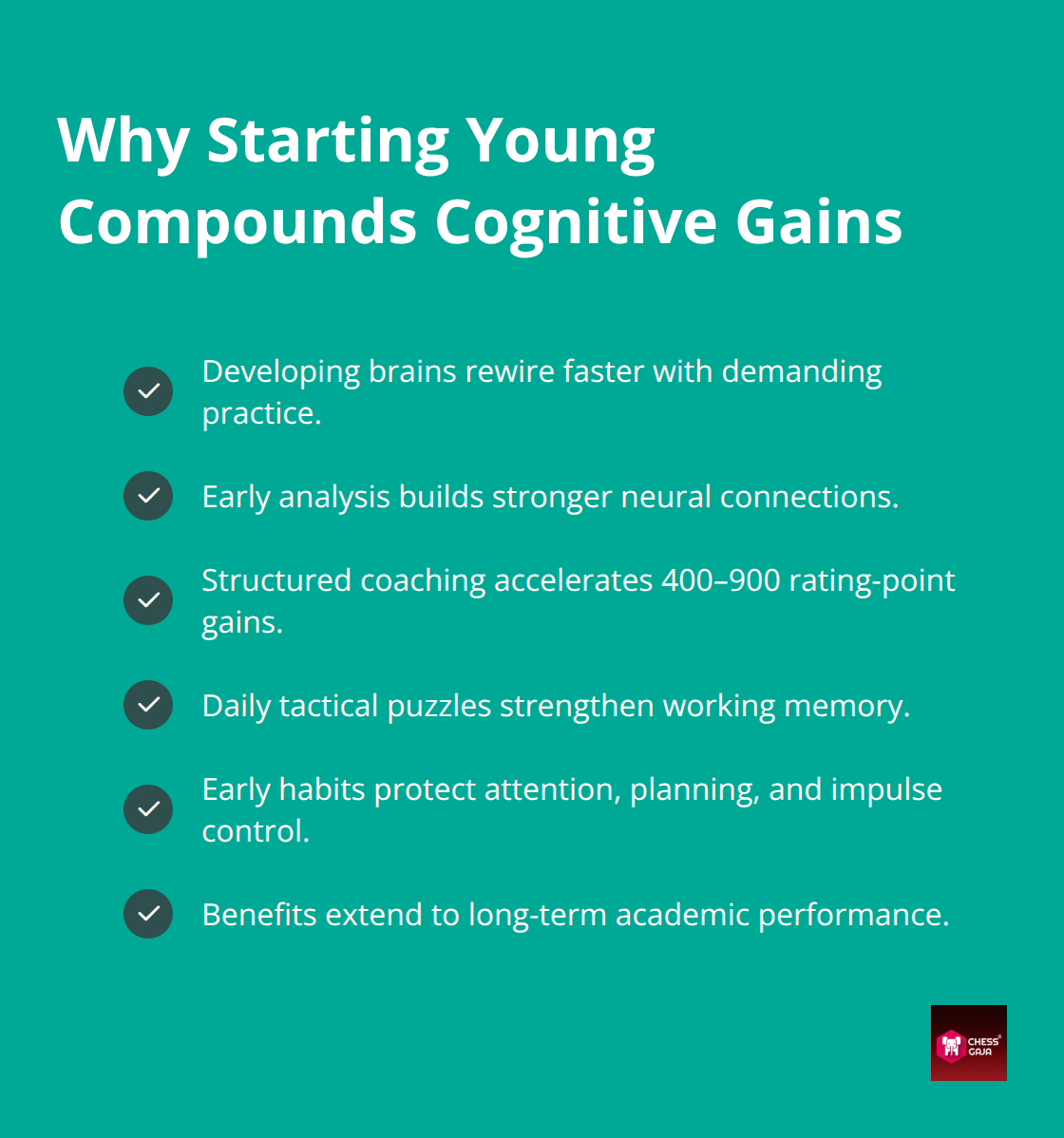
The cognitive shift happens because chess forces young minds to hold multiple variables in working memory simultaneously-your threats, your opponent’s threats, position strength three moves ahead-then make decisions when the outcome is genuinely uncertain. This exact mental process strengthens executive function, the brain’s command center for planning, impulse control, and task switching. Chess-related cognitive training may help protect older adults from dementia by challenging multiple cognitive domains simultaneously, which means the neural pathways built early through chess practice provide lasting protection. Starting young matters because developing brains are more plastic; they rewire faster in response to demanding practice. A child who learns to analyze positions systematically builds strong neural connections during peak formative years. Students who achieve consistent rating gains under Grandmaster guidance started with structured coaching early because that consistency compounds.
Cognitive gains stem from structured chess practice. While chess memory is specialized, the habits of visual focus and information processing directly support complex math and reading comprehension. Students who solve 10 tactical puzzles daily for three months show measurable improvements. They process and manipulate information much better during math and reading tasks.
Pattern Recognition Develops Before Academic Pressure Hits
The practical advantage of starting early is that your child’s brain develops automatic pattern recognition before adolescence, when academic demands accelerate. A young student who spent time in group classes and daily puzzle training internalized hundreds of tactical patterns visually. She entered higher grades with a strong cognitive toolkit: rapid pattern recognition, systematic decision-making, and emotional regulation. As a result, heavy homework loads and test pressure felt manageable rather than overwhelming. This shows in academic outcomes: students who receive structured chess training early demonstrate stronger performance gains in mathematics and reading than those who start later, because these foundational cognitive skills are embedded during peak learning years.
Early Starters Avoid the Frustration Plateau
Starting early also means your child avoids the frustration plateau that older learners hit. A 16-year-old beginner must catch up cognitively to peers who’ve had years of pattern training, which creates discouragement. A 6-year-old has no such comparison; they simply improve at their own pace and celebrate each small win. This positive reinforcement loop during formative years builds intrinsic motivation-the child plays chess because they love it and feel competent, not because parents force it. This intrinsic drive keeps students committed to chess long-term. It separates players who achieve lasting cognitive gains from those who drop out early. The students who reach national champion level started young, trained consistently under rated coaching, and developed mental resilience through dozens of tournament experiences. That trajectory takes time, which is why starting at 6 or 7 gives your child the runway to develop mastery by their teens.
How Cognitive Advantages Compound Over Time
Because early practice turns complex analytical thinking into muscle memory, these cognitive advantages compound smoothly into long-term academic and personal success. Early pattern recognition builds a foundation of quick, confident decision-making, turning potential high-pressure situations into opportunities for growth. Trying to build this level of automatic intuition starting at age 14 or 15 becomes significantly harder, as teenagers must balance chess alongside heavier academic loads, extracurricular, and social commitments. By starting around age 7, a young player naturally builds hundreds of hours of deliberate practice during their most adaptable learning years. This early investment creates lasting neural connections, sharper problem-solving instincts, and an enduring mental resilience that stays with them well into adulthood.
Final Thoughts
The cognitive benefits of chess span every age group, from a 6-year-old learning their first moves to a teenager competing in regional tournaments. Young players develop sharper decision-making, stronger pattern recognition, and mental resilience that transfers directly to academic performance and life skills. Students who start early compound these advantages over years of consistent practice, building neural pathways that support focus, memory, and problem-solving long into adulthood.
Professional coaching accelerates these cognitive gains dramatically. A rated coach teaches your child to think systematically, analyze their mistakes, and apply lessons immediately to the next game. Without coaching, young players often repeat the same errors and plateau quickly, but with coaching they develop the analytical habits that separate casual players from serious ones. The difference is measurable. Students trained under Grandmaster guidance across 40+ countries often gain 400 to 900 rating points over 12 to 24 months, benefiting from direct feedback on their decision-making process.
The next step is simple: book a Paid Starter Class with one of our coaches at Chess Gaja. During this session, we evaluate your child’s current chess level and identify their cognitive strengths. We then design a personalized learning path matching your family’s schedule and goals, giving you a clear roadmap for their chess journey.