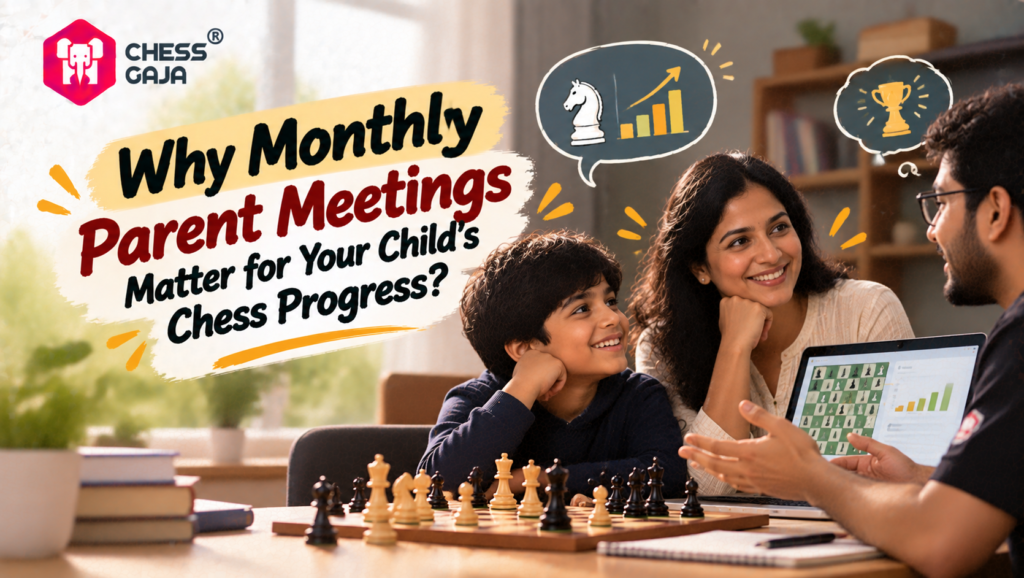
Your child just earned their first rating point. Or maybe they just played in their first tournament. Either way, you’re wondering: what happens next?
At Chess Gaja, we’ve found that parents who stay connected to their child’s progress see faster improvement. Monthly parent meetings give you direct insight into your child’s strengths, growth areas, and realistic goals-straight from their coach and our Grandmaster team.
Why Monthly Meetings Keep Your Child on Track
The Competition Landscape Demands Structured Review
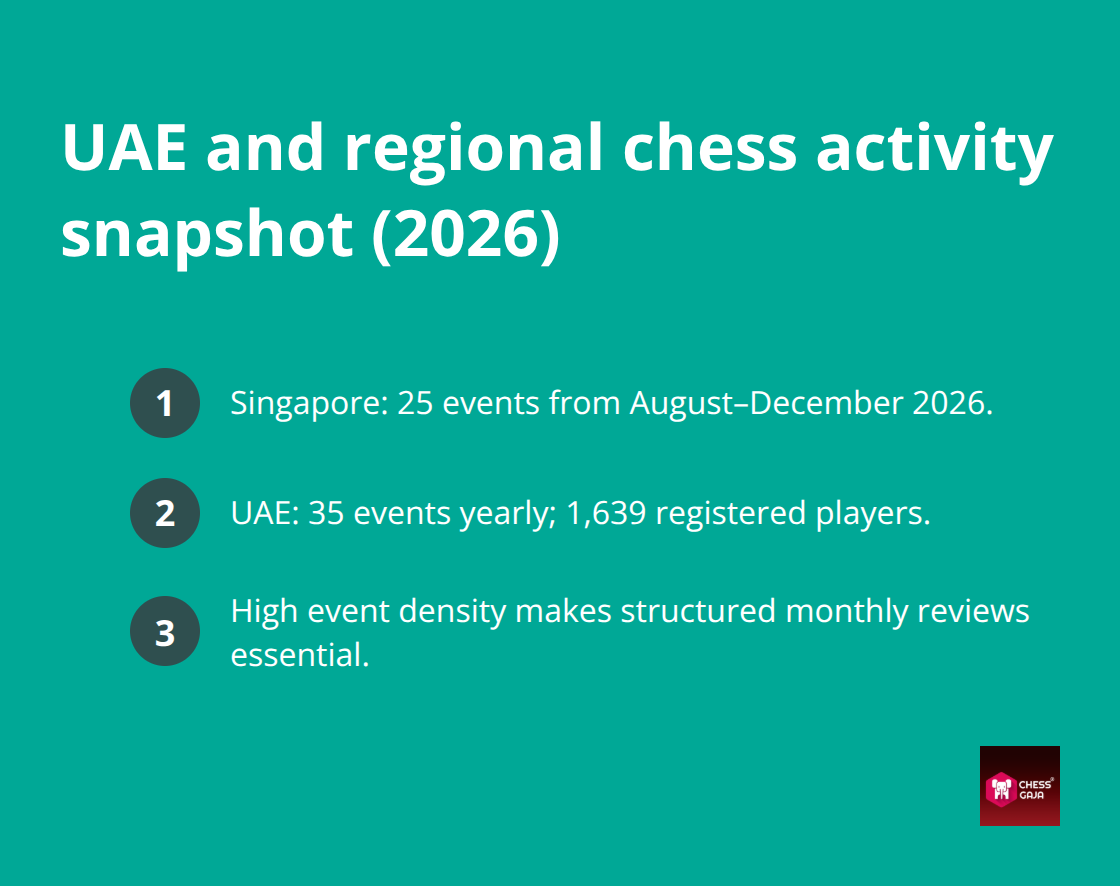
The Singapore Chess Federation calendar lists dozens of events annually across rapid, blitz, and standard formats. The UAE Chess Federation runs 35 events annually with 1,639 registered players.
In the USA, scholastic chess participation has grown steadily, with thousands of young players competing in state and national tournaments each year. This density of competition creates a real problem: without structured review, parents lose sight of whether their child actually improves or simply accumulates tournament results. Monthly parent meetings solve this by anchoring progress to concrete data. You see your child’s rating trajectory, identify which tournament formats they excel in, and spot skill gaps before they become obstacles.
Pattern Recognition Reveals Where to Focus
A child may score well in rapid events but struggle in standard play. This usually reveals a need for deeper calculation training and board stamina rather than quick intuition. Similarly, a player with solid tactics but weak opening play highlights a clear need to master fundamental opening principles and plan transition into the middlegame. This isn’t guesswork-it’s pattern recognition based on actual games and performance metrics. Without these meetings, you might spend months on irrelevant practice while your child plateaus in the areas that matter most. Your coach tracks which concepts stick and which need reinforcement.
You learn how your child absorbs chess concepts best—whether through deep game analysis, structured puzzle sets, or active coaching sessions.
Realistic Goals Prevent Frustration and Burnout
Many parents set targets based on age or peer comparison rather than their child’s actual trajectory. A child rated 1200 might improve 150-200 rating points in six months with focused work. Monthly meetings with your child’s coach ground expectations in what is actually achievable. They account for your child’s current skill level, practice time, and tournament schedule.
You’ll learn whether your child needs more tournament exposure to build confidence, deeper tactical training to reduce blunders, or time-management drills under clock pressure. This alignment between what you expect and what’s realistic prevents frustration and keeps your child motivated. It also prevents over-training, which burns out young players.
What This Alignment Looks Like in Practice
Families who attend monthly meetings report higher confidence in their child’s progress and fewer moments of doubt about whether the coaching investment pays off. The coach identifies whether your child needs tournament exposure, tactical reinforcement, or time-management work. You understand your child’s actual learning pace rather than comparing them to peers. You catch skill gaps early, when they’re easiest to address. This structured feedback loop transforms coaching from a guessing game into a measurable development process. With this foundation in place, the next step is understanding what happens inside these meetings and how they connect to your child’s day-to-day progress.
Inside Your Monthly Parent Meeting
The Structure That Transforms Data Into Action
Each month, you sit down with your child’s coach for a structured 30-minute conversation focused on one goal: turning data into action. This isn’t a casual check-in. It’s a working session where your child’s actual game records, puzzle completion rates, and tournament results drive every decision. The coach opens by walking through your child’s performance in the previous month’s tournaments. If your child played in a Singapore Chess Federation event or a UAE rapid tournament, the coach analyzes specific games—not to criticize, but to identify patterns.
Pattern Recognition Drives Your Study Plan
A child might navigate the opening well against a 1350-rated player, yet lose an equal endgame to a 1400-rated opponent. This reveals solid opening preparation alongside a clear weakness in endgame conversion. That single structural observation becomes your primary study focus for the next four weeks. The coach then evaluates whether the identified gap matches your child’s rating trajectory.
A 900-rated player who struggles with basic endgame technique should focus on basic checkmating patterns and simple piece coordination before tackling pawn endgames.
A 1600-rated player, on the other hand, might need structured rook endgame principles before refining their positional understanding. This calibration-matching study intensity to actual rating and skill level-prevents wasted effort.
The coach then shares your child’s puzzle completion data from the previous month. If your child consistently solves tactical puzzles but struggles with positional puzzles, the personalized study plan shifts toward positional understanding. You leave the meeting with a concrete one-month study schedule: 20 minutes of endgame drills on Monday and Wednesday, 15 minutes reviewing critical opening pawn structures on Friday, and 10 puzzles daily from a curated set matched to your child’s weak spots. The coach also recommends specific chess resources-a particular book chapter, a software tool, or a video series-rather than vague suggestions to practice more.
Tournament Planning Prevents Emotional Decisions
The second half of the meeting focuses on tournament planning. If your child tries for the National Blitz Championships in September, the coach explains what skill gaps matter most for blitz success: faster pattern recognition and time management under pressure. The study plan shifts accordingly-more 5-minute blitz games, timed puzzle solving, and rapid decision-making drills.
If your child struggles in standard play but excels in rapid, the coach might recommend practicing longer time-control games in training sessions first to build stamina and focus before jumping back into multi-day standard tournaments. This forward-looking approach prevents parents from making emotional decisions based on a single tournament loss.
You understand that a disappointing result in one event might actually be the right stepping stone toward your child’s longer-term goal. The coach also addresses your questions directly. If you’re concerned your child is losing confidence after three consecutive losses, the coach explains what the games actually show: maybe the losses reveal coachable mistakes rather than a lack of talent. Maybe your child needs a break from tournaments to rebuild through puzzle training. Maybe the tournament schedule is too dense. These conversations anchor your parenting decisions in chess reality, not in anxiety or comparison to other families.
What Happens Between Meetings Matters Just as Much
You leave with clarity on whether your child is progressing, where exactly they need work, and what realistic improvement looks like over the next 90 days. But the real progress happens in the weeks between meetings. Your child completes the study plan, plays practice games, and solves puzzles tailored to their weak spots. You track their performance through tournament results and puzzle completion rates. When the next monthly meeting arrives, you and the coach have concrete new data to analyze. The cycle repeats-pattern recognition, skill gap identification, customized study plan, tournament planning.
This rhythm transforms coaching from a guessing game into a measurable development process. With this foundation in place, the question becomes: how do you actually support your child’s progress on the days when you’re not in a meeting with the coach?
What Happens Between Coaching Sessions
The monthly meeting provides direction, but real chess development occurs in the four weeks that follow. Families who actively track progress between meetings see faster rating gains. Those who simply attend sessions often plateau. The difference isn’t talent-it’s structure. After each coaching session, your child receives an AI-powered class summary delivered to your LMS dashboard. This summary captures what was taught, which concepts your child struggled with, and exactly what practice work matters most for the next seven days. Instead of relying on your child’s memory of what happened in class, you have a precise record.
Data-Driven Practice Replaces Guesswork
A typical summary shows that your child spent 25 minutes mastering tactical pattern recognition and 15 minutes applying those patterns to basic endgame positions. It flags that your child missed several back-rank tactic puzzles-a clear signal that back-rank patterns need reinforcement before moving forward. You don’t guess what to practice. You follow the data. The puzzle sets recommended in these summaries are never generic. They’re calibrated to your child’s current rating and the specific weak spots identified in that week’s coaching session. A child rated 950 who struggles with basic tactics receives 15 tactical puzzles focused exclusively on fundamental double-attacks and back-rank patterns, not a random assortment of 50 mixed puzzles.
A 1300-rated player who regularly blunders in complex tactical positions receives puzzles tied directly to calculation stability and piece coordination. Your child solves 10–15 puzzles daily from these tailored sets. Within two weeks, the improvement appears in tournament games. The pattern recognition that took months to develop through generic practice happens in weeks through targeted work.
Tournament Analysis Connects Results to Training
Between monthly meetings, you monitor your child’s actual game performance in real time. If your child played in a Singapore Chess Federation scholastic event or a UAE rated rapid tournament, you review the specific games within 48 hours while the positions are fresh. Your coach provides analysis of critical moments-the move where your child lost material, the endgame where time pressure caused a blunder, the opening where a small inaccuracy snowballed. This analysis connects directly to the study plan. If your child lost a game because of weak endgame technique, that week’s puzzle practice shifts toward endgames. If time management cost a rapid event, the next two weeks include dedicated rapid training games with strict time-budgeting constraints to practice paced decision-making.
The Momentum Cycle Drives Consistent Improvement
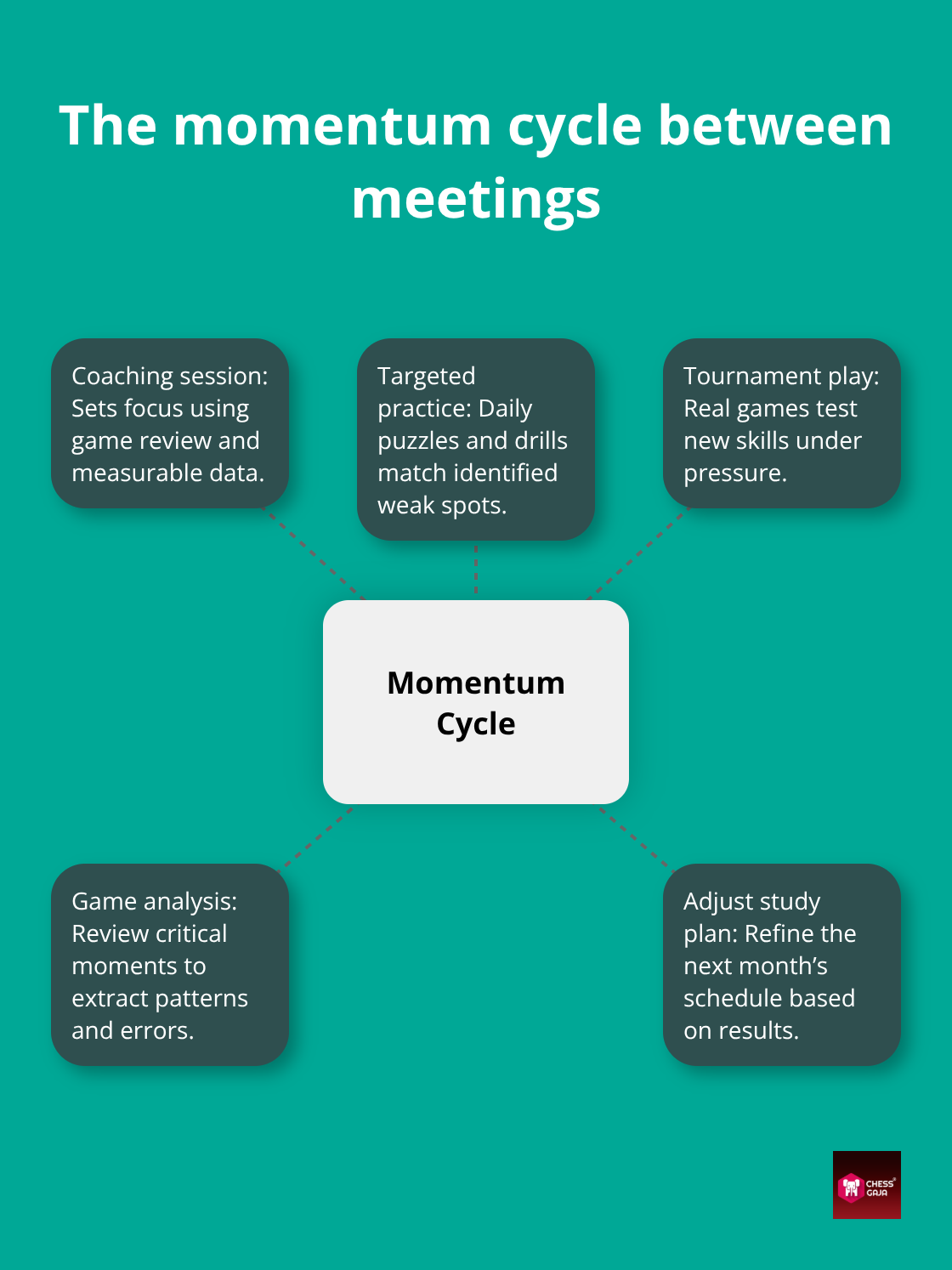
The cycle between coaching session, targeted practice, tournament play, and game analysis creates momentum. Your child isn’t practicing in a vacuum. Every puzzle set, every training session, every tournament has a specific purpose tied to measurable skill gaps. Families who skip this between-meeting work plateau. Those who follow the structure improve consistently. The difference is not motivation-it’s precision. Your child completes the study plan, plays practice games, and solves puzzles tailored to their weak spots.
You track their performance through tournament results and puzzle completion rates. When the next monthly meeting arrives, you and the coach have concrete new data to analyze. The cycle repeats-pattern recognition, skill gap identification, customized study plan, tournament planning.
Final Thoughts
Monthly parent meetings transform chess coaching into a coordinated development system. You track real progress instead of simply accumulating tournament results. At Chess Gaja, we build this approach around your child’s success. We combine GM-led monthly parent meetings with personalized study schedules tailored to their rating and goals. Your child’s coach stays with them throughout their entire journey, building a relationship-based learning environment rather than rotating instructors.
The families seeing the fastest rating gains across the USA, UAE, and Singapore treat coaching as a collaborative process, not a service they purchase and forget. They attend monthly parent meetings, review AI-powered class summaries between sessions, follow personalized study plans, and analyze tournament games with their coach. They understand that the four weeks between meetings matter most. This structured partnership accelerates progress measurably.
The first step is simple: book a Paid Starter Class evaluation with us. During this session, your child’s coach assesses their current skill level, identifies immediate growth areas, and outlines what realistic improvement looks like over the next 90 days. Thousands of families have taken this step and discovered that monthly parent meetings, combined with targeted practice and tournament experience, produce consistent rating gains and genuine chess understanding.