


Your opening moves set the tone for your entire game. Many beginners waste time memorizing complex variations when they should focus on solid, proven systems that work.
At Chess Gaja, we have coached thousands of young players worldwide. These students transformed their game through beginner friendly openings built on principles instead of endless theory. This guide covers which openings to study first and why they work.
What Separates Beginner Openings from Everything Else
Beginner openings work because they ignore what Grandmasters memorize and focus on what actually wins games at your level. The difference is stark. A 1200-rated player studying deep Ruy Lopez variations wastes time on rare positions. In contrast, a player mastering the Italian Game reaches playable middlegames in 12 moves and wins consistently. In fact, students focusing on core principles advance 200–300 rating points faster than those chasing theoretical depth.
The reason is simple: beginner openings teach you to control central squares with your pawns, develop minor pieces to active squares efficiently, keep your king safe through early castling, and transition smoothly into the middlegame. No memorization required. No obscure move orders to master. Just clear, logical chess that works from move one through move 15.
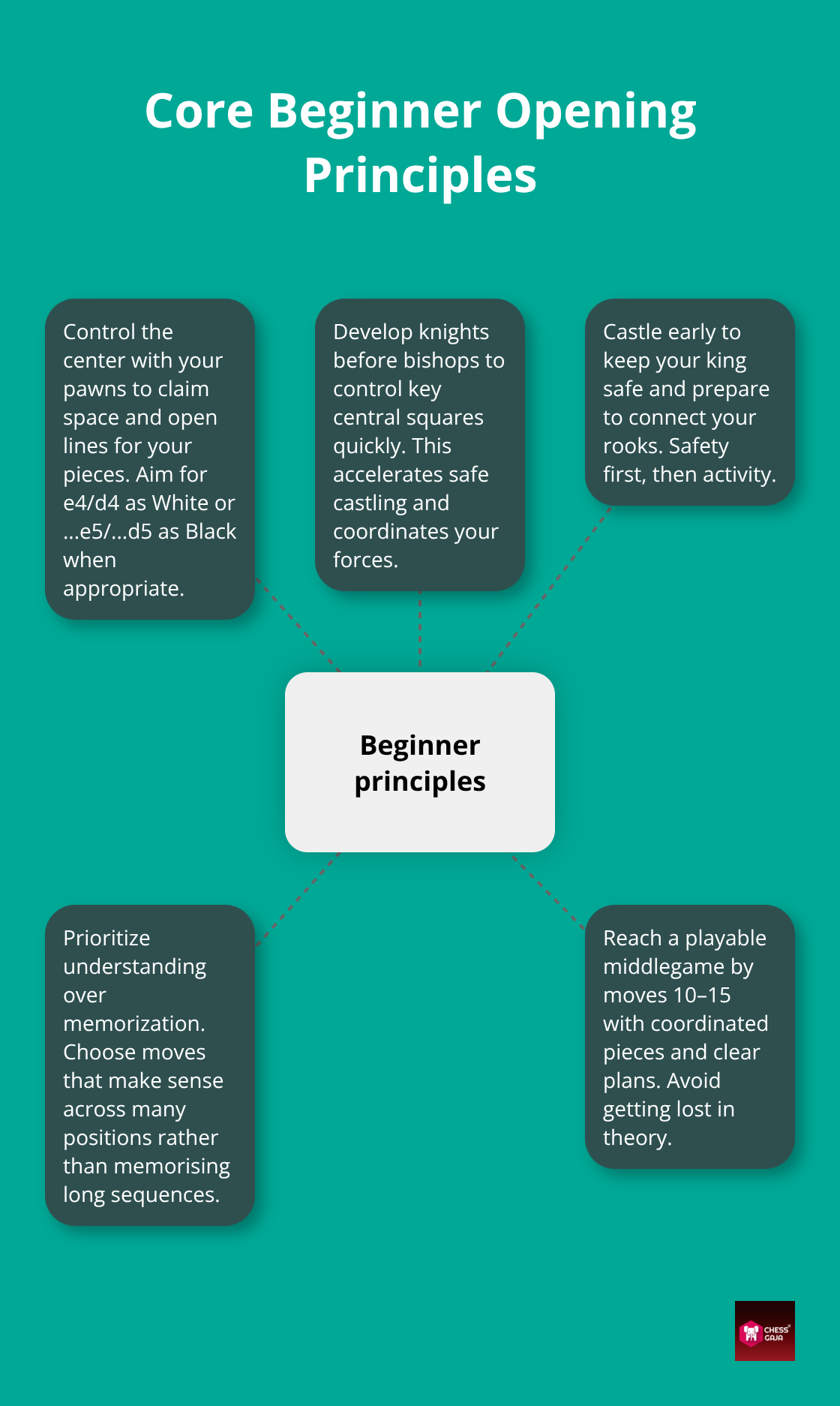
Control the Board, Not the Entire Game
The opening’s real job is positioning your pieces for the middlegame, not winning material or launching attacks. Too many beginners treat openings like a race to grab pawns or launch premature attacks, then wonder why their king gets mated. Beginner-friendly openings emphasize controlling central squares—whether by placing pawns directly on e4 or d4, or supporting the center with natural pawn structures like c3 and e3—while placing knights on natural squares like f3 and c3, and keeping the king protected on g1 (for White). This creates a stable position where your pieces coordinate naturally.
The London System exemplifies this simple approach. White plays a consistent setup regardless of Black’s moves. This eliminates the need to memorize dozens of responses. Your pieces reach active squares quickly, allowing you to focus on middlegame strategy.
Speed Matters More Than Perfection
Openings that complete piece development quickly beat openings that offer theoretical advantages three moves later. Development speed is measurable: get your knights out, develop your bishops, castle your king to safety, and connect your rooks. In the Italian Game, you accomplish all this by move 10-12. In sharp theoretical systems, you might still be in the opening labyrinth at move 20. Fast development gives young tournament players a clear edge in scholastic events. Completing development first allows you to execute plans while opponents are still struggling with theory. This creates a concrete, repeatable advantage in every game.
Why Theory Fails Beginners
Memorizing 20 moves of opening theory sounds productive until you face a position your opponent plays differently. Most beginners abandon their preparation by move 8 or 9 and panic. Beginner-friendly openings solve this problem by teaching you principles instead of move sequences. Knights belong on f3 because they control central squares and support your pawns. Understanding this idea lets you play the move confidently in any position. You are applying logic instead of following a script. This mental shift makes you adaptable when opponents deviate from expected lines.
Building Your Foundation Before Complexity
The openings we recommend next-the Italian Game, London System, and Scandinavian Defense-all share one quality: they teach you to think like a strong player without requiring you to memorize like a computer. Each one builds your understanding of piece coordination, pawn structure, and king safety. Once these principles become automatic, you’re ready to explore more complex systems with confidence.
Three Openings That Work Right Now
The Italian Game: Attack f7 and Control the Center
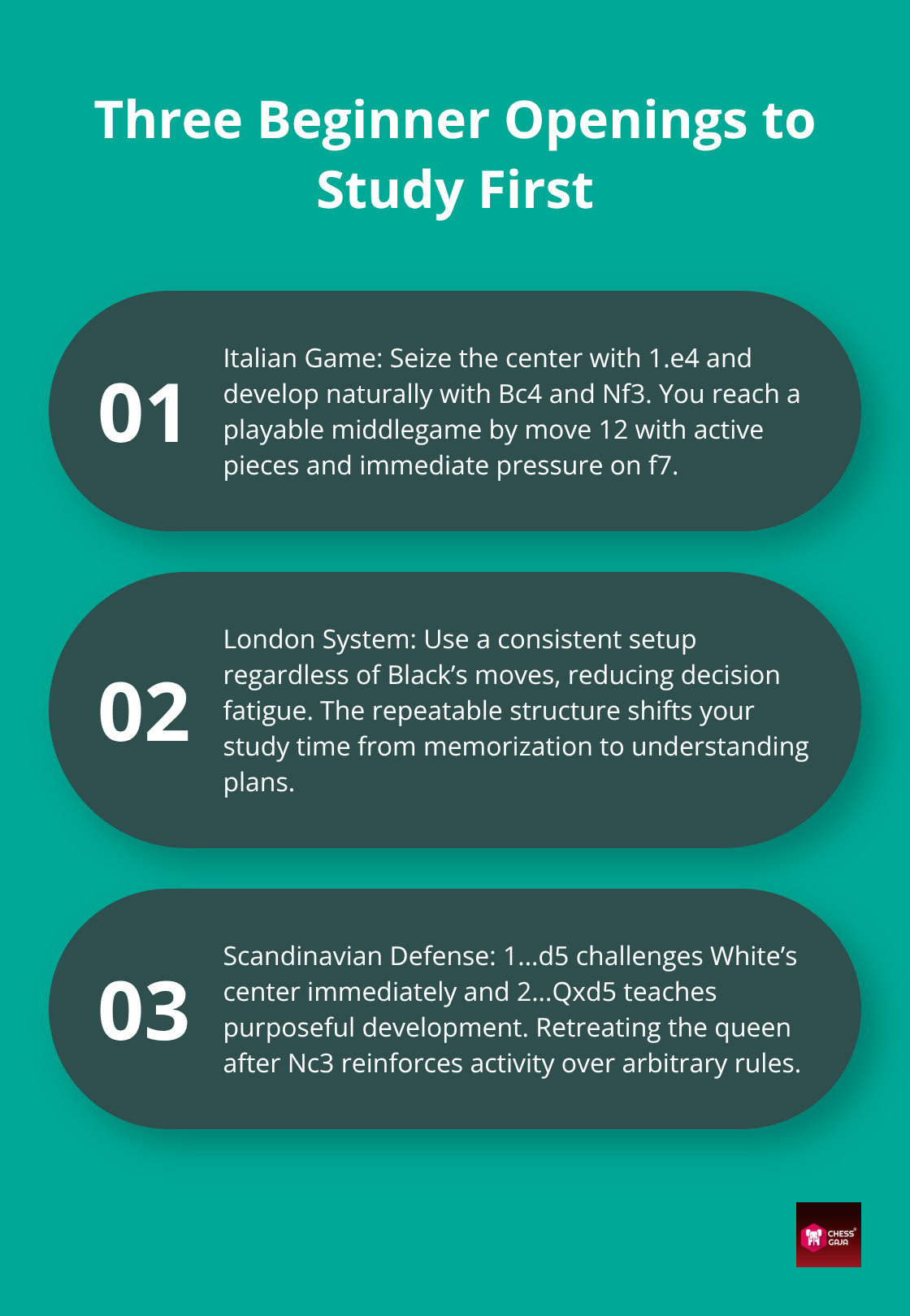
The Italian Game remains the strongest opening choice for beginners because it teaches you to seize the center immediately and coordinate your pieces without memorizing obscure variations. White starts with 1.e4, develops the knight to f3 to control the center and attack e5, and then plays the bishop to c4, where it targets f7—Black’s weakest square. You reach a playable middlegame by move 12 with all your pieces active and a clear plan: your bishop on c4 creates immediate threats, your pawns solidly support the center with e4 and d3, and your king sits safely on g1. Young players using the Italian Game consistently outperform peers who memorize the Ruy Lopez at the same rating level.
The reason is practical: the Italian Game’s principles apply to most positions you’ll face, while the Ruy Lopez requires knowing multiple move sequences before you even reach the middlegame. Start with 1.e4 e5 2.Nf3 Nc6 3.Bc4, and you’re ready to win.
The London System: Consistency Over Calculation
The London System solves a different problem-it eliminates decision-making entirely. White plays the same setup regardless of Black’s moves: pawns on d4, e3, and c3, the dark-squared bishop actively placed on f4, the light-squared bishop on d3, and knights on f3 and d2. This consistency means you never face an unexpected position in the opening. You can focus entirely on understanding your pawn structure and piece placement instead of calculating whether your opponent’s rare variation gives them equality.
Players who switched to the London System after struggling with multiple opening systems report rating improvements within months, simply because they spent their study time on middlegame strategy rather than opening theory. The London System teaches you that a solid plan executed consistently beats perfect theoretical knowledge executed uncertainly.
The Scandinavian Defense: Active Play From Move One
Beginners benefit from the Scandinavian Defense because it is simple, flexible, and forces players to understand the logic behind every move rather than following a memorized script. After 1.e4 d5, Black immediately challenges White’s central control, and the natural continuation 2.exd5 Qxd5 brings the queen out early. While an early queen excursion might seem risky, retreating to safe squares like a5 or d6 when White plays Nc3 teaches players how to handle active pieces without falling behind in development.
By contesting the center on move one, Black exerts immediate pressure on White’s position and forces White to respond to tactical threats rather than freely executing their own opening plan. Such an active defensive mindset builds confidence in young players who are often taught to play passively. Ultimately, players using the Scandinavian maintain higher win rates because they stay dynamically engaged from the very first move.
Which Opening Fits Your Style
All three openings share one critical advantage. They finish your piece development by move 12 to 14. This allows you to execute middlegame plans while opponents waste time calculating variations.
For tactical players, the Italian Game rewards aggressive piece placement and rapid attacks. Players seeking consistency will prefer the London System, which eliminates complex memorization. Meanwhile, the Scandinavian Defense suits active defenders by forcing opponents to respond to immediate threats from move one.
The specific opening matters far less than committing to one system and mastering its core principles until you can play it without thinking about which moves come next. Once you’ve chosen your opening, the real work begins-understanding the middlegame positions that emerge from your preparation.
Common Mistakes Beginners Make in Openings
Beginners lose openings not because they play the wrong moves, but because they play moves without understanding what the opening is supposed to accomplish. The three most destructive mistakes happen repeatedly in games across the USA, UAE, and Singapore scholastic circuits, and each one stems from a fundamental misunderstanding of opening strategy.

Chasing Material Instead of Completing Development
A beginner plays the Italian Game and spots Black’s vulnerable f7 pawn. Instead of castling to finish development, the beginner attacks f7 prematurely with multiple pieces. Black sacrifices a pawn or two to activate pieces and launch a counterattack, leaving the beginner’s uncastled king exposed to checkmate before move 15.
Your job in the opening is not to win material; your job is to position every piece on an active square, castle your king to safety, and connect your rooks. Material gains come naturally once you accomplish these tasks.
Exposing Your King While Attacking
Beginners see their opponent’s king in the center and become obsessed with checking it, often ignoring their own king’s safety. A beginner plays the Scandinavian Defense, moves the queen aggressively, and when White develops with Nc3, the beginner checks the White king instead of retreating the queen to a safe square like a5 or d6. White simply blocks the check with Be2 while developing another piece, the beginner has accomplished nothing except wasting valuable time, and White’s development lead becomes overwhelming.
This pattern repeats across tournament games: the player who completes development first wins because their pieces coordinate while the opponent’s king remains exposed.
Playing Without a Concrete Plan
Strong players using the London System know that after the setup is complete, the plan usually revolves around anchoring a knight on the central e5 outpost, launching a kingside pawn storm, or expanding on the queenside depending on Black’s setup. A beginner plays the London System, places the bishop on f4, advances pawns to e3 and c3, and then plays random moves because the opening book ended and no clear plan emerges.
Without a plan, every move becomes a guess. Openings with built-in plans build strong decision-making skills. The London System and Italian Game offer clear, reliable goals. Understanding these strategic ideas beats memorizing moves without knowing the reasoning behind them. The difference between a strong beginner and a struggling one is simple: one knows what to do after the opening ends, and the other does not.
Final Thoughts
Mastering beginner friendly openings requires understanding core principles. You must control the center, develop pieces quickly, and protect your king consistently until these habits become automatic.
The Italian Game, London System, and Scandinavian Defense all teach these fundamentals. Each opening leads to playable middlegames by move 12 to 14, where your real chess education begins. Young players who commit to one opening advance much faster than peers chasing theoretical depth.
Structured coaching accelerates this progress dramatically. At Chess Gaja, we work with students across 40+ countries. You can explore more of our online chess blogs or learn with our personalized coaching curriculum built by Grandmaster Priyadharshan Kannappan and FIDE-rated coaches.
Your next step is booking a Paid Starter Class for a skill evaluation. During this session, a coach will assess your current level and identify the best opening for your playing style. We will then create a study plan tailored to your goals. This evaluation removes guesswork and puts you on a clear path toward tournament success.