

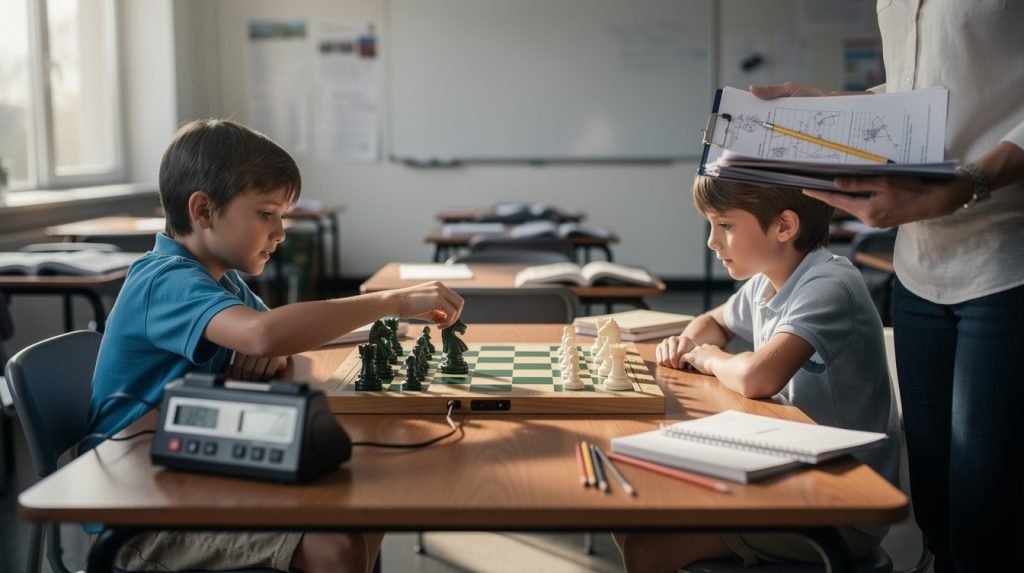
Your child’s chess performance in tournaments directly reflects their ability to think ahead, remember patterns, and solve problems under pressure. These same skills transfer directly to the classroom, where focus and strategic thinking determine academic success.
At Chess Gaja, we’ve seen firsthand how the cognitive benefits chess kids gain reshape their entire approach to learning. Young players who enroll in our online chess classes train with a Grandmaster-led curriculum across 40+ countries. Through structured play, they develop mental capabilities that extend far beyond the 64 squares.
How Chess Improves Focus and Concentration
Chess Forces Extended Mental Engagement
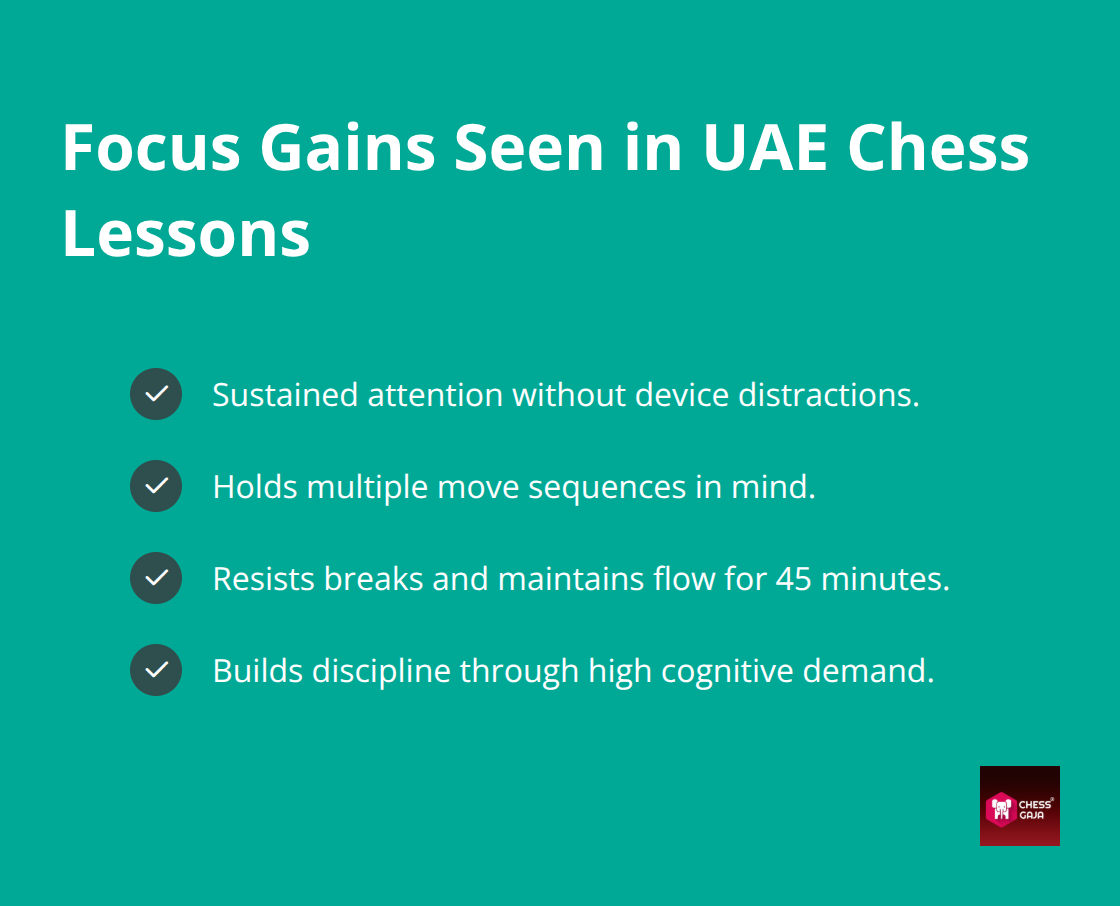
A student in Dubai sits down for a chess lesson at 6 PM. Within minutes, they analyze a position that requires them to calculate three to four candidate moves deep, evaluate potential opponent responses, and verify whether their tactical combination holds. They don’t check their phone. They don’t ask for a break. Forty-five minutes pass without distraction.
This is what happens when a young player trains seriously at chess.
The cognitive demand of chess creates a natural focus pressure. Most classroom activities simply cannot match this level of sustained engagement. Research shows clear differences in chess players’ focus capabilities. They maintain attention over extended periods far better than non-players. This isn’t theoretical-it’s observable in real tournament play, where a single lapse in concentration costs a player an entire game.
Building Sustained Attention Spans in Young Players
Students who initially struggle to sit through a full lesson without distraction begin naturally extending their focus windows because the game itself demands it. The pressure to calculate accurately and avoid tactical mistakes trains the brain to resist distraction. Within weeks of consistent training and guided practice, young players begin developing noticeably stronger attention spans that persist outside the chess context.
This shift happens because chess rewards focus and punishes carelessness immediately. A missed tactic loses material. A calculation error loses the game. This direct feedback loop conditions the mind to maintain concentration without external reminders or rewards.
Classroom Performance Gains from Improved Focus
The transfer from chessboard to classroom is direct and measurable. A student who has trained to calculate multiple move sequences approaches word problems differently-they break complex problems into smaller steps, evaluate consequences before committing to an answer, and catch their own mistakes before submitting work. Teachers in Singapore and the UAE who work with chess-trained students report noticeable improvements in reading comprehension and mathematical problem-solving, particularly in students aged 8–14.
Chess trains the brain to hold competing variables in mind simultaneously, which is exactly what algebra requires, what reading comprehension demands, and what strategic planning in any subject involves. A student who has spent months recognizing tactical motifs in chess positions becomes faster at identifying patterns in history timelines, scientific processes, and mathematical sequences. When a young player learns to pause and think before moving a piece, they build a habit of deliberate decision-making that naturally extends into their academic work and test-taking approach.
The cognitive habits formed through chess-systematic analysis, consequence evaluation, and pattern recognition-reshape how students approach learning itself. This foundation prepares them well for the next critical skill that chess develops: the ability to think strategically and solve problems from multiple angles.
Strategic Thinking and Problem-Solving Skills
Chess Forces Multiple Solution Pathways
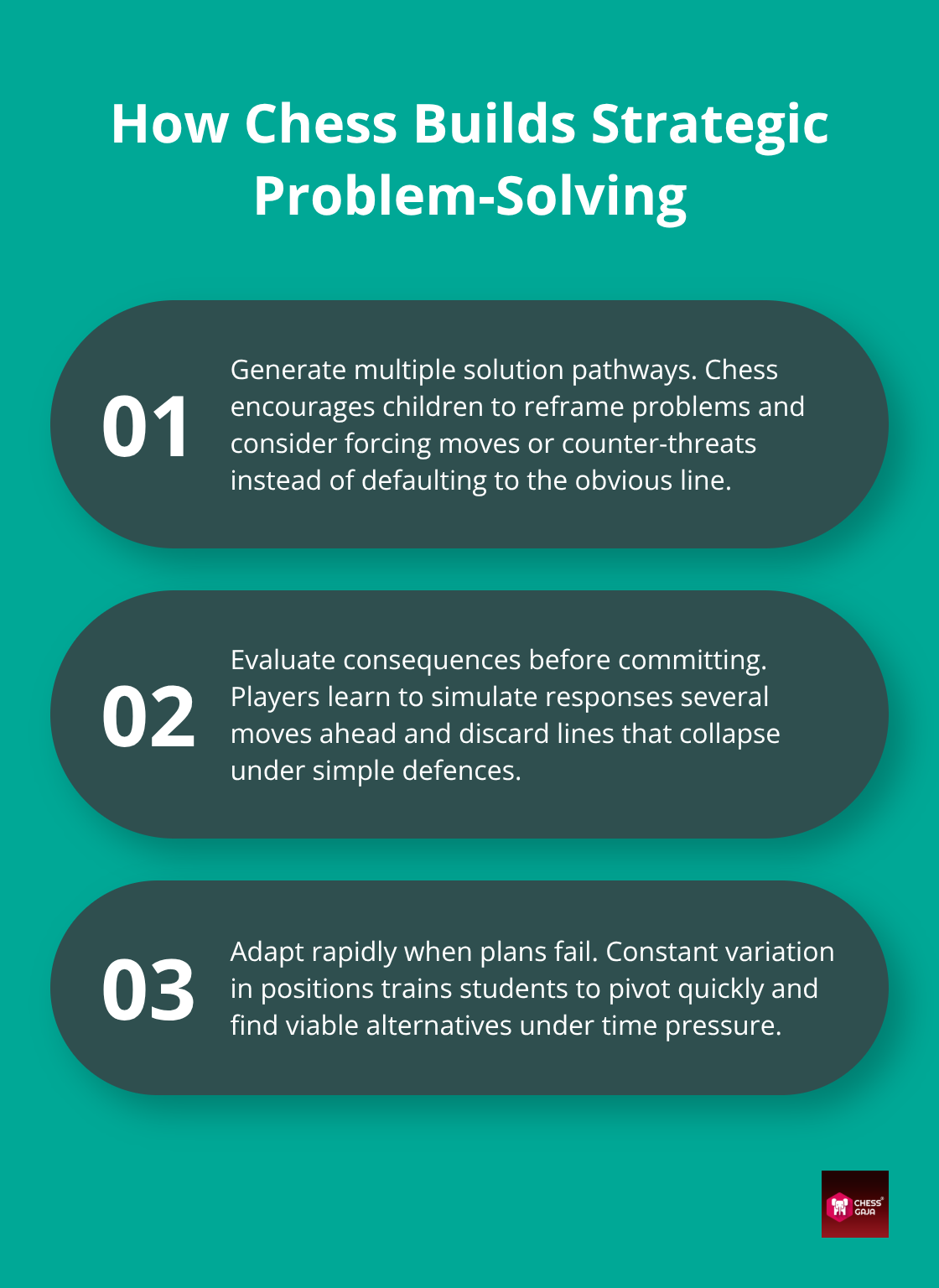
A student in Singapore faces a chess position where their rook is attacked and moving it loses material either way. Rather than panic, they pause and ask themselves a different question: what if I don’t move the rook at all? What if I attack something of theirs first? Within seconds, they spot a candidate move or forcing tactic that shifts the entire position and solves the problem without the sacrifice they initially thought necessary. This mental shift-from one solution pathway to multiple pathways-is exactly what separates strong problem-solvers from weak ones, and chess trains it relentlessly.
Chess doesn’t allow you to solve problems the same way twice because no two positions are identical. A tactic that works in one scenario fails in another. A plan that succeeded last week collapses under a different defensive setup. This constant variation forces the brain to evaluate consequences before committing to any single approach, then rapidly generate alternatives when the first option doesn’t work.
How Chess Develops Cognitive Flexibility
Students who train seriously in chess develop what researchers call cognitive flexibility-the ability to shift between different mental strategies based on changing circumstances. A student who has spent weeks analyzing positions learns to think in terms of consequences: if I do this, what can my opponent do? If they respond with that, what happens next? This forward-planning habit transfers directly to academic problem-solving.
A student approaching a multi-step math problem or a complex science question applies the same methodology: map out the sequence, identify potential obstacles, evaluate whether the path leads to the answer, and adjust if needed. The practical advantage shows up immediately in how chess-trained students approach unfamiliar problems. They don’t freeze or pick the first answer that comes to mind. Instead, they break complex problems into smaller parts and test their logic before committing.
From Chessboard Analysis to Academic Success
A student in the UAE who trains with professional coaches learns to see options where others see dead ends. This isn’t a theoretical skill-it’s practiced hundreds of times per week during chess training, reinforced through tournament play, and validated through immediate feedback when a solution either works or fails. Over time, this becomes automatic. The student stops thinking about thinking and simply applies sound problem-solving methodology to whatever challenge appears, whether it’s on the chessboard or in the classroom.
The transfer of these problem-solving habits into academic work happens naturally because both rely on parallel processes of evaluation, logic, and consequence mapping. A student who has trained to calculate multiple move sequences now approaches word problems with the same systematic mindset. They catch their own mistakes before submitting work. Teachers in Singapore and the UAE report noticeable improvements in reading comprehension and mathematical problem-solving in students who have trained consistently.
This foundation of strategic thinking and consequence evaluation prepares young players for the next critical cognitive skill that chess develops: the ability to recognize patterns instantly and retain complex information under pressure.
Memory Development and Pattern Recognition
Chess Strengthens Working Memory
A student in Dubai analyzes a tactical position where they must hold multiple forcing variations in working memory while evaluating whether their planned attack holds. They execute this mental operation repeatedly during a single training session. After twelve weeks of consistent chess training, research shows working memory capacity improvements that transfer directly to academic performance. Students who previously struggled to retain multi-step instructions suddenly manage complex academic tasks with ease. The mechanism is straightforward: chess forces the brain to hold competing information simultaneously and manipulate it mentally before acting. A student calculating three moves ahead must track multiple board elements simultaneously. They keep piece positions, defensive resources, tactical threats, and strategic objectives in mind all at once. This isn’t abstract mental exercise-it’s repeated, high-stakes practice that strengthens working memory through direct application.
Building Automaticity Through Position Recognition
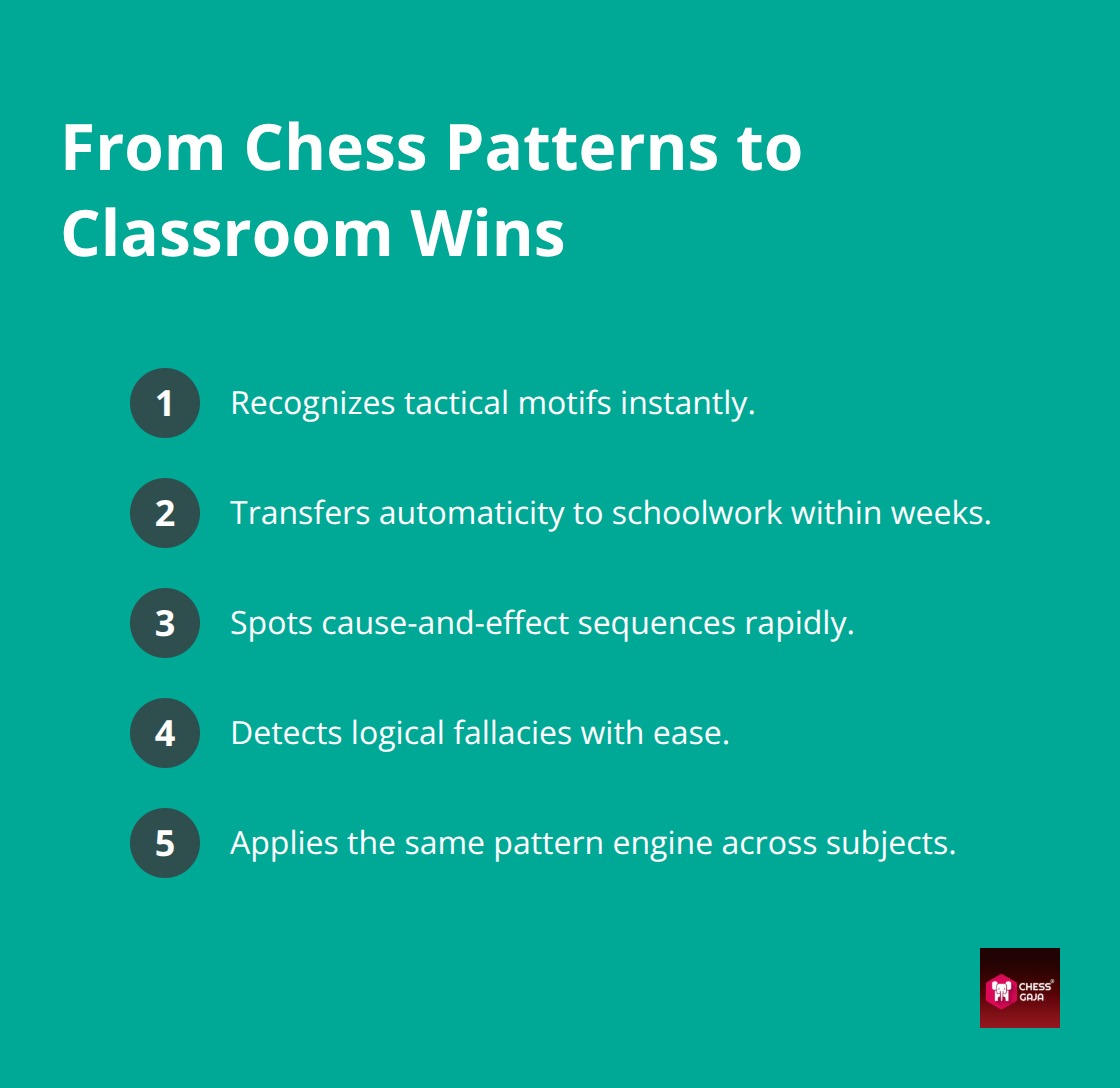
The pattern recognition component of chess develops as students train to plan several moves ahead and anticipate consequences. A student who reviews 50 chess positions per week begins recognizing tactical patterns instantly—forks, pins, and skewers become automatic tactical motifs rather than slow, conscious calculations. After four to six weeks, this automaticity extends into academic work. A student who spent weeks identifying back-rank weakness patterns in chess positions now spots cause-and-effect sequences in history timelines instantly. A student who trained to spot pinned pieces, skewers, or trapped officers suddenly catches logical fallacies in reading comprehension passages.
This transfer happens because pattern recognition operates identically whether applied to chess positions or academic material. The neural pathways strengthened through chess training activate automatically in classroom contexts.
Academic Benefits from Enhanced Pattern Recognition
Teachers in Singapore and the UAE who work with chess-trained students report measurable improvements in how quickly these students process information and retain complex multi-step concepts. A student trained to analyze chess positions becomes faster at solving algebra problems because both require identifying patterns within structured systems and manipulating those variables mentally. The practical advantage compounds over time. Students with strong pattern recognition learn faster in every subject. They complete assignments efficiently and perform noticeably better on complex tests. A young player spends months spotting tactical motifs in chess positions. As a result, they approach academic material with the same systematic eye for structure and relationships. This cognitive foundation transforms how students process information. It improves learning across all subjects, from mathematics to language arts and science.
Final Thoughts
Studies and classroom observations show measurable improvements in academic performance when students train consistently in chess over an eight to twelve week period. Students show stronger grades in mathematics and faster reading comprehension. Chess builds focus, strategic thinking, and pattern recognition through repeated, high-stakes practice. The cognitive benefits chess kids gain transfer directly into the classroom because these core habits of analysis, evaluation, and logic naturally apply whether solving a tactical puzzle or an algebra problem.
Professional coaching accelerates this development significantly. Experienced coaches structure learning progressively so cognitive gains compound faster. At Chess Gaja, our Grandmaster-led curriculum across 40+ countries builds these mental capabilities systematically. Every student receives personalized coaching matched to their level. They receive AI-powered feedback after each session and work with a dedicated coach throughout their journey.
A Paid Starter Class with a FIDE-rated coach provides a professional skill evaluation. It identifies exactly where your child stands and what they need to improve. During this session, your coach assesses focus, pattern recognition, and problem-solving ability. Afterwards, they build a personalized study plan tailored specifically to your child’s goals. Book your child’s Paid Starter Class at Chess Gaja today and build the cognitive foundation that transforms how your child learns, thinks, and performs.