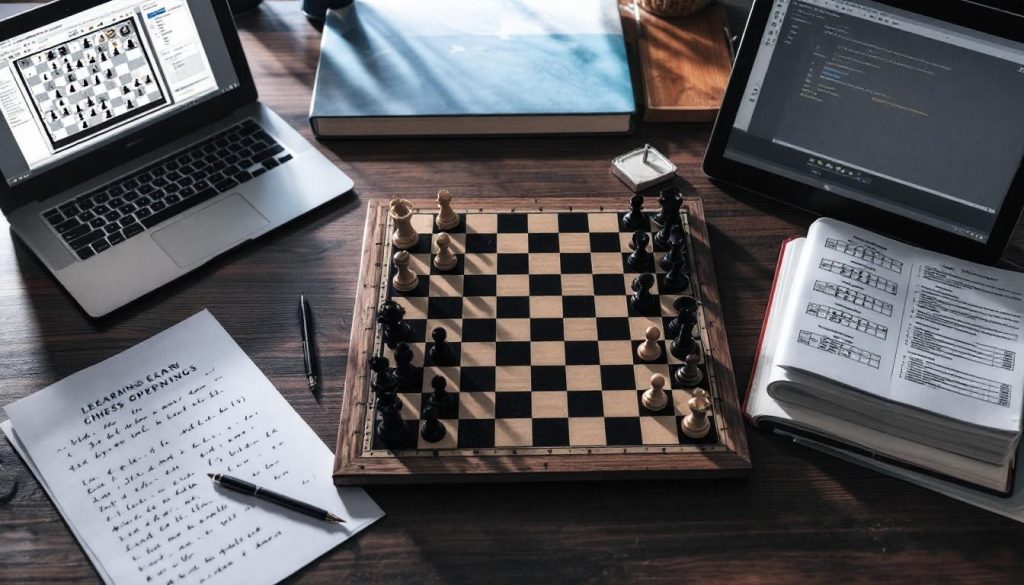
Last month, a 1600-rated student in Dubai told us she spent hours trying to study chess openings by memorizing 20 different lines, only to lose in the first 15 moves. The problem wasn’t her memory—it was her approach.
Most players study chess opening strategies by cramming variations, then panic when their opponent plays something unexpected. At Chess Gaja, we’ve found that the players who improve fastest focus on understanding principles instead.
As Grandmaster Priyadharshan Kannappan, FIDE Trainer and founder of Chess Gaja Academy, I have helped thousands of students move beyond rote memorization to develop a deep, structural understanding of the opening phase.
Many players waste hours on engine lines they never use, but the “right way” involves mastering the typical middlegame plans and pawn structures that arise from your choices.
In this guide, I share my professional methodology for studying openings efficiently, ensuring that every minute of your preparation translates into better results and greater confidence over the board.
Why You Should Study Chess Openings Through Principles, Not Memorization
Why Memorizing Rules Backfires When You Study Chess Openings
Memorization works until it doesn’t. A player memorizes 15 moves of the Sicilian Defense, plays them perfectly, then faces move 16 and has no idea what to do. This happens constantly at the 1600 rating level. The real problem is that memorized lines create false confidence.
A player feels prepared until the variant runs out, and by then the position is already losing. Hundreds of hours are wasted memorizing variations that collapse the moment an opponent deviates.
The chess world produces an enormous volume of opening books and videos-so much material that most players chase information instead of understanding.
This approach fails because chess opening strategies aren’t sequences to memorize; they’re frameworks built on repeating ideas.
When you memorize without understanding, you can’t adapt. Improvising becomes impossible, and panic quickly sets in over the board.
The Three Ideas That Actually Matter
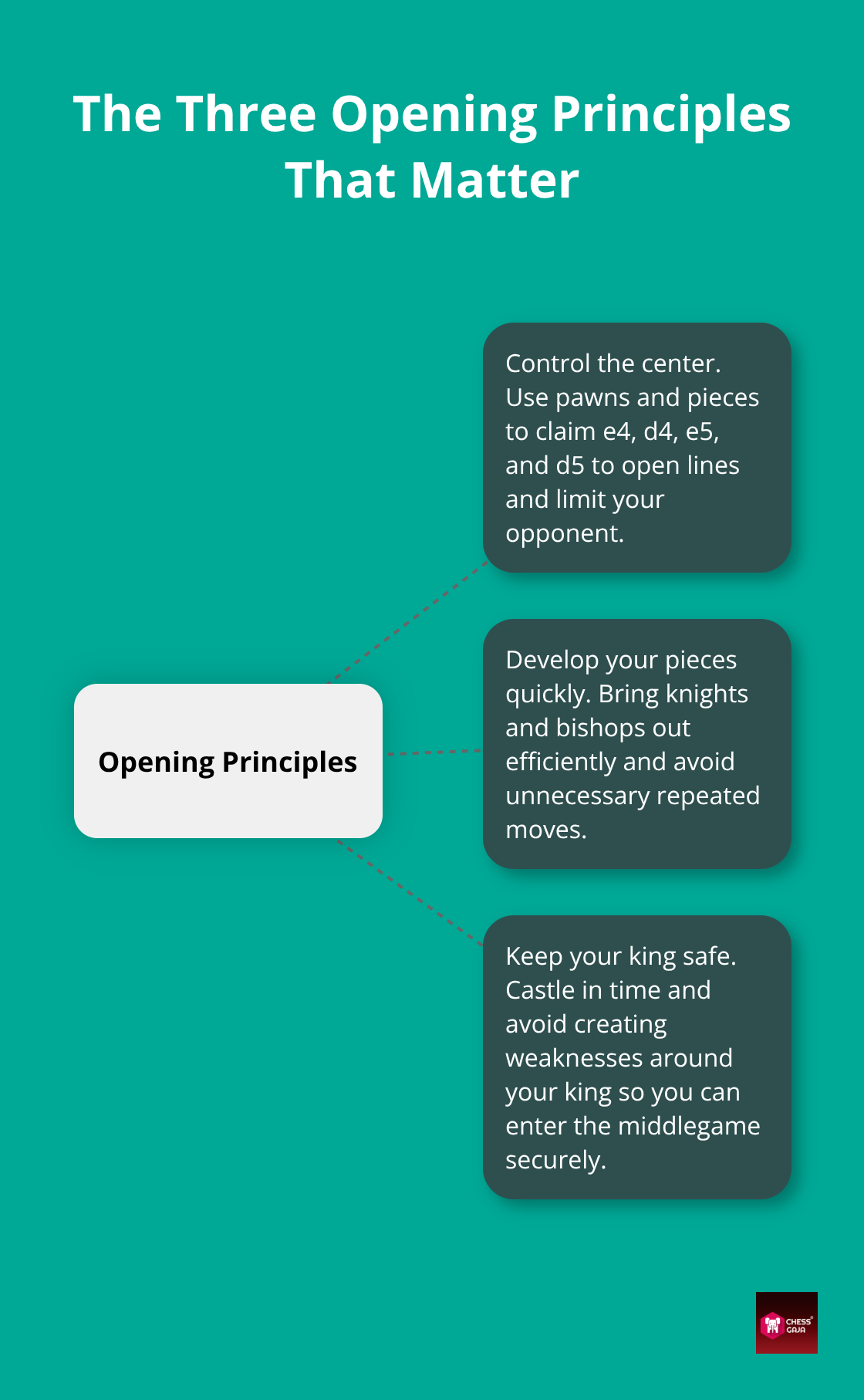
Every opening teaches the same three core concepts: control the center, develop your pieces quickly, and keep your king safe.
These aren’t suggestions-they’re the foundation of every strong opening on earth.
The Italian Game teaches you to plant your bishop on c4 and castle early. You quickly learn to seize the center with e4 and d3. Similarly, the Ruy Lopez teaches you to pressure Black’s e5-pawn while maintaining control.
Playing the Sicilian Defense from the Black side shows you how to challenge White’s center to create immediate imbalances.
Different openings, same underlying logic. Once you understand these three principles, you recognize patterns across positions you’ve never studied.
You see that a weakened kingside in one opening appears in another.
You notice that a strong knight placement in the center works whether you’re playing the French Defense or the Caro-Kann.
This pattern recognition replaces memorization. It’s faster, more reliable, and it transfers to positions your opponent creates.
How Grandmasters Study Chess Openings Differently
Study model games of GrandMasters in the openings you play. Seeing model games helps you better understand the underlying pawn structures and patterns of the ensuing positions in middlegame and endgame.
When you see how GrandMasters played the Ruy Lopez, you see where they placed their pieces, how they attacked weaknesses, and what their middlegame plans looked like.
You learn the actual ideas, not abstract variations. Use databases like 365Chess.com or ChessBase to find classical/rapid games in your chosen openings.
Do a deep down understanding of the opening positions, and try to use the habit of chunking information to better remember the opening ideas in detail.
You start recognizing that pawn structures matter more than move order, that piece placement matters more than tempo, and that understanding the position matters infinitely more than reciting variations.
This approach to opening study actually compounds into rating gains, and it prepares you to make smarter choices when you sit down to analyze your own games.
How to Study Chess Openings and Build a Strategic Repertoire
The biggest mistake players at 1600 rating make is treating their opening repertoire like a grocery list. They play the Sicilian on Monday, the French on Wednesday, and the Caro-Kann on Friday, never giving any opening time to develop real understanding. This scattered approach guarantees shallow knowledge across many lines rather than competence in a few.
You need to pick openings that match how you actually play, then commit to them long enough to recognize patterns.
Match the Way You Study Chess Openings to Your Playing Style
If you love tactical complications and sharp positions, the Sicilian Defense makes sense.
If you prefer calm, strategic battles where you can outmaneuver your opponent, the Queen’s Gambit or the Ruy Lopez suit you better. The key is honest self-assessment.
Most intermediate players haven’t played enough games to know their true style. When you decide to learn an opening, play a series of training games online against engines or human players. See how comfortable you feel in the resulting middle and endgame positions.
A player who struggles in sharp, forcing positions shouldn’t force themselves to memorize the Najdorf Sicilian. A player who finds long-term planning boring shouldn’t grind through the Slav Defense.
Your opening choice compounds into hundreds of future games, so match it to your natural instincts rather than copying what stronger players use.
Play One Opening for 30 Games
Intermediate players should choose one opening for White, and one solid defense for Black against both 1.e4 and 1.d4. Logging practice games online builds the comfort you need. Soon, you will have the confidence to play these same lines in FIDE-rated over-the-board tournaments.
Once You’ve seen enough variations to recognize the underlying patterns. You understand where your pieces belong and what your middlegame plan looks like.
Many players abandon an opening after three losses because they assume it’s weak. In reality, they’ve only scratched the surface.
The Italian Game, the Ruy Lopez, the Queen’s Gambit, and solid defenses all work perfectly at 1600 rating.
What matters isn’t which opening you choose, but that you give it enough repetition to develop real feel.
Expand Your Repertoire Gradually
Once you get a strong feeling that you have a certain level of mastery with your primary opening, add a second option that is adjacent to your primary line.
For example, If someone plays 1.d4 and you normally play Queen’s Gambit Declined, and now have a good understanding of it, this is the right time to learn Queen’s Gambit Accepted as a secondary weapon.
This gradual expansion prevents overwhelm and keeps your opening knowledge connected rather than fragmented.
Turn Your Losses Into Personal Opening Notes
After each game, spend 5-10 minutes analyzing where your opening understanding broke down.
Did you miss your opponent’s best response on move seven? Did you reach move 15 and have no plan? Write down the critical moment in a simple document. After 10 games, you’ll see patterns in what you misunderstand. These patterns become your personal opening agenda.
These specific weaknesses are far more valuable than studying random opening variations.
Use an engine like Stockfish to check critical positions from your losses, but don’t memorize the engine’s recommendations.
Learn From Your Losses to Fix Your Opening Gaps
Your losses contain the most valuable opening lessons you’ll ever find, but only if you analyze them correctly. Most players replay a losing game, see they made a blunder on move 23, and move on. That’s a waste. The real diagnostic work happens in moves 1 through 15, where your opening understanding either held up or collapsed.
Wait Before You Analyze
After you lose a game, wait at least one day before analyzing it. This prevents emotional analysis and lets you think clearly about what went wrong.
Open your game in a tool like Chess.com or Lichess.org analysis feature or ChessBase and find the exact moment where your position shifted from playable to difficult.
Usually this happens between moves 10 and 18, when you’ve left your memorized lines and must rely on understanding.
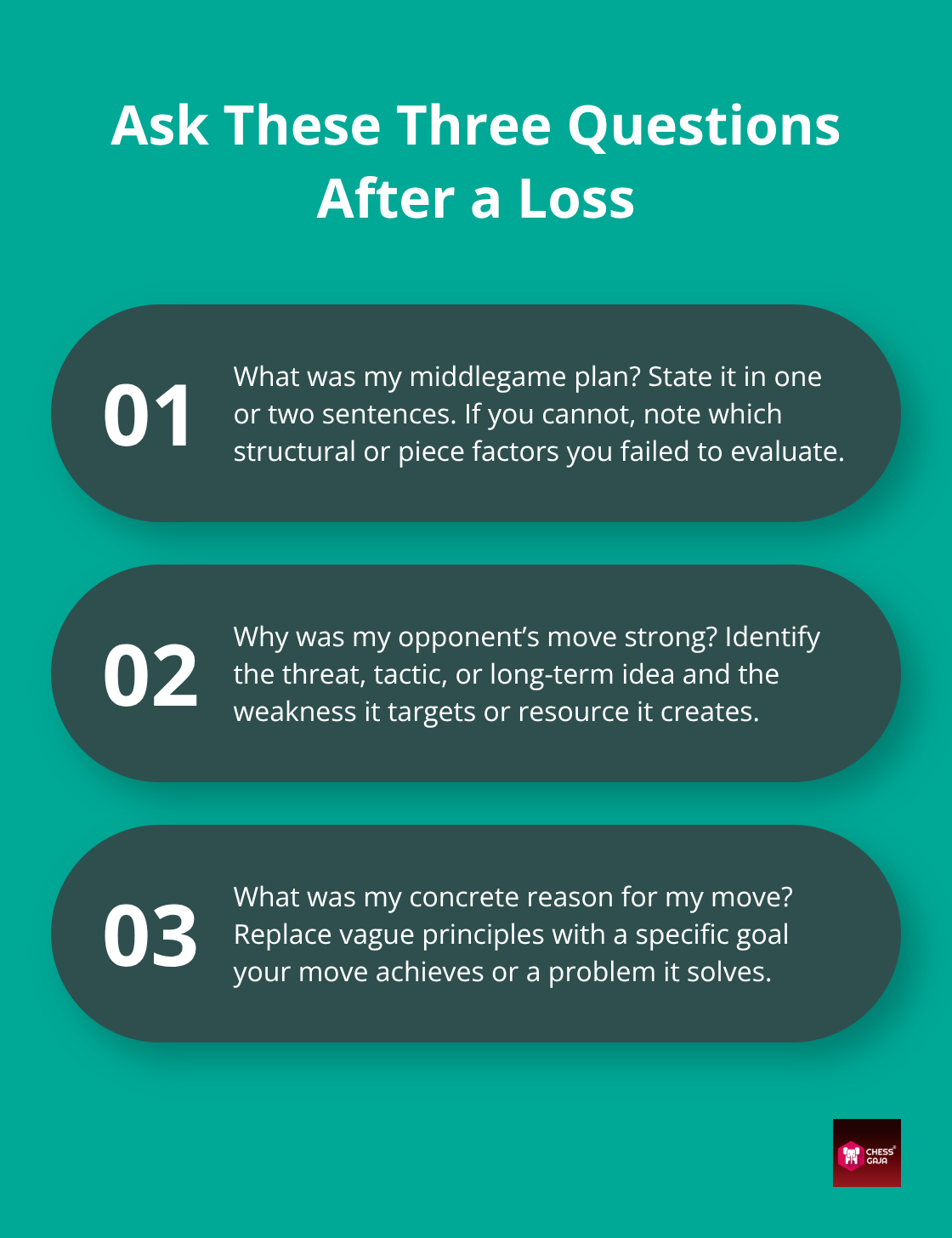
Ask Three Critical Questions
Ask yourself three specific questions about the critical position:
1)Did I know what my middlegame plan was supposed to be?
2)Could I explain why my opponent’s move was strong?
3)Did I have a concrete reason for my own move, or was I just making aimless developing moves without a plan?
Write down the critical position and your honest answer to each question. This five-minute exercise reveals whether you lacked opening knowledge, positional understanding, or tactical awareness.
If you consistently can’t answer these questions in the same opening, you’ve found your actual weakness.
Document this in a simple spreadsheet with the opening name, the critical move number, and what you didn’t understand. After 30 games, patterns emerge.
Maybe you realize that in the Ruy Lopez you never know when to break with d4 versus maintaining the central tension. These specific gaps matter far more than studying random opening variations, because they’re tailored to your actual mistakes.
Use Engines to Understand Ideas, Not Memorize Moves
Engine analysis works best when you use it to understand ideas, not memorize moves.
After you identify a critical position from your loss, run Stockfish or another engine and let it analyze for 20 seconds per position. Don’t just accept the engine’s recommendation.
Instead, ask why it prefers one move. What weakness does it exploit in your position? What advantage does it create? Write down the engine’s assessment in plain language: for example, the move opens the e-file for a future rook, or it prevents your opponent’s knight from reaching a strong square. This transforms passive memorization into active learning.
Focus on Depth Over Breadth
Many players make the mistake of analyzing too many games.
If you lose 10 games in a month, pick the two where you felt most confused in the opening phase and analyze only those.
Depth beats breadth. Spend 15 minutes on one critical position where you’ll actually learn something, rather than 90 minutes skimming 10 games.
After you analyze a loss, create a personal opening note in a document titled with your opening name.
Write the key position, the move you didn’t understand, and what the engine revealed about why that move works. Keep this document short and simple.
After five or six losses in the same opening, you’ll have a personalized set of principles that apply to your games, not generic opening advice from books. This is your real opening preparation.
A 1600-rated player who reviews two losses per month and documents specific gaps will improve faster than a player who memorizes 30 opening lines. Your losses are data. Treat them that way, and they’ll teach you more than any opening course ever will.
Final Thoughts
The shift that matters most isn’t learning more openings-it’s learning openings differently.
You’ve watched players memorize variations, panic when their opponent deviates, and wonder why their rating stalls.
The players who break through this ceiling stop chasing lines and start chasing understanding. They study chess openings by analyzing their own losses, recognizing patterns across positions, and building a repertoire that fits how they play.
This mindset change compounds faster than you’d expect. Once you hit 30 games with one opening, you stop feeling lost. By the 60-game mark, you begin to recognize positions before your opponent even plays them. Reaching 100 games turns this opening knowledge into pure intuition. Your rating gains follow naturally because you make smarter decisions earlier in the game.
Pick one opening for White and one solid defense for Black, then play only those for 30 games. After each loss, spend five minutes identifying where your opening understanding broke down and write it down.
If you want structured guidance through this process, Chess Gaja offers personalized coaching with FIDE-rated coaches who analyze your games and build opening plans tailored to your playing style.