


Your opening moves determine whether you’ll win or lose most of your games. The basics of chess openings aren’t complicated, but they’re often misunderstood by beginners.
At Chess Gaja, we’ve coached thousands of young players through their first tournaments, and we’ve seen the same mistakes happen repeatedly. The good news is that mastering three core principles will immediately improve your results.
Three Rules That Win Openings
Control the Center First
The first three moves of your game aren’t about memorizing lines. They’re about following three concrete rules that separate players who win consistently from those who don’t. Control the center with your pawns and pieces before your opponent does. Right from move one, place a pawn in the center on d4, e4, d5, or e5, and support it with your surrounding pieces. Players at the U.S. Chess Federation’s youth tournaments who control the center by move six win far more games than those who don’t.
Develop Your Pieces to Active Squares
After you control the center, develop your pieces to useful squares immediately. This means you move your knights to f3 or c3, your bishops to natural squares like c4 or f4, and you castle your king to safety within the first twelve moves. Don’t move the same piece twice while other pieces sit at home. Beginners often waste moves by shuffling one knight around while their rooks, bishops, and queen remain undeveloped. Your pieces must support your center pawns and create threats for your opponent.
Castle Your King Within the First 10 to 12 Moves
Your third rule is non-negotiable: castle your king within the first 10 to 12 moves. Castling kingside (O-O — placing the king on g1 for White, or g8 for Black) is the default choice for beginners because it’s the quickest and safest option in most positions. Early castling helps your king escape threats and keeps it away from the center where it’s vulnerable.
How These Three Rules Work Together
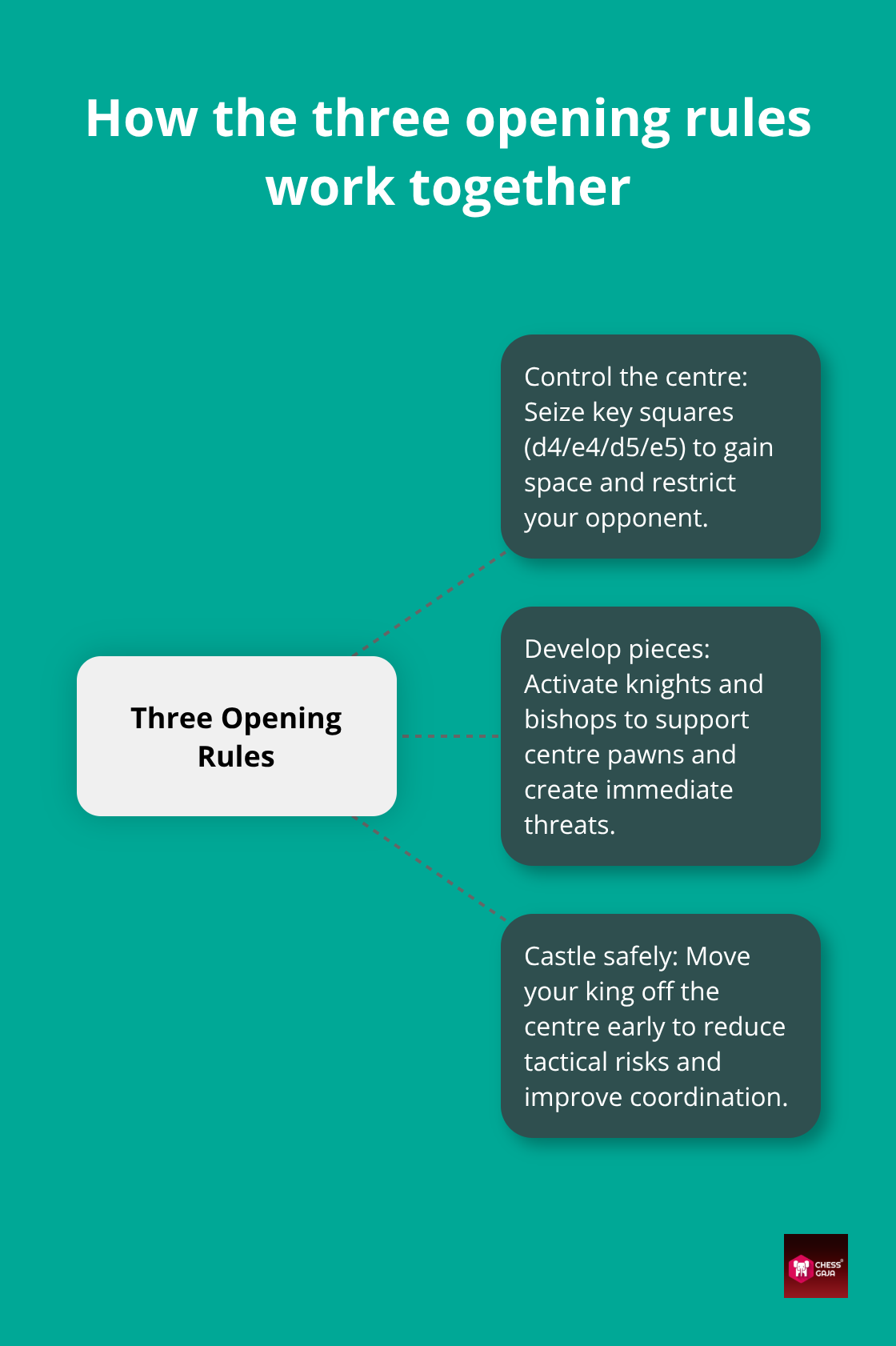
Controlling the center allows you to claim space and restrict your opponent’s options. Next, develop pieces so they actively support your center pawns and create threats. Finally, castle early to move your king out of danger before the position opens up.
Apply These Rules During Your Game
Don’t treat openings as something you memorize before the game. Treat them as a sequence of rules you apply during the game. When you sit down at the board, your job is to control the center, develop pieces to that center, and castle safely. Everything else flows from those three decisions. This practical approach removes the anxiety many beginners feel about openings and replaces it with a clear action plan. Once you master these fundamentals, you’re ready to explore specific opening systems that put these principles into action.
Three Opening Systems That Follow the Rules
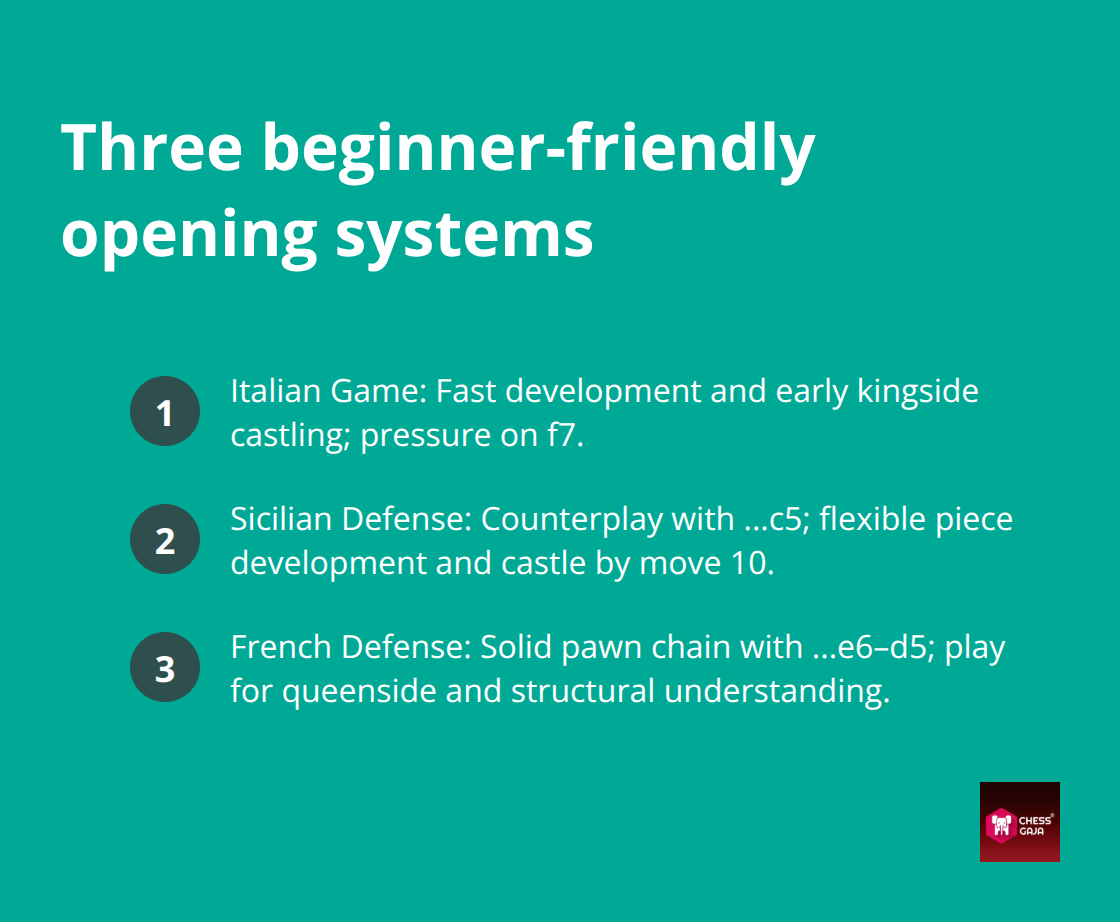
The three core principles you just learned-control the center, develop pieces, and castle safely-work the same way across different opening systems. The difference is how you arrange your pieces to follow those rules. The Italian Game, Sicilian Defense, and French Defense are the three most practical choices for beginners because they reward disciplined play and punish lazy moves. At youth tournaments across the United States, Singapore, and the UAE, players who master one of these systems win consistently. You don’t need to memorize 30 variations. You need to understand the first 8 to 12 moves and the plan behind them.
The Italian Game Wins Fast for White
The Italian Game starts 1.e4 e5 2.Nf3 Nc6 3.Bc4. This opening follows all three rules immediately. Your e4 pawn controls the center, your knight on f3 supports it, and your bishop on c4 attacks Black’s f7 square—the weakest point in Black’s position. You control the center and develop two pieces in three moves, naturally placing early pressure on Black’s defense.
Your plan is simple: castle kingside early, build a solid center with moves like c3 and d3, and coordinate your pieces to exert pressure on Black’s center and kingside. The Italian Game rewards aggressive play when Black makes mistakes, but it also gives you a solid position if Black defends correctly.
After 3.Bc4, play 4.d3 or 4.O-O depending on what Black does. If Black plays 3…Bc5 (the Giuoco Piano), building central control with c3 and d4 gives White a lasting initiative. If Black plays 3…Nf6 (the Two Knights Defense), you can defend e4 with 4.d3 or play aggressively with 4.Ng5 to target f7 immediately.
The Sicilian Defense Gives Black Real Counterplay
If you play Black, the Sicilian Defense (1.e4 c5) is the most popular choice at tournaments because it fights for the center without allowing White to control it completely. After 2.Nf3 d6 or 2.Nf3 Nc6, you develop your pieces to active squares while keeping White’s central advantage in check. The key is that your c5 pawn challenges White’s e4 pawn, keeping your position active throughout.
White often plays 3.d4 to open the position, leading to 3…cxd4 4.Nxd4. This trade exchanges Black’s side c-pawn for White’s central d-pawn, giving Black a long-term central pawn majority. Your knights go to f6 and c6, your dark-squared bishop develops to e7 or g7, and you castle safely. Rather than memorizing lines, focus on understanding the pawn structure—your main counterplay flows along the open c-file and through central breaks like …d5.
The French Defense Teaches You Pawn Structure
The French Defense (1.e4 e6) is the most solid choice for Black because it teaches you how pawn chains shape your plans. White controls d4, and your e6 pawn creates a chain supporting your d5 counterattack. After 1.e4 e6 2.d4 d5 3.Nc3, Black typically responds with 3…Nf6 or 3…Bb4. Once White advances with 4.e5 (locking the center), Black strikes back with …c5 to challenge White’s strong d4 pawn.
Your pieces develop smoothly with knights on c6 and f6 and your dark-squared bishop on e7 or b4. While the French Defense is slower than the Sicilian, it is much safer due to its rock-solid pawn structure. Maneuver your light-squared bishop carefully via d7, b7, or by trading on a6, and maintain counterplay by pressuring d4 with …c5 and …Qb6.
What Separates Winners From Beginners
Each of these three systems teaches you something different about how openings work. The Italian Game shows you how to attack when you control the center. The Sicilian Defense shows you how to counterattack when your opponent controls space. The French Defense shows you how to counter White’s space advantage through structured pawn play and central pressure. The players who win tournaments aren’t the ones who memorize the most lines. They’re the ones who understand which system matches their style and then play it with conviction. Once you pick one system and play it in five or six games, the moves become natural. You stop thinking about what to play and start thinking about what your opponent is trying to do. That shift from memorization to understanding is what separates quick wins from slow, frustrating losses.
Opening Mistakes That Cost You Games
Moving the Same Piece Twice While Others Wait at Home
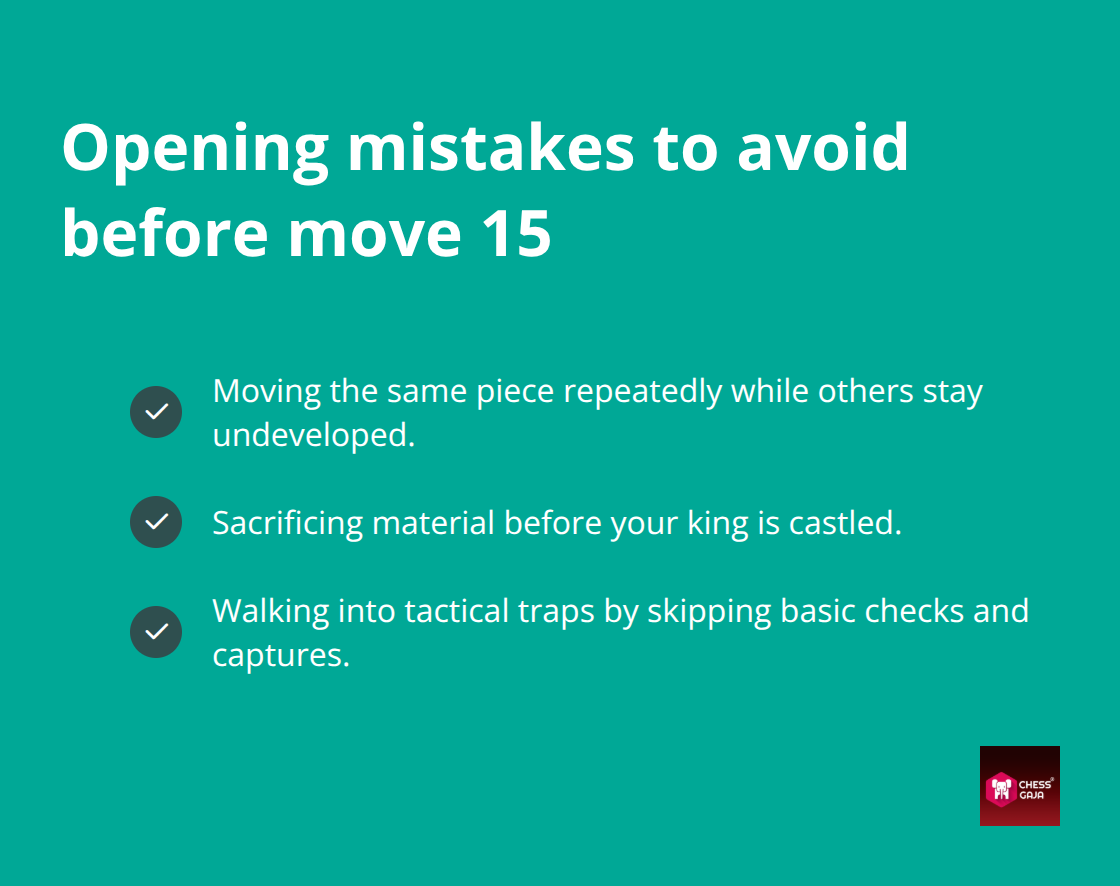
Beginners lose games in the opening not because they lack theory, but because they make three specific mistakes that hand their opponent an advantage before move 15. The first mistake is moving the same piece multiple times while other pieces remain undeveloped. This happens constantly at youth tournaments in the United States, UAE, and Singapore. A player moves their knight to f3, then to e5, then back to f3 again-all while their light-squared bishop, rooks, and queen sit at home. Your opponent develops three pieces while you shuffle one piece around, and suddenly you fall behind in development. The fix is straightforward. Before you move any piece a second time, ask yourself if all your other pieces have a useful square to move to. If they do, develop them first. Your knight can wait one more move if it means getting your bishop outside your pawn chain.
Hunting Pawns Before Your King Reaches Safety
The second mistake is pawn-grabbing before your king is safe. You capture a risky pawn on b2 with your queen, your opponent opens lines toward your uncastled king, and suddenly you face checkmate by move 18. This happens because beginners treat the opening like a material-collecting game instead of a survival game. King safety comes before winning pawns. After you castle, you have time to hunt for material. Before you castle, you should assume every move your opponent makes is a threat to your king. The players who win consistently at tournaments protect their king first and collect material second. This simple priority shift prevents most tactical disasters in the opening phase.
Walking Into Tactical Traps in the First 15 Moves
The third mistake is walking into tactical traps in the first 15 moves. The Sicilian Defense has dozens of traps. The French Defense has tactical pitfalls like early queenside pin traps or pawn-structure traps where Black can lose material if careless. The Italian Game can lead to aggressive tactical lines like the Fried Liver Attack (which occurs when Black responds with 3…Nf6). These aren’t theoretical curiosities-they happen regularly in beginner games because players follow their opening plan without checking if their opponent set a trap. Solve one tactical puzzle every morning before you play. This trains your brain to spot forcing moves, checks, and captures that appear in standard openings. Players who complete tactical puzzles regularly before playing games make fewer tactical errors in the opening phase than those who don’t practice tactics at all.
Final Thoughts
The chess opening principles come down to three actions: control the center, develop your pieces, and castle safely. Master these fundamentals, and you’ll win more games immediately. The Italian Game, Sicilian Defense, and French Defense give you three practical systems to apply these rules without memorizing endless variations.
Avoid moving the same piece twice, protect your king before hunting material, and solve tactical puzzles to spot traps before they catch you. These principles work at youth tournaments in the United States, UAE, and Singapore because they reflect how strong players actually think during the opening phase. Structured coaching accelerates your progress dramatically because a coach analyzes your actual games and identifies your specific weaknesses.
Book a Paid Starter Class with Chess Gaja for a professional skill evaluation. Our FIDE-rated coaches assess your current opening knowledge, identify which system matches your style, and create a personalized improvement plan tailored to your goals. You’ll receive detailed feedback on your opening choices and concrete steps to win more games.