

Your opening choice determines whether you win or lose in the first 15 moves. Most players waste years playing random moves instead of sound, proven systems.
We at Chess Gaja have coached thousands of students across 40+ countries, and we’ve seen one pattern: the best chess openings aren’t the flashiest ones-they’re the ones that match your skill level and playing style. This chess openings guide shows you exactly which openings work at every stage of your chess journey.
Essential Openings for Beginners
However, beginners often think opening mastery requires memorizing 20 moves. That is a mistake. In fact, players who improve fast master two or three simple, sound systems.
The Italian Game and London System form a strong foundation. They teach you to control the center, develop pieces in order, and avoid tactical blunders.
The Italian Game (1.e4 e5 2.Nf3 Nc6 3.Bc4) puts your bishop on an active square early. It helps you control central squares while keeping your king safe.
The London System (1. d4, 2. Bf4, 3. e3, and 4. Nf3) uses a solid, harmonious setup for both pawns and pieces. It lets you focus on piece play instead of memorizing long lines. Both systems reward understanding over memorization.
Why Memorization Fails Beginners
Beginners who memorize 15 moves of the Sicilian Defense often collapse when opponents deviate. Early on, players lack the pattern recognition needed to adapt on the fly.
Instead, focus on understanding why each move matters. For instance, the Italian Game places your bishop on c4 to attack f7, the weakest square in Black’s setup.
Likewise, the London System places pawns on d4, e3, and c3 to form a solid central barrier. This foundational knowledge applies to every game you play.
The Three Biggest Beginner Mistakes
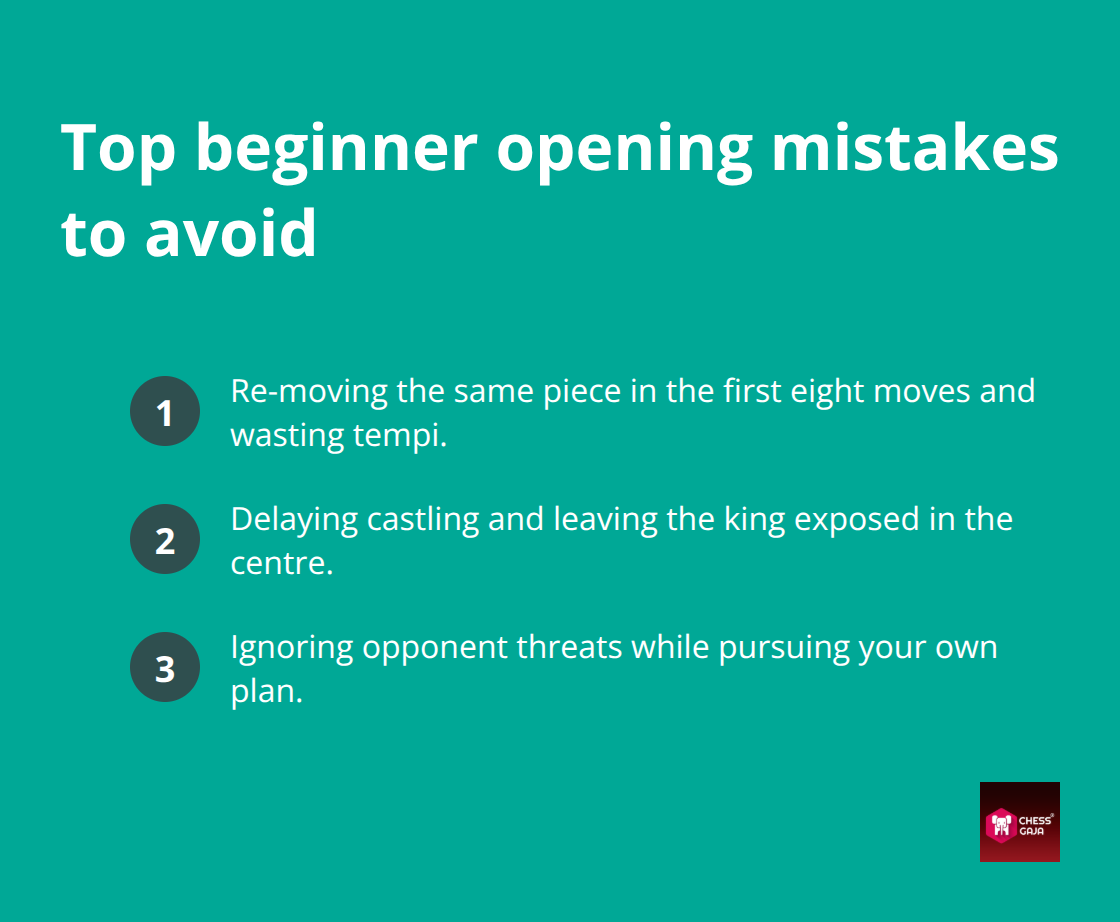
First, beginners often move the same piece twice in their first eight moves. For example, after 1. e4 e5 2. Nf3 Nc6, playing passive moves like 3. h3 or moving the same piece twice early on wastes critical development time.
Second, novices castle too late. Leaving your king in the center during tactical skirmishes invites trouble. Aim to castle by move 5–8 whenever possible.
Third, many players ignore opponent threats while pursuing their own plans. Always address immediate threats before executing your main strategy.
Both openings offer quick development. They help you avoid these common traps from the start.
Moving Forward to Intermediate Play
After 20 or 30 games, you will spot clear patterns. You will learn which positions feel easy and which ones feel tough. That awareness signals it is time to expand. Intermediate players need flexible openings. This is where the Sicilian Defense and French Defense come in.
Intermediate Level Strategies
At the intermediate level, opponents stray from standard lines by move three or four. Simple setups like the Italian Game or London System become less effective as play gets less predictable.
Now, the Sicilian Defense and French Defense become vital. In fact, the Sicilian (1.e4 c5) is one of the most popular and frequently played responses in master-level chess.
The Sicilian creates sharp, unbalanced games. Black fights for dynamic counterplay instead of quick equality.
When you play 1.e4 and Black responds 1…c5, White typically plays 2.Nf3 and 3.d4. Black trades on d4 immediately.
This trade grants Black queenside space and central counterplay. Meanwhile, the French Defense (1.e4 e6) Meanwhile, the French Defense (1. e4 e6) prepares Black to challenge White’s center immediately with 2… d5. As a result, White must build the center differently.
After 1.e4 e6 2.d4 d5, Black gains a solid setup. White then chooses between tactical lines (3.Nc3 or 3.Nd2), the Advance Variation (3.e5), or the Exchange Variation (3.exd5).
Both openings require learning core pawn structures over memorizing moves. Pick one defense against 1.e4 and play 15 games before making any changes.
Choosing Between Sicilian and French Based on Your Style
The Sicilian suits players who enjoy sharp tactics and counterattacks. Imbalanced positions reward concrete calculation over rote memory.
Conversely, choose the French Defense if you prefer solid setups. It creates strategic battles where small errors rarely lose the game right away.
Therefore, avoid switching between defenses constantly. Pick one opening and test it against 10–15 opponents at your level.
Next, note which move orders cause trouble and which feel natural. As a result, analyzing these results shows whether to deepen your knowledge or tweak your approach.
Building Your Defense Against 1.d4
Against 1.d4, intermediate players should play 1…d5. Learning many complex setups takes too much time.
The Queen’s Gambit Declined (1. d4 d5 2. c4 e6) is a top pick. It teaches solid chess without heavy memorization.
Most of all, this line rewards good piece play and pawn structure knowledge.
Reading Your Opponent and Adapting Within Your System
Adaptability does not mean abandoning your system mid-tournament. Rather, it means steering toward positions you know best.
For instance, suppose you base your defense against 1. d4 on Queen’s Gambit Declined structures. If White avoids 2. c4 and plays 2. Bf4 (the London System), you can still reach familiar solid setups with … Nf6, … e6, and … d5.
Move orders shift naturally because pawn structure matters most.
Start by studying one main line per opening, plus two common sidelines. Do not waste energy on rare moves.
Next, review your last 20 games on Chess.com or Lichess. Pinpoint exact positions where you struggled. Ask whether losses came from missed tactics or strategic errors.
Tracking your results by opening shows why you lose games. Players who review games regularly improve much faster than those who study at random.
As you climb toward advanced play, opponents will target your specific repertoire. They expect you to know key positions deeply.
At this stage, opening study shifts naturally. You move from general principles to mastering precise lines used in top-level tournaments.
Advanced Opening Mastery for Competitive Play
At advanced levels, your opponents study specific variations. They expect you to know key positions where games are won or lost. Therefore, preparation must shift from basic principles to exact tournament lines.
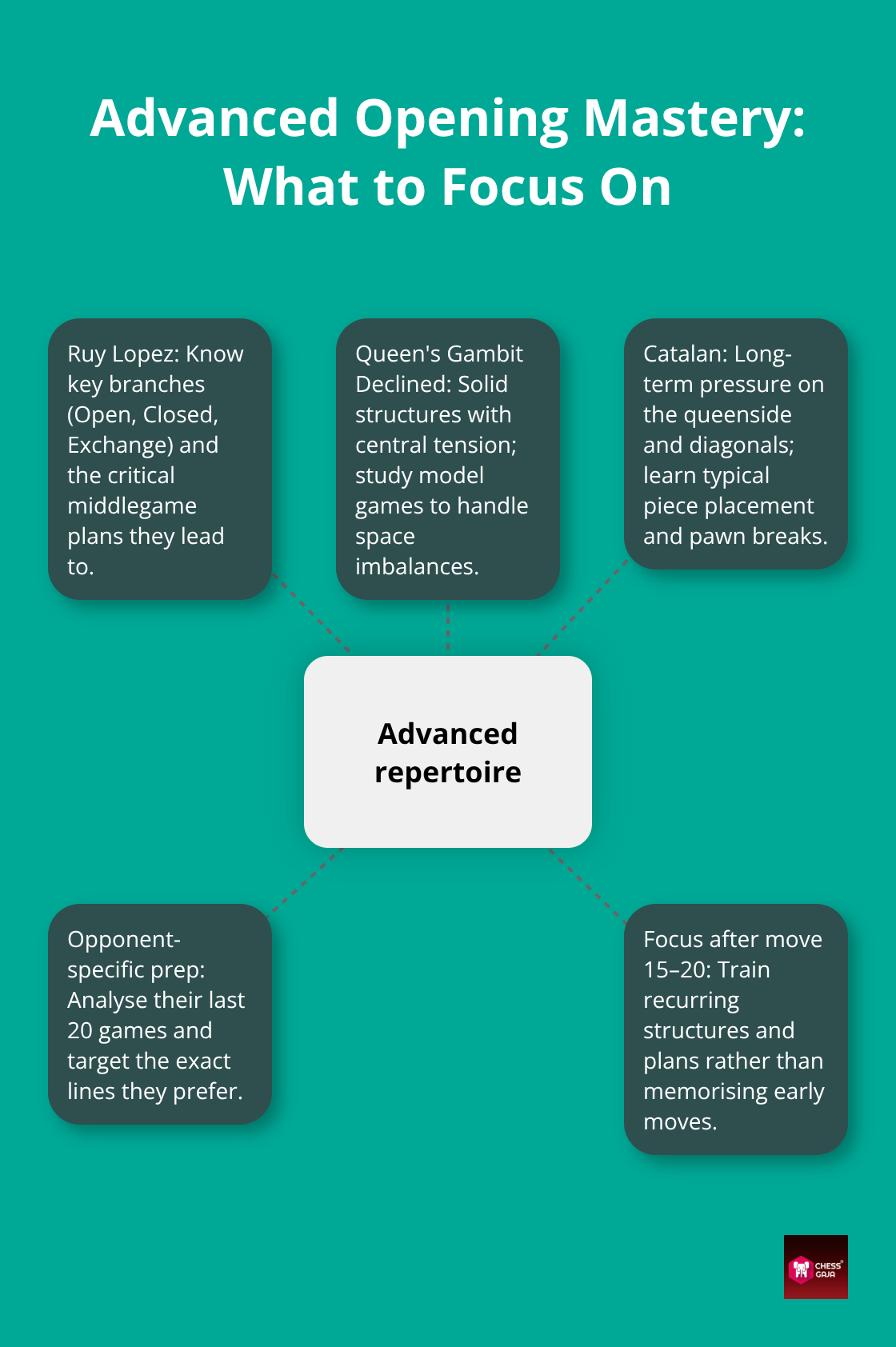
Players rated 1700+ need solid knowledge of main lines. Openings like the Ruy Lopez, Queen’s Gambit Declined, and Catalan offer great plans that reward study.
For example, White’s 9th move in the Closed Ruy Lopez (9. h3) sets the strategic course, branching into famous setups like the Chigorin, Breyer, or Zaitsev variations.
Before a tournament, analyze your opponent’s past games. If they consistently pick the Open Variation, target your study on that line. Focusing on positions after move 15 saves significant study time compared to analyzing all lines equally.
Where Deep Preparation Actually Matters
Advanced players often waste time memorizing early moves when Key decisions happen after move 20.
As founder of Chess Gaja, I suggest studying master games over single moves. Pick 10 to 15 games by top grandmasters in your opening. Watch how they move from opening to middlegame.
Your preparation should answer three core questions:
- Which pawn structures arise from your opening?
- What main plans does White execute in these setups?
- How can Black utilize available defensive resources?
Look at the Queen’s Gambit Declined Exchange Variation (1. d4 d5 2. c4 e6 3. Nc3 Nf6 4. cxd5 exd5). This leads to the classic Carlsbad pawn structure, where White attacks on the queenside with a b4–b5 minority attack or prepares a central break with f3 and e4. Meanwhile, Black gets safe central play and kingside chances.
Study Anatoly Karpov’s games in this line. He scored heavily in this structure during his peak.
These games prove White has a comfortable edge, not a force-win. Focus your preparation on reaching sound structures rather than hunting for non-existent knockouts.
Building Your Competitive Repertoire
Advanced players should limit their repertoire to 2–3 main lines as White and 2–3 responses as Black. Adding more lines reduces your depth of preparation.
If you play too many systems, you split your study time thin. Track your results over 30 games to see which lines suit your style.
Adding a new line mid-tournament often leads to avoidable rating drops due to shallow knowledge. Instead, spend six months mastering existing systems.
Coaches also suggest flexible move orders. If an opponent avoids a main line, steer the game back into your familiar structures.
Opponent Analysis and Targeted Preparation
Your strategy changes when you know your opponent in advance. Tournament pairings usually come out days early. This gives you time to research your opponent’s favorite lines.
Download their last 20 games from a database to spot habits. See if they repeat lines or switch by color. Check if they like sharp play or solid setups.
Additionally, look at how early they leave main line theory. This vital information guides your targeted preparation.
If your opponent plays the Sicilian Defense exclusively, focus on your primary anti-Sicilian system. Do not waste energy on obscure sidelines.
When an opponent plays multiple defenses, prepare your main line. Rely on your positional understanding to navigate the middle game.
Spending dedicated time analyzing a specific opponent yields far better results than studying general opening theory.
The Role of Concrete Analysis Over Memorization
Pure memorization fails when your opponent strays from standard theory. At that point, accurate calculation takes over.
Rather than memorizing 20 moves, study key positions after move 15. Ask critical questions:
- What key squares does White control?
- Where should Black place their pieces?
- What pawn breaks are available?
Understanding these goals matters much more than move order choices like a3 or a4.
Read grandmaster annotations to grasp the logic behind every move. This practice builds pattern recognition. As a result, when opponents play unexpected moves, you can adapt using sound principles.
Final Thoughts
Your opening choice reflects your playing style, rating, and competitive goals.
For instance, beginners who study deep theory struggle with basic tactics. Meanwhile, intermediate players who ignore pawn play get stuck at 1400. Likewise, advanced players who skip prep lose fast to ready rivals.
At Chess Gaja, we train students across 40+ countries. We see that players with coaching make steady, rapid rating gains.
First, our coaches review your games to pick your best openings. Next, we walk you through key spots where players fail. This personalized approach keeps you from wasting months on bad lines.
Book a Starter Class with Chess Gaja today. You will get a full skill evaluation and clear feedback. We will also build a plan to track your progress over the next three months.