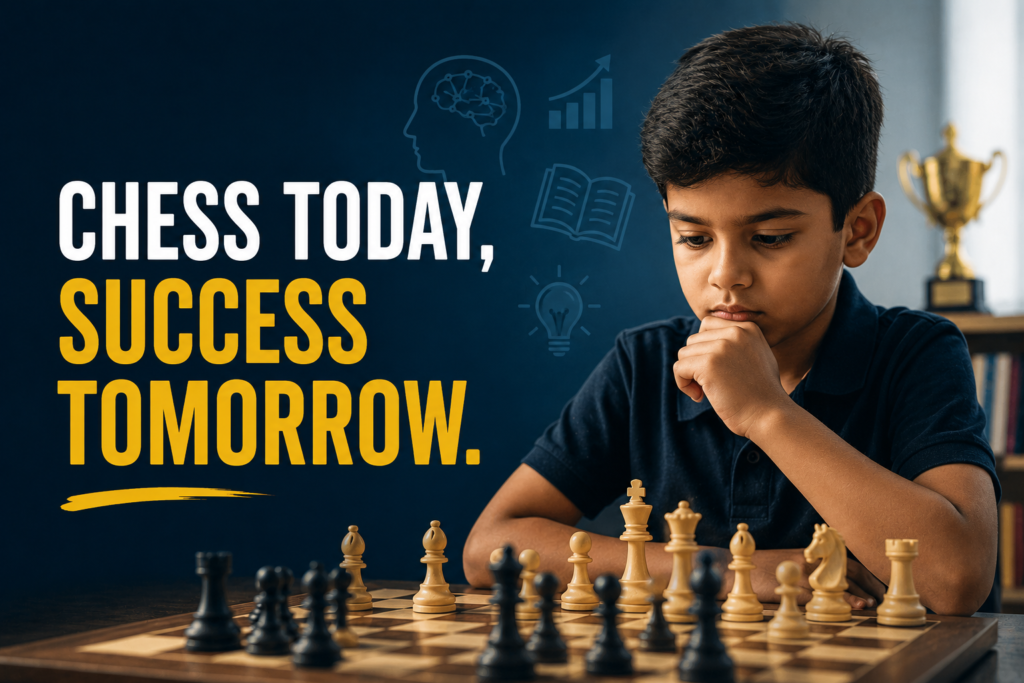
A student in Dubai just won her first regional tournament. Soon after, her math grades jumped two letter grades. This is no coincidence. Chess builds young minds in measurable ways.
At Chess Gaja, founded by GM Priyadharshan Kannappan, we see these cognitive benefits daily. Our programs reach students in over 40+ countries. Chess sharpens problem-solving and boosts grades. More importantly, it builds mental toughness for life.
How Chess Sharpens Real Problem-Solving
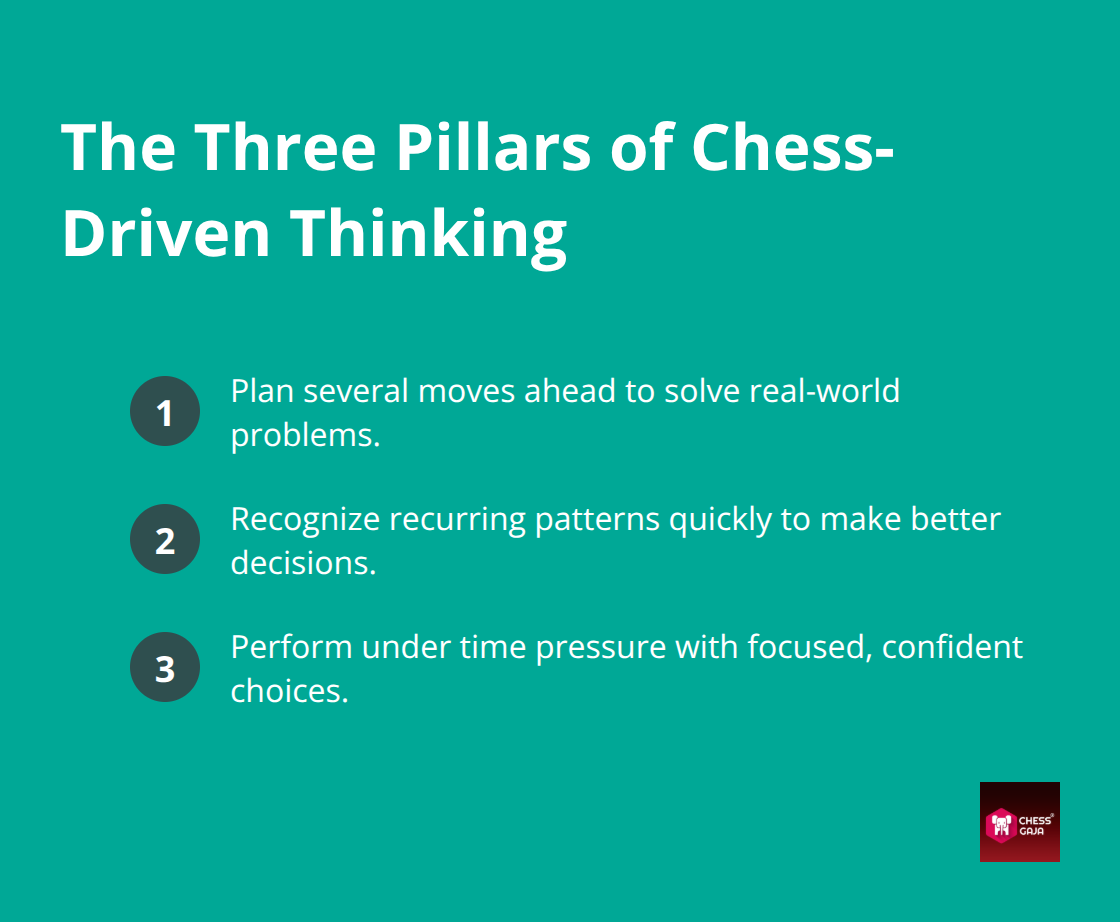
Picture a nine-year-old in a tournament game. She faces dozens of possible moves. She cannot evaluate every move at once. Instead, she asks critical questions:
- What happens if I move my knight here?
- How can my opponent respond?
- What is my next move?
Thinking several moves ahead builds key mental skills. This habit transfers directly to schoolwork and daily decisions.
At Chess Gaja, GM Priyadharshan and our FIDE-rated coaches teach structured calculation. Students learn concrete calculation over wild guessing. This step-by-step visualization helps with math problems, essay outlines, and group projects.
Spotting Patterns Faster Than Most Kids
Pattern recognition is not simple memorization. Young players spot tactical motifs like forks, pins, and back-rank mate threats across many games. Soon, their brains recognize these patterns instantly.
A student who studies 50 back-rank checkmates spots danger in seconds. A beginner might miss it entirely. Research shows this pattern-spotting ability extends to math. Recognizing problem structures helps kids solve algebra and geometry faster.
Combining tactical training with grandmaster-led strategy yields fast results. Children who solve daily puzzles spot connections quicker in other subjects.
Staying Sharp When the Clock Ticks
Tournament play under time pressure forces young players to make decisions fast without the luxury of endless analysis. This is because real mental toughness develops under realistic constraints. A player in a rapid tournament cannot hesitate for extended periods; instead, she must evaluate the position, calculate threats, and make decisions within seconds. As a result, this pressure trains working memory and teaches kids to trust their calculations rather than second-guess themselves endlessly. Over a tournament session, maintaining this level of focus builds mental stamina. Furthermore, this stamina helps students concentrate through longer exams and complex assignments. Therefore, the experience of playing multiple games in one day teaches time management and decision-making under realistic constraints—skills that matter far more than perfect play in comfortable conditions.
These three pillars-forward planning, pattern recognition, and performance under pressure-work together to reshape how young players approach challenges both on and off the board. The next section explores how these cognitive shifts translate into measurable gains in academic performance, backed by research from multiple countries.
Chess and Academic Performance: What Research Shows
Real Evidence From Parents and Students
The Dubai student’s jump in math grades is not an isolated story. A 2021 Romanian study surveying parents of chess-playing children found that most parents primary association with chess was its cognitive benefits, consistently rating its mental impact higher than any other factor.
Classroom research matches these parent reports. Because chess players develop stronger working memory, chess directly boosts math skills and reading comprehension.
For instance, when a child visualizes move sequences and calculates candidate moves in advance, this process uses spatial visualization and working memory together. Consequently, the same skills trigger when solving algebra or reading complex texts.
However, the connection is not magic; it is mechanical. The cognitive benefits of chess arise because chess practice strengthens specific neural pathways, allowing those pathways to fire again during school exams.
Parents who play chess themselves rated the cognitive impact even higher than non-playing parents, suggesting that those closest to the game understand its direct transfer to academics. Strategic thinking in chess-weighing options, evaluating consequences, planning sequences-mirrors the exact thinking required in essay structure, scientific method design, and project planning. A student who learns to ask what happens next on the chessboard starts asking the same question about their schoolwork.
How Tournament Play Builds Academic Stamina
Tournament experience accelerates this transfer. For example, playing timed tournament games—from fast-paced rapid rounds to longer classical matches—trains the brain to make decisive choices under pressure. In fact, this skill applies directly to timed exams and standardized tests. A child who maintains concentration across five tournament rounds in a single day builds deep mental stamina. As a result, this concentration translates into the ability to sustain attention through extended problem sets or reading assignments.
One critical finding from the Romanian study stands out: parents widely observed distinct cognitive benefits of chess in children who play compared to their non-playing peers, along with clear improvements in character and discipline. This means chess does not just feel beneficial-parents see measurable shifts in how their children approach learning and handle challenges.
Structured Coaching Produces Sharper Results
Kids in structured chess programs, especially those receiving coaching from FIDE-rated instructors, show the sharpest improvements because their practice is guided rather than random. Tactical drills paired with game analysis reinforce pattern recognition across multiple domains. A child who studies endgame technique learns not just chess mechanics but also develops the systematic, step-by-step problem-solving approach that strengthens performance across math, science, and reading subjects.
These academic gains depend on consistent, quality instruction. The next section explores how chess builds something equally important: the mental toughness and confidence that young players carry into every challenge they face.
Building Resilience Through Tournament Losses
A ten-year-old from Singapore lost her first tournament game decisively. Her opponent gained an early advantage, and a tactical oversight on move 15 sealed the game. Rather than spiral into frustration, her coach asked a single question: What would you do differently? Within days, she reviewed her score sheet, identified the opening inaccuracy and the key tactical blunder that led to a losing position, and adjusted her preparation. Two months later, she won a regional title. This is not a feel-good story about persistence-it is how the brain actually learns.
Losses Provide Clearer Feedback Than Grades
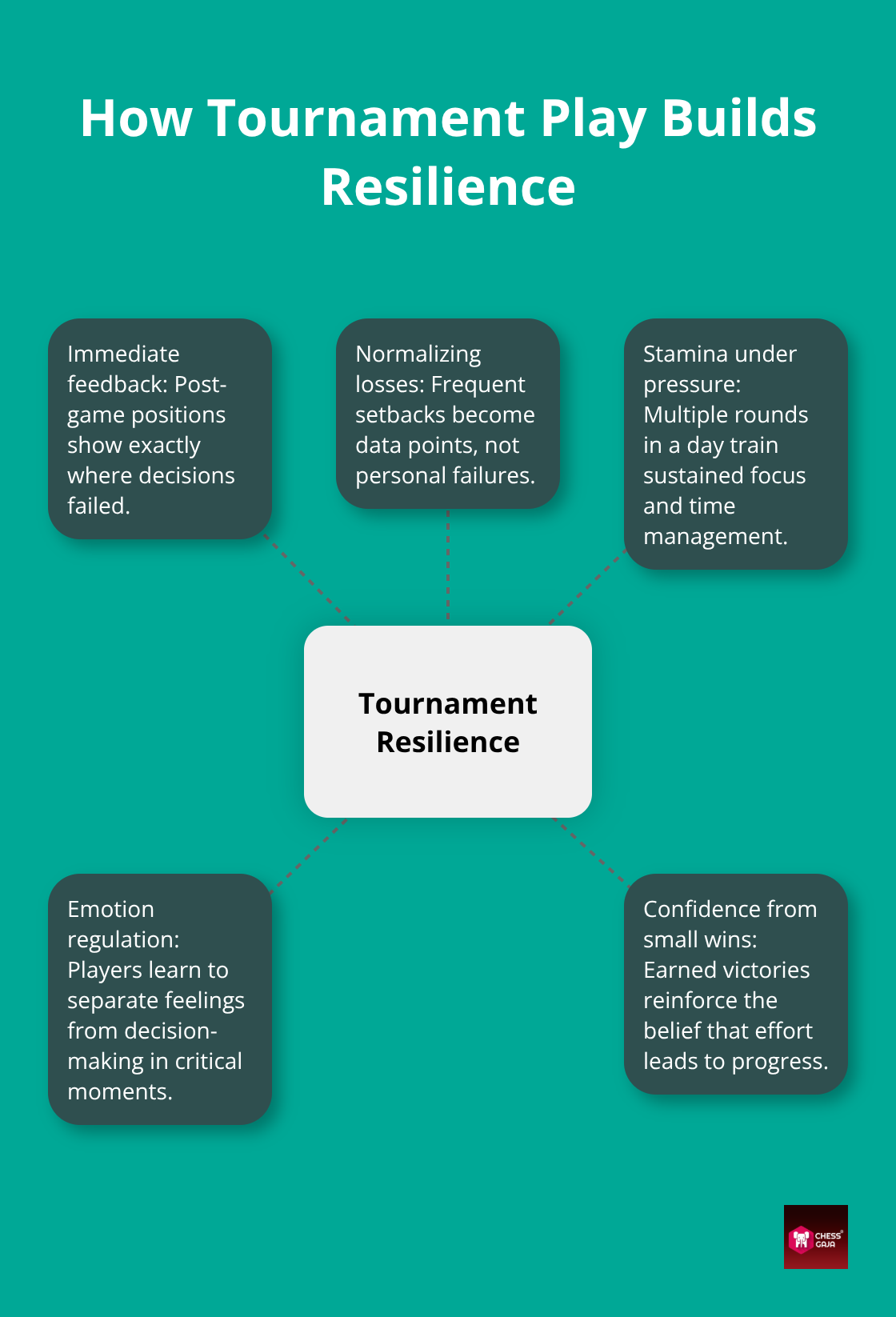
Research shows that chess helps young players develop emotional resilience and overcome negative emotions through tournament play. Specifically, tournament chess forces young players to face failure in real time with a clear record of exactly where things went wrong. A child who loses a game receives immediate, concrete feedback—through the final position and recorded score sheet, which pinpoint exactly where the blunder occurred. Therefore, this clarity accelerates learning in ways that classwork rarely does.
Kids who play tournaments regularly stop viewing losses as personal failures and start treating them as data points. A player who has lost twenty games understands that losses are part of improvement, not proof of inadequacy. This mindset shift transfers directly to academics. A student who approaches a failed test the same way she approaches a lost chess game-analyzing the mistake, understanding the gap, and adjusting strategy-improves dramatically faster than a student who simply feels discouraged.
Multiple Games in One Day Build Mental Stamina
Tournament play itself builds resilience through sheer repetition. A child playing in a five-round tournament faces multiple opponents, multiple positions, and multiple outcomes in a single day. Some games go well; others do not. The mental stamina required to stay focused and play your best game in round five, after losses in rounds two and three, develops genuine toughness. Research on chess players shows that this experience under pressure trains the brain to separate emotional reactions from decision-making-a skill that matters enormously in high-stress academic environments like standardized testing or college applications.
Small Victories Create Lasting Confidence
Small victories along the way matter tremendously. A beginner who wins her first game feels genuine accomplishment because she earned it against a real opponent. That win is not a participation trophy; it is proof of progress. Parents report that chess tournament success significantly boosts their children’s confidence in other areas. A child who wins a trophy in chess starts believing she can succeed at math competitions, debate, or science fairs.
Players who experience tournament success develop a growth mindset that extends far beyond the board. They stop saying “I am not good at math” and start saying “I have not learned this yet.” This single shift in language reflects a fundamental change in how young players approach challenges. The confidence built through small chess victories compounds over time, creating students who tackle difficult schoolwork with genuine belief that effort produces results.
Final Thoughts
Chess builds young brains in ways that extend far beyond the board. Working memory and visual processing strengthen as children calculate candidate variations and evaluate trees of move options during a game, directly building the focus needed to manage multi-step equations and complex reading passages. A child who learns to hold and assess candidate moves three or four steps ahead develops the cognitive discipline that supports learning across subjects, creating a strong foundation that lasts for years.
Social development happens naturally through competitive play. A nine-year-old from the UAE sits across from an opponent she has never met, shakes hands before the game, and learns to respect someone who plays differently than she does. Tournament environments bring together kids from different schools and backgrounds, creating friendships that extend beyond chess-parents in the Romanian study reported that a vast majority of chess-playing children made new friends through chess clubs, showing that these connections teach cooperation, sportsmanship, and the ability to work alongside peers who challenge you.
In conclusion, early training creates advantages that compound over years. Because a child who starts chess at age six receives consistent coaching from FIDE-rated instructors, she develops pattern recognition, decision-making speed, and emotional regulation. As a result, these habits shape how she approaches every challenge ahead. If your child is ready to build these cognitive benefits through quality coaching, book a Paid Starter Class for a professional skill evaluation.