

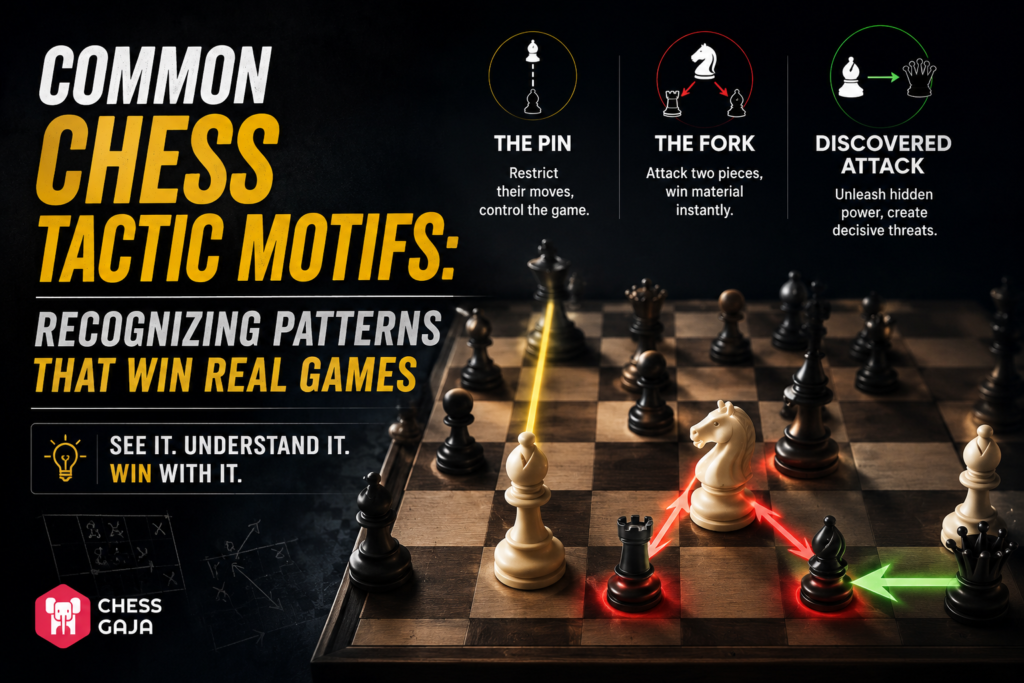
Strategic chess tactics decide most chess games below 2000 rating. Whether competing in the USA or UAE, spotting key tactical motifs separates winning players from those experiencing rating stagnation.
At Chess Gaja, we’ve coached students across 40+ countries. We’ve seen how mastering pins, forks, and discovered attacks transforms results in weeks—not months. This guide breaks down the exact patterns you need to recognize and win real games.
The Pin: Trapping Your Opponent’s Pieces
What Makes a Pin So Powerful in Real Games
A pin paralyzes a piece. A piece is pinned when moving it exposes a more valuable piece behind it. Once pinned, you control its destiny. In U1600 tournament play, pins appear constantly. Beginners fail to spot them and miss chances to exploit them ruthlessly. Once you spot a pin, you have choices. You can attack the pinned piece until it falls, restrict the opponent’s defense, or pile on relentless pressure.
Two types of pins matter at your level. An absolute pin targets the king. The pinned piece cannot move at all because doing so puts the king in check. A relative pin involves a more valuable piece standing behind the pinned one (such as a knight pinned in front of a queen). The front piece can legally move. However, doing so exposes the higher-value piece behind it to immediate capture. Most tournament games feature relative pins because absolute pins are rarer, but both win games decisively. In a 2024 UAE Junior Championship match, a nine-year-old won with a simple bishop move. He pinned his opponent’s knight on f6 to the queen on d8 along the diagonal using a bishop on g5. The opponent had no way to unpin the knight without losing the queen, and three moves later, the knight fell. That single tactical motif decided the tournament.
Spotting Pins in Three Moves
You spot pins by asking one question: Is there a valuable piece directly behind this piece on the same line? If yes, and if your piece can attack the front piece while the back piece holds more value, you have a pin. The fastest way to find pins is to scan your opponent’s pieces for alignment. Look for rooks and queens on files and ranks, and bishops and queens on diagonals. Does an enemy piece sit on a line with a more valuable target behind it? If your piece can attack it, move to that line immediately. Do not overthink this. A pin takes seconds to spot once you train your eyes to see piece alignment.
Converting Pins Into Material Wins
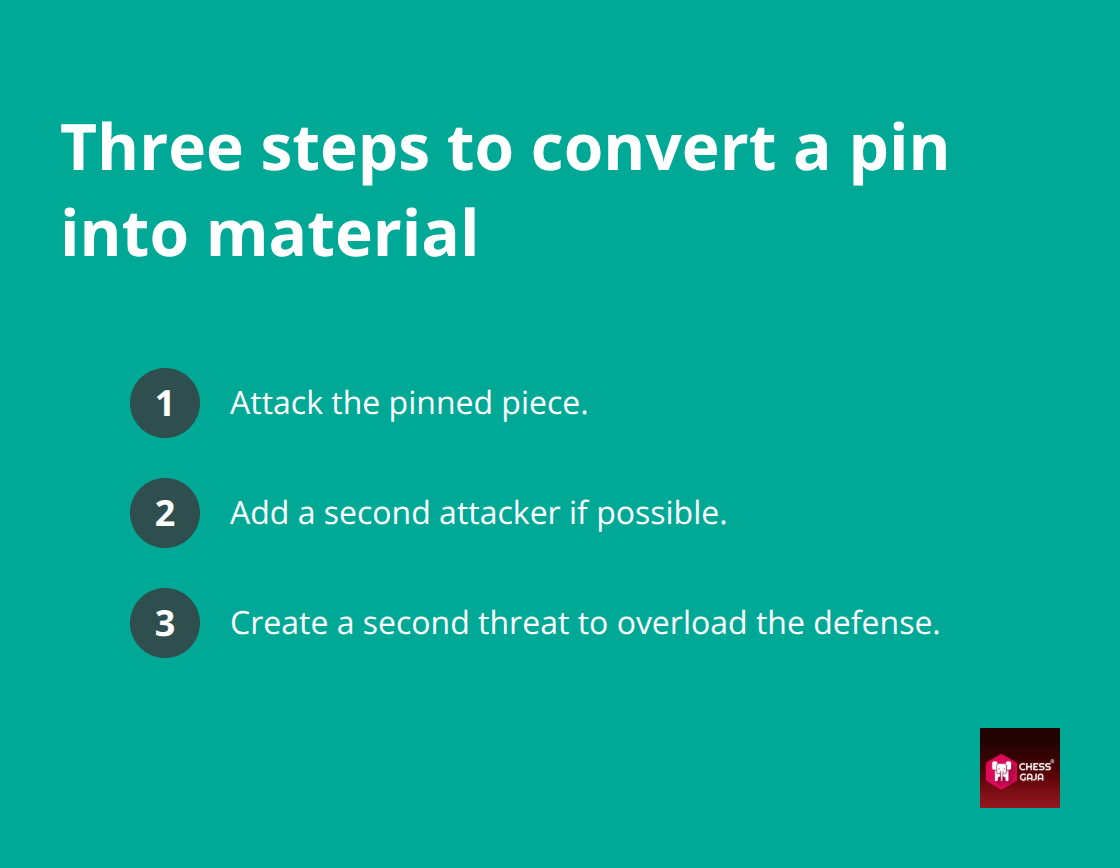
Winning material from a pin requires a specific approach. First, attack the pinned piece. Second, attack it again if possible. Third, create a second threat that forces your opponent to choose between saving the pinned piece or defending something else.
During a youth tournament in Singapore, a twelve-year-old attacked a pinned knight three times in a row. At the same time, he threatened checkmate on the back rank. The opponent could only defend one threat, and the knight fell on move fifteen. This pattern repeats constantly in tournament play: when you pin a piece, pile on the pressure immediately. Hesitation gives your opponent time to unpin or create counterplay. Attack the pinned piece relentlessly, and material falls into your lap.
Why Forks Complement Pins in Winning Sequences
Pins work best when you combine them with other tactical motifs. Many winning sequences start with a pin and end with a fork or a discovered attack. Once your opponent’s piece sits pinned and under pressure, a follow-up fork often seals the win because your opponent cannot move the pinned piece to safety. This tactical layering—pin first, then fork—appears constantly in real games. It separates strong tactical players from weaker ones. The next section shows you how forks operate independently and how they stack with pins to create unstoppable threats.
The Fork: Your Weapon for Winning Material Fast
What Makes a Fork Unstoppable
A fork attacks two pieces at once, and your opponent can only save one. The fork is straightforward, yet it wins material constantly. Players fail to spot it until their piece disappears. In a 2024 USA Junior Championship match, a ten-year-old forked a rook and bishop with one knight move. The opponent had built a seemingly solid position, but one unguarded square allowed the fork to happen, and the material loss ended the game by move twenty-two. Forks are not flashy, but they are relentless. Pins require repeated attacks to build pressure. In contrast, forks win material in a single move. Your opponent cannot defend both pieces simultaneously. This makes forks the highest-priority tactic to master because they deliver immediate, concrete results.
Why Forks Force Your Opponent Into a Losing Choice
The reason forks win so consistently is simple: they force a choice. Your opponent must decide which piece to save, and the other piece falls. In middlegames, forks often appear when pieces cluster together on central squares. In endgames, forks dominate because fewer pieces remain on the board, making each piece more valuable and easier to target with a single attacking move. A knight fork is the most common pattern. Knights move in an L-shape and reach unexpected squares, creating sudden double attacks. A rook fork on the seventh rank, attacking the king and an undefended piece simultaneously, appears so regularly in tournament games that spotting it instantly is non-negotiable.
How to Spot Forks Before Your Opponent Moves
Scan your opponent’s position for two valuable or undefended pieces. Look for a single target square where one move attacks both pieces simultaneously. Then, check if any of your pieces can safely move to that target square to deliver the double attack. Ask yourself: If I move my knight, rook, bishop, or queen to square X, do I attack two enemy pieces at once? If yes, calculate whether your opponent can capture your attacking piece before you capture the forked pieces. If your attacking piece is safe, the fork wins material. The fastest way to train this skill is to solve fork puzzles daily. Chess.com’s Custom Puzzles feature allows you to filter and practice puzzles specifically by the fork motif, allowing you to practice hundreds of fork patterns in weeks. After two weeks of consistent practice, you will spot forks in your own games instantly, without calculation.
Building Fork Recognition Through Focused Puzzle Training
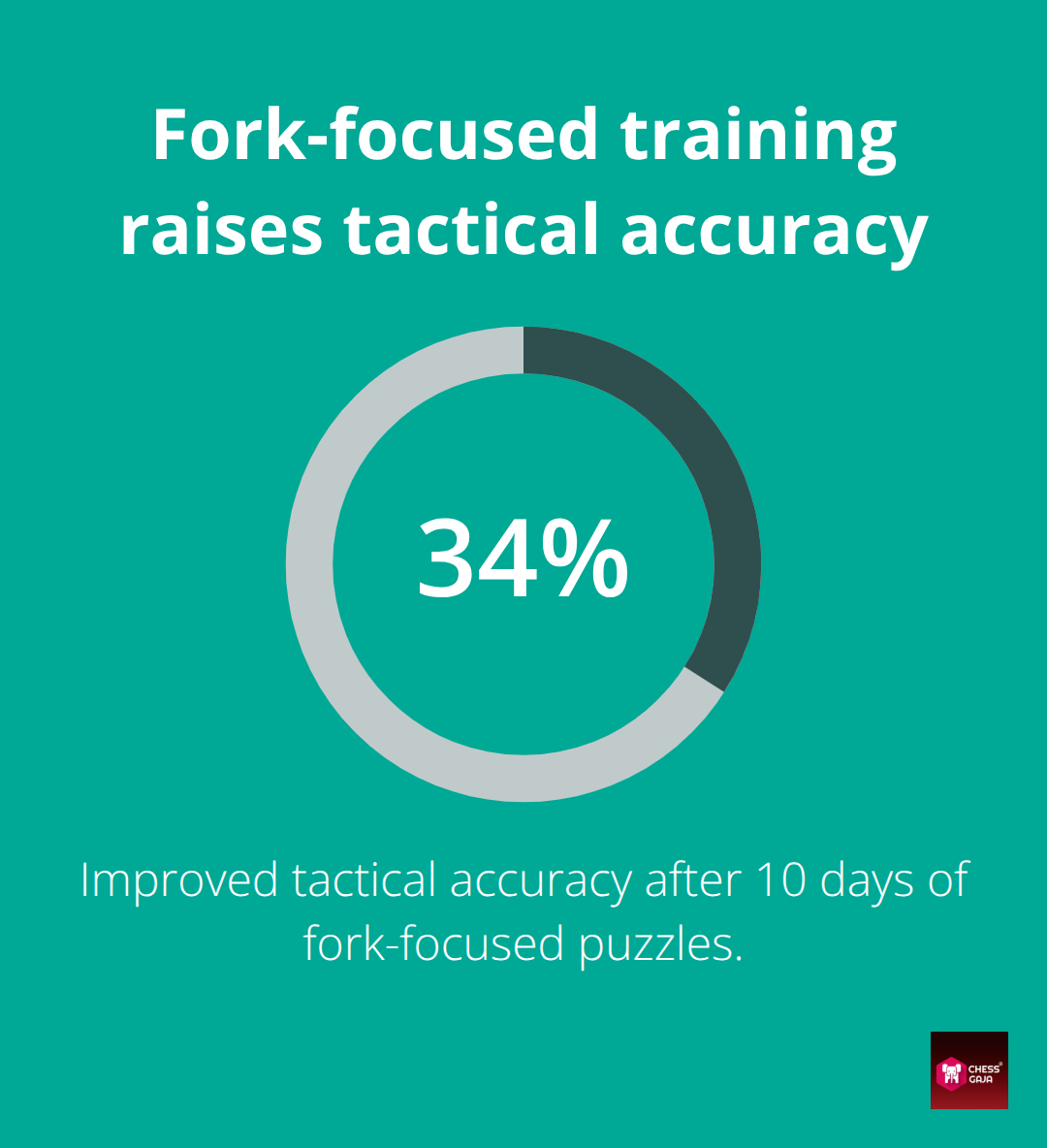
In a 2025 Singapore youth tournament, players who completed just ten days of fork-focused puzzle training showed a noticeable jump in tactical precision compared to players who did general puzzle work. The specificity matters.
Focused motif training produces fast, measurable results. It works much better than scattered puzzle practice. This pattern holds across all skill levels: when you isolate one tactical weapon and practice it repeatedly, your brain recognizes it faster in real positions. The next section introduces skewers and discovered attacks-two advanced motifs that often combine with forks to create unstoppable tactical sequences that end games decisively.
Skewer and Discovered Attack: Two Tactics That Finish Games
How Skewers Reverse the Pin and Win Material
A skewer is a pin in reverse, and it wins material just as decisively. Unlike a pin—where a lower-value piece shields a higher-value one—a skewer attacks the high-value piece directly. This forces the valuable piece to move out of danger, leaving the lower-value (or undefended) piece behind it exposed to capture. In a 2024 USA Junior Championship game, a player delivered a rook check along an open file. This forced the enemy king to move, exposing the queen lined up behind it. The rook captured the queen on the next move, forcing a resignation shortly after. The opponent’s queen was the most powerful piece on the board, yet it fell because the king had to flee first.
Skewers occur frequently below 1800 rating. Players forget that escaping a check often leaves a piece behind unprotected. A bishop skewer on a long diagonal, a rook skewer on a file or rank, or a queen skewer combining these geometries will win material in a single forcing sequence. To spot a skewer, ask yourself: If I attack this valuable piece with check or a forcing move, where must my opponent move it, and what piece—defended or undefended—sits on that same line behind it that I can win for a material profit?
Recognizing Skewer Patterns in Real Tournament Play
The fastest way to master skewers is to practice them daily. Within two weeks of consistent skewer puzzle training, you will start seeing them instinctively in your own games. The pattern becomes automatic once your brain recognizes the alignment of pieces and the forcing nature of the initial check or attack. Tournament players who spot skewers early gain a decisive advantage because the tactic forces an immediate material loss with no counterplay available.
Discovered Attacks: Creating Double Threats Your Opponent Cannot Defend
A tactic like a discovered attack operates on a different principle but delivers equally devastating results. When you move one of your pieces, you uncover an attack from another piece behind it, creating a double threat your opponent cannot defend simultaneously. A discovered check is the most forcing pattern. Your opponent must respond to the check immediately, leaving no time to defend against the second threat.
In a 2025 Singapore youth tournament, a fourteen-year-old won a queen through a discovered check: jumping a knight to a safe square while uncovering a rook check along an open file. Forced to address the check immediately, the opponent had no time to save their queen, which fell on the next move. Discovered attacks combine two threats into one forcing sequence, making them harder to defend than simple forks or pins.
Building Discovered Attack Recognition Through Focused Study
To build discovered attack recognition, look for positions where your long-range piece (like a queen, rook, or bishop) is aiming directly at an enemy target, but is blocked by one of your own pieces. Moving that front piece out of the way reveals a hidden attack. Move the front piece to create a double threat, and calculate whether your opponent can defend both threats simultaneously. The answer is almost always no.
Solve discovered attack puzzles using Chess.com’s Custom Puzzles feature, focusing specifically on discovered checks combined with piece attacks. After ten days of focused practice on this single motif, your calculation speed for these patterns will improve significantly, directly translating to wins in tournament games where you spot the tactic before your opponent sees the danger.
Final Thoughts
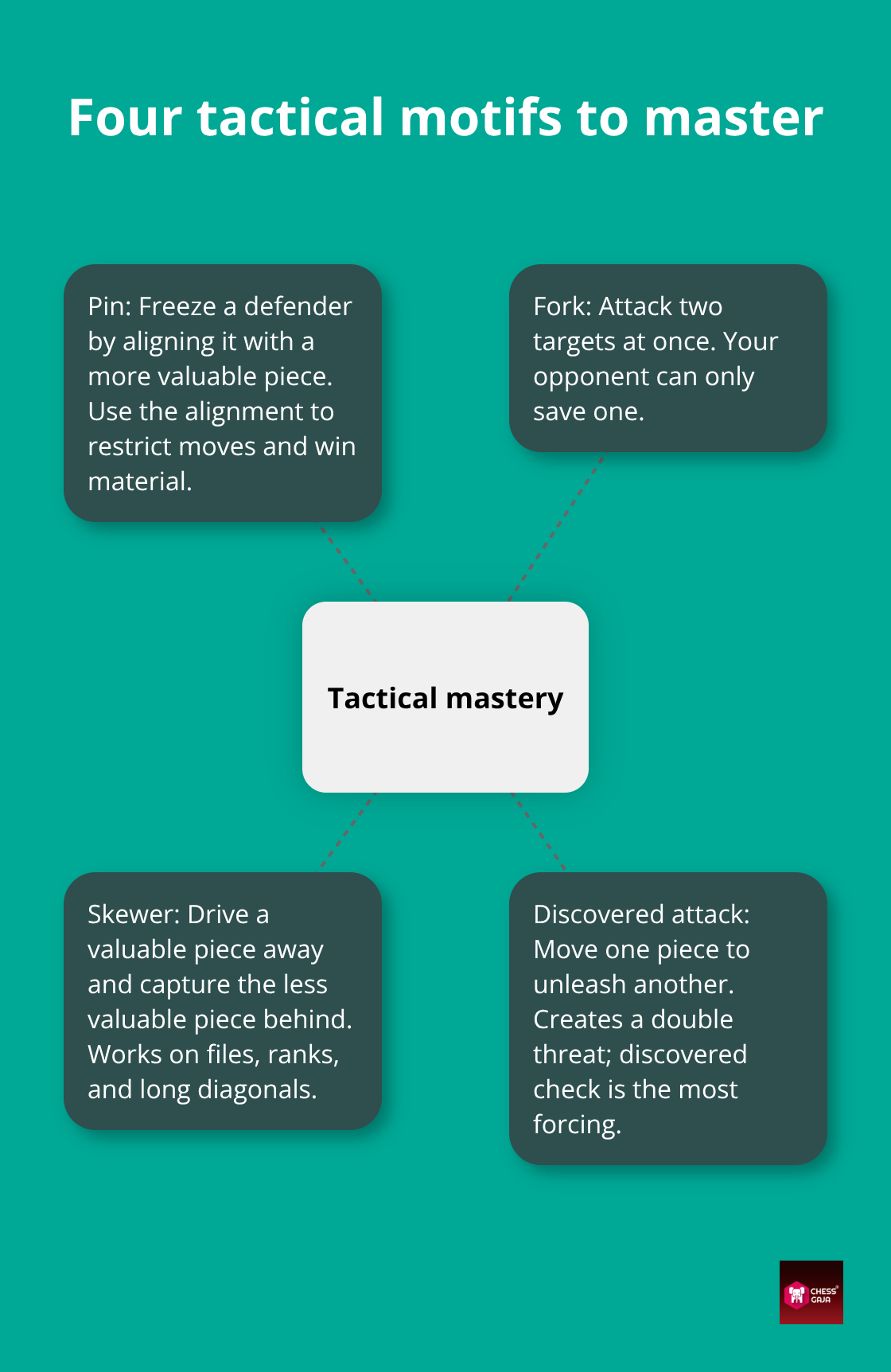
Pins, forks, skewers, and discovered attacks form the foundation of tactical mastery, and recognizing common chess tactic motifs accelerates your rating growth directly. Players who master these four patterns consistently outperform opponents at their level because they spot winning moves faster and convert advantages into decisive material gains.
In a 2025 Singapore youth tournament, players who completed focused puzzle training on these specific motifs sharpened their tactical accuracy within two weeks, and that improvement translated directly into tournament results.
Build a daily fifteen-minute puzzle routine. Spend five minutes on pins, five on forks, and five on discovered attacks using Chess.com’s Custom Puzzles feature filtered by motif. After two weeks, your brain will recognize these tactics instinctively during your own games. After one month, you will spot them faster than your opponents can calculate defenses, and your rating will reflect that improvement.
Book a Paid Starter Class with a FIDE-rated coach at Chess Gaja. Your coach will assess your tactical vision to identify missed motifs. Then, we’ll build a personalized study plan tailored to your rating goals. This is not a generic lesson-this is a professional skill evaluation designed to accelerate your improvement from day one.