


Aggressive chess openings separate proactive players from reactive ones. For instance, most beginners play passively and wait to see what their opponent does, which is a quick way to lose.
At Chess Gaja, we have coached thousands of young players in the USA, UAE, and Singapore. Ultimately, learning to attack early transforms your tournament results fast.
The Three Foundations That Separate Attackers from Defenders
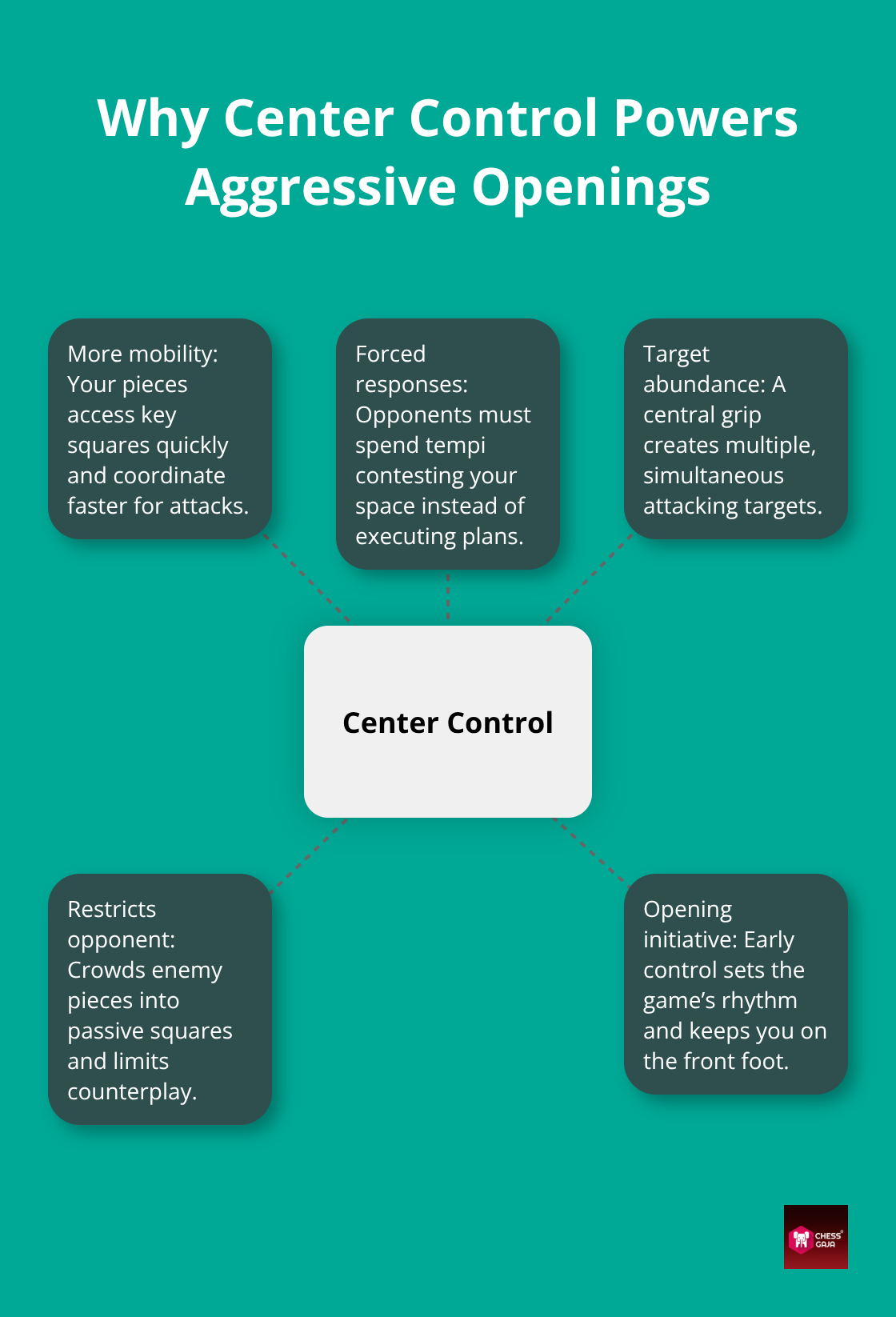
Aggressive chess means taking control before your opponent can defend. Specifically, the central squares—d4, d5, e4, and e5—dictate the whole game. When you control the center, your opponent must react to you.
Control the Center With Purpose
In the Italian Game, White plays 1.e4, 2.Nf3, and 3.Bc4. This setup controls the center and targets f7. It forces Black to make tough choices early.
The Sicilian Defense works the same way for Black. After 1…c5, you fight for d4 immediately. Because central control gives your pieces room to move, it creates early targets.
Develop Pieces With Immediate Impact
However, rapid development matters far more than memorizing moves. Every opening move should improve your pieces and advance your attack.
In the Italian Game, for instance, Bc4 puts your bishop on an active square aimed at f7, Black’s weakest pawn. As a result, the bishop creates real pressure as it develops. In contrast, passive squares like Be2 develop the piece without creating any immediate threats, while playing a3 or a4 wastes valuable time without activating pieces.
Young tournament players often waste moves shuffling pieces. Therefore, you should finish basic development—knights to f3 and c3, bishops active, and king castled—within the first 10 to 12 moves.
The French Defense also uses this principle. After 1.e4 e6 2.d4 d5, Black uses the d5-pawn to challenge White’s center directly. Black then strikes at White’s pawn chain with …c5 and develops pieces with purpose—such as playing …Nc6 to pile pressure on d4. Thus, speed and purpose work together to build strong attacks.
Generate Threats Your Opponent Cannot Ignore
Strong openings produce direct threats. After controlling the center and developing, you need a concrete target. In the Italian Game, Bc4 threatens f7 right away. Black must play defensive moves like …Nf6 or …d6 to stay safe.
The Sicilian Defense gives Black similar tools. Specifically, in lines like the Najdorf or Sveshnikov, Black plays …e5 to fight for the center directly. As a result, this move controls the key d4 square and builds dynamic counterplay.
In tournaments, the player who creates threats first sets the pace. So, after every move, ask yourself: What must my opponent do next? If they only have forced responses, then your pressure is working.
Three Opening Systems That Deliver Real Attacking Chances
The Italian Game: White’s Direct Path to Pressure
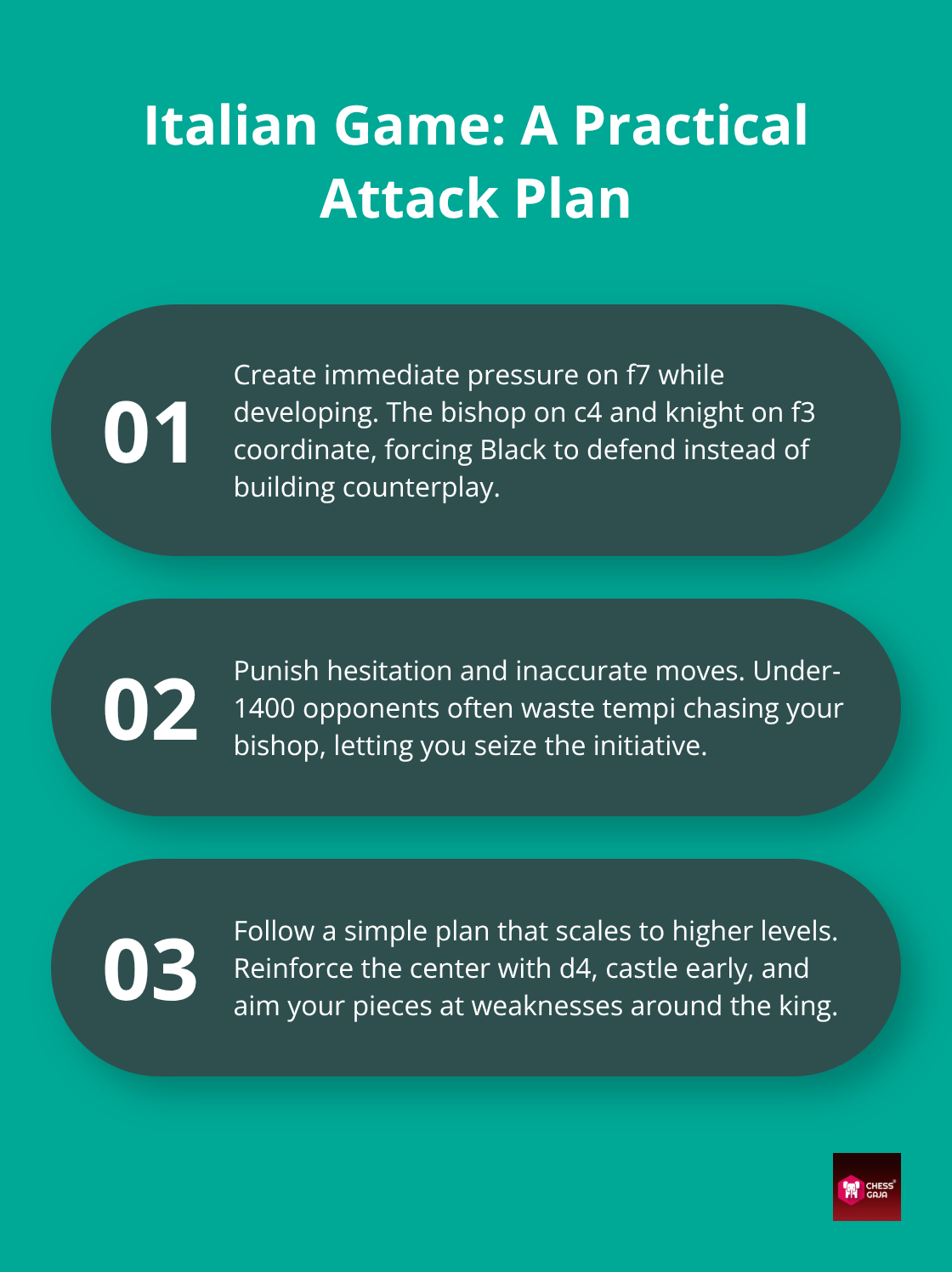
The Italian Game gives White an instant attacking weapon. After 1.e4 e5 2.Nf3 Nc6 3.Bc4, you control the center, develop two pieces, and target f7 in just three moves.
Most players under a 1400 rating struggle here because they lack a clear defensive plan. Therefore, your job is simple: complete development, prepare a central strike with c3 and d4 (or play an energetic d4 in the Scotch Gambit), and look for weaknesses near Black’s king.
The Sicilian Defense: Black’s Counterattacking Arsenal
The Sicilian Defense is Black’s best response to 1.e4. By playing 1…c5, you fight for the d4 square on move one and stop White’s easy central setup.
Furthermore, this creates sharp, unbalanced positions. While White usually attacks on the kingside, Black counters on the queenside. Mastering these sharp calculation lines ultimately leads to fast wins.
The French Defense: Strategic Aggression With Structure
The French Defense offers a structured, strategic way to attack. After 1.e4 e6, the e6-pawn supports 2…d5 to challenge White’s center. This setup lets Black develop with purpose rather than rushing into chaos.
Your pieces reach key squares purposefully. Black often attacks the d4-pawn immediately with …c5, bringing the queen’s knight to c6 and the queen to b6. In lines where White advances with e5, Black can route the king’s knight to e7 or f5 while keeping pressure on White’s center before launching further breaks like …f6.
Young players love the French Defense. It offers clear structure and strong counter-attacking power.
All three systems operate on the same foundation: control the center, develop with purpose, and create immediate threats. The Italian Game attacks quickly.
The Sicilian fights for the center on move one. The French Defense builds a solid chain before counter-striking. Your choice depends on your style. However, all three demand that you understand the tactical patterns that make aggressive openings work. These patterns appear in almost every position, and mastering them transforms your attacks.
Tactical Weapons That Win Aggressive Games
These three opening systems create positions where specific tactical patterns appear repeatedly. Knowing these patterns separates strong attackers from players who just hope for the best. In the Italian Game, the f7 square is a main target for direct sacrifices and pins. In the Sicilian, open c-file attacks and central battles create forks and double threats.
Understanding which tactics emerge from your opening transforms theoretical knowledge into winning moves.
Pins Control Your Opponent’s Pieces
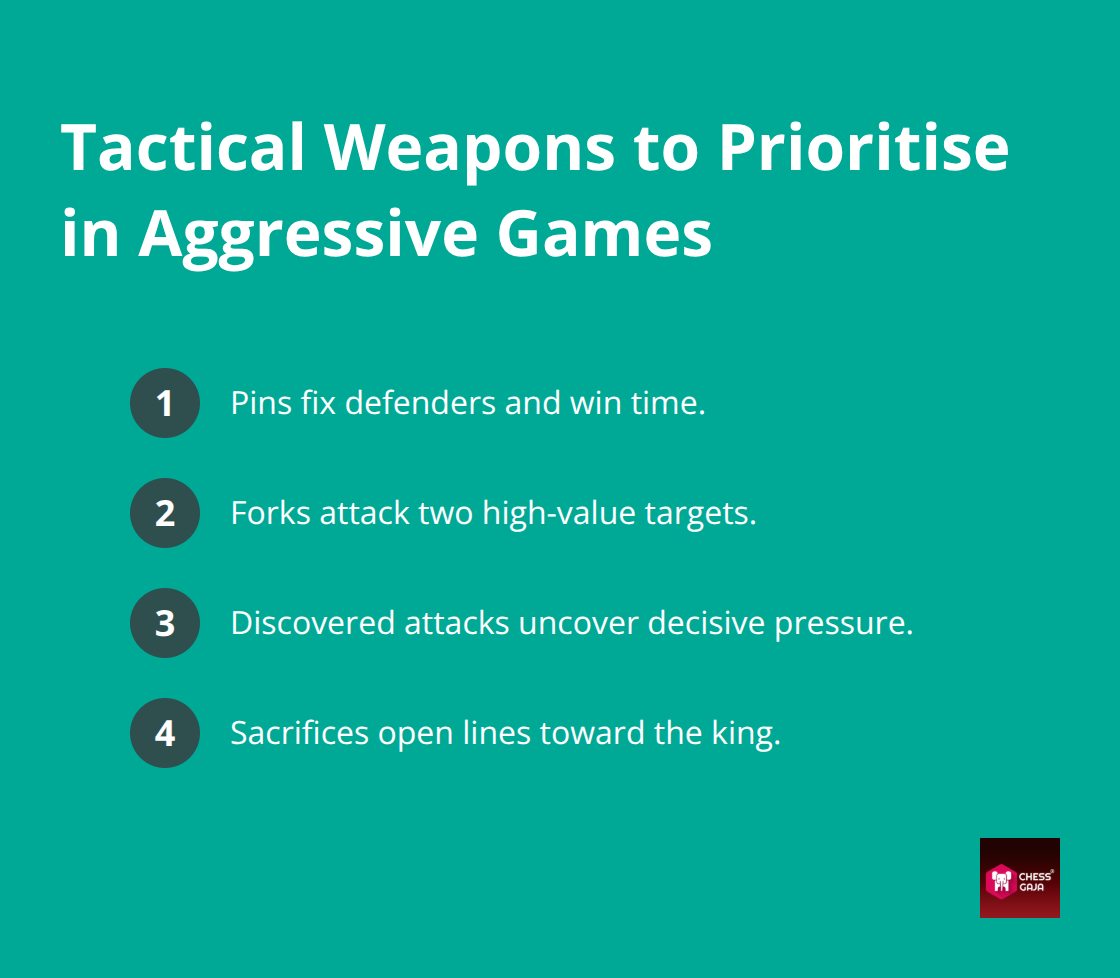
Pins are common tactical weapons in aggressive openings. For example, when a piece cannot move without exposing a bigger target behind it, you dominate the board. Consequently, you gain control over key squares.
In the Italian Game, White plays 3.Bc4. If Black plays …Nf6 and …d6, White often plays Bg5. This pins Black’s knight on f6 to their queen on d8, restricting Black’s mobility and creating tactical opportunities.
Intermediate players often overlook pins. Scan the board for them on every move.. Ask yourself: Are my opponent’s pieces aligned with their king or queen? If so, look for a pin to win tactics quickly.
Forks and Double Threats Attack Multiple Targets
Forks target two pieces at once. After developing your pieces in the Italian Game (1.e4 e5 2.Nf3 Nc6 3.Bc4 Nf6), a knight jump with 4.Ng5 targets the f7-pawn. This threatens a devastating fork against Black’s queen on d8 and rook on f8 via 5.Nxf7.
Young scholastic players frequently miss knight forks because they focus only on basic king threats. The best forks attack the king and a defender at the same time. As a result, your opponent loses material while staying under pressure. In addition, discovered attacks work on a very similar principle.
A discovered attack happens when a piece moves out of the way to reveal a second attack from a piece behind it. For example, jumping your knight away can open a diagonal for your bishop to deliver check on the king. Because your opponent is forced to respond to the check, your knight is free to capture an undefended piece elsewhere.
Sacrifices Open Lines Toward the King
Sacrifices open lines toward the enemy king. Specifically, surrendering material creates an immediate attack. However, this attack must outweigh the lost piece to succeed.
The Fried Liver Attack uses a knight sacrifice on f7 (1.e4 e5 2.Nf3 Nc6 3.Bc4 Nf6 4.Ng5 d5 5.exd5 Nxd5 6.Nxf7!). This forces Black’s king to capture with 6…Kxf7, pulling it into the open center. White follows up with 7.Qf3+, attacking both the exposed king and the pinned knight on d5 to mount a winning attack.
Players under a 1400 rating often avoid sacrifices because they fear losing material. Hesitation costs them winning positions.
To succeed with a sacrifice, calculate variations beforehand. Look three moves ahead to confirm that your attack wins material back or forces checkmate. Sacrificing on f7 removes a key defender and opens the f-file. Young players who calculate sacrifices accurately win more games against stronger opponents.
The Sicilian Defense teaches this principle from Black’s side. Black often strikes with …d5 or plays an exchange sacrifice with …Rxc3. This move looks reckless to beginners. However, it breaks White’s pawns and forces them to defend.
Calculation Separates Winning Sacrifices From Blunders
Precise calculation separates a winning sacrifice from a blunder. Therefore, you must verify that your attack continues forcefully. Otherwise, if your opponent neutralizes your attack, the sacrifice fails.
Tournament players study master games extensively for this reason. Analyzing how Grandmasters execute sacrifices shows which positions justify material loss.
These tactical patterns appear in every opening. Pins lock down pieces. Forks attack two targets at once. Discovered attacks create double threats. Good sacrifices open lines to the king. Master these tools to win more games.
Final Thoughts
Aggressive chess openings force your opponent to respond to your plans. The Italian Game, Sicilian Defense, and French Defense all share the same goal: control the center early and create threats.
Tactics like pins, forks, and sacrifices convert these opening moves into winning positions.
At Chess Gaja, we offer a curriculum designed by GM Priyadharshan Kannappan. Our FIDE-rated coaches provide personalized instruction to players across 40 countries. Book a Paid Starter Class with Chess Gaja to evaluate your skills and start improving today!