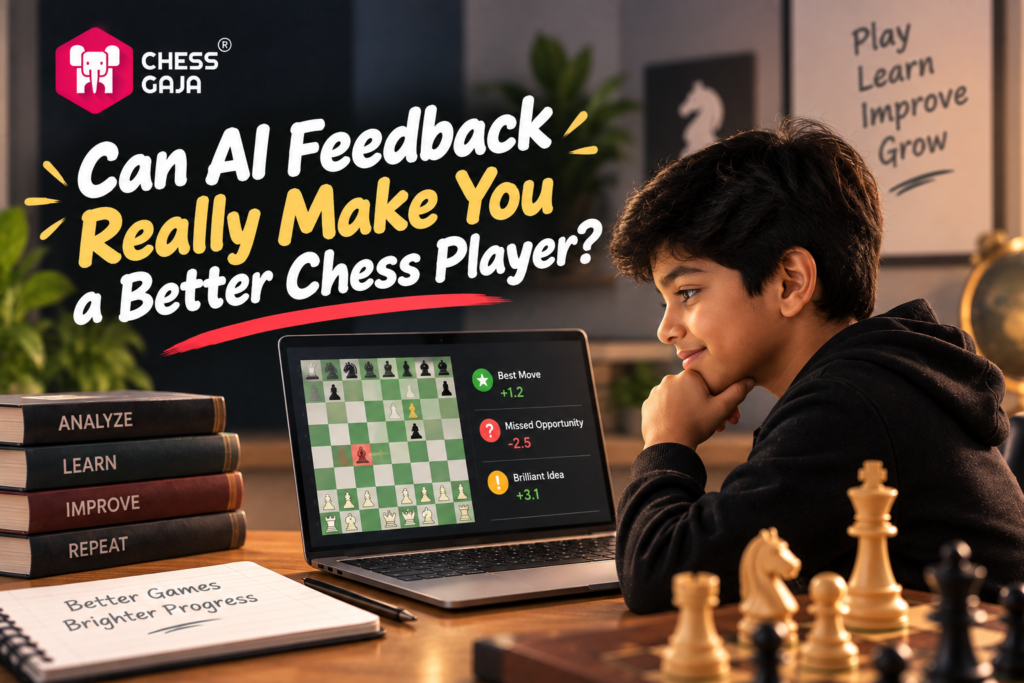
Your coaching sessions are only as good as the feedback you receive. AI feedback for chess has transformed how players identify mistakes and improve between lessons, giving you insights that would take hours to uncover manually.
At Chess Gaja, we’ve seen firsthand how combining AI analysis with expert coaching accelerates progress. This post shows you exactly how technology and human guidance work together to sharpen your game.
What AI Reveals About Your Games
Real-time analysis transforms coaching from a conversation about chess into a conversation backed by concrete data. When you play a game with AI feedback enabled, the system tracks every available move option. It immediately flags the precise moment you deviate from the strongest continuation. This matters because most players cannot calculate deeply enough to spot their own tactical oversights during play. Data across thousands of games at Chess Gaja shows tactical errors cause most rating losses below 1800. However, players rarely spot these errors without external analysis. AI catches these patterns instantly and surfaces them before your coach even needs to ask what went wrong.
During a coaching session with engine feedback active, the coach receives a key heat map. It shows which moves cost rating points and which positions created decision-making pressure. Your coach does not replay the entire game move-by-move. Instead, they jump directly to critical moments where improvement matters most. A student in a rapid game might sacrifice material expecting an attack. The engine reveals the move instantly drops evaluation by 2.5 pawns, exposing a clear gap between intention and reality.
Your coach explains why the move failed. More importantly, they show you how to spot similar patterns in future games to stop repeating the error.
Tactical Blindness Has a Fix
Most players below 1600 miss tactical opportunities by ignoring forcing moves—checks, captures, and threats. They evaluate passive options first rather than calculating concrete forcing lines. AI instantly surfaces the forcing sequences human intuition skips. A coach using AI feedback highlights missed forcing moves. A hidden threat you dismissed often sets up a tactical blow two moves later. This trains your calculation to evaluate concrete forcing lines before defaulting to passive developing moves.
The outcome is clear. Students reviewing games with AI feedback and coaching consistently spot tactical blind spots over time. They internalize patterns they previously skipped. After each student game, the AI-powered learning management system generates a summary highlighting the top three tactical misses ranked by severity. Your coach then assigns two or three similar positions for homework. This ensures you practice the exact pattern you failed to recognize. This targeted drill takes a few minutes but addresses the root cause rather than symptoms.
Strategic Weaknesses Emerge Across Multiple Games
AI does not just flag tactical errors; it reveals strategic imbalances that develop slowly and silently. You might allow opponents to control open files or expose your king early. These patterns repeat across dozens of games before you consciously notice them. AI analysis tracks these positional tendencies and clusters them. Your coach then sees if you struggle in bishop endgames or if your technique breaks down in complex rook endings.
A player might have a 1700 rating overall but perform at a much lower strength in basic Rook and Pawn endgames. Without AI feedback, this weakness remains hidden. Players often blame endgame losses on simple time trouble rather than recurring technical missteps.
With AI, your coach identifies the gap early and builds a focused endgame training block. When AI flags an endgame weakness, your coach assigns targeted drills. These match your exact rating and the specific ending type you struggle with. Progress happens faster because practice targets the weakness, not the entire endgame universe.
How AI Feedback Connects to Your Next Coaching Session
The real power of AI feedback emerges when your coach uses it to shape what happens next. Instead of starting your next session with vague questions about what went wrong, your coach arrives with specific data about your patterns, your weaknesses, and the exact positions where you lost rating points. This shifts your coaching time from diagnosis to solution. Your coach can spend less time explaining what happened and more time teaching you how to handle similar situations in the future. The next chapter explores how this targeted approach-powered by AI insights-transforms your entire coaching experience and accelerates your improvement between lessons.
How AI Turns Your Games Into Actionable Coaching Blueprints
Post-Session Summaries That Prioritize What Matters
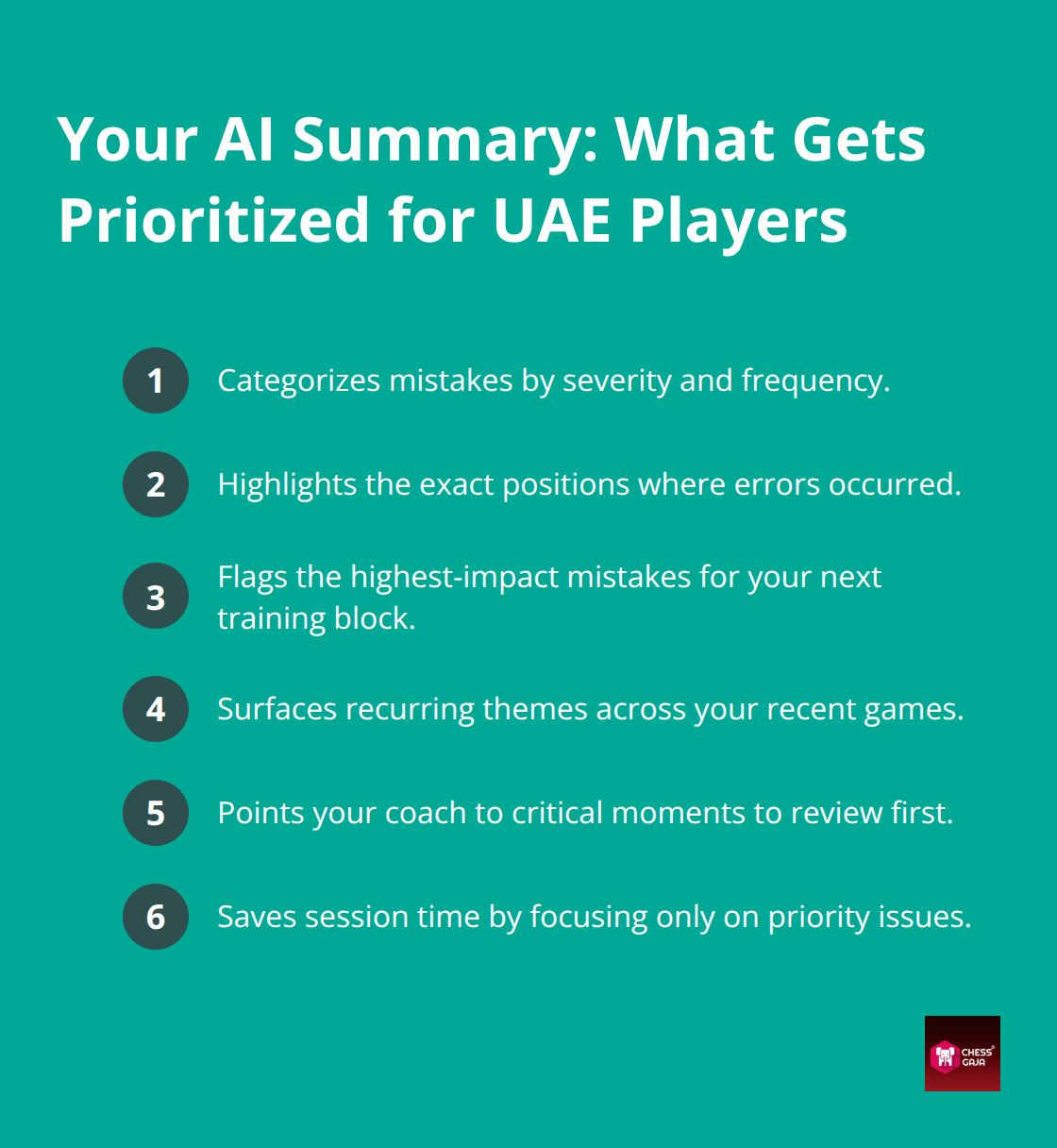
After each coaching session, our AI-powered Learning Management System generates a detailed summary that arrives on your phone within hours. This summary does not simply list your mistakes; it categorizes them by severity, frequency, and the specific positions where they occur. If you made a tactical error on move 15 that cost 1.2 in engine evaluation, and another tactical error on move 34 that cost 0.8, the system flags the first as higher priority for your next training block. A student playing three games might lose two from weak pawn endgame technique. The third loss might come from missing a middlegame forcing sequence. Your coach skips broad reviews. They know exactly where to focus next week’s lesson.
Coaching time is valuable and finite. AI ensures every minute addresses a real, measurable weakness rather than generic topics.
Playing Style Analysis Shapes Your Training Path
The system tracks your playing style across sessions, identifying whether you tend toward aggressive attacking play, solid defensive positions, or positional maneuvering. Students often discover their performance drops in closed positions. They struggle to find a plan compared to open tactical games. Your coach recommends openings and study materials matched to your natural strengths. They avoid forcing skills that contradict your personal style. This approach respects how you actually play chess instead of imposing a one-size-fits-all method.
Measuring Real Progress Across Weeks and Months
Tracking progress across multiple coaching sessions becomes concrete when AI aggregates your data over weeks and months. Chess Gaja data shows students make steady rating gains with structured coaching. The key is focusing systematically on one weakness at a time. AI identifies your primary monthly weakness. Your coach assigns targeted drills, and the system tracks performance changes in subsequent games. A tactical weakness might show low forcing-move accuracy initially. It improves sharply after focused drill work with your coach.
This measurable improvement gives you concrete proof that your training works, not just a feeling that you are progressing.
Catching Hidden Patterns Before They Sabotage You
The system also flags when a weakness you thought you fixed reappears in a different guise. You might solve rook ending problems in classical games. However, the same technique often fails in rapid games due to time pressure. AI catches this pattern and alerts your coach that you need clock training in addition to pure endgame study. Without this data layer, players often repeat cycles of improvement and regression without understanding why. With AI feedback integrated into your coaching journey, progress becomes linear and intentional rather than random. Your coach now possesses the information needed to design your next training block with surgical precision, addressing not just what went wrong, but why it went wrong and how to prevent it from happening again.
Why Your Coach Sees What AI Misses
The Engine Flags Moves; Your Coach Explains Decisions
AI excels at identifying what happened in your games, but it cannot explain why you should care about what happened. A chess engine flags move 23 over move 24, showing a 0.6 evaluation loss. Your coach, however, understands that move 23 reflects your playing style, your time situation, and your psychological state in that moment. Your coach knows whether the 0.6 point loss matters strategically in the resulting position or whether it was a pragmatic choice given your opponent’s tendencies. An engine treats all positions equally; a coach understands that a small positional concession might be acceptable if it avoids a tactical minefield where you historically struggle. This distinction transforms feedback from mechanical correction into genuine learning.
A student in Dubai might receive AI feedback showing they played a solid move that lost 0.3 in evaluation compared to the engine’s top engine choice, but your coach recognizes that the move demonstrates improved pattern recognition from last week’s lesson and should be reinforced rather than criticized. Without this contextual judgment, students chase engine perfection instead of pursuing the specific improvements that accelerate their rating growth.
Pattern Recognition Meets Strategic Adaptation
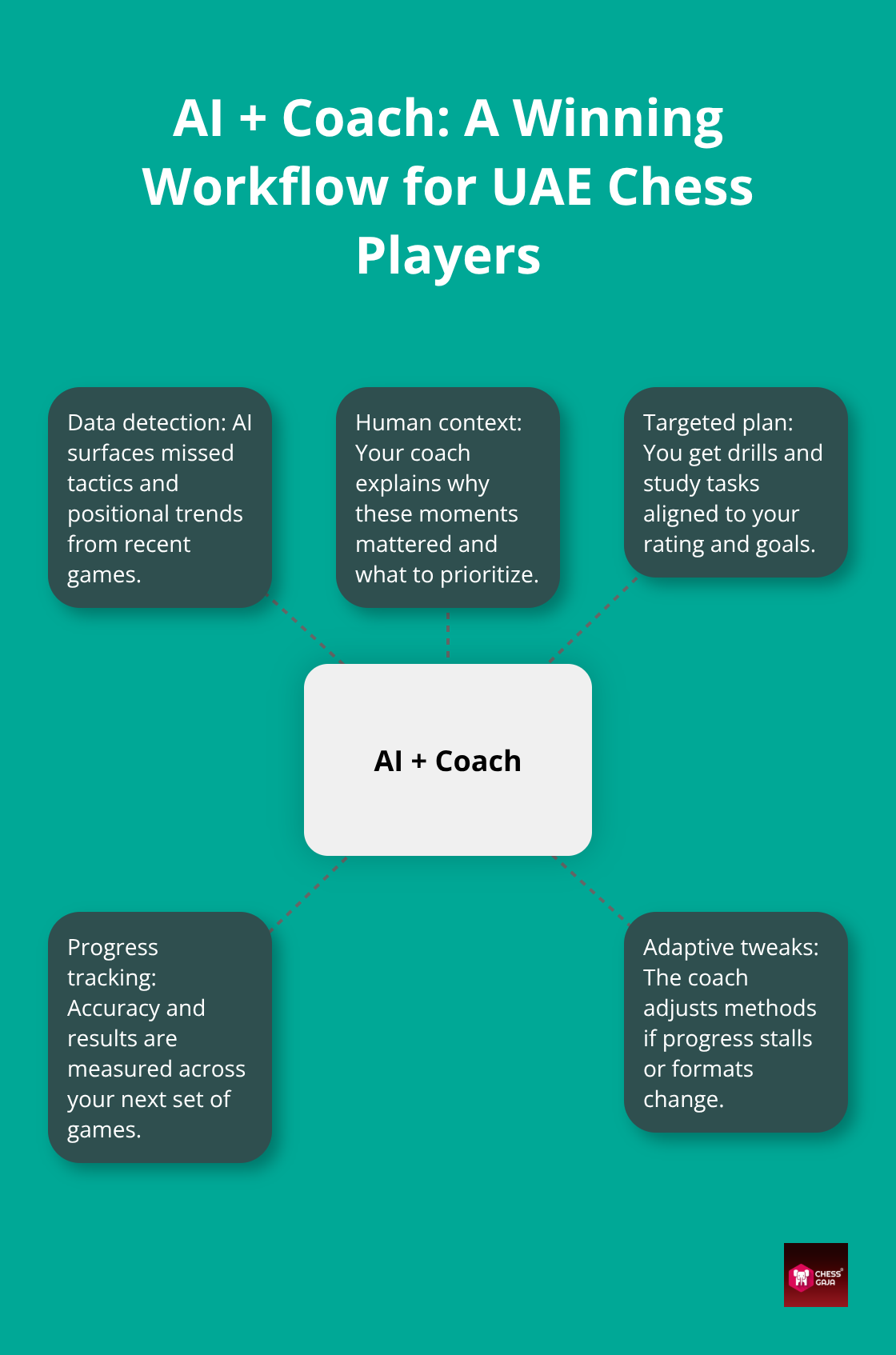
AI pattern recognition combined with human strategic guidance creates a feedback loop that neither can achieve alone. The system identifies when you consistently miss forcing moves in candidate positions, then your coach teaches you a specific calculation method to spot checks, captures, and threats faster. Over subsequent games, AI measures whether your forcing move execution improves, and your coach adjusts the training approach if progress stalls. This partnership avoids two common coaching failures: coaches who provide vague feedback without data, and AI systems that generate overwhelming lists of improvements without prioritizing what matters most for your rating.
Experience at Chess Gaja proves that students improve fastest when they focus on one weakness at a time with measurable progress tracking. AI identifies the weakness and tracks execution; your coach ensures you work on the right tactical or positional concepts and adapts the strategy if the training method is not producing results.
Building Strategy Across Months, Not Just Games
Your coach builds your development across months and years, not just individual games. AI cannot decide whether you should spend the next month on endgames or openings based on your tournament schedule and your long-term rating goals. Your coach knows that if you compete in rapid tournaments in March, now is the time to build time-management discipline in that format, and AI feedback becomes a tool to measure whether that specific training works. This integration means your coaching relationship becomes genuinely strategic rather than reactive, with AI providing the detailed feedback and your coach providing the strategic direction that transforms feedback into measurable improvement.
Human coaches understand the broader context of your chess development. They recognize when a weakness in one area (such as time management in rapid) connects to a strength in another area (such as deep calculation in classical). Your coach leverages these connections to accelerate your growth, while AI supplies the precise data about where improvement occurs. Together, they create a development path tailored to your specific needs, your tournament calendar, and your long-term goals.
Final Thoughts
AI feedback for chess accelerates your improvement between coaching sessions by transforming every game into a learning opportunity. Instead of waiting a week to analyze your mistakes with your coach, you receive detailed summaries within hours that identify your exact weaknesses ranked by severity. This speed matters because patterns fade from memory quickly; AI captures them while they remain fresh, and over weeks and months, this continuous feedback loop compounds into measurable rating gains that would take far longer through traditional coaching alone.
The future of chess coaching combines AI data with human judgment rather than replacing one with the other. Your coach uses AI-powered feedback to make smarter decisions about your training, identifying which tactical patterns you miss repeatedly, which endgame types expose your weaknesses, and which time controls amplify your mistakes. Armed with this information, your coach designs a focused training plan that targets your specific gaps rather than generic improvement areas, creating results that neither AI nor human coaching could achieve independently.
If you are ready to experience how AI feedback for chess works alongside expert coaching, book a Paid Starter Class at Chess Gaja to receive a professional skill evaluation from one of our FIDE-rated coaches. Your coach will assess your current level, identify your primary weaknesses, and design a personalized study plan tailored to your rating and goals. You will experience firsthand how AI-powered feedback and human coaching accelerate your improvement.