

Your hands shake as you sit down for the final round of the regional youth tournament. The clock is ticking, and one mistake could cost you everything.
At Chess Gaja, we’ve worked with hundreds of young players facing this exact moment. Confidence under pressure training isn’t about playing perfectly-it’s about staying steady when the stakes are highest. This post shows you how top players build mental resilience and why structured practice changes everything.
What Happens to Your Brain When Pressure Rises
Your decision-making accuracy drops significantly under time pressure, and the data backs this up. When time constraints tighten, your nervous system responds as if facing a physical threat—your heart rate increases, vision narrows, and mistakes spike as calculation depth gives way to rapid pattern matching. Top tournament players don’t have naturally faster brains; they thrive under pressure because they have systematically trained their pattern recognition and stress response beforehand.
Your hands shake and your breathing quickens under stress. Your vision narrows because your nervous system treats the position like a physical threat. This is not a weakness. It is a natural stress response affecting beginners and grandmasters alike. The real separation between players comes down to preparation. Players who thrive have simply trained this response beforehand.
The Clock Becomes Your Opponent
In rapid and blitz formats across the UAE chess calendar-events like the iMaster Open Blitz and Improve ME Institute Open Blitz-time pressure is the dominant factor, not position evaluation. Players who lose aren’t always in worse positions; they’re players who couldn’t execute their moves before the flag fell. Most beginners make a harsh mistake: they treat time as an unlimited resource during practice. If you’ve never played with a clock in training, your first tournament will feel foreign and terrifying.
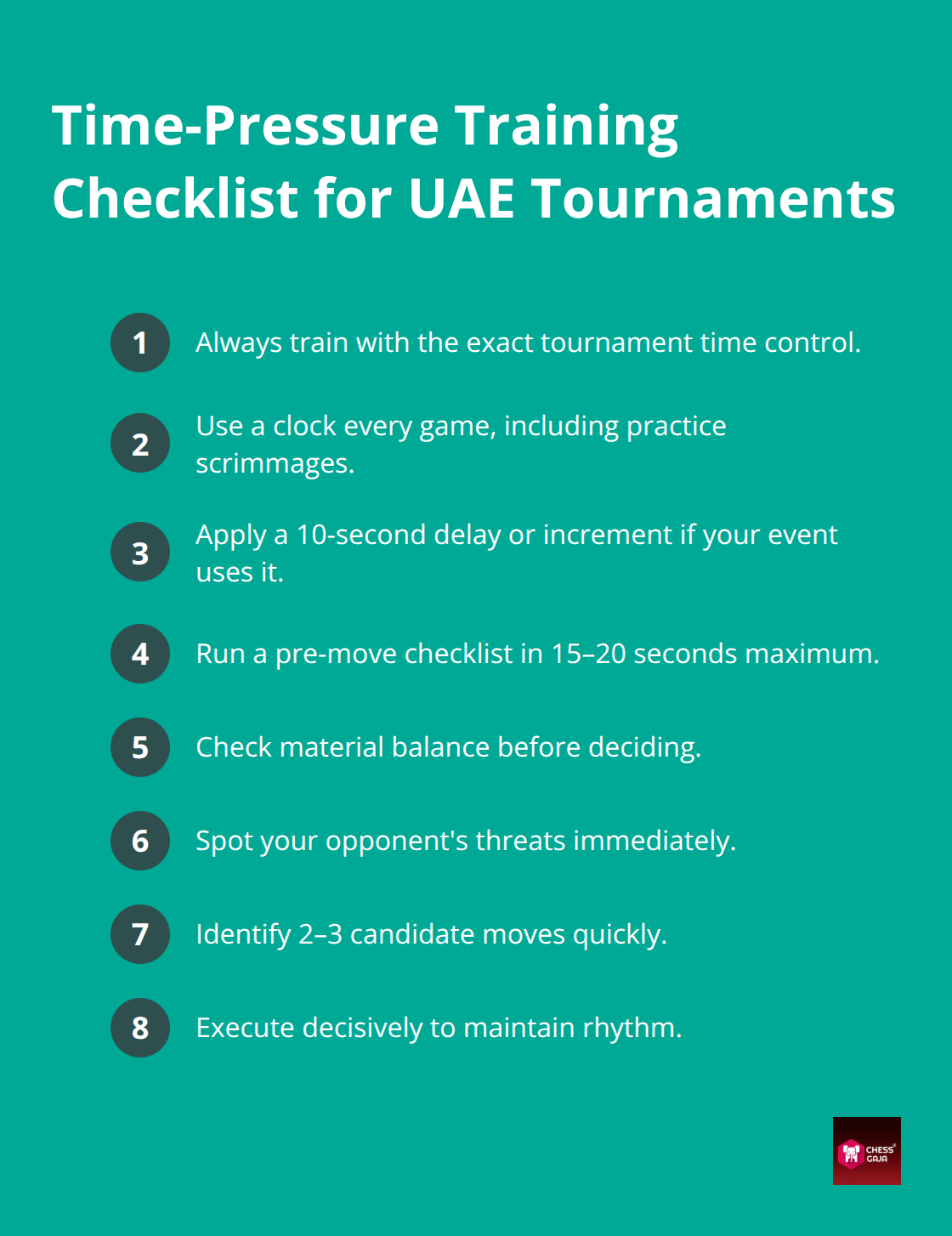
The solution is direct. Practice every single game with a clock set to the exact time control you’ll face in competition. Practicing with a strict 3-second increment or delay forces you to manage your time without relying on frantic move-scrambling. You need to build a pre-move checklist that takes 15-20 seconds maximum-check material balance, spot opponent threats, identify your candidate moves, and execute. This rhythm, repeated hundreds of times, becomes automatic. When the tournament arrives, your brain already knows the pace.
Recovering From Mistakes is a Skill
One bad move in a tournament game triggers a cascade: frustration clouds your next three moves, and suddenly you’re losing a position you could have held. Chess players at all levels struggle with this mental reset. Champions implement a specific reset ritual after mistakes-a controlled breath, a 5-second pause to refocus on the board, and then a deliberate move forward. This takes 10 seconds total and prevents the spiral.
You must practice this in every training game, not just tournaments. When you blunder in a casual game online, stop, breathe, and continue as if nothing happened. Repeat this 50 times in training, and your nervous system learns that one mistake doesn’t end the game. The players who handle pressure best aren’t the ones who never blunder-they’re the ones who’ve blundered hundreds of times and learned that recovery is possible. Your mental toughness is built in training, not discovered in tournaments.
Why Pattern Recognition Matters Under Time Pressure
Your brain processes chess positions through two systems: fast pattern matching and slow deliberate calculation. Under time pressure, the slow system shuts down, and you rely entirely on patterns you’ve already internalized. A player who has studied 500 endgame positions recognizes the winning move instantly in a time scramble. A player who has only read about endgames calculates frantically and loses on time.
This means your training strategy must shift. Spend time on positions you’ll actually face in tournaments (openings, tactical patterns, endgame structures). Drill these positions repeatedly until your brain recognizes them without conscious thought. When the clock ticks down, your pattern library becomes your only weapon. The players who thrive under pressure have invested thousands of hours building this automatic recognition system.
Building Your Tournament Simulation Practice
Casual online games don’t prepare you for tournament pressure because the stakes feel different. Your heart rate stays low, your focus drifts, and you never experience the full nervous system activation that real competition triggers. You need to simulate the exact conditions you’ll face: the time control, the rating of opponents, the tournament format, and ideally, the physical environment (sitting at a board, with a real clock, in a quiet room).
Set up practice sessions that mirror your target tournament. If you’re entering a rapid tournament with 25 minutes per side, play 3 to 4 rapid games in a realistic training block. If you’re preparing for a blitz event, play 15 to 20 blitz games back-to-back. This trains your nervous system to handle sustained pressure and teaches you how your decision-making changes as fatigue sets in. The players who perform best in tournaments are the ones who’ve already experienced that exact pressure in training.
Train Pressure Into Your Nervous System
Most chess players treat practice and competition as separate worlds. They study positions calmly at home, then panic when the clock starts ticking in a tournament. This gap costs rating points and confidence. Students who perform 200 rating points below their actual strength often struggle simply because their nervous system hasn’t learned to operate under real pressure. The fix is deliberate: you must train with time controls and tournament-style conditions until pressure feels normal, not foreign.
Register for Real Tournaments and Work Backward
The UAE chess calendar offers concrete opportunities for this training. Events like the iMaster U1800 Classic and Improve ME Institute Open Blitz run regularly across Dubai, Sharjah, and Abu Dhabi. Register for these tournaments now and work backward from your target event.
If your goal is a rapid tournament with 25 minutes per side, your training sessions must replicate that exact format. Simulate full multi-round match days by playing 4 to 5 rapid games with realistic breaks between rounds. This teaches your body how decision-making degrades in later rounds when fatigue sets in and your calculations become sloppy.
A player rated 1400 who plays only one rapid game per week will never prepare their nervous system for a full five-round match day. Completing 4 to 5 structured rapid games in a simulated tournament block builds genuine competitive resilience, ensuring high-quality decision-making even as the clock ticks down.
How Champions Allocate Their Time Per Move
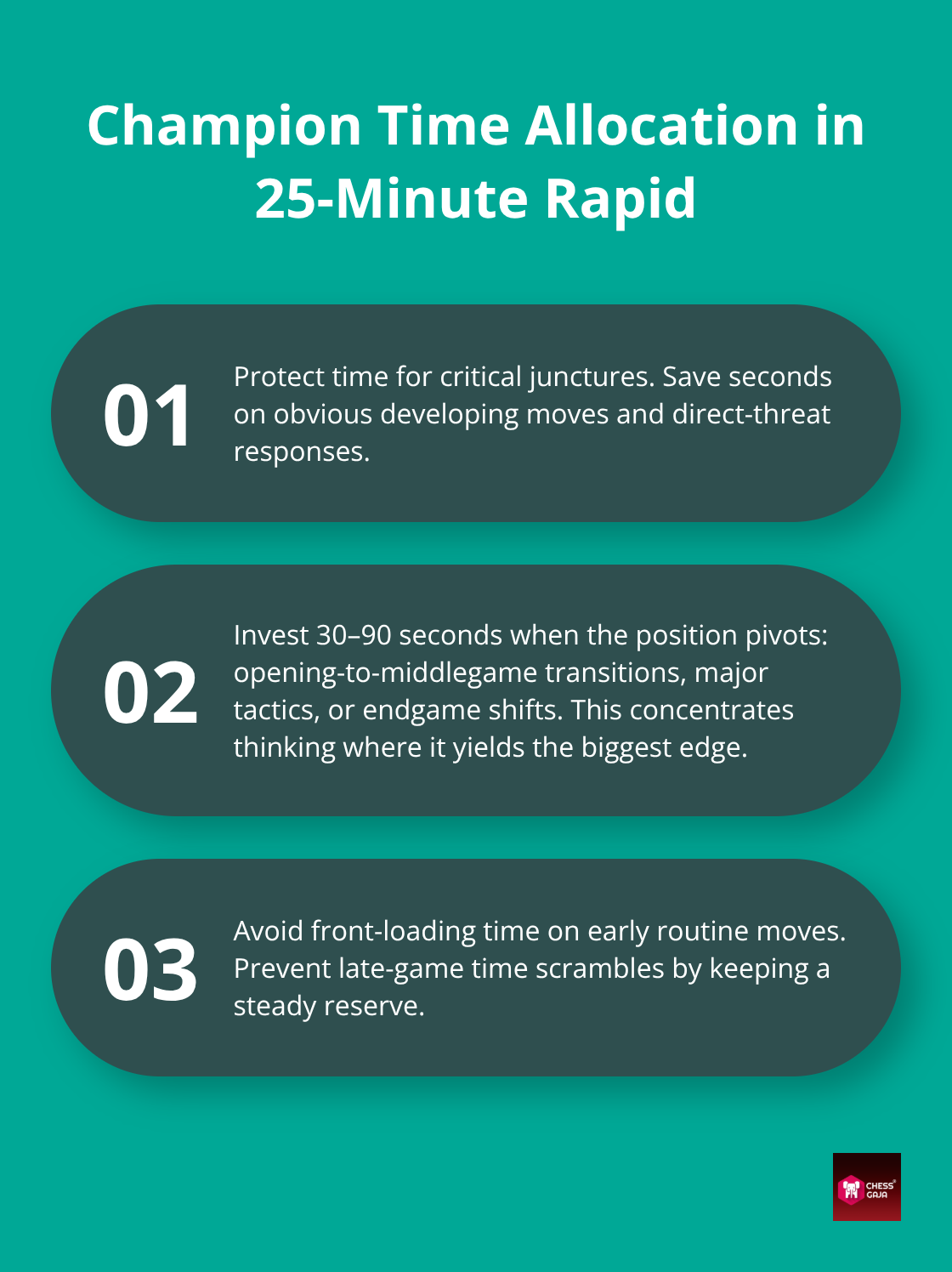
Top players don’t calculate every move equally. They use a time allocation strategy that protects critical moments and saves seconds during routine moves. In a 25-minute rapid game, a strong player spends 3–5 seconds on routine moves and 2–3 minutes on critical decisions (opening/middlegame transitions, complex tactics, structural changes). Beginners do the opposite: they burn 3 minutes on move 5, then rush critical decisions on moves 25–35 when the position matters most.
Start training this discipline now. In practice games, set a personal rule. Spend no more than 3 minutes on any single decision. This forces faster pattern recognition and prevents analysis paralysis. When reaching a familiar setup, rely on pattern recognition. You make accurate moves without re-calculating basic principles. In unfamiliar positions, apply general chess rules. Control the center, develop safely, and create threats instead of calculating 15 moves ahead. Practiced over 50 games, this discipline becomes automatic.
Recovery Rituals Prevent Mental Collapse
The moment after a blunder is where tournaments are lost. A single bad move triggers cascading errors because your confidence collapses and your calculation becomes desperate. Players who perform well under pressure have internalized a specific recovery ritual. Immediately after a mistake, they pause for 5 seconds, take one controlled breath, and consciously shift their focus to the current position (not the move they just made). This 5-second reset prevents the mental spiral.
You must practice this in every single training game, not just tournaments. When you blunder online, stop. Breathe. Continue as if the position is a new puzzle. Focus on what you can do better next time and use the experience to refine your strategy. Repeat this in training, and your nervous system learns that recovery is possible. Players who skip this practice in training will not execute it under tournament pressure. The stakes feel too high, and old habits take over. But players who’ve recovered from training blunders have built genuine neural pathways for resilience. Your mental toughness isn’t developed in tournaments; it’s developed in the thousands of practice moments that precede them.
Pattern Recognition Becomes Your Weapon Under Time Pressure
Your brain processes chess positions through two systems: fast pattern matching and slow deliberate calculation. Under time pressure, the slow system shuts down, and you rely entirely on patterns you’ve already internalized. A player who has studied 500 endgame positions recognizes the winning move instantly in a time scramble. A player who has only read about endgames calculates frantically and loses on time. This means your training strategy must shift. Spend time on positions you’ll actually face in tournaments (openings, tactical patterns, endgame structures). Drill these positions repeatedly until your brain recognizes them without conscious thought. When the clock ticks down, your pattern library becomes your only weapon. The players who thrive under pressure have invested thousands of hours building this automatic recognition system, and now you understand exactly what separates them from those who crumble when the stakes rise.
How Pressure Skills Transfer Beyond Chess
The mental systems you build under chess pressure are identical to the systems that control your performance in job interviews, university exams, surgical decisions, and high-stakes presentations. Resilience training strengthens performance under real-world pressure, not just in competitive settings. When you practice recovering from a blunder in a rapid game, your brain develops the same neural pathways it uses to recover from a professional mistake. The difference is that chess mistakes cost you rating points; professional mistakes cost you income or reputation. This means your chess training directly translates into workplace confidence and academic performance.
A student who trains pressure management in chess tournaments becomes the person who stays calm during final exams. A professional who practices decision-making under time constraints in blitz games becomes the leader who executes clearly when the company faces a crisis.
Your Time Allocation Strategy Becomes Your Work Efficiency System
The discipline you develop in chess—allocating seconds to routine moves and up to a few minutes to critical crossroads—directly improves your professional productivity. In a typical work environment, 80 percent of daily decisions are routine and should consume minimal time. You waste hours per week if you spend 90 seconds deciding which email to answer first, which meeting to attend, or which report to prioritize.
Chess players who train time allocation learn to recognize which decisions are genuinely critical and which are routine. A chess player spends 3 seconds making a routine central development move; they do not overthink basic fundamentals. A professional should spend 30 seconds responding to a routine email rather than spending 10 minutes overthinking tone. This mental discipline, built through hundreds of rapid games, transfers directly into workplace efficiency. Chess players who develop disciplined time allocation avoid decision fatigue and execute routine decisions instantly, reserving mental energy for choices that actually matter.
Pattern Recognition Becomes Your Competitive Advantage in School and Career
In chess, pattern recognition separates players who thrive under pressure from those who collapse. A player who has studied 500 endgame positions recognizes winning moves instantly; a player who calculates from scratch loses on time. The identical principle applies to academic and professional environments.
A student who has solved 300 algebra problems recognizes the correct approach to a new problem within seconds. A student encountering algebra for the first time calculates frantically and runs out of time on the exam. A professional who has managed 100 budget cycles recognizes warning signs and solutions instantly when a new financial problem emerges. A professional encountering a new challenge from scratch wastes weeks investigating.
Your chess training teaches you to build pattern libraries systematically. You do not just solve one problem and move on; you solve similar problems repeatedly until your brain recognizes the pattern automatically. This exact methodology applies to school subjects, professional skills, and technical competencies.
How Chess Accelerates Pattern Recognition Development
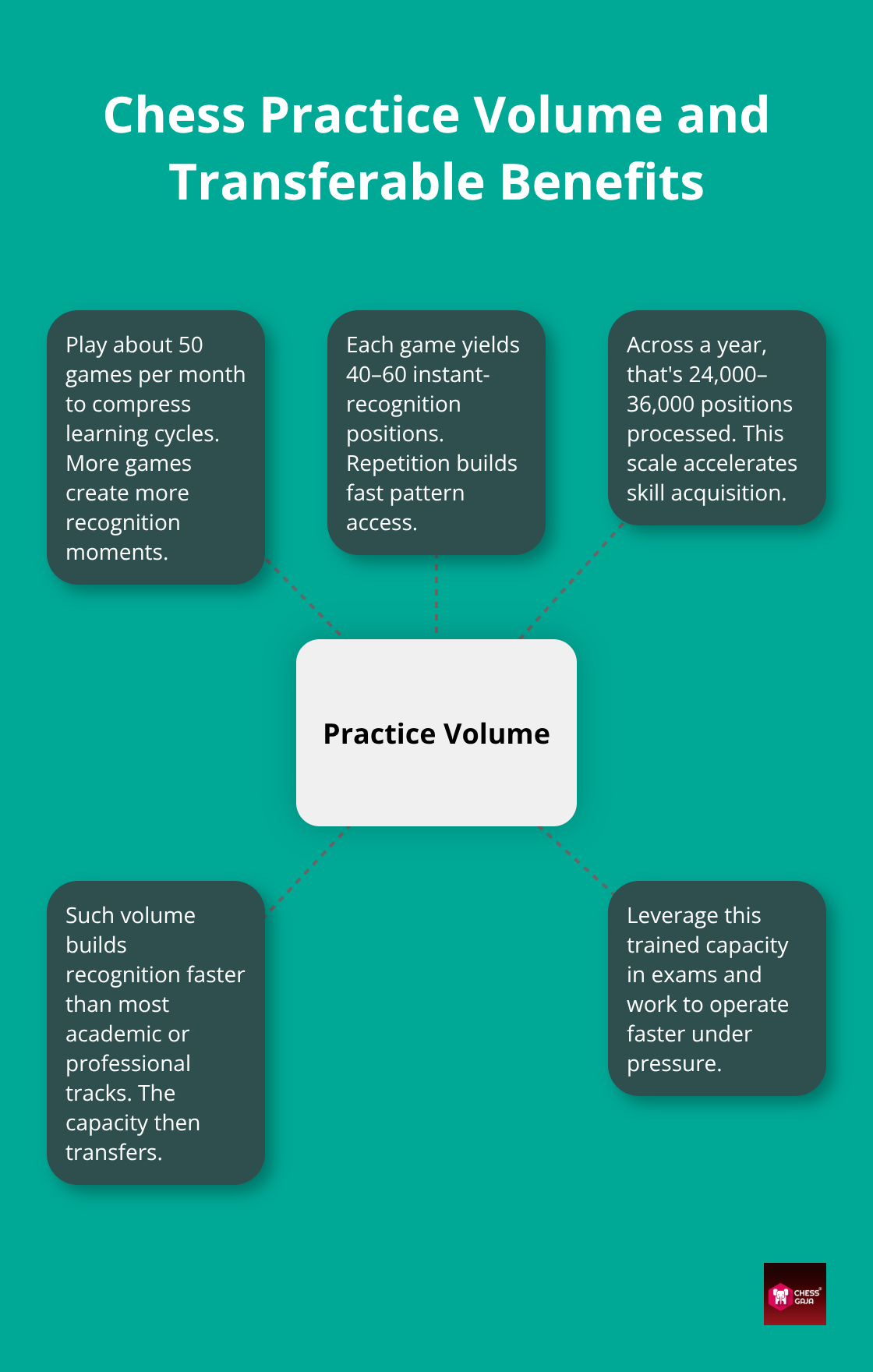
Chess compresses pattern recognition training into a measurable timeframe. An active player completing 50 games a month evaluates over 2,000 distinct tactical and strategic patterns every 30 days—totaling over 24,000 position evaluations a year. This volume of practice, compressed into chess, builds pattern recognition capacity far faster than most professional or academic environments.
When you transfer this trained capacity to your career or studies, you operate at a measurably higher level of decision-making speed and technical accuracy.
The students and professionals who perform best under pressure are not the ones with the highest IQ; they are the ones who have built the deepest pattern libraries through deliberate, repetitive practice. Your chess training teaches you to build these libraries systematically and apply them instantly when stakes rise.
Final Thoughts
Confidence under pressure training works because it addresses the gap between what you know and what you can execute when stakes rise. The three core principles are simple: simulate tournament conditions in every practice session, build pattern recognition through repetition, and develop recovery rituals that prevent mental collapse after mistakes. These aren’t advanced techniques reserved for elite players-they’re foundational skills that any player from beginner to competitive level can develop through structured, deliberate practice.
The real separation between players who perform well under pressure and those who crumble isn’t talent or IQ. It’s whether they’ve trained their nervous system to operate calmly when the clock ticks and the position matters. A player rated 1400 who regularly trains under strict tournament conditions will often outplay a 1600-rated home student in a time scramble, because the lower-rated player has built practical time-management resilience while the higher-rated player has only built static knowledge.
Structured coaching accelerates this development significantly. At Chess Gaja, our FIDE-rated coaches work with students across 40+ countries. We build confidence under pressure through personalized study plans and monthly academy tournaments. Students also receive AI-powered feedback after every session. Register for a tournament in your region today. Then, book a Paid Starter Class at Chess Gaja. You will get a professional skill evaluation and a pressure-training plan tailored to your goals.