
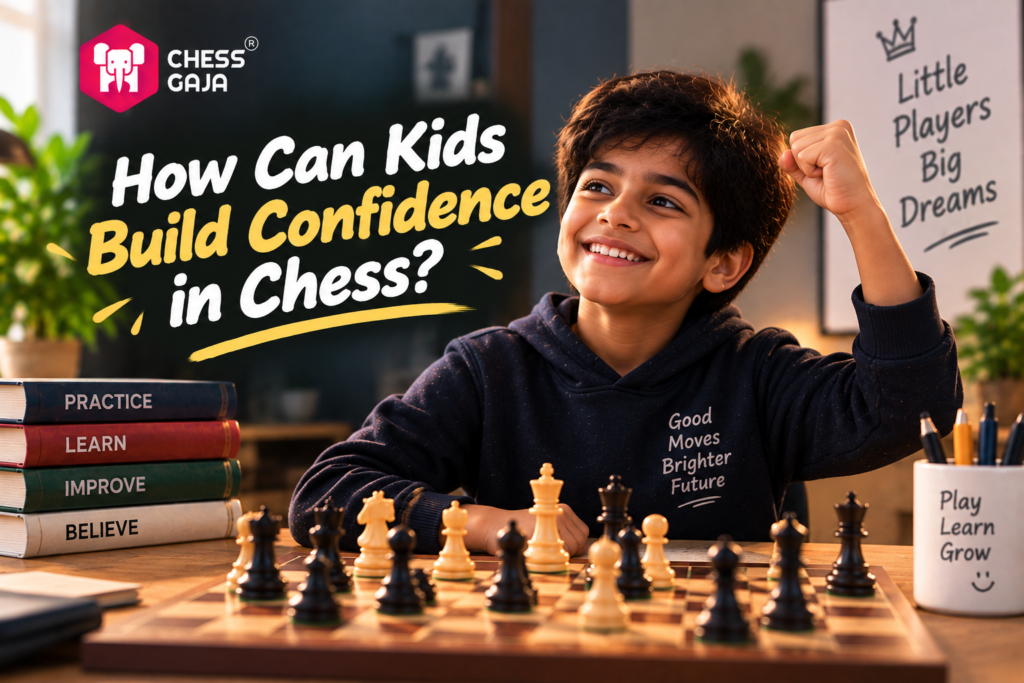
A hesitant move in a scholastic tournament often costs more than a bad move. Young players who doubt themselves second-guess decisions, burn time, and miss winning chances.
At Chess Gaja, we’ve coached thousands of students across 40+ countries, and we’ve seen firsthand how kids chess confidence growth directly correlates with rating improvement. When young players develop confidence fluency-the ability to recognize positions and act decisively-their tournament results transform.
How Confidence Shapes Chess Decision-Making in Young Players
Why Hesitation Costs Rating Points in Scholastic Tournaments
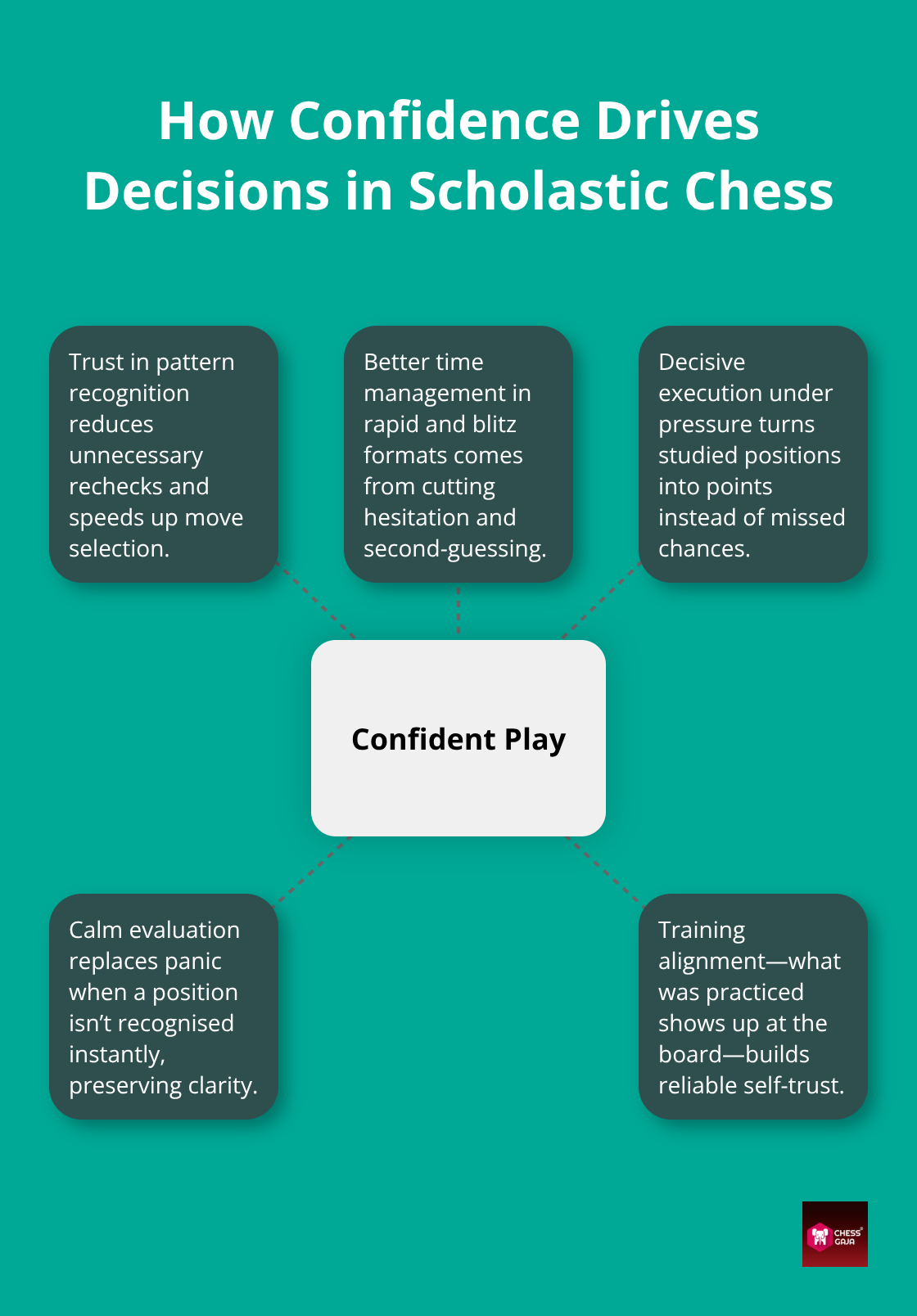
When a young player sits across from an opponent in a scholastic tournament, confidence determines the speed and quality of their decisions. A student who doubts their position evaluation will waste precious time rechecking moves, second-guessing tactics, and looking for non-existent threats. In rapid and blitz formats common in American scholastic circuits, this hesitation directly translates to lost rating points. The difference between decisive and hesitant play isn’t superior calculation-it’s confidence in pattern recognition. When young players trust their training and the positions they’ve studied, they move decisively. When doubt creeps in, they burn clock and miss winning chances entirely.
The Connection Between Self-Doubt and Blunders
Self-doubt leads to one of the most frustrating errors in scholastic chess: the missed win. A hesitant player will play a solid, safe move when a winning combination sits on the board because they lack confidence in their calculation or pattern recognition. Hundreds of scholastic tournament games reveal an unmistakable pattern. Young players frequently abandon winning positions not from a lack of tactical skill, but because they don’t trust themselves under time pressure. A student might see a forcing sequence but question whether they’ve calculated it correctly, so they play a neutral move instead. Their opponent escapes, the position becomes drawn, and rating points evaporate. Tournament results from scholastic federations across the USA and Singapore confirm that rating growth accelerates dramatically once young players move from tentative play to decisive play. The technical skill was always there; confidence unlocked it.
Real Tournament Scenarios Where Confidence Determines Outcomes
Consider a typical Under-12 tournament position: a student has a queen, rook, and passed pawn versus a queen and rook, holding a clear material advantage against an exposed opponent king.
A confident player spots the winning plan-advance the passed pawn while activating their rook-and executes it methodically. A self-doubting player second-guesses every rook move, worries about perpetual checks that don’t exist, and eventually allows the opponent to consolidate.
This scenario plays out weekly in scholastic tournaments across Dubai, New York, and Singapore. Young players with identical ratings produce vastly different results based purely on confidence in their decision-making. The student practices similar endgames with a coach and receives immediate feedback. By competing in monthly academy tournaments, they build the mental blueprint needed to trust themselves when it matters.
Without that structured confidence-building, even talented players underperform their actual strength. This gap between potential and performance is exactly what structured coaching addresses-and it’s where the real transformation begins.
Building Confidence Through Structured Chess Coaching
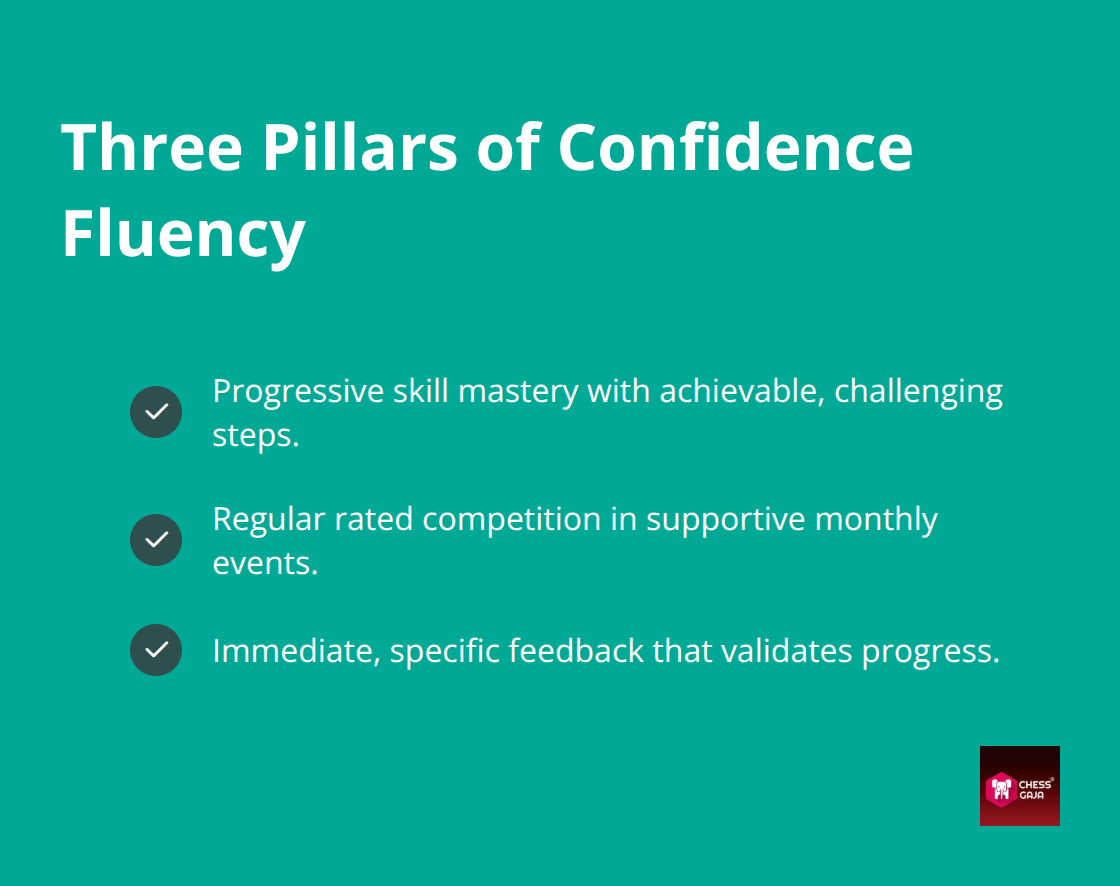
Confidence does not appear overnight, and it certainly does not come from casual play against friends. Young players develop genuine, unshakeable confidence through three interconnected mechanisms: mastering skills incrementally, competing regularly against rated opponents, and receiving immediate, specific feedback that validates their progress. The sequence matters enormously.
Progressive Skill Mastery Creates Natural Confidence
A student who jumps into tournaments without foundational pattern recognition will lose repeatedly and develop the opposite of confidence. A student who practices puzzles for months without tournament experience will freeze when facing a real opponent with a clock. Structured coaching orchestrates these three elements into a progression that actually works.
Effective coaching begins by assessing where a student sits in their development journey. From basic piece movement to endgame technique, we build a personalized ladder where every rung is achievable yet challenging. This is progressive skill mastery, and it forms the bedrock of confidence fluency.
A student completes a lesson on back-rank tactics and solves related puzzles. When they execute that exact tactic in their next rated game, something shifts psychologically. They’ve proven that studying chess produces results. That proof repeats across dozens of lessons and hundreds of games. Within six months of consistent coaching, young players report they feel fundamentally different at the board-less paralyzed by decision-making, more willing to trust their instincts.
How Regular Practice Against Rated Opponents Strengthens Mental Resilience
Regular tournament play against rated opponents is non-negotiable. A student can solve 500 puzzles and still collapse in a tournament because the emotional context is completely different. Monthly academy tournaments place students against opponents of similar strength in a controlled, supportive environment. They experience wins, losses, draws, and the emotional management required in each scenario. Crucially, they see their rating change based on actual performance. This objective feedback is powerful: A student watches their rating climb and sees that work yields measurable progress. They stop second-guessing because the data proves their improvement.
After each tournament, coaches conduct game reviews where students analyze their own moves and identify decision points where they hesitated. This post-tournament reflection transforms a tournament experience from simply winning or losing into a learning cycle. A student realizes they had a winning position but played passively because they doubted their attack-then they drill attacking positions for two weeks before the next tournament.
The Role of Immediate Feedback in Reducing Self-Doubt
Immediate feedback during coaching sessions accelerates confidence development dramatically. When a coach stops a lesson and says, “You just played this move instantly and it was correct-that’s pattern recognition working,” the student registers that their intuition is trustworthy. When a coach asks “What were you thinking before you played that?” and the student admits “I wasn’t sure,” the coach can then teach them how to build certainty through calculation or position evaluation.
Over dozens of sessions, students learn what confidence feels like at the board. Preparation meets recognition, and their trained instincts align with objective correctness. This isn’t arrogance; it’s earned self-trust. Young players who complete structured coaching programs report a clear shift. Tournament play becomes enjoyable rather than anxiety-inducing because they’ve built the mental architecture to handle it. This foundation of earned confidence then determines how they perform. when facing the specific pressures of tournament time controls and high-stakes positions.
Turning Pattern Recognition Into Tournament Wins
Recognizing Patterns and Acting Decisively
When a young player enters a scholastic tournament, the positions they face are rarely entirely new. Within the first 8 to 10 moves, players encounter familiar setups. They see opening pawn structures and tactical motifs already studied in practice. The difference between players who convert these familiar patterns into wins and those who hesitate comes down to one factor: they’ve trained themselves to recognize and act on what they’ve already studied. A student rated 1400 who has solved 2,000 tactical puzzles has internalized dozens of recurring patterns-the back-rank mate, the knight fork, the pin. When these patterns appear in a real game, their brain should fire instantly, triggering a decisive move. Instead, many young players second-guess themselves and recalculate unnecessarily. They waste valuable time on positions already mastered in training, revealing a gap between puzzle practice and tournament confidence.
Building Pattern Fluency Through Focused Training
The solution is deliberate pattern exposure combined with tournament play. A coach identifies the specific tactical and positional patterns a student struggles with, assigns focused puzzle sets of the same type, then monitors whether that student executes those patterns decisively in their next rated tournament. This cycle repeats monthly. Within three months, a student’s recognition speed accelerates dramatically, and their tournament performance reflects it.
Time pressure amplifies this dynamic. Rapid tournaments across American scholastic circuits feature 25 minutes per side. In these fast formats, hesitation becomes lethal. A player who takes 90 seconds to play a move they’ve solved in 5 seconds during practice is wasting 85 seconds they’ll desperately need later.
The mental shift required is simple but demands explicit training: in tournament games, a young player should play moves they recognize instantly. If they don’t recognize a position, they should calculate calmly rather than panic. If they recognize a straightforward tactical pattern, they should trust their calculation and execute without second-guessing.
Coaches structure training to reinforce this exact behavior—mixing puzzle training with blitz and rapid games where students practice executing tactical patterns under time pressure, then reviewing their decisions afterward to confirm when their instinct was correct. A student who completes this cycle develops genuine tournament confidence because they’ve proven repeatedly that their pattern recognition works.
Executing Winning Endgames With Confidence
Converting a winning position into an actual win requires a different confidence skill: the ability to play accurately without looking for non-existent complications. A student with a rook and passed pawn versus a rook in an endgame has already achieved a technically winning position. What remains is execution—advancing the pawn, activating pieces, and avoiding unnecessary checks, perpetual check sequences, or stalemate traps.
Yet many young players in this scenario play cautiously, move their king back and forth, and allow their opponent to create confusion. The mental block is fear: they doubt whether they’ve calculated the endgame correctly and worry about hidden defensive resources that don’t exist.
The antidote is endgame training focused on confidence. A coach teaches a student three to five core winning endgame patterns per month—queen and pawn versus queen, rook and pawn versus rook, king and pawn versus king—then has that student play dozens of practice games in those exact positions. They win some, they lose some, and they see firsthand what mistakes actually lead to draws. This experiential learning is far more powerful than memorizing theoretical technique. A student who has played 20 practice games in rook endgames and won 18 of them will enter a tournament game in a similar endgame with genuine confidence. They’ve seen that the position really is winning if they play straightforwardly. They won’t second-guess a simple king move because they’ve done it successfully before. This earned confidence translates directly into rating points.
Measuring Conversion Rate to Identify Gaps
Tournament records from scholastic federations consistently show that players who consistently convert their winning positions achieve significantly higher ratings than players who struggle to convert, even when both groups have identical tactical ability. The difference is psychological: one group trusts themselves to execute, the other doesn’t.
A young player serious about rating growth should measure their conversion rate after every tournament-count winning positions they achieved and how many they actually won-then discuss those games with a coach to identify whether the issue was calculation, pattern recognition, or pure hesitation. This feedback loop, repeated over months, builds the specific confidence fluency that produces tournament results.
Final Thoughts
In our coaching data across the USA, UAE, and Singapore, we consistently observe that young players who develop genuine confidence fluency unlock rapid rating acceleration—often gaining 200 to 300 rating points within their first twelve months of structured tournament play. This transformation happens not because they suddenly calculate better or memorize more openings, but because they trust their training, recognize familiar positions, and act decisively under pressure. Kids chess confidence growth removes the hesitation that costs rating points in every tournament.
Three elements work together to create this confidence. Progressive skill mastery ensures each lesson builds on the previous one. Young players never face unprepared positions at the board. Regular tournament play against rated opponents in a supportive environment transforms losses into learning cycles. Immediate feedback from coaches validates when a student’s instinct was correct and guides them when it wasn’t. Without all three, confidence remains fragile and tournament results stagnate.
The next step is straightforward: book a Paid Starter Class with Chess Gaja for a professional skill evaluation. Our coaches assess where your student sits in their development journey, identify the specific confidence gaps holding back their rating, and design a personalized pathway forward. Within three months of consistent coaching and tournament play, you’ll see the transformation firsthand.