

Tactical sequences separate players who win tournaments from those who don’t. Most beginners struggle because they calculate without a system, wasting time and missing winning moves.
At Chess Gaja, we’ve coached thousands of young players through this exact challenge. This guide shows you the calculation method that works under pressure, with real examples from youth tournaments across the USA, UAE, and Singapore.
Why Calculation Breaks Down Under Pressure
The Scattered Mind Problem
Calculation under pressure fails for one reason: beginners try to see everything at once instead of following a structured path. Imagine a young player from Dubai facing a tournament puzzle with five minutes remaining. Their mind jumps between candidate moves, evaluates lines halfway through, and abandons promising sequences to chase distractions. Such a scattered approach burns critical time and produces blunders. Mental processing during tactical sequences must be ruthless—you have to identify which moves matter, calculate only forcing continuations, and stop wasting energy on lines your opponent will never play.
Three Critical Errors That Sabotage Calculation
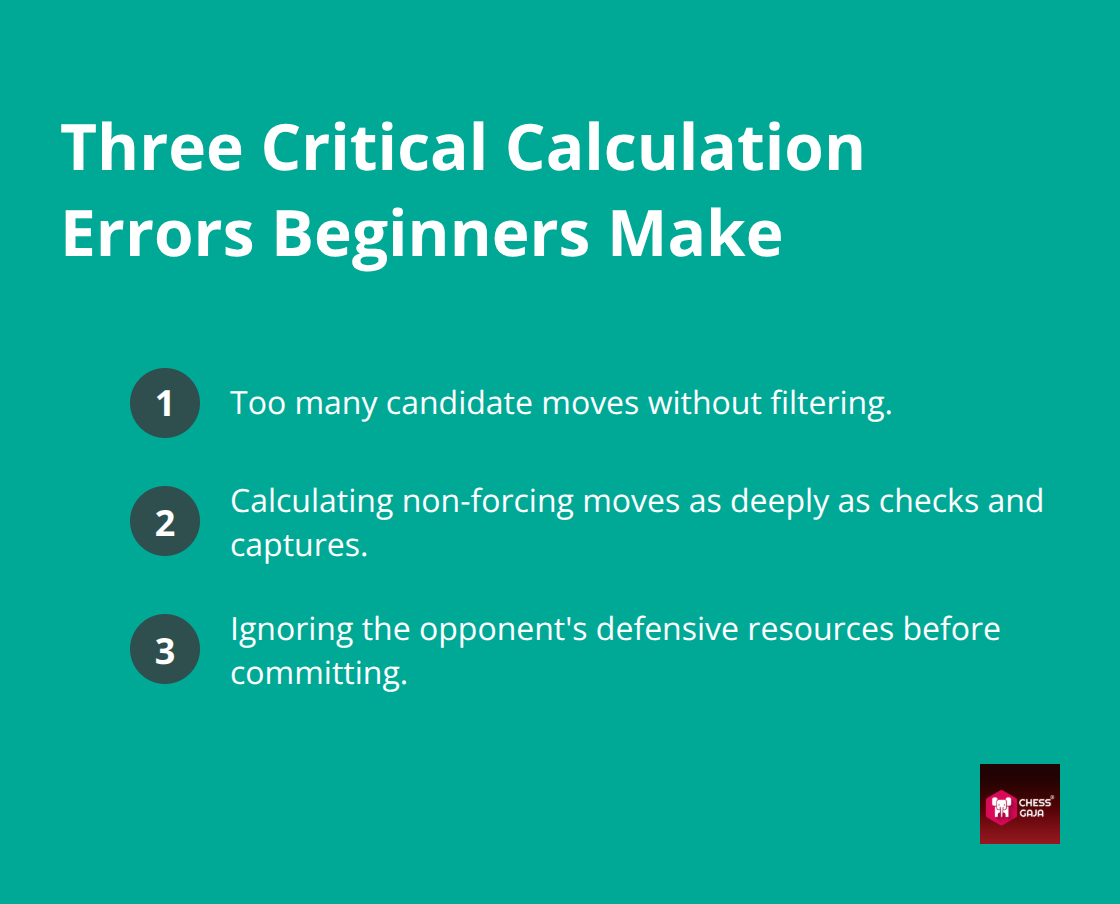
Beginner calculation usually breaks down due to three primary errors. To start, players examine too many candidate moves without filtering. Additionally, non-forcing moves receive the same calculation depth as checks and captures. Finally, players fail to anticipate opponent defensive resources before committing to a line.
A student from Singapore might spend two minutes calculating a quiet rook move. However, they often miss an opponent’s back-rank check that destroys the entire plan. These mistakes compound under time pressure, turning a winning position into a loss.
How Grandmaster Coaches Teach Systematic Calculation
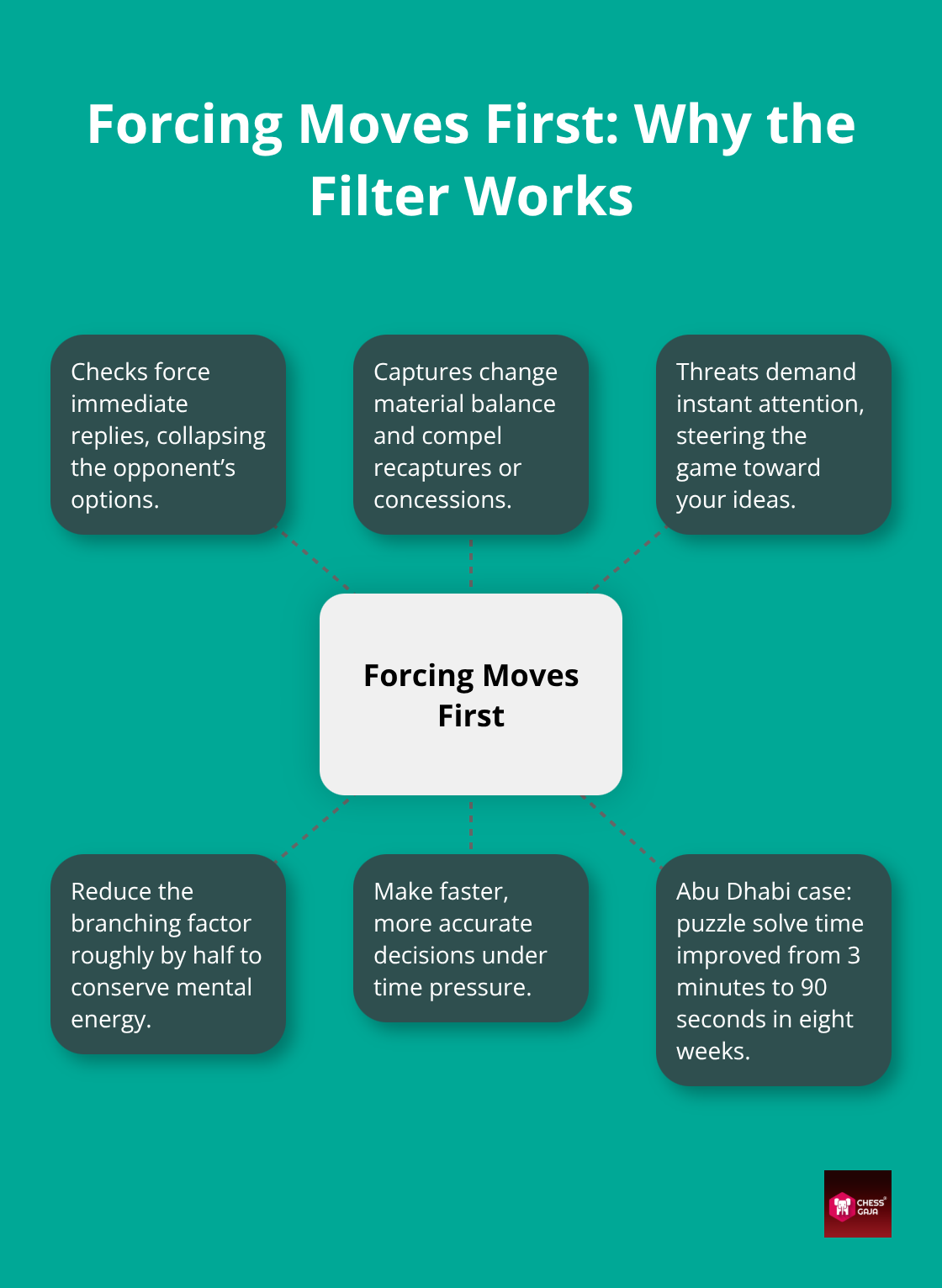
Grandmaster-level coaches teach calculation systematically by enforcing three non-negotiable rules. To begin, construct a short list of candidate moves before calculating anything—typically checks, captures, and threats. This filtering step alone cuts calculation time in half. Next, prioritize forcing moves because they require the opponent to reply in a specific way, reducing the branching factor that makes positions unmanageable. Finally, once you select a candidate move, immediately assess the opponent’s counterplay to identify potential weaknesses in your plan.
A young tournament player from the USA should always ask, “What can my opponent do to stop this?” before committing to a move. Doing so provides an enormous advantage over peers who calculate in a vacuum.
The Rating Gap: Knowledge Versus Disciplined Calculation
The difference between a 1200-rated player and a 1600-rated player is not superior chess knowledge-it is disciplined calculation under time pressure. Without a system, even memorized opening lines collapse when the position diverges from your preparation. With a system, you make sound decisions even when the clock ticks and your heart races. This is why structured training transforms players. The next section reveals the exact step-by-step method that coaches use to build this calculation discipline in their students.
The Candidate Move Filter
Filter Before You Calculate
The moment you face a tactical position, your instinct screams to calculate everything. Resist that impulse. A young player from Dallas faced a middlegame position with 90 seconds remaining and immediately started calculating seven different moves simultaneously-queen checks, rook moves, pawn advances. Within 45 seconds, mental fatigue set in. She played a weak move and lost her advantage. The issue was not her chess knowledge, but rather the absence of a structured filter. Grandmaster-level coaches teach the candidate move method because it works in real tournaments under genuine time pressure.
Identify Forcing Moves First
Start with only the forcing moves: checks, captures, and threats that demand immediate attention. In the Dallas player’s position, exactly three moves qualified as forcing—a queen check, a rook capture, and a discovered attack threat. Eliminating the remaining four options before spending a second on calculation preserves mental energy and reveals the winning continuation. Applying this simple filter cuts your overall calculation burden roughly in half, resulting in faster decisions and far fewer missed tactics.
For example, one student from Abu Dhabi reduced her average puzzle-solving time from 3 minutes to 90 seconds over eight weeks by prioritizing forcing moves. Disciplined process matters far more than raw calculation depth.
Build Shallow Trees, Not Deep Holes
Once you have identified your candidate moves, construct a shallow calculation tree instead of drilling deep into one line. Most beginners make the opposite mistake by picking a single candidate move and calculating 8–10 moves deep, only to discover an overlooked defensive resource. To prevent this, evaluate each candidate move 2–3 moves deep. Determine whether it yields a clear advantage or fails tactically before moving to the next candidate. A tournament player from Singapore saw a tempting knight fork. However, shallow calculation revealed that the opponent’s counterattack won material back. Spending just 20 seconds on that line allowed her to quickly pivot to a safer, winning candidate move.
Accelerate Through Targeted Practice
Practical drill work accelerates this process dramatically. Solve tactical puzzles using platforms like ChessTempo or Chess.com, but impose a strict time limit-start with 60 seconds per puzzle, then reduce to 40 seconds after two weeks. This builds speed without sacrificing accuracy. After solving, spend 30 seconds reviewing the solution to cement the pattern. Over four weeks of consistent practice, your brain internalizes the candidate move filter and the shallow tree method, turning them into automatic habits rather than conscious steps.
What Happens When You Master the Filter
The candidate move filter transforms how you approach every tactical position. Instead of drowning in possibilities, calculating endlessly, or missing tactics under time pressure, you narrow your focus, evaluate efficiently, and spot key moves consistently. The next section shows you how to stay calm when the clock ticks and the pressure mounts-because knowing the method means nothing if panic derails your execution.
Tournament Pressure: Calculation in Real Time
The System Works When Stakes Rise
A 14-year-old from Houston sat at board three of the Texas Youth Championship with 15 minutes on the clock in a double-edged middlegame position. Suddenly, her opponent sacrificed a piece to open lines toward her king. Facing a tight 90-second window, she needed to decide whether the sacrifice was sound or a miscalculation. Filtering her choices led to three primary candidate moves: accepting the sacrifice, retreating her king, or launching a counter-check. Calculating each line three moves deep, she saw that the counter-check completely defused Black’s attack and won material cleanly. With a decisive play, she secured the tournament victory. This is not luck. This is the candidate move method under actual tournament pressure, and it works because it removes the mental paralysis that destroys most young players.
Building Trust in Your Calculation Process
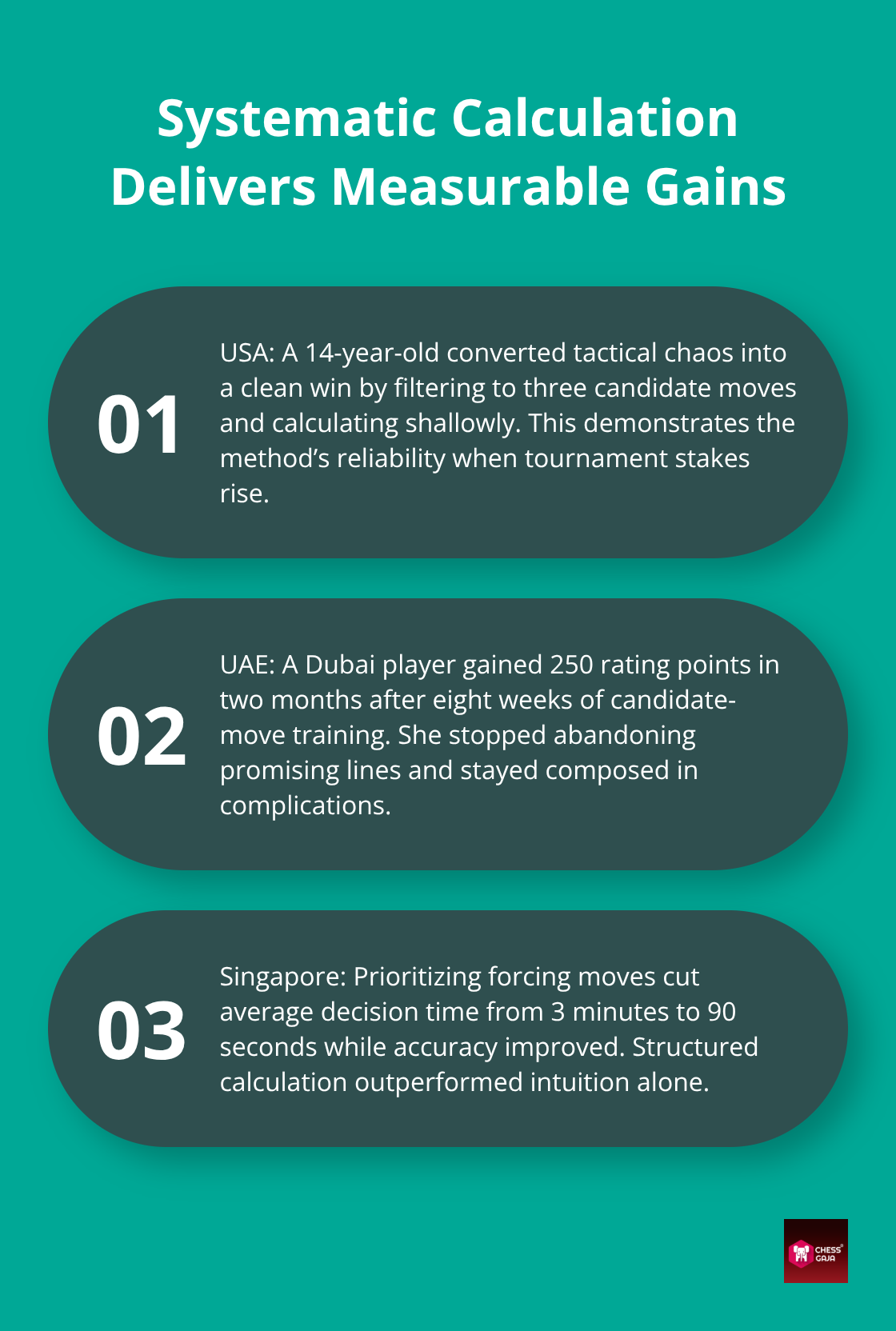
Tournament scenarios from the USA, UAE, and Singapore reveal a clear pattern. Players who calculate systematically win more games than those who calculate chaotically—even with identical chess knowledge.
For instance, a 12-year-old student from Dubai who trained for eight weeks using the candidate move filter improved from 1200 to 1450 rating points—a gain of 250 points in two months. Her coach reported that she stopped abandoning promising lines halfway through and stopped panicking when opponents created complications.
Similarly, a Singaporean student reported that after learning to prioritize forcing moves, her average decision time dropped from 3 minutes per move to 90 seconds while her accuracy actually improved. These gains come directly from applying a system rather than hoping intuition carries you through.
The critical shift happens when a young player realizes that staying calm under time pressure is not about controlling emotions-it is about trusting the method. When you know exactly which moves to examine and in what order, the clock becomes less threatening because you have a roadmap.
Maintaining Discipline When Time Pressure Strikes
The moment the clock shows five minutes remaining, most beginners abandon their discipline and start calculating frantically. This is the exact moment when discipline matters most. A tournament player from Abu Dhabi reported that she used to spend 30 seconds per move in the opening, then accelerate recklessly in the middlegame when time pressure appeared. After coaching, she maintained consistent decision-making throughout a game by enforcing a personal rule: never spend more than 60 seconds on any single move, even in critical positions. This forced her to filter candidate moves ruthlessly and trust her shallow calculation rather than drilling endlessly into one line.
The result was not just faster decisions but better decisions because she evaluated multiple options instead of fixating on the first idea that seemed promising. Real tournament data from youth events across three continents reveals a clear pattern. Players who maintain consistent calculation speed score 200-300 rating points higher than those whose calculation deteriorates under time pressure.
Executing the Complete Calculation Process
A position from a recent youth tournament in New York illustrates the complete process. White had a rook on the seventh rank, a bishop on an active diagonal, and Black’s king restricted on h8. White had 2 minutes and 45 seconds remaining. Step one: identify candidate moves. White’s forcing candidate moves were a rook check on c8, a bishop sacrifice on h7, or a quiet rook move to e7 threatening a double attack. Step two: calculate each line shallowly. The rook check on c8 failed because Black’s back-rank rook simply captured it. A bishop sacrifice looked tempting, but shallow calculation showed Black’s king escapes toward g7.
Fortunately, playing the quiet rook move to e7 created dual threats against Black’s weak f7 pawn and back-rank defense that Black could not meet simultaneously. White played the quiet move and won within three moves.
The entire decision process took 55 seconds because the candidate move filter narrowed the focus. Without the filter, a player might have spent 90 seconds calculating the rook check alone, panicked as time dwindled, and played impulsively. Ultimately, the boundary between a tournament victory and defeat comes down to a simple question: did you stick to your process under pressure? Maintaining calculation discipline when time runs short consistently separates tournament winners from equally skilled peers.
Final Thoughts
Systematic calculation separates tournament winners from casual players by transforming knowledge into results under pressure. A player with solid opening prep loses if she panics when tactics appear. Conversely, a student with average theory beats stronger opponents by calculating methodically and staying composed. The real difference is discipline. Once you master this skill, you stop hoping for opponent mistakes and start forcing decisive positions.
The path forward requires three concrete actions. Start by practicing the candidate move filter daily using platforms like ChessTempo or Chess.com, beginning with 60-second puzzles and reducing time as accuracy improves. In addition, play tournament games regularly to test your calculation under real pressure, because puzzle training alone cannot replicate live game stress. Finally, review your games within 24 hours to identify missed tactics and reinforce key visual patterns.
Structured coaching accelerates this journey dramatically. At Chess Gaja, we work with students across the USA, UAE, and Singapore using a proven calculation curriculum. Our FIDE-rated coaches teach the exact method outlined in this guide and monitor your progress through personalized study plans.
Book a Paid Starter Class with one of our coaches to receive a professional skill evaluation tailored to your current rating and tournament goals. During this session, a coach will assess your calculation speed, identify specific weaknesses in your tactical vision, and design a personalized roadmap to competitive improvement.