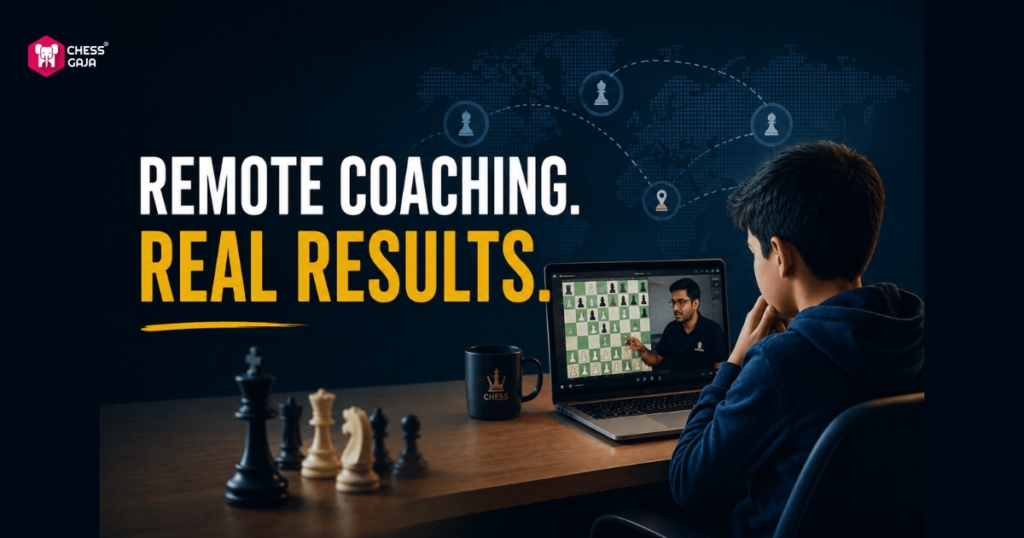
A student in Singapore just jumped from a 1200 to a 1450 rating in four months with remote coaching. That’s not luck-it’s the result of structured guidance from a qualified mentor working with you on your specific weaknesses.
At Chess Gaja, we’ve seen firsthand how the benefits of online chess coaching accelerate progress in ways self-study simply cannot match. The right coach identifies exactly what’s holding you back and fixes it systematically. The right coach identifies exactly what’s holding you back and fixes it systematically.
Why Remote Coaching Works for Your Schedule
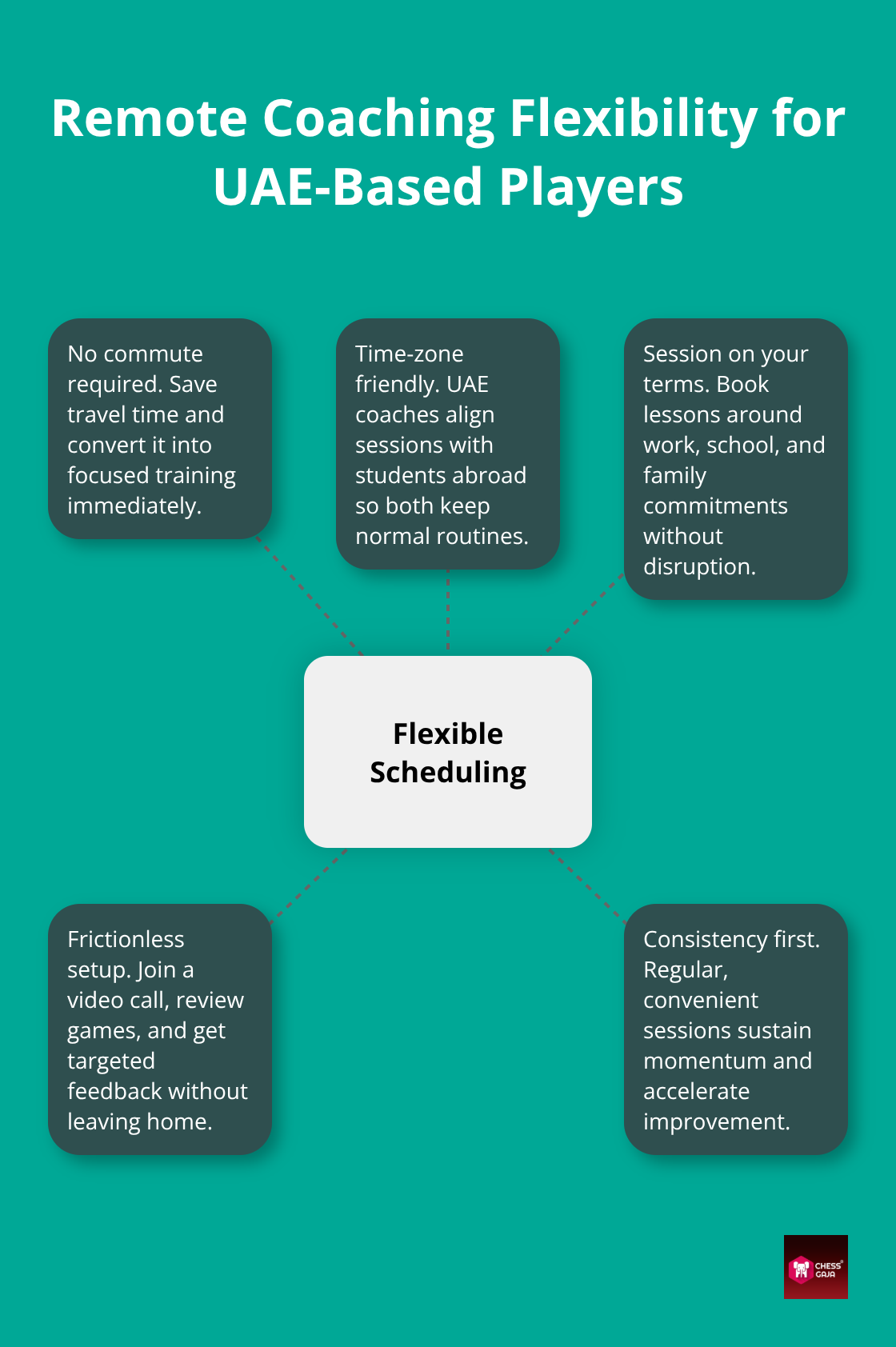
Online chess coaching options eliminate the travel time and rigid scheduling that made traditional lessons impractical.
For instance, a coach in the UAE can meet a student in Singapore at 7 PM Singapore time (3 PM UAE time). Both fit the lesson into their routines without disruption. You skip driving to a local chess club or waiting for open academy slots. Instead, you log into a video call, analyze your games, and receive feedback tailored to your rating. This flexibility matters enormously for busy professionals and students. The coaching happens on your terms, not the institution’s terms.
Finding the Right Coach Across Borders
Access to high-quality coaching was once geographically limited. For example, a talented 14-year-old in the USA needed a titled coach within driving distance, which severely restricted their options.
Today, that same player can hire a Grandmaster within minutes. You can filter coaches by rating, language, and specialty, selecting a mentor whose teaching style matches your exact needs. You never have to settle for whoever lives nearby—a specialist in the Sicilian Defense can guide you even if no such expert lives in your city.
Customized Learning Based on Where You Stand
Personalized instruction at scale separates remote coaching from generic online courses. A coach reviews your last ten games to find where pattern recognition fails. They then design a two-week drill focused on tactical motifs from your actual positions. Self-study means you buy a 400-page endgame manual and hope the content applies to your weaknesses. In contrast, coached learning means your mentor analyzes your recent tournament game in depth. They pinpoint where your calculation broke down and assign five specific positions to fix it.
The Science Behind Structured Remote Training
Research on online chess training studied young adults with limited experience over 10 weeks. The results showed measurable improvements in both inhibitory control and focus. That’s the power of targeted, systematic guidance rather than scattered practice. A remote coach delivers this same structured approach. Your mentor tracks your progress, adjusts the curriculum, and holds you accountable to consistent practice.
What Sets Effective Remote Coaches Apart
Effective online coaches do not simply record video lectures or assign generic puzzle sets. Instead, they analyze your specific games, understand your playing style, and build a customized curriculum around your weaknesses.
A skilled coach identifies whether you struggle with time management, tactical vision, or strategic planning—and creates targeted drills to fix that exact gap. Because your mentor works with you repeatedly over several months, this level of customization and deep game understanding develops naturally. Ultimately, your progress becomes measurable through rating gains, tournament results, and overall game quality.
How Coaches Turn Rating Gains Into Tournament Wins
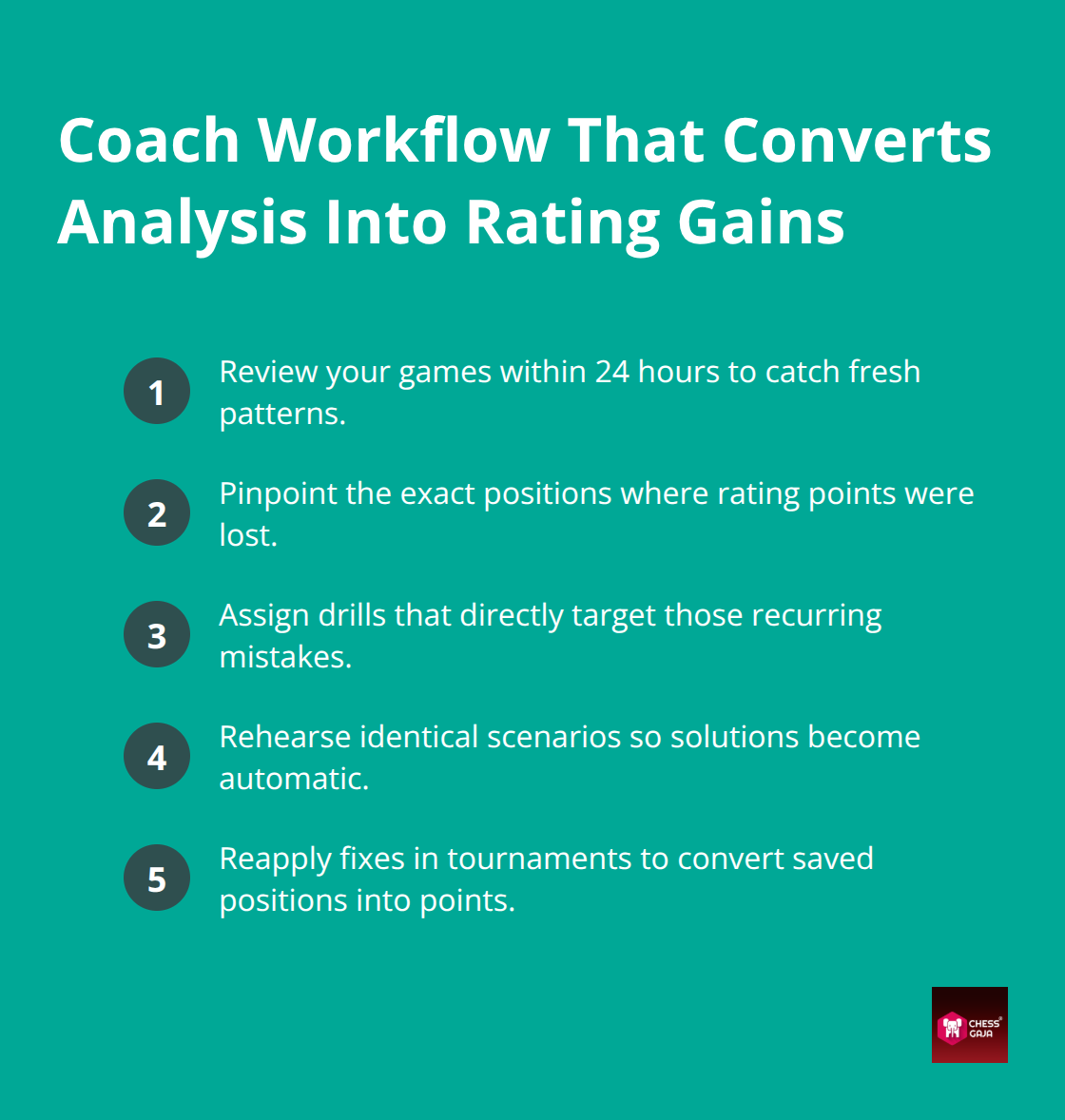
A student in Singapore moved from 1200 to 1450 in four months. That's a 250-point jump, which translates to climbing a full rating category over four months. Self-study players at the same starting level typically gain 50 to 100 points annually. The difference isn’t talent-it’s accountability and targeted feedback. Remote coaches analyze your games within 24 hours. Specifically, they identify positions where you dropped evaluation and assign drills that directly address those gaps. Suppose you sacrifice material without sufficient compensation in sharp middlegames. Your coach assigns drills focused on dynamic compensation and candidate-move calculation before you give up material. You practice those exact scenarios, replay them in your next tournament, and suddenly you’re not losing those points anymore.
Structured Practice Produces Measurable Results
A 2026 study by Sperandio, Cavadini, and Markostamou examined structured chess practice over 10 weeks. They evaluated young adults with limited playing experience. The chess group completed just 20 hours of training and showed measurable improvements in inhibitory control—the ability to stop yourself from making impulsive moves. Consequently, a remote coach reinforces this with candidate-move verification. They track your move accuracy scores and increase positional complexity as you master each level. You’re not grinding random puzzles; you’re following a progression designed to build specific mental skills that directly improve your play.
Tournament results confirm this pattern. Coached players in the USA, UAE, and Singapore consistently place higher in scholastic events. Within six months, they regularly outperform self-study players. A 10-year-old in Dubai worked with a coach for four months and jumped from 1100 to 1350, winning her regional section. That leap required systematic corrections to her calculation and opening knowledge.
Coaches Eliminate Wasted Effort
Self-study leads to memorizing 20-move forcing lines in the Marshall Attack that you never reach. You waste 40 hours on theory while missing basic tactical threats in actual games. A coach watches your games, sees you lose material in 15 out of your last 20 losses, and redirects your focus. Therefore, they recommend stopping opening study for two weeks. Instead, solve tactical puzzles for 30 minutes daily. Play rapid games with increment so you have time to calculate and spot threats before moving. After two weeks, your blunder rate drops. Your rating rises. You’ve gained 50 points from fixing one specific weakness rather than spreading effort across ten theoretical topics.
Coaches eliminate guesswork and focus your practice on what matters most. Next, we look at how coaches use game analysis and AI tools to track improvement over time.
How Effective Coaches Analyze Your Games and Build Your Skills
The Power of Immediate, Targeted Game Analysis
An effective remote coach reviews your games within 24 hours, not weeks later. They pinpoint the exact moment your position collapsed—not just the final blunder, but the three setup moves beforehand.
For example, a student in the USA recently lost at move 18 to a kingside attack. A generic coach might simply advise working on defense. However, an expert coach notices that on move 12, the student missed a chance to trade pieces and neutralize the attack. On move 15, another simplifying trade was available.
The coach assigns five drills on offering trades to diffuse attacks, plus five exercises on identifying dangerous board tension. The student enters their next tournament with these concrete ideas in mind and avoids repeating the mistake.
AI Tools That Accelerate Progress Tracking
AI-powered tools accelerate analysis significantly. A state-of-the-art Learning Management System with AI-powered summaries analyzes your games automatically and flags critical moments. You don’t wait for a manual review of 40 moves. The system highlights key evaluation drops, allowing your coach to focus entirely on solutions. Progress tracking becomes measurable in real time. Your coach watches your move accuracy score climb steadily week after week. This proves the tactical calculation drills are producing results.
They see your opening preparation and move-verification habits quickly reduce early blunders. In fact, many students drop from six early blunders per tournament to just one.
Long-term curriculum design relies on this data. After three months, as basic tactics and middlegame calculation improve, your coach shifts focus to your opening repertoire and time management. Suppose tournament results show you reaching winning positions but losing late in classical games. Your coach adds practical conversion drills and endgame time-management strategies.
Experience Across Thousands of Students Worldwide
Remote coaches work across 40 countries, teaching thousands of players at your exact rating level. A coach who has guided hundreds of students from 1200 to 1600 knows which opening systems work best and which tactical patterns appear most frequently in your games. They apply this experience to your study plan immediately, skipping the trial-and-error phase that slows down self-study. Instead of experimenting, your coach implements proven methods refined over thousands of teaching hours. For example, whether helping an adult in the USA fix time trouble or guiding a player in the UAE to a championship, our coaches draw from real-world game analyses to deliver results quickly.
Final Thoughts
Remote coaching delivers results because it combines accountability, targeted feedback, and experience into a system designed specifically for your progress. A coach analyzes your games, identifies the exact weaknesses costing you rating points, and assigns drills that fix those gaps. Online chess coaching benefits extend far beyond rating gains. You build confidence by understanding losses, improve decision-making under pressure, and establish an effective study routine.
Getting started with professional chess instruction requires exploring various chess coaching options to find a coach whose experience matches your goals. You need someone who analyzes your specific games, not someone who delivers generic lectures. You need accountability-a coach who tracks your progress weekly and adjusts your curriculum based on measurable improvements.
At Chess Gaja, we offer personalized 1-on-1 coaching and group classes led by experienced FIDE-rated coaches under the guidance of Grandmaster Priyadharshan Kannappan. A coach will review your recent games, identify your specific weaknesses, and outline a concrete plan to accelerate your progress. Visit Chess Gaja to book your Paid Starter Class for a professional skill evaluation and start transforming your game today.