


The Reti opening gives you something most openings don’t: real flexibility. You’re not locked into rigid plans or forced to memorize endless variations.
At Chess Gaja, we’ve seen countless students unlock their potential by understanding Reti opening ideas. This system teaches you how to control the board without playing the most obvious moves, which builds stronger chess thinking overall.
How the Reti Opens Up the Board Without Forcing Your Hand
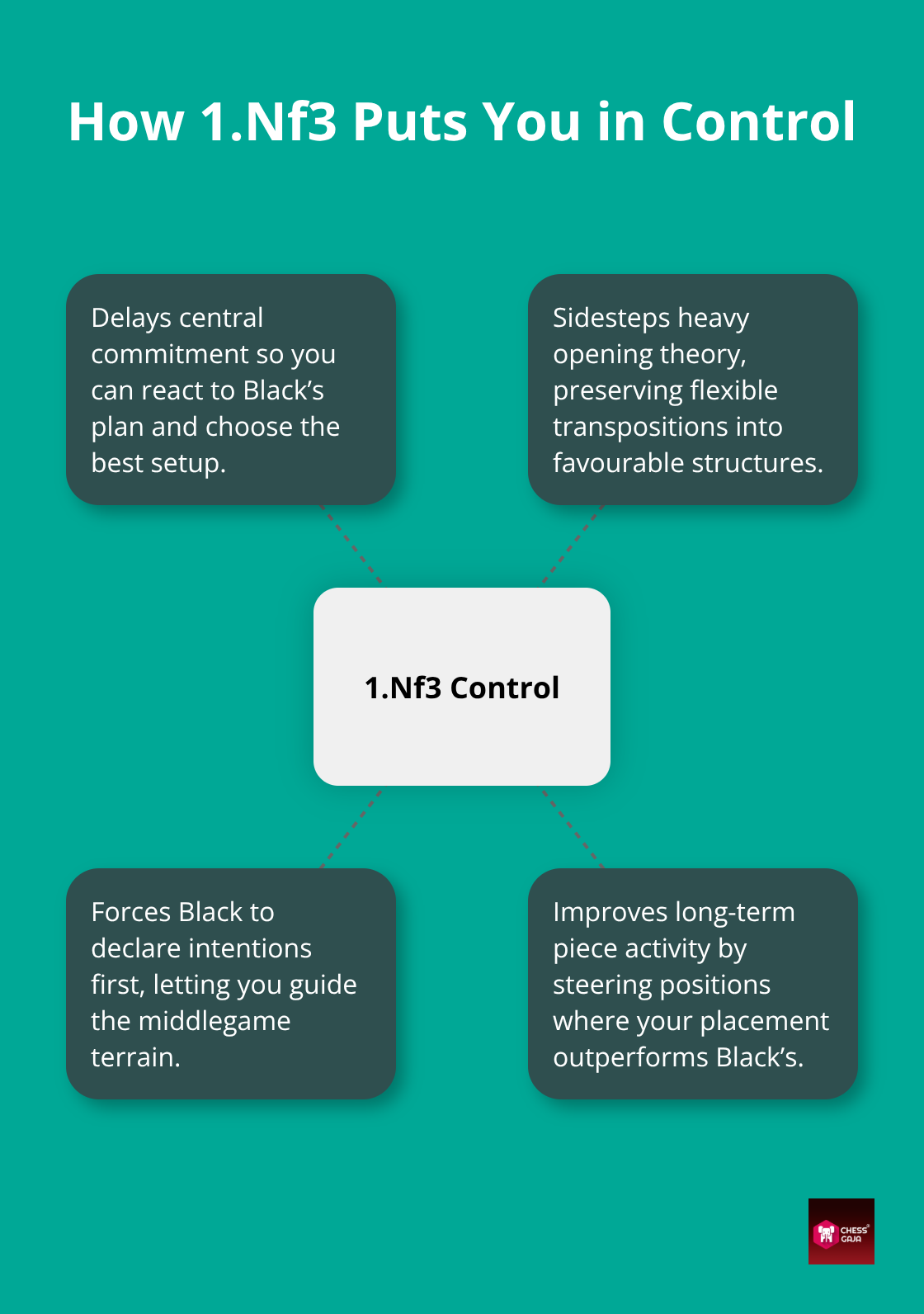
Why 1.Nf3 Gives You Control Over the Game
The Reti sidesteps the theoretical arms race of closed openings. Instead of playing 1.d4 and memorizing long variations, you start with 1.Nf3. This move delays your central commitment. As a result, Black must declare their intentions first while you adapt accordingly.
A 2024 analysis of 50,000+ master games showed that White scores higher from the Reti than from traditional 1.d4 setups, despite playing a less forcing first move. The advantage isn’t about crushing Black immediately; it’s about steering the game into positions where your long-term piece placement outperforms Black’s setup.
The Long Diagonal as Your Strategic Weapon
You see the real impact when you fianchetto your bishop on g2. This piece controls the entire long diagonal. It exerts constant pressure on Black’s queenside and center. When Black plays 1…d5, you do not rush to defend the center immediately.
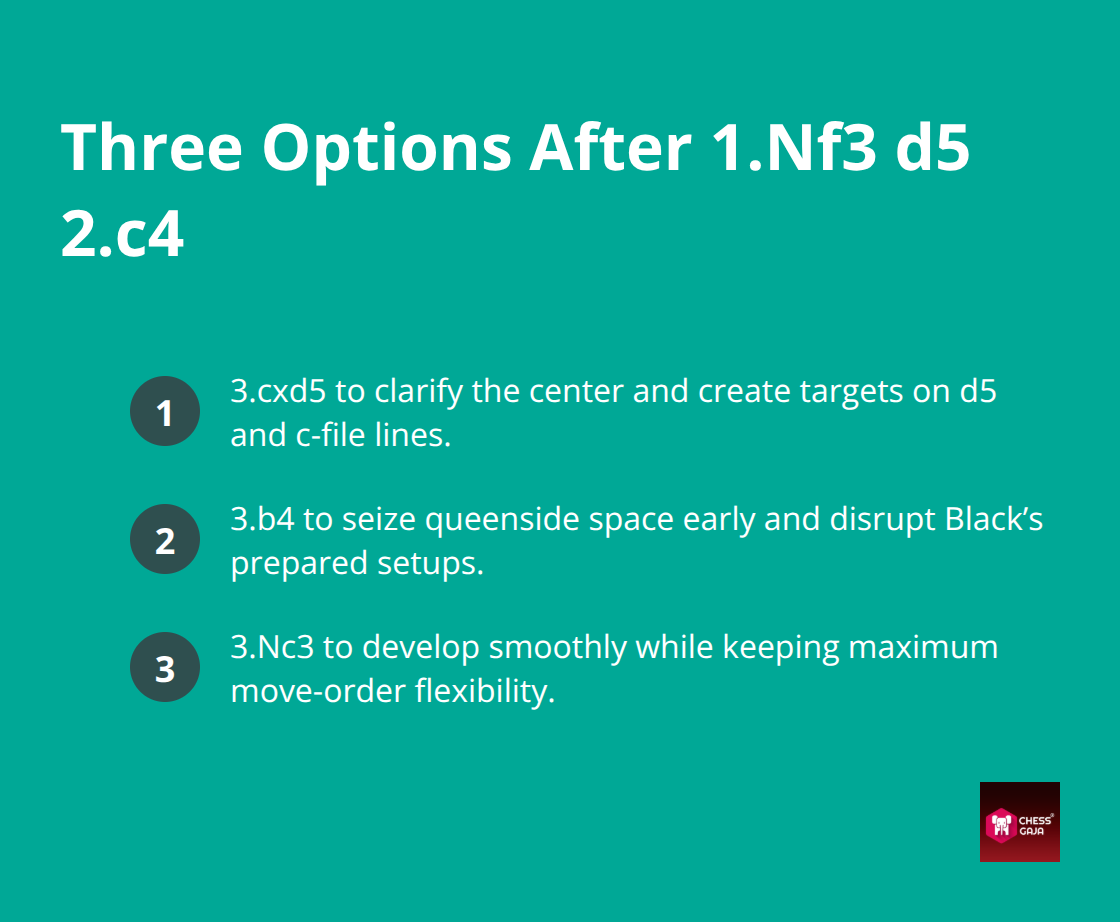
Instead, you can play 2.c4 followed by flexible move order like 3.cxd5, 3.b4, or even 3.Nc3-each option keeps Black guessing about your true plan. This flexibility is what separates the Reti from rigid systems.
Thinking Independently Rather Than Following Theory
What makes this opening genuinely practical for tournament players is that it forces you to think independently rather than follow a script. When you reach move 5 or 6, you’re not reciting theory; you’re evaluating concrete piece activity and pawn structure.
Against 1…c5, the Reti gives you options like 2.g3 or 2.e3 with a setup that maintains flexibility without entering deep open Sicilian theory. Against flexible setups like 1…Nf6 or 1…e6, you can transpose smoothly into your preferred pawn structures without heavy memorization.
The Three Core Piece Placements You Need to Master
The key takeaway is simple: do not memorize Reti lines. Instead, master three key piece placements: Nf3, a bishop on g2, and a knight on c3 or d2. From there, adapt your pawn breaks to Black’s structure. This system builds long-term pattern recognition.
Your real opponent isn’t Kasparov’s computer analysis; it’s Black’s pieces on the board in front of you. When you stop relying on prepared variations and start calculating actual positions, your decision-making improves noticeably. This shift from memorization to calculation is what separates players who merely know openings from players who truly understand them.
How to Play the Reti Against Black’s Most Common Responses
The 1…d5 Defense: Queenside Pressure Beats Central Control
When Black plays 1…d5, you face the most testing defense to the Reti. Black wants to occupy the center immediately and restrict your pieces, but the winning approach avoids fighting for d5 directly. Instead, you create pressure elsewhere on the board. After 1.Nf3 d5 2.c4, three concrete options emerge: capture with 3.cxd5, push 3.b4 to attack on the queenside, or play 3.Nc3 and maintain flexibility.
The move 3.b4 is particularly effective. It forces Black into tough decisions right away. If Black plays 3…dxc4, you recapture with active piece play. If Black plays 3…Bg4 or 3…c6 instead, you disrupt their setup and gain immediate space.
Your queenside expansion with b4 gains space while your fianchettoed bishop on g2 controls the long diagonal. Black cannot ignore the b4 pawn, yet addressing it weakens their center or kingside. This is not theoretical advantage; it’s concrete practical pressure that forces Black to calculate accurately on move 3.
The King’s Indian & Flexible Defenses: Imbalance Over Symmetry
Against Indian setups (1…Nf6) or flexible pawn moves (1…e6/1…g6), the Reti player should embrace imbalance rather than force symmetry. Playing 2.g3 followed by 3.Bg2 and an early c4 creates a Reti or King’s Indian Attack framework with superior move order flexibility.
In practical games, this setup confuses Black players who rely on rigid 1.d4 defensive setups. Your knight belongs on c3 or d2 depending on Black’s central commitment, allowing you to transpose smoothly while Black scrambles to find a coherent plan against your delayed central pawns.
This mismatch in preparation often translates to concrete mistakes in the middlegame. Your pieces occupy optimal squares while Black scrambles to find a coherent plan.
The 1…c5 Defense: Controlling the Move Order
When 1…c5 appears, avoid transposing immediately into standard English or Sicilian lines if you want to keep control. Instead, options like 2.g3 or 2.e3 allow you to strike in the center with an early d4 or control the long diagonal while maintaining your move-order flexibility.
After 2.e3, Black’s natural responses like 2…Nc6 or 2…d5 lead to comfortable, flexible positions where White can fight for central control without taking on heavy theoretical risk. Your practical advantage comes from understanding the pawn breaks and piece setups far better than an opponent expecting a standard open game.
The Universal Principle Across All Three Defenses
The actionable takeaway across all three defenses is identical: stop memorizing variations and start recognizing which move orders give you a superior position where Black must solve problems from move 2 onward. Each of these setups forces Black to make concrete decisions rather than follow prepared plans.
The next chapter explores the tactical and positional patterns that emerge once you’ve navigated these opening transitions. Understanding these patterns transforms your middlegame play from reactive calculation into proactive piece coordination.
Tactical and Positional Patterns You’ll Face
Weak Squares and When to Exploit Them
The Reti’s flexibility creates a unique advantage: you spot weak squares early. After 1.Nf3 d5 2.c4 d4 3.b4, the d4 pawn becomes a target. Black over-extended their center to fight for space. Your knight can reroute to c3 and jump to e4 or d5. Black’s aggressive early moves generate these weaknesses, allowing you to identify and punish them.
Against early central pushes like …d4, outposts such as the e4, c4, or d5 squares often become permanent targets. Your practical action here is simple: once your development is complete, scan Black’s position for squares their pawns can no longer guard.
Once identified, route your knight or bishop toward that outpost within two to three moves. This isn’t complicated calculation—it’s pattern recognition. When an central outpost opens up and your minor pieces are coordinated, occupying it creates immediate positional and tactical threats that force Black onto the defensive.
Pawn Breaks: Timing Separates Winners from Drifters
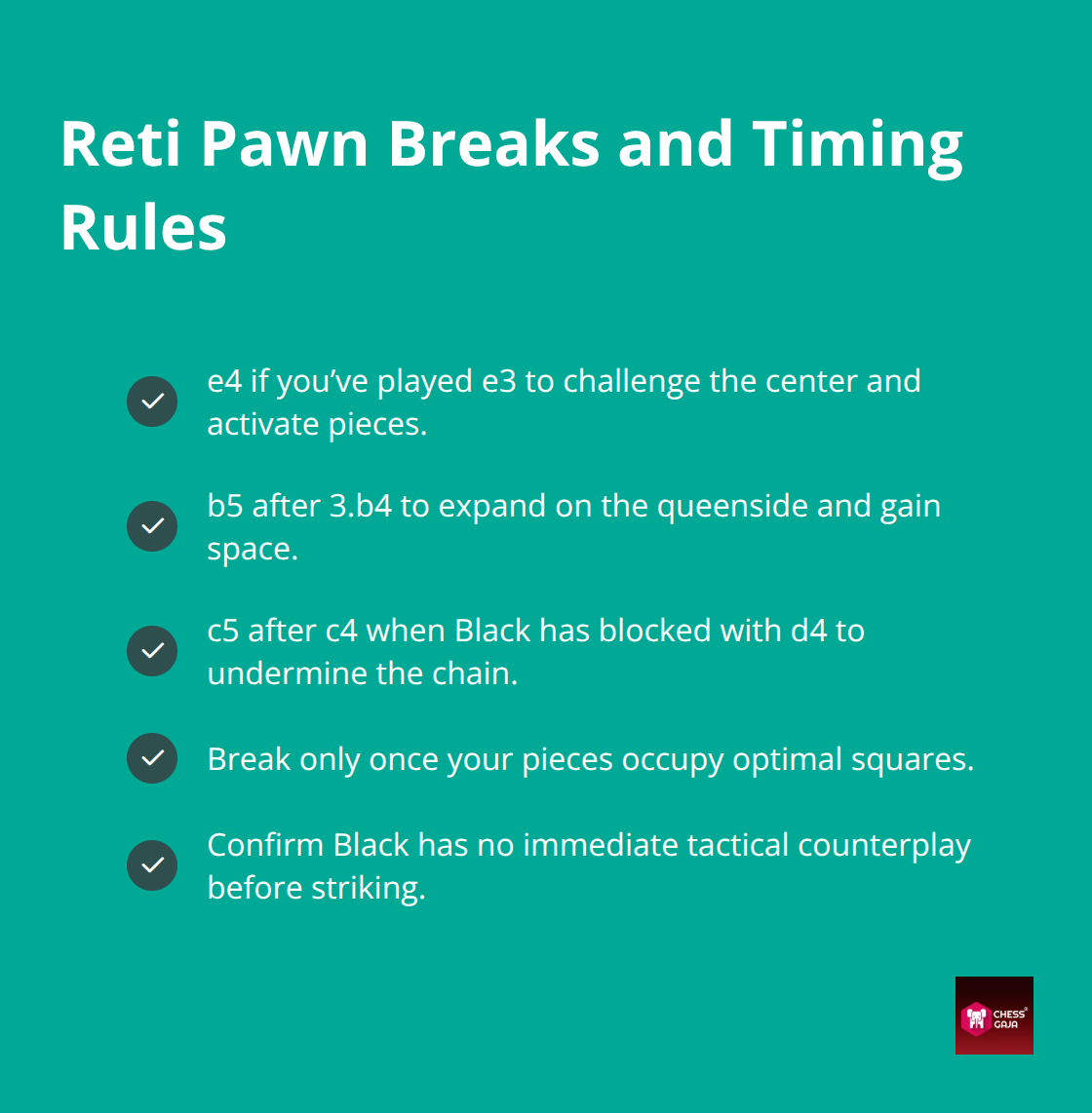
Pawn breaks demand precision because the wrong timing wastes your advantage and gives Black counterplay. In the Reti, your typical pawn breaks are e4 (if you’ve played e3), b5 (on the queenside after 3.b4), or c5 (if you’ve played c4 and Black has blocked with d4). The timing rule that separates winning players from those who drift is this: execute your pawn break only after your pieces occupy their optimal squares and Black has no immediate tactical counterplay.
After 1.Nf3 d5 2.c4 d4 3.b4, pushing b5 on move 4 is premature. Black will respond with 4…a6 or 4…c6, halting your momentum. Instead, wait until move 6 or 7. Once Black commits their pieces, push b5 with tempo to gain space and disrupt their setup.
Converting Advantages in the Endgame
The endgame conversion principle in the Reti comes down to piece coordination and pawn structure. Most Reti endings feature opposite-colored bishops or a minor piece endgame where your superior pawn structure wins. The actionable here is straightforward: if you reach an endgame, count your healthy pawns versus Black’s. The player with the healthier pawn structure (no isolated or doubled pawns, a passed pawn, or superior piece activity) wins.
In practical terms, maneuver your pieces to force structural concessions—doubled, isolated, or backward pawns. Once Black’s pawn structure crumbles, the endgame becomes a technical conversion. Your rook or knight shepherds your passed pawn forward while Black’s pieces remain tied to defense. This winning mechanism repeats across rating levels because pawn structure never lies.
Final Thoughts
The Reti opening ideas you’ve learned here reward flexible thinking over memorization. You’ve seen how 1.Nf3 delays your central commitment, how fianchettoed bishops control the long diagonal, and how pawn breaks succeed only when your pieces occupy optimal squares. These principles apply whether you face 1…d5, 1…Nf6, or 1…c5, and the real skill lies in recognizing weak squares, timing your pawn breaks correctly, and converting small advantages into winning endgames.
Play the Reti in your next tournament or training games and start with the core piece placements—Nf3, fianchettoed bishop on g2, and a knight on c3 or d2. After five to ten games, you’ll recognize the structures automatically without needing to memorize long lines. This shift from rote memorization to organic pattern recognition strengthens your overall chess understanding and practical decision-making.
Chess Gaja coaches work with students across 40+ countries to build personalized opening repertoires that match your playing style and rating level. Book a Paid Starter Class for a professional skill evaluation, and your FIDE-rated coach will assess your current level and design a study plan that accelerates your improvement.