
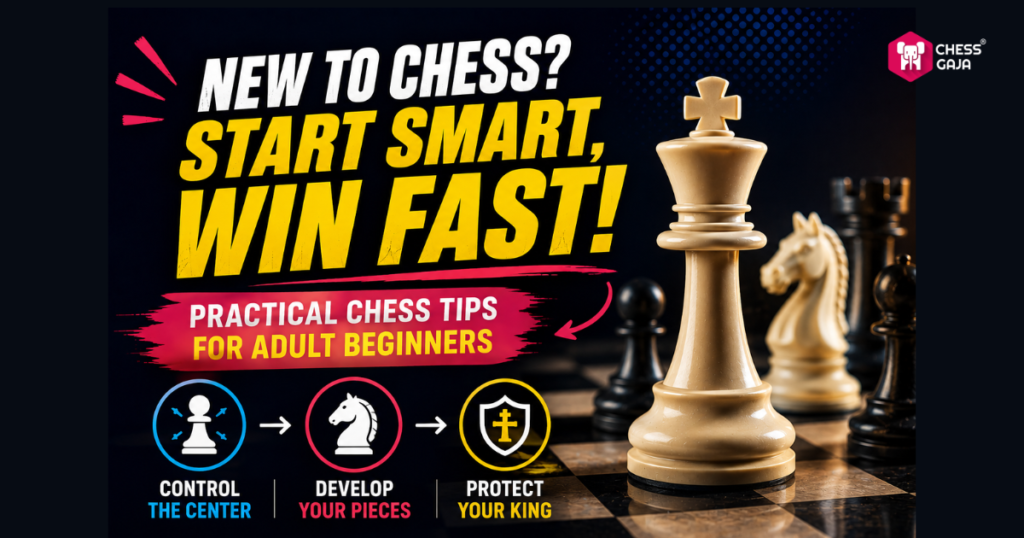
Starting chess for beginners as an adult feels intimidating, but it doesn’t have to be. The good news is that adult beginners can progress quickly by focusing on what actually matters-and skipping the noise.
We at Chess Gaja have coached thousands of adult players, and we’ve seen the same pattern: those who master fundamentals first build confidence fast. This guide breaks down the chess tips for adult beginners starting out, from piece movement to strategic thinking, so you can play stronger games immediately.
Master the Fundamentals First
What Every Piece Actually Does
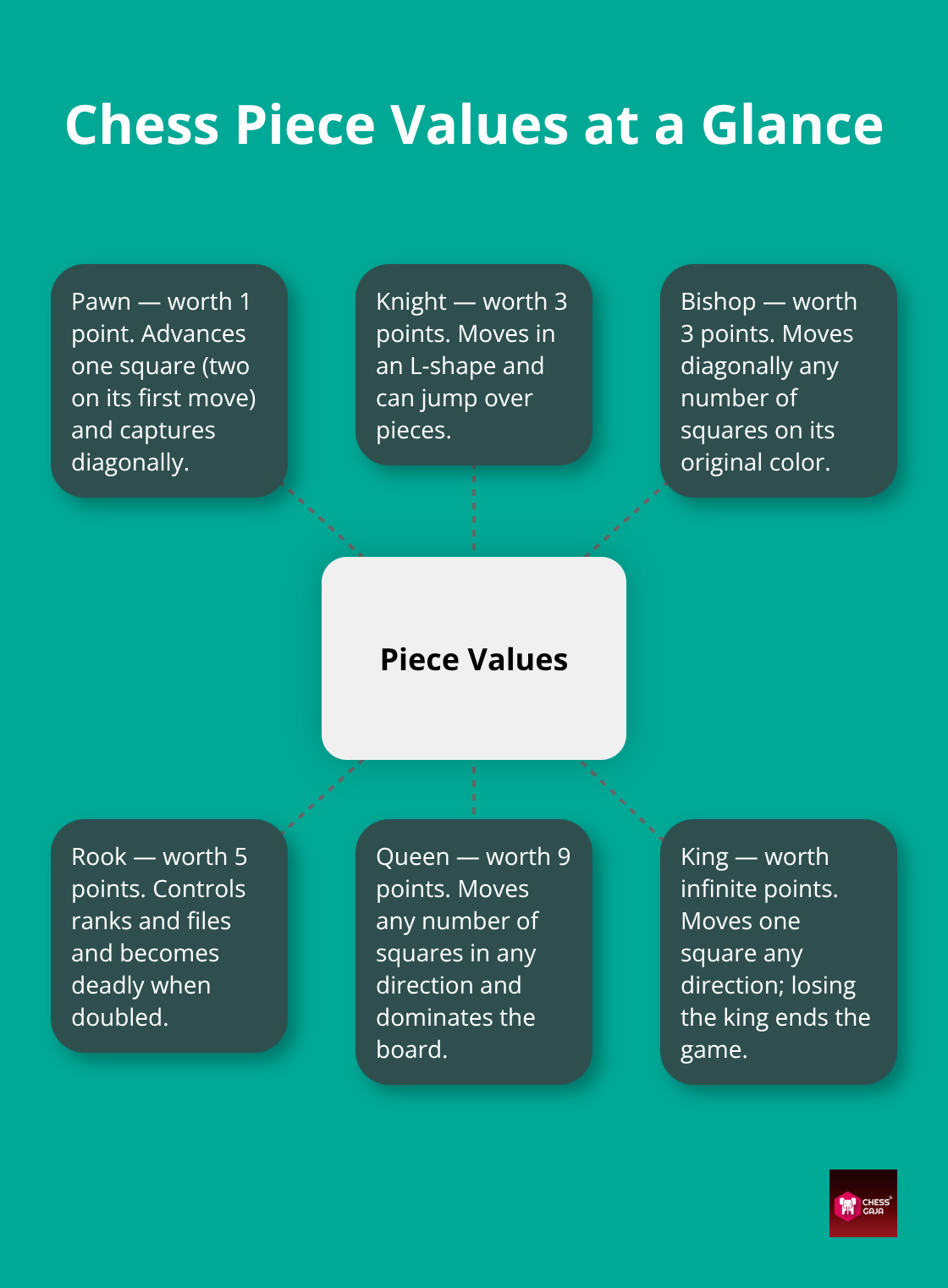
Each chess piece has a specific job, and understanding what it does-plus how much it’s worth-separates confident players from those who waste moves. The pawn is worth 1 point and moves straight forward one square (or two squares on its initial move), capturing one square diagonally forward. If a pawn reaches the 8th rank (or 1st rank for Black), it promotes to a higher-value piece—most commonly a queen.
The knight is worth 3 points and moves in an L-shape-two squares in one direction, then one perpendicular-making it the only piece that jumps over others. The bishop is worth 3 points and moves diagonally any number of squares, always staying on its original color.
The rook is worth 5 points and moves along ranks or files (straight lines), becoming especially dangerous when two rooks protect each other. The queen is worth 9 points. She moves any number of squares in any direction—forward, backward, sideways, or diagonally—making her the most powerful piece on the board. The king has no point value because it can never be captured or traded; the game ends when a king is checkmated. It moves one square in any direction but can never step onto a square that is under attack (moving into check).
Adult beginners often move the same piece multiple times in the opening while leaving other pieces on the back rank. This costs you tempo and weakens your position. Instead, prioritize developing your minor pieces-your knights and bishops—toward the center. Developing them early prepares rapid castling, controls key central squares, and makes your position much harder to attack.
The Board Setup That Matters
The board is arranged so the bottom-right square for each player is a light color. Your rooks belong in the corners, then knights next to them, then bishops, with the queen on her own color and the king on the remaining square. Pawns fill the second rank completely. When you know this setup automatically, you can focus on strategy instead of mechanics, rather than hesitating over piece placement.
Learn algebraic notation too—files are labeled a through h from left to right, and ranks are numbered 1 through 8 from bottom to top. Each square has a unique coordinate, like e4 or d7, so you can read and write moves without confusion. This notation matters because when you study games or take lessons, you’ll see moves written as e4, Nf3, or Bc4. Without notation, you cannot follow along or improve from studying master games.
Opening Moves That Build Real Advantage
Adult beginners often play random opening moves and wonder why they fall behind. The strongest opening principle is controlling the center—advancing the pawn in front of your king or queen two squares on your first move. This translates to 1. e4 or 1. d4. Grandmaster Bobby Fischer famously favored 1. e4, calling it “best by test”. Controlling the center provides space, piece mobility, and long-term positional control.
After your first move, develop your pieces toward the center rather than the edges. Place your knights on squares like f3 or c3 where they control central squares and support your plan. While establishing central pawns on e4 and d4 (or e5 and d5 for Black) is ideal, always prioritize developing your minor pieces (knights and bishops) over making excessive pawn moves. Castle early to move your king to safety and bring a rook toward the center where it belongs.
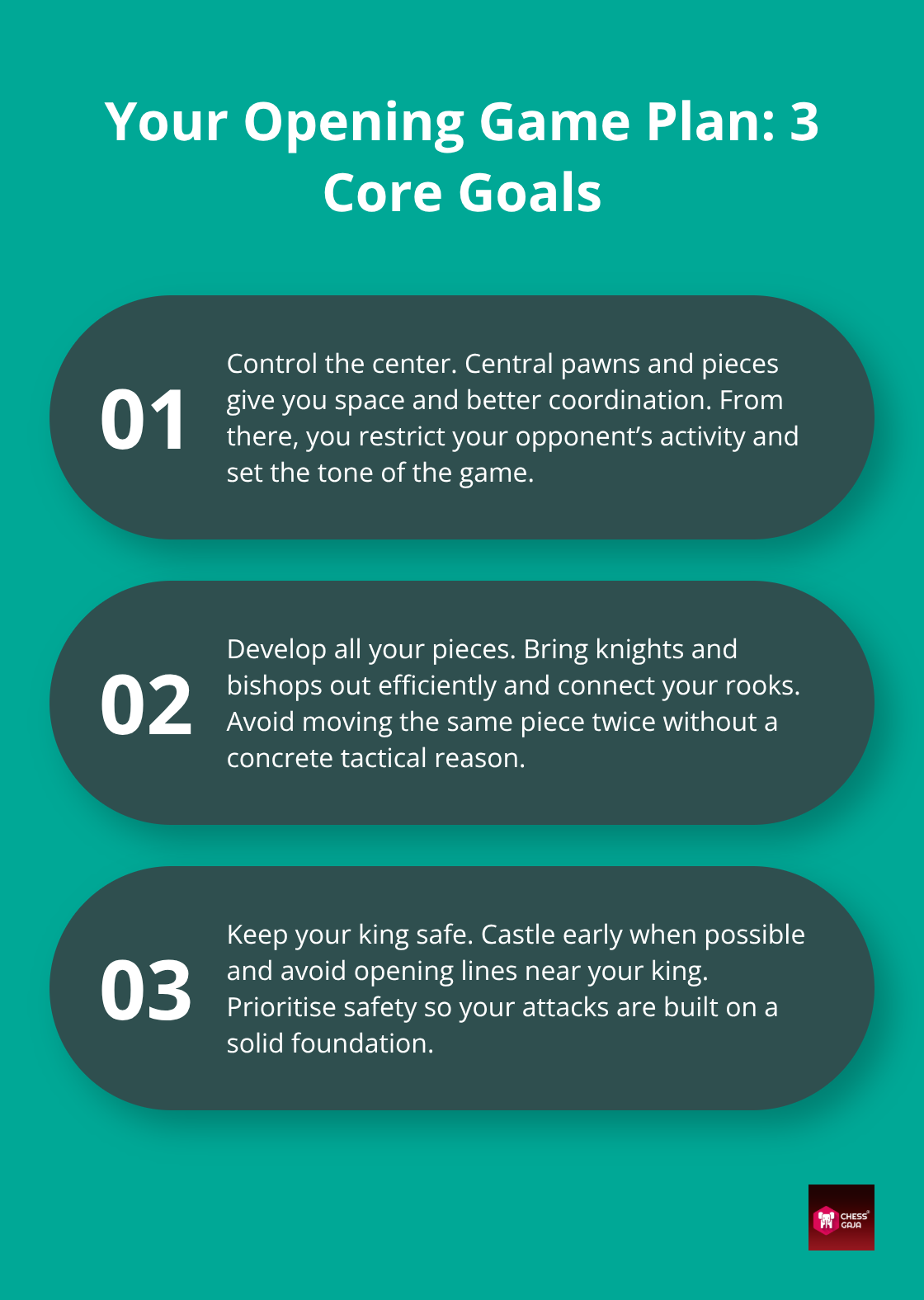
Avoid moving the same piece multiple times during the opening. Only do so to capture material, escape a threat, or win tactics. This prevents tempo loss and keeps your development on schedule. The goal of your opening is simple: control the center, develop all your pieces, and keep your king safe. Adult learners who follow these three principles find that their positions feel more stable and their attacks more coordinated.
Once you establish these habits in your opening play, you’re ready to explore how strategic thinking shapes the middle of your game.
Build Your Strategic Foundation
Control the center and Coordinate Your Pieces
The opening gives you the tools, but the middlegame is where adult beginners either capitalize on their advantage or waste it.
After you develop your pieces and castle your king to safety, your next task is maintaining control. Center control isn’t just about occupying the middle squares-it’s about using those squares to coordinate your pieces and restrict your opponent’s options.
When you control the central squares, your pieces gain better placement and your opponent struggles to find active squares for their knights and bishops. This dominance translates directly into winning positions.
Activate Your Worst Piece First
The practical action here is straightforward: after castling, look at your worst-placed piece. That piece usually sits on the back rank or the edge of the board doing nothing. Move it toward the center or toward an open file where it influences the game.
In many positions, your worst piece after castling is a rook stuck on a1 or h1. Get it onto an open file where it gains real power. A rook on an open file penetrates deep into your opponent’s position and creates threats that force concessions. Activating your worst piece and placing rooks on open files wins games. For adult beginners, this single habit works far better than memorizing 20 opening variations.
Defend Your King Without Falling Into Passivity
King safety remains your second priority in the middlegame, even after castling. Castling moves your king away from the center, but it doesn’t make your king invulnerable. Monitor whether your opponent builds an attack along the files or diagonals near your king.
If your kingside structure is exposed (such as an open f-file or g-file), do not open further lines. Prevent your opponent from gaining direct attacking routes against your king. Keep active defenders nearby or counter in the center to neutralize your opponent's momentum before launching play elsewhere.
Adult beginners often panic when their opponent advances pawns near the castled king, but the solution isn’t passive defense—it’s creating an active counterplay elsewhere. Control the center, activate your pieces, and target your opponent’s weaknesses. These actions force your opponent onto the back foot, preventing them from mounting a successful attack while defending their own position.
Once you build a strong foundation in these middlegame principles, you’ll notice that your positions feel more stable and your attacks more coordinated. The next step is recognizing the mistakes that derail most adult players before they reach this level of control.
Common Mistakes Adult Beginners Make
Play With Purpose, Not Impulse
Adult beginners often play moves that feel reasonable in the moment but have no connection to winning the game. You move a piece, your opponent responds, and suddenly you react instead of controlling the board. This happens because you lack a concrete plan before each move.
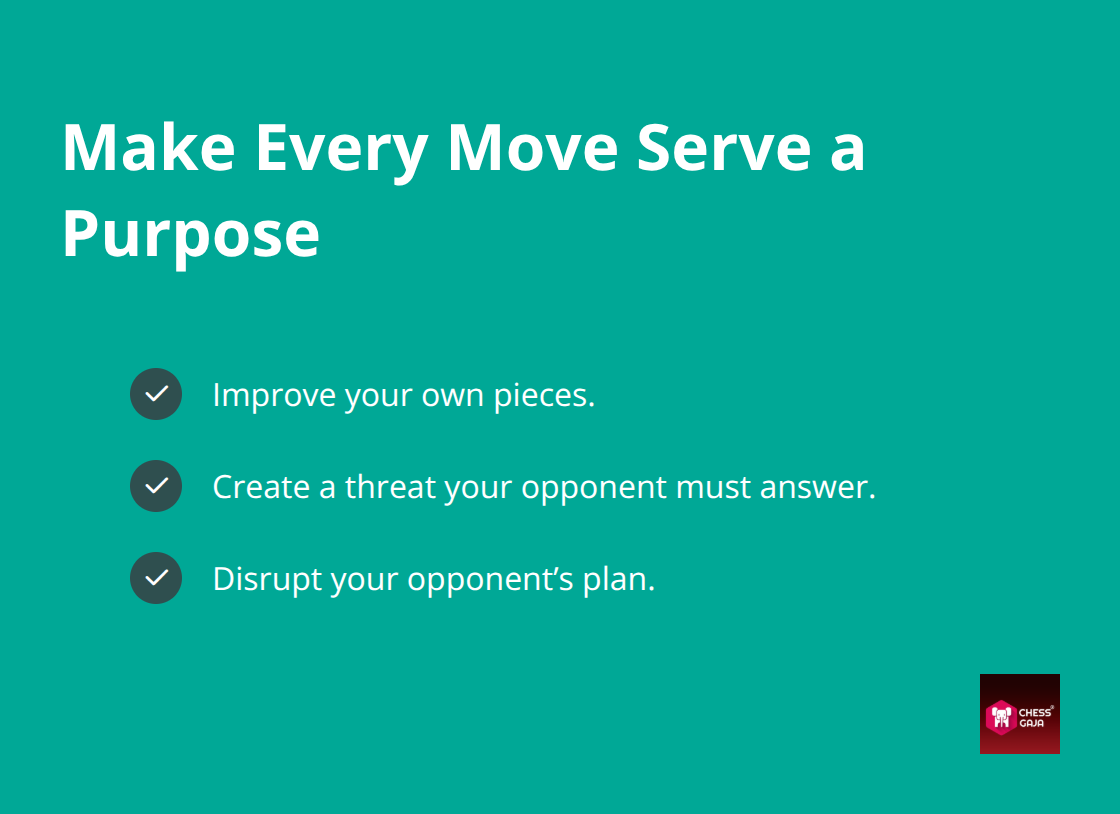
Every single move must serve one of three purposes: improve your own pieces, create a threat your opponent must answer, or disrupt your opponent’s plan. If a move accomplishes none of these, it wastes a turn and hands your opponent the initiative.
A practical test works immediately. Before you move, state aloud what your move accomplishes. If you cannot answer in one sentence, do not play it. Adult players who adopt this habit see their positions stabilize because they stop drifting and start directing the game.
Protect Every Piece on the Board
The second major leak in adult beginner games is leaving pieces undefended after the opening ends. You develop your knight to f3, your bishop to c4, and your rook to e1, but you never check whether each piece is protected. An undefended piece becomes a gift to your opponent. If your opponent can capture it without losing material of equal value, they will.
Many adult beginners lose material by making unfavorable trades—such as capturing a defended 1-point pawn with a 3-point knight or 5-point rook, resulting in a direct net loss of material.
The solution is mechanical: after you move, ask yourself whether your piece can be captured. If yes, either defend it with another piece or move it to a safer square. In the middlegame, ensure every attacked piece has at least as many defenders as attackers—and prefer defending minor pieces or pawns with pawns rather than tying down heavy pieces (rooks or queens) to defensive duties.
Recognize When Your Opponent Threatens Your Position
Adult players who consistently defend their pieces reduce losses dramatically because they stop giving free material to tactical opponents. The same principle applies to your opponent’s pieces. When your opponent moves a piece, ask whether that piece now threatens anything you own.
If your opponent’s knight lands on e5, it may threaten key central squares or attack vulnerable weak points like f7 (or d7). Always identify these tactical threats before selecting your move. Checking your opponent’s active threats on every turn prevents simple blunders and lost material.
Final Thoughts
The chess strategies for beginners work only if you apply them consistently across dozens of games. Reading this guide once won’t transform your game-playing while keeping these principles in mind will. Each game teaches you patterns you’ll recognize in future positions, and pattern recognition builds through repetition, not theory.
Working with a coach accelerates your progress far more than playing alone. A coach watches your games, identifies the specific mistakes holding you back, and corrects them before they become habits.
At Chess Gaja, our FIDE-rated coaches offer personalized instruction tailored to your level. Designed by Grandmaster Priyadharshan, our curriculum spans three levels: Beginner, Intermediate, and Advanced. Each level takes roughly 35 classes to complete.
Start playing consistent games this week. If you want rapid improvement, book a Paid Starter Class with Chess Gaja for a professional skill evaluation.