
A student in Singapore just won her first youth tournament. Her secret? She stopped guessing during games and started using AI-assisted training to analyze every move with precision.
At Chess Gaja, we’ve watched hundreds of players transform their results through AIpowered chess coaching combined with expert analysis. The difference isn’t just faster improvement-it’s smarter improvement.
How AI Shows You Exactly What You’re Missing
Real-Time Feedback That Stops Patterns Cold
AI analysis platforms like Stockfish and Lichess deliver move-by-move evaluations within seconds of finishing a game. This isn’t just about seeing which moves lost material-it’s about understanding the precise moment your position shifted from winning to losing. A 1400-rated player in the UAE recently reviewed a rapid game. On move 18, she played a natural move that was significantly worse than the engine’s top choice. That small mistake compounded in the middlegame and cost her the tournament. Without AI feedback, she would have repeated the same pattern in her next event.
The real power lies in spotting patterns you can’t see alone. Most players under 1800 miss tactical opportunities because they lack a systematic process for candidate move identification and threat assessment. AI tools flag these blindspots by showing you which piece combinations you consistently overlook. One student in Singapore found that her accuracy on knight fork puzzles was low—a concrete, measurable tactical weakness. She then spent two weeks solving targeted knight-fork puzzles on Chess.com’s AI-powered training module, and her overall tactical accuracy jumped significantly in her next tournament games. This is data-driven self-awareness in chess training, not guesswork.
Converting Game Reviews Into Targeted Practice
Post-game analysis through platforms like ChessBase or Lichess creates a searchable archive of your mistakes. Rather than vaguely remembering you played badly, you now have timestamped evidence: move 24, position X, eval drop of 1.2 centipawns. You can then filter these mistakes by opening, by opponent rating, or by time control. A player preparing for the UAE Team Chess Championship might discover that a majority of her losses came from weak middlegame planning after a specific opening sequence. She can then target that exact weakness with AI-generated training puzzles that replicate similar structures.
Precision Metrics Replace Vague Progress
Traditional chess improvement is murky. You win some games, lose others, and hope your rating climbs eventually. AI-powered platforms eliminate this ambiguity. Lichess tracks your accuracy percentage per game, per opening, and even per phase of the game. A student in New York noticed his endgame accuracy was higher than his middlegame accuracy. That gap told him exactly where to focus his training time. After six weeks of endgame drills, his accuracy climbed substantially, and his overall rating jumped 45 points. The data guided the effort, not intuition.
These insights form the foundation of what separates random chess study from strategic chess improvement. When you know your exact weaknesses and measure your progress with precision, you stop wasting time on areas where you’re already strong. This efficiency becomes critical when you’re preparing for competitive events or working toward a specific rating goal. The next step is taking these AI-powered insights and building them into a personalized study plan that fits your schedule, your rating, and your ambitions.
How to Build Your AI-Driven Study Plan
The mistake most players make is treating AI like a magic fix. They run one game through Stockfish, see their blunders highlighted in red, and assume that’s enough. It isn’t. AI analysis without a structured study plan is like having a detailed map but no destination. We’ve seen students waste months jumping between different training tools because they lacked a coherent strategy tied to their actual rating and tournament goals.
The players who accelerate fastest are those who use AI insights to build a concrete, measurable weekly routine.
Match Your Training Intensity to Your Rating
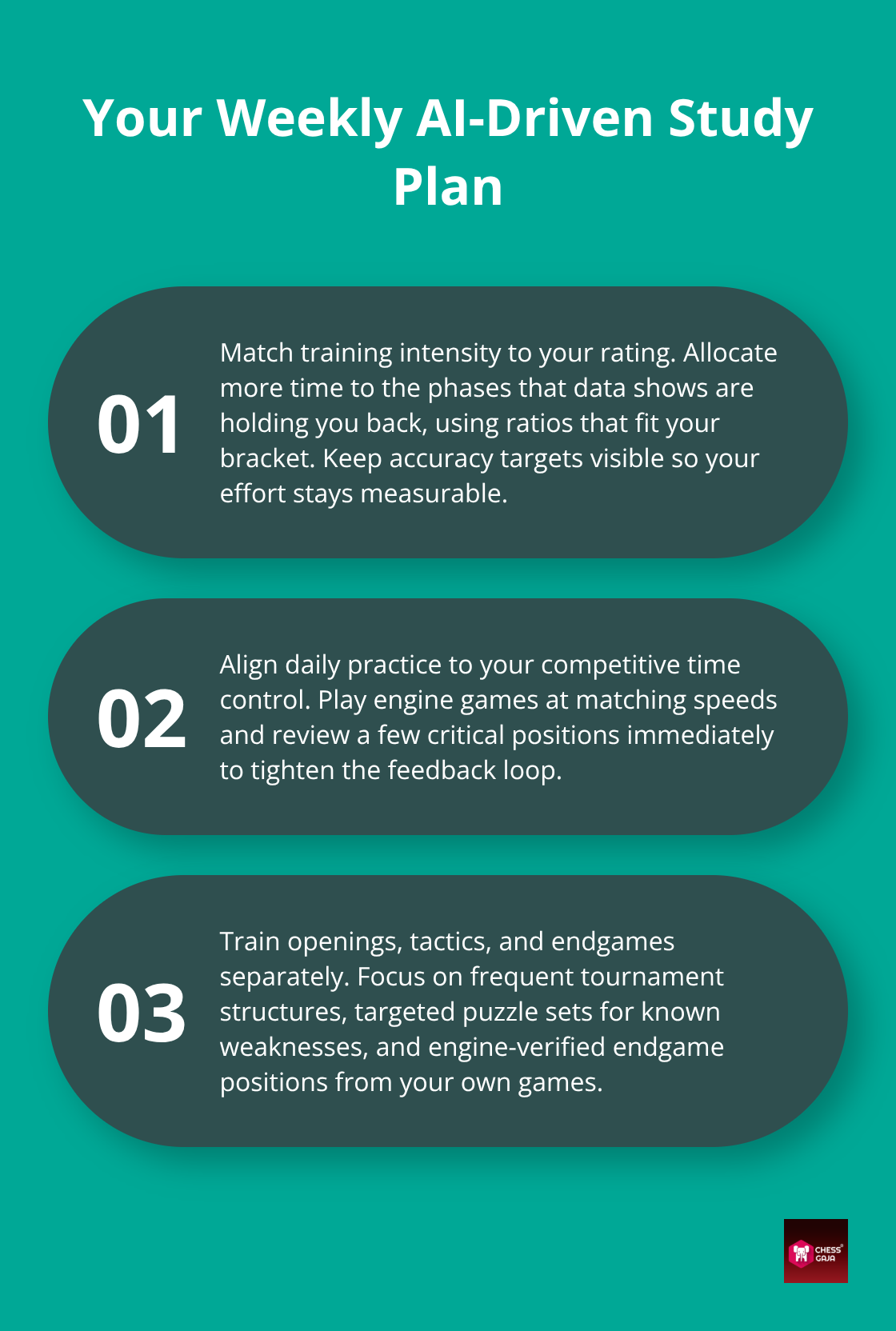
Your first step is aligning your training intensity to your rating bracket. A player rated 1200 preparing for a rapid tournament in Dubai should spend most of their study time on tactical pattern recognition and opening fundamentals, with minimal time on deep endgame theory. A 1600-rated player competing in the UAE Team Chess Championship should adjust those priorities: focusing primarily on opening refinement and middlegame planning, followed by endgame conversion and light tactical upkeep. Platform data across Lichess and Chess.com shows that players under 1400 gain rating points fastest by solving 20-30 tactical puzzles daily while maintaining a high puzzle accuracy rate.
One student in New York rated 1350 committed to 25 daily puzzles for eight weeks and jumped 110 rating points. The structure mattered more than the volume. She solved puzzles at the same time every morning, tracked her accuracy by puzzle type, and identified that she struggled with sacrificial motifs. She then spent one week specifically on sacrifice puzzles, and her overall tactical accuracy improved noticeably. This is precision planning, not random grinding.
Align Daily Practice to Your Time Control
If you play rapid chess, your daily practice must include rapid-format training. This seems obvious, but most players study with long time controls and then panic when they compete in 10-minute games. Post-game AI tools on Lichess and Chess.com let you instantly evaluate games played under specific time controls. Spend 30 minutes daily playing rapid games against human opponents (or human-like AI bots calibrated to your rating), then spend 15 minutes letting Stockfish highlight the three most critical turning points.
A player in Singapore preparing for the Back-to-School Junior Chess League found that her classical (longer) format practice wasn’t translating to rapid tournament performance. She added 30 minutes of daily rapid AI practice with immediate post-game analysis, and her rapid accuracy jumped significantly within four weeks. The time control alignment matters because it conditions your mental processing speed to match the actual demands of competition.
Train Openings, Tactics, and Endgames Separately
Opening study with AI is about repertoire efficiency, not memorization depth. Use ChessBase or Lichess opening analysis to identify which three openings appear most frequently in tournaments you’re entering. Then spend 15 minutes weekly studying only those openings against AI, pushing the engine to find forced variations. Don’t memorize 20 moves. Instead, understand the key ideas and the three primary tabias (critical theoretical junctions) where mistakes happen.
For middlegame and tactics, AI-generated tactical exercises focusing on specific motifs are non-negotiable. Chess.com’s personalized puzzle feature uses machine learning to serve tactical patterns tailored specifically to your rating and past blunders. If your post-game analysis shows you consistently miss back-rank threats, the AI system adapts and feeds you targeted back-rank puzzles until the motif becomes second nature. One student in Abu Dhabi noticed she lost 12 games to back-rank checkmate patterns over six months. After two weeks of targeted back-rank puzzle training on Chess.com (30 puzzles daily), she eliminated this weakness entirely.
Custom Endgame Drills with AI
For endgames, tablebases integrated with engines like Stockfish provide exact win/draw/loss (WDL) classifications for simplified positions. Rather than studying abstract endgame theory, upload 5-10 endgame positions from your recent losses into an endgame trainer and have the engine show you the exact winning sequence. A player rated 1550 studying for rapid tournaments found that engine-guided endgame study strengthened her play significantly. She spent 20 minutes twice weekly on three specific endgame types that appeared in her games, and her endgame conversion rate improved substantially within eight weeks.
This structured approach transforms AI from a passive analysis tool into an active training partner. Once you establish this routine and track your progress through measurable metrics, you’ll notice something shift: your games start reflecting the patterns you’ve trained. The next step is understanding how to avoid the common pitfalls that derail most players who attempt AI-assisted training on their own.
Where AI Analysis Misleads You Most
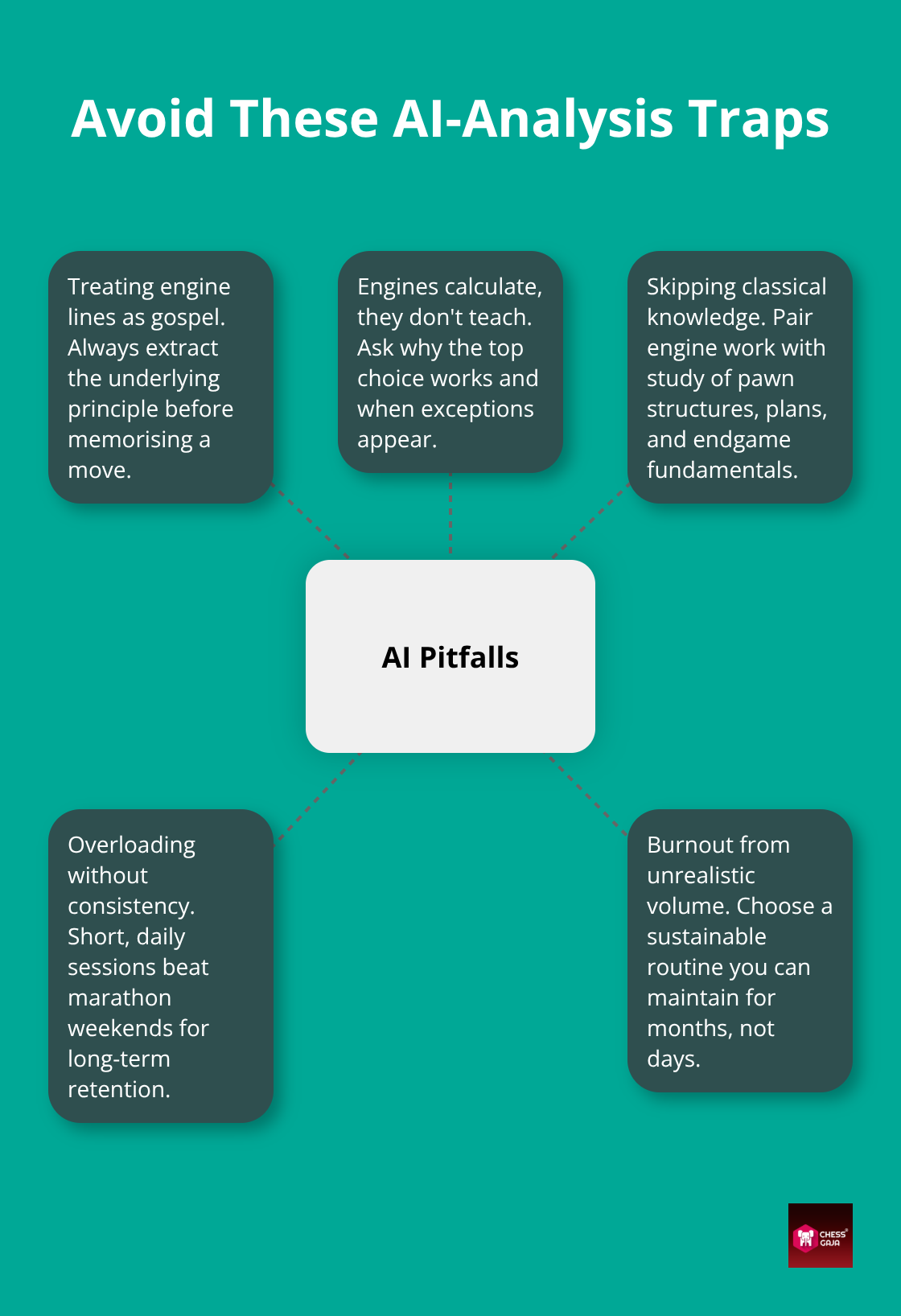
Most players treat engine recommendations as gospel truth. A student in Dubai ran her game through Stockfish, saw the engine evaluated a complex piece sacrifice as +1.5, and assumed the line was winning in all similar setups. She memorized the tactical sequence without understanding why it worked. Three weeks later, she faced a nearly identical position in a tournament and played the sacrifice automatically. However, the opponent’s pawn structure had slightly changed. Her attack collapsed quickly, and she lost the game. She had memorized a concrete calculation line beyond human depth instead of learning the positional principle behind it.
This is the fundamental mistake that stalls improvement: treating AI recommendations as instructions rather than explanations.
Engines Calculate, They Don’t Teach
Engines are calculators, not teachers. They show you what’s objectively best, but they don’t explain the positional reasoning, the tactical justifications, or when exceptions exist. A player rated 1550 in Singapore spent six weeks studying engine lines from her games without understanding the underlying strategy. Her rating didn’t budge. When she switched to analyzing only three critical positions per game and asking herself why the engine preferred each move, her understanding deepened. Within four weeks, her rating jumped 38 points. The difference was comprehension, not volume.
The worst trap is using AI analysis as a substitute for classical chess knowledge. Engines calculate billions of positions instantly, but they don’t teach you pawn structures, piece coordination, or the strategic principles that govern positions. A player preparing for the UAE Team Chess Championship spent two months studying engine lines from master games without reading a single chess book about middlegame planning. She memorized sequences but couldn’t recognize similar structures in her own games. Combining engine analysis with classical chess study transformed her results. By solving tactical sets from The Woodpecker Method alongside studying positional concepts from books like How to Reassess Your Chess and endgame basics from Silman’s Complete Endgame Course, her pattern recognition improved dramatically. Tournament results quickly followed. Engine analysis reveals what happened; classical study teaches you why it matters.
A 1400-rated player in New York combined her daily puzzle training with AI-powered analysis of chess fundamentals. Her tactical accuracy improved dramatically within six weeks because she understood the underlying patterns, not just the surface moves. This pairing of AI tools with classical knowledge creates the foundation for genuine improvement.
Consistency Beats Intensity Every Single Time
The second critical mistake is treating AI training like a sprint instead of a marathon. A player in Abu Dhabi spent 12 hours analyzing games in one weekend, felt accomplished, then didn’t touch chess for two weeks. When she returned, she’d forgotten half of what she studied. This on-and-off pattern guarantees stagnation.
Research shows that players who train consistently gain rating points significantly faster than players who train sporadically. Your brain consolidates chess patterns through consistent, spaced repetition. A student in Singapore committed to 25 minutes of daily puzzle training for 16 consecutive weeks without missing a single day. Her rating climbed 87 points. When she tried the same total training hours compressed into weekends, she gained only 12 points over the same period. The schedule matters more than the volume.
AI-powered platforms track your consistency automatically. Lichess shows your training streak; Chess.com logs your daily puzzle accuracy. Use these metrics ruthlessly. If your streak breaks, that’s data telling you your current routine isn’t sustainable. Adjust the volume downward until the training becomes automatic. A 1600-rated player prepared for rapid tournaments using 30 minutes of daily AI practice. She played rapid games followed by 10-minute reviews. This routine remained sustainable for 90 consecutive days. When she tried 90 minutes daily, she burned out after three weeks. The smaller commitment produced measurable results because she actually completed it.
Final Thoughts
The players who accelerate fastest combine AI-assisted training with expert human guidance and stick to a structured plan. A student in Dubai won her first youth tournament not because she had access to Stockfish, but because she paired engine analysis with personalized coaching that explained why each move mattered. This combination transforms AI from a passive analysis tool into an active accelerator of your chess growth.
We at Chess Gaja have trained over 5,000 students across 40+ countries since 2019, and the pattern is unmistakable. Students who receive AI-powered post-session summaries after every class, combined with personalized study plans calibrated to their exact rating and goals, gain rating points 3-4 times faster than those who study alone. Our FIDE-rated coaches explain the strategic principles behind each recommendation, ensuring you understand the reasoning, not just the moves.
Your next step is to book a Paid Starter Class with one of our FIDE-rated coaches for a professional skill evaluation. Your coach will assess your current level, identify your specific weaknesses, and build a personalized improvement plan tailored to your goals. This is where your accelerated chess journey begins.