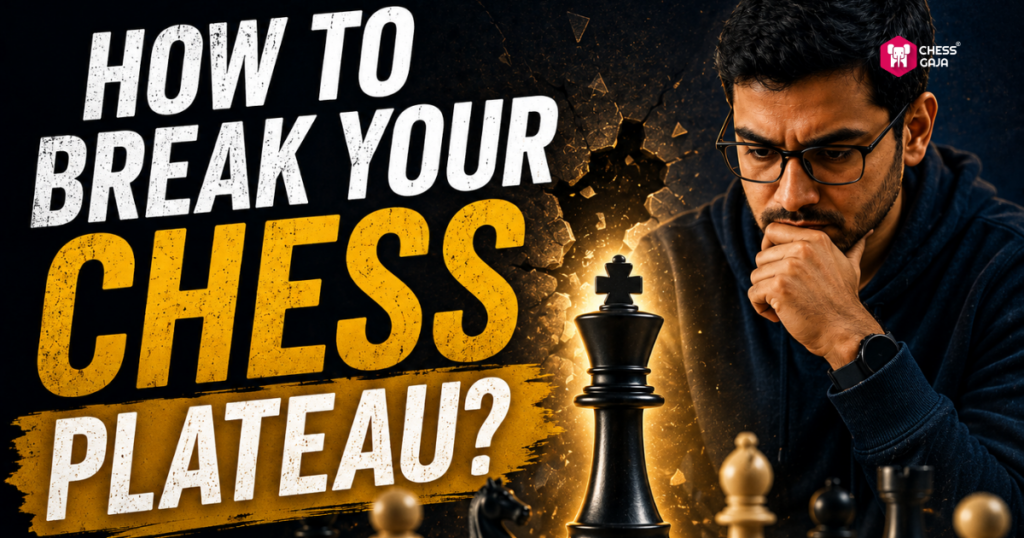
Your rating plateaued at 1400. You’ve been playing for two years, studying sporadically, but nothing seems to stick. The problem isn’t your talent-it’s your approach.
Deliberate chess practice works differently than casual study. At Chess Gaja, we’ve seen hundreds of players break through their ceilings by switching from random training to structured, focused work. This blog post shows you exactly how.
How Your Brain Learns Chess Differently Than You Think
Your brain does not improve at chess through osmosis. Playing 50 games a month without post-mortem analysis leaves your neural pathways stuck in old patterns.
Research shows that players who balance playing and studying gain rating points much faster. Anders Ericsson’s work on expert performance proves that targeted training—not total hours—determines skill growth.
Students who commit to structured game analysis see measurable rating gains within 6 to 8 weeks. Meanwhile, casual players plateau for months. The difference isn’t talent; it’s how you train your brain.
What Happens When You Analyze Your Own Games
Sitting down with your game 24 hours after playing creates a powerful feedback loop. You spot the exact moment you made a mistake and understand why it failed. This process encodes the correction into long-term memory.
Analyzing games within 24 hours produces far better retention than reviewing them weeks later. A 1400-rated player who spends 30 minutes analyzing three games per week will outpace someone playing three games daily without review.
Specificity is key here. Don’t just note that you lost. Categorize whether the loss came from a tactical blunder, a calculation error, or a strategic misunderstanding. This breakdown tells you exactly what to practice next.
Solving Puzzles That Match Your Actual Skill Level
Tactical puzzle training works only when the difficulty matches your current capability with a small stretch. Puzzles far below your level waste time; puzzles far above it build frustration, not skill. If you’re a 1400-rated player, solving 1200-rated puzzles teaches you nothing new. If you jump to 2000-rated puzzles, you’ll fail most of them and learn nothing except discouragement. The sweet spot sits at puzzles 50 to 100 rating points above your current level. Spend 15 to 20 minutes daily on this targeted practice, and you’ll develop faster pattern recognition and calculation speed. Track your performance: if you are solving most puzzles correctly without much effort, increase difficulty. If you find yourself missing the majority of them, step back one level. This isn’t guesswork; it’s precision training.
Why Opening Memorization Wastes Your Time
Most 1400-rated players memorize 15 opening variations and forget them within weeks. Instead, learn the three core ideas behind your opening: what squares you control, where your pieces belong, and what your opponent wants to stop. A player at your level wins or loses in the middlegame and endgame, not in the opening. Spend two weeks understanding the principles of your opening (what White is trying to achieve, what Black’s counterplay looks like) and you’ll play those openings at a higher level than someone who memorized 30 lines. This principle-based approach transfers directly to positions you’ve never seen before, while memorization fails the moment your opponent deviates.
The Role of Structured Feedback in Breaking Through
Your own analysis has limits. You can spot where you went wrong, but you cannot always see why a stronger move exists or what pattern you missed. A coach identifies the blind spots you cannot see alone. Coaches who work with students at your level (1400 rating) spot recurring mistakes that you repeat across multiple games-tactical oversights, calculation errors under time pressure, or positional weaknesses in specific openings. Structured feedback from a coach accelerates improvement far beyond what self-analysis alone produces. The next section shows how professional guidance transforms your practice from scattered effort into a system that works.
Three Tools That Actually Work for Deliberate Practice
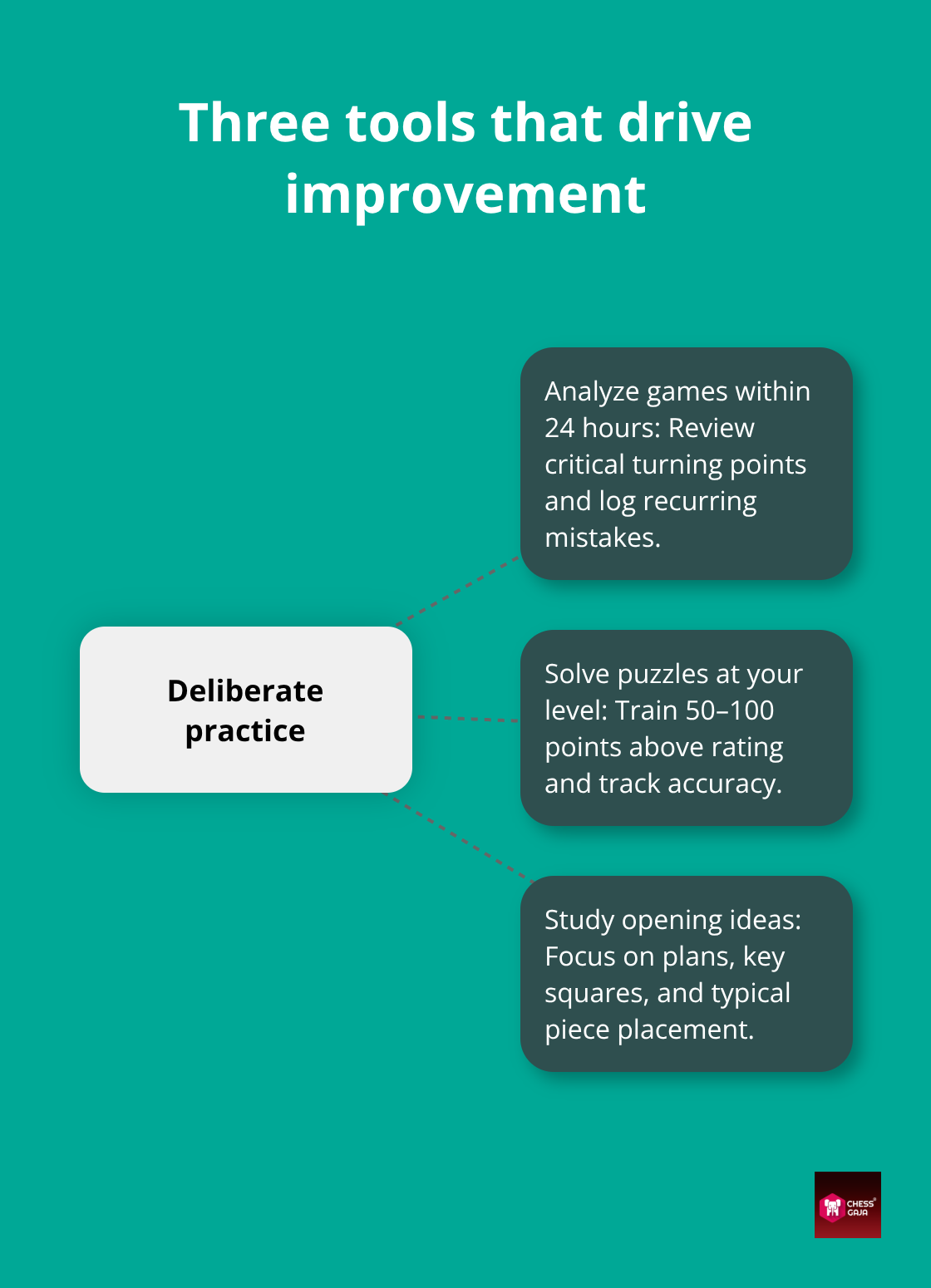
Analyze Your Games Within 24 Hours
Game analysis within 24 hours is non-negotiable for real progress. Most players wait weeks or skip review entirely. As a result, their brains never connect the mistake to the solution.
Analyze your game on your own first for 15 minutes to recall your thought process. Only after marking your critical moments should you turn on an engine to verify tactical or calculation errors. Focus strictly on the 3 to 5 key positions where the game actually turned.
For a player in Dubai or Singapore playing two to three games weekly, dedicate 90 minutes per week to review. Track your errors in a simple spreadsheet by category: tactical misses, time pressure errors, or strategic misunderstandings. Players using this method see measurable rating gains within 6 to 8 weeks.
Solve Puzzles at Your Exact Skill Level
Tactical puzzle training works best when pitched at your current ability with a slight stretch upward. Solving puzzles far below your level wastes time. Attempting puzzles far above your level builds frustration instead of skill.
Aim for puzzles where you succeed consistently while still needing to calculate carefully. On platforms like Chess.com or Lichess, work on puzzles close to your current puzzle rating.
If you rarely make mistakes, increase the difficulty. If your success rate drops noticeably, step back to reinforce core patterns. Your brain wires tactical patterns through repetition at the right difficulty, not by struggling with extreme puzzles.
Study Opening Ideas, Not Memorized Lines
Opening study should focus on understanding core ideas rather than memorizing lines that evaporate within weeks. A 1400-rated player wins or loses in the middlegame and endgame, not the opening.
Spend time learning what your opening accomplishes: controlled squares, ideal piece placement, and opponent plans to prevent. You will play those positions much better than someone who crammed 30 lines.
This principle-based approach transfers to unfamiliar positions, whereas memorization collapses the moment your opponent steps outside prepared lines. When you understand why a move works, you can adapt when the position shifts.
What Separates Improvement From Stagnation
The three techniques above form the foundation of deliberate practice. What separates players who improve from those who stagnate is execution: you must analyze every game, solve puzzles at the right difficulty, and study openings for understanding. This is how your brain actually wires chess skill into long-term capability. Yet execution alone isn’t enough-you need someone who can see what you cannot see about your own play, someone who spots the patterns you repeat across multiple games and corrects them before they calcify into permanent weaknesses.
How to Structure Your Weekly Practice Without Burning Out
Most players fail not from a lack of talent, but because they try to do everything at once and burn out. A player practicing two hours daily without structure improves slower than someone practicing 45 minutes daily with precision.
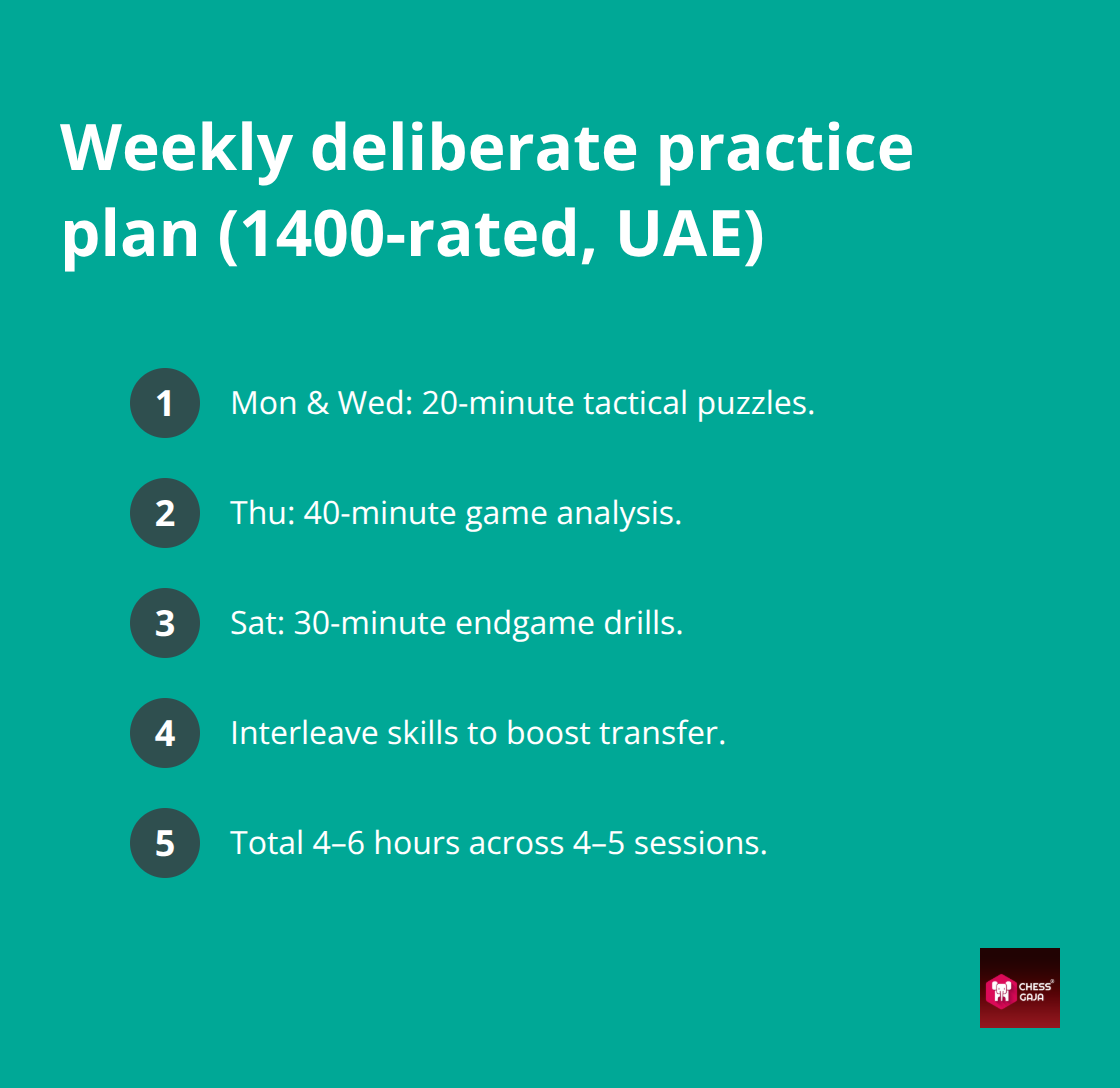
Structure every training session into mixed, bite-sized blocks rather than devoting whole days to one topic. Spend 15 minutes on calculation puzzles, 15 minutes on an endgame drill, and 15 minutes reviewing a past game.
Research on interleaving proves that alternating skills within a single 45-minute session builds stronger pattern retention than practicing one subject in isolation.
Aim for 4 to 6 hours weekly, split across four or five sessions. If time is tight, cut sessions shorter rather than abandoning the structure entirely. Thirty minutes of focused work beats two hours of unfocused play every time.
Track the Three Numbers That Actually Matter
Stop counting total games played. Instead, track three concrete metrics:
- Puzzle consistency at your target difficulty level.
- Number of critical positions analyzed deeply per week.
- Rating change across a 12-week cycle.
If you reach consistent success on 1450-rated puzzles, set a goal to master them comfortably within 4 weeks before moving up. Record this in a simple spreadsheet.
For game analysis, target 3 to 4 critical positions per week for deep evaluation. Spend 15 to 20 minutes per position calculating candidate variations manually before checking engine lines.
Track your online rating monthly to gauge steady progress. For active over-the-board players, official FIDE ratings will catch up during classical tournaments. If your rating stalls for 12 weeks despite consistent practice, adjust your training structure. Deliberate practice should yield 80 to 120 rating points over a year.
Use Tools That Show You What You’re Missing
An engine alone cannot teach you because it won’t show you why your thought process failed. Use Chess.com or Lichess puzzles tuned to a challenging yet manageable difficulty level, allowing automatic adjustments to guide you.
Complete manual analysis first before turning on an engine. If you made a blunder, pause and ask why that move seemed reasonable during the game. Identifying calculation errors or missed patterns builds true self-awareness.
For endgame study, use tools like Lichess Practice or Chess.com Endgame Trainers to test conversion against a computer opponent. Mastering five practical endgames (Rook and Pawn vs. Rook, King and Pawn endgames, and the concept of opposition) beats studying 20 endgames superficially.
Spend 30 minutes per week on a specific endgame theme, working through 3 to 4 interactive positions. Move to a new theme only after converting them flawlessly.
Final Thoughts
Deliberate chess practice provides a clear, repeatable path to consistent improvement. However, self-analysis has limits—a coach transforms this knowledge by identifying blind spots and recurring tactical mistakes across your games.
Our coaches at Chess Gaja hold FIDE ratings and have trained seven national champions across 40 countries, including the UAE, USA, and Singapore.
When you book a Paid Starter Class, a coach evaluates your play, identifies your weaknesses, and builds a personalized study plan. Start your structured journey today and turn scattered effort into real rating gains.