

You’ve watched a young player miss a winning position because they didn’t recognize the back rank threat. Or maybe you’ve been that player yourself, seeing the checkmate one move too late.
At Chess Gaja, we know that checkmate patterns practice transforms how you finish games. The difference between a strong player and a tournament winner comes down to pattern recognition. GM-level speed means spotting winning moves in seconds instead of minutes.
Three Patterns That Win Tournaments
Back Rank Mate: The Most Common Tournament Finish
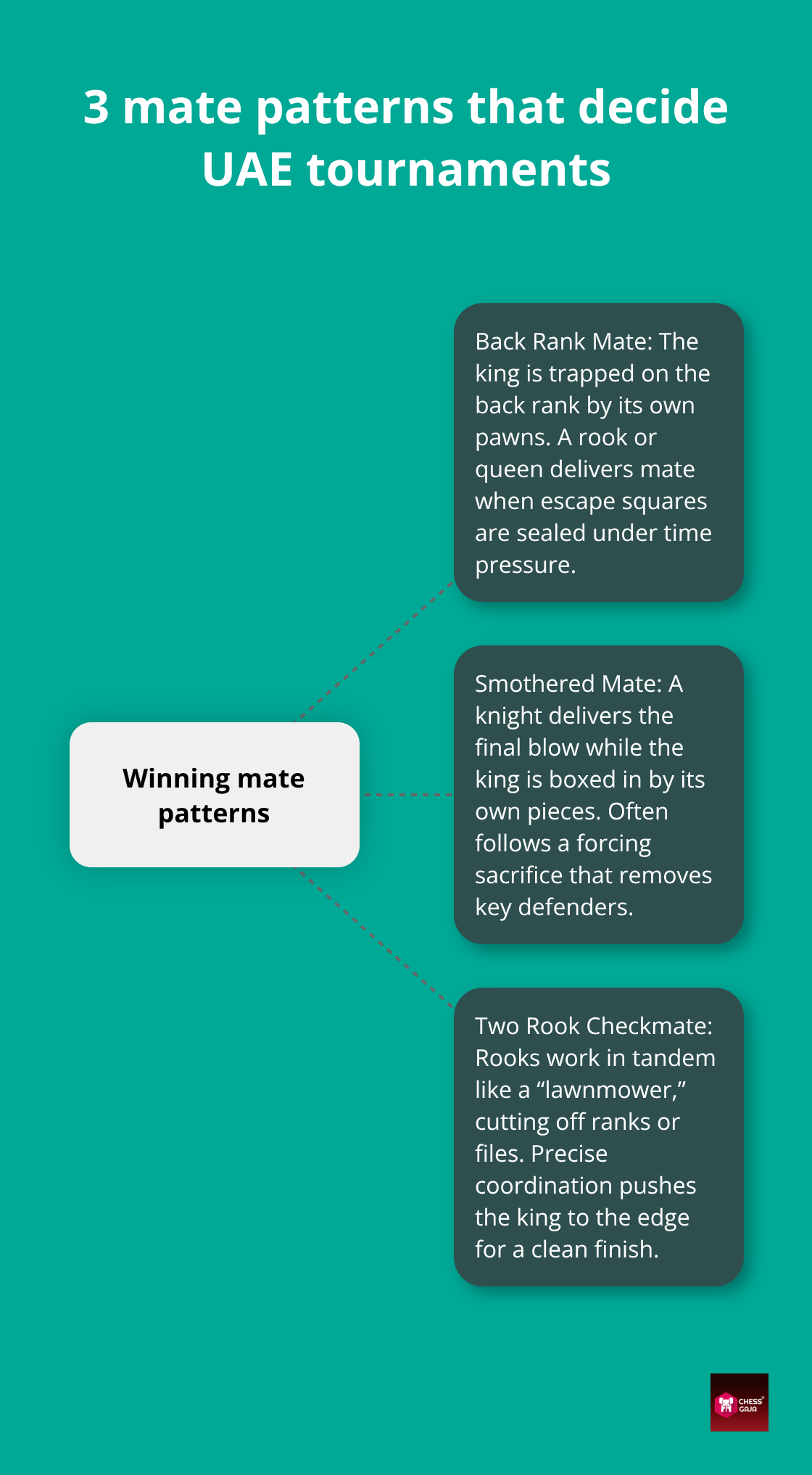
The back rank mate stops more players than any other pattern, especially in rapid and blitz games where time pressure clouds judgment. This pattern emerges when your opponent’s king sits on the back rank with pawns blocking escape squares. A single rook or queen delivers mate because the king has nowhere to run. In youth tournaments across the UAE and USA, this pattern repeats constantly. Players advance pieces aggressively but leave their king trapped.
The defense is straightforward: keep one escape square open for your king, typically by creating breathing room (luft) with an h-pawn or g-pawn move. When you attack, look for positions where your opponent’s king lacks breathing room. Spotting a back rank weakness allows a simple forcing move to deliver a fast checkmate. One variation catches players completely off guard. A quiet rook move threatens checkmate on the next turn. This forces a losing position because the threat cannot be stopped.
Smothered Mate: The Knight’s Hidden Strength
The smothered mate uses a knight to deliver the final blow while the king suffocates, boxed in by its own pieces. This pattern appears less frequently than back rank mate, but when it does, players miss it because they focus on queen and rook moves instead of the knight. A knight on f7 delivers the final blow against Black’s king on h8 (or a knight on f2 when attacking White’s king on h1). The opponent’s king remains trapped by its own surrounding pieces.
The key is forcing your opponent’s king into a corner, then positioning your queen or rook to support the knight’s final move. In tournament games, smothered mate typically follows a sacrifice that removes a defender or opens lines toward the king. The pattern rewards players who think beyond obvious moves. Minor pieces often finish what major pieces start.
Two Rook Checkmate: Converting Material Advantage
Two rook checkmate, sometimes called the lawnmower mate, requires both rooks working in tandem on adjacent ranks or files to trap and finish the opponent’s king. This fundamental mating technique appears when one player converts a decisive material advantage into an unassailable line-by-line attack. The technique involves moving rooks in lockstep. One rook cuts off escape while the other advances, driving the king to the edge.
A player with two rooks versus a lone king should deliver mate in fewer than 20 moves with proper technique. This pattern matters because rook endgames appear regularly in tournament play. A player who converts these positions efficiently gains rating points others leave behind. Mastering this mechanical finish separates players who win tournaments from those who merely reach winning positions.
Building Your Pattern Recognition Routine
Study Real Games Before Puzzles
Spotting a checkmate pattern in a real game requires deliberate practice with actual positions and the application of chess strategy techniques. Students who memorize back rank mate theory still miss it in tournament play because they trained on isolated puzzles, not on positions that resemble actual games. The solution is to anchor your pattern training in real games first, then use targeted puzzles to sharpen your eye.
Start by studying annotated games from strong players where your chosen pattern appears. Watch how patterns emerge naturally during the opening and middlegame. If you focus on back rank mate this week, analyze master games with back rank weaknesses occurring after 20 or 30 normal moves. Lichess offers free Practice and Study modules. You can search community studies by checkmate pattern and filter high-rated master examples. Spend 15 minutes analyzing each game without an engine first. Then, compare your findings with engine analysis. This trains your brain to recognize the warning signs: a king on the back rank, pawns blocking escape squares, and pieces that can deliver the final blow.
Solve Puzzles With Purpose and Restraint
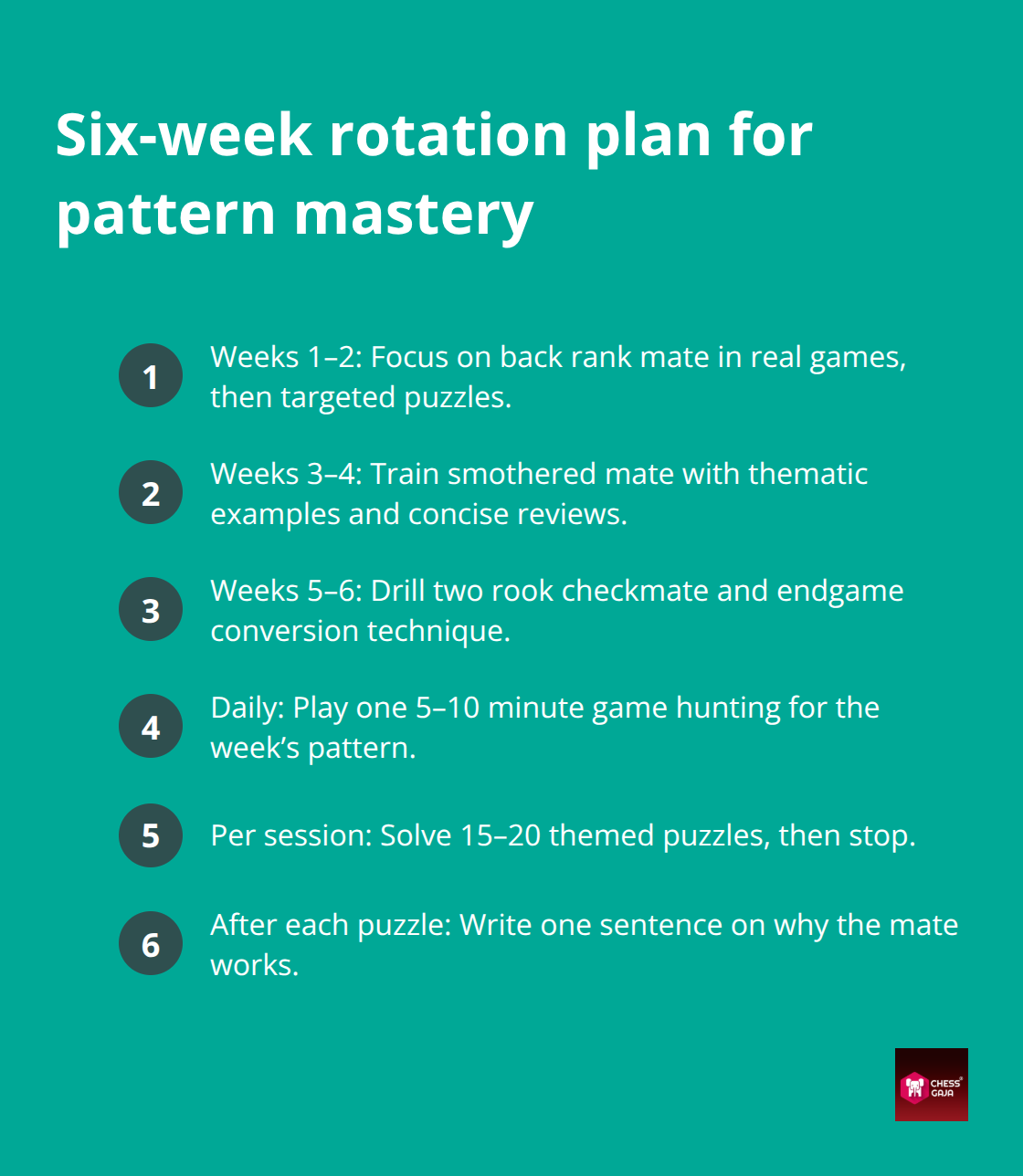
Once you’ve studied real games, move to puzzle training, but with a strict rule: solve 15 to 20 puzzles on your chosen pattern each session, then stop. Solving 50 puzzles in one sitting leads to mindless pattern-matching, not deep understanding. Use Lichess Puzzle Themes or Chess.com themed packs to isolate patterns. After each puzzle, write one sentence explaining why the mate works and what tactical feature enabled it. This forces your brain to articulate the principle rather than just click the winning move.
Test Your Recognition Under Tournament Pressure
After two weeks of this focused work, test yourself in blitz and rapid games by playing one 5-minute or 10-minute game per day where you specifically hunt for your pattern. Don’t play to win-play to spot the pattern and pause the game when you see it, even if the position is still complex. Blitz builds pattern recognition and helps identify weaknesses in your tactical vision.
Rotate between three patterns over a six-week cycle: back rank mate for two weeks, smothered mate for two weeks, two rook checkmate for two weeks. This rotation prevents boredom and builds a deeper library of finishing ideas.
Players who follow this professional training routine typically report faster recognition within four weeks and measurable rating improvement within eight weeks because they finish winning positions that others leave hanging.
The patterns you’ve learned now form the foundation of your finishing toolkit. But knowing these patterns means little if you cannot spot the defensive resources your opponent uses to resist them-and that’s where the next chapter takes you.
Where Pattern Training Goes Wrong
Memorization Collapses When Reality Shifts
Most players who plateau on checkmate patterns made one critical error: they memorized the winning move without understanding why that move wins. A student solves 50 back rank mate puzzles in one sitting. They click the correct rook move each time and assume they’ve mastered the pattern. Two weeks later, in a tournament game, they face a back rank position and freeze because the board looks slightly different from the puzzles.
The back rank is defended by a hidden knight, or a pawn sits on h6 creating an escape square on h7. Suddenly the pattern feels unfamiliar, and they miss the win. This happens because pattern memorization without principle creates brittle knowledge that shatters the moment reality shifts. The winning move in a back rank mate delivers a decisive check along the back rank, relying on the opponent’s own pawn structure to trap the king. If you understand that principle, you recognize the threat instantly whether you are attacking Black’s eighth rank as White or White’s first rank as Black, regardless of minor variations in piece placement.
Top students spend most of their practice on real positions and annotated master games. Rather than relying strictly on isolated puzzles, coaches recommend studying why a pattern emerges in context. This approach analyzes what conditions allow it to work and how the opponent should have defended. Making the shift from memorization to understanding takes longer upfront but compresses your learning timeline dramatically once the principle clicks.
Your Opponent Fights Back-Account for Defense
The second trap is practicing patterns as if they exist in a vacuum, disconnected from how your opponent fights back. A player trains on smothered mate setups, learning to execute the classic queen sacrifice that suffocates a castled king. In a real game, they jump their knight forward expecting a forced mate, but their opponent simply plays a defensive resource like h6 (creating an escape square on h7 for Black) or Rd8 (defending f7). The pattern collapses because the player relied on a static puzzle picture rather than calculating the opponent’s active defensive options.
Tournament players defend actively, and your pattern practice must account for this reality. When you study a master game featuring smothered mate, analyze not just the winning move but the mistakes the defender made and what they could have played instead. If your opponent had moved differently, would the pattern still work? This defensive perspective trains your brain to spot when a pattern is available and when it’s just a trap waiting to punish you.
After you solve a puzzle, spend 30 seconds asking yourself: how could my opponent have prevented this mate? What defensive move would have forced me to find a different plan? This single habit transforms puzzle solving from passive clicking into active strategic thinking. Players in the UAE and USA who add this defensive step catch opponent counterplay faster. They spot threats weeks ahead of players who skip defensive analysis.
Connect Patterns to Your Opening Choices
The third mistake is disconnecting pattern practice from opening and middlegame strategy. A player learns two rook checkmate but has no idea how to reach a position where they actually have two rooks against a lone king. They focus entirely on the endgame technique while ignoring how their opening and middlegame choices either create or prevent the conditions for that pattern to emerge.
A back rank mate requires the king to stay trapped behind its pawn shield. This weakness is rarely random. It stems from specific opening errors and middlegame slip-ups. Understand your opponent’s opening systems to predict tactical patterns. This lets you target the exact checkmates likely to occur. A player who frequently faces open king-pawn structures (like 1.e4 lines) should prioritize back-rank and open-file mates, while players facing closed queen-pawn systems (like 1.d4 lines) more frequently encounter smothered mates and knight forks in crowded positions.
Linking opening theory directly to pattern availability ensures your practice reflects actual game scenarios. Study your own tournament games and identify which patterns appeared most frequently. Allocate practice time based on your stats. If back rank mate appears in most of your wins while smothered mate occurs rarely, spend three weeks on back rank patterns and one week on smothered mate.
A data-driven approach to pattern selection cuts wasted practice time while accelerating overall improvement.
Align Your Training With Your Actual Games
Aligning pattern training with recurring tactical themes yields faster rating gains than practicing patterns at random. The reason is simple: you train what matters most in your specific tournament environment. A player in Singapore encounters different opening systems and middlegame structures than a competitor in the USA or UAE. Your pattern library should reflect your reality, not a generic checklist of every mate pattern ever discovered.
Final Thoughts
The checkmate strategies you’ve practiced over these weeks transform how you finish games. Through this training, students learn to recognize back rank weaknesses, spot smothered mate setups, and convert material advantage into clean finishes. Equally important, players connect these patterns to real games while mastering opponent defenses and aligning training with actual tournament positions.
Young players in Dubai who master back rank mate stop leaving rating points on the board in rapid tournaments. For students in Singapore, understanding smothered mate principles helps convert positions others miss entirely. Meanwhile, competitors in the USA who practice two rook checkmate finish endgames in 15 moves instead of 25, gaining time and confidence for the next round. Consistent practice over eight weeks transforms complex calculation into instant recognition.
At Chess Gaja, our FIDE-rated coaches are led by Grandmaster Priyadharshan Kannappan. We build personalized study plans connecting pattern training to your specific repertoire and tournament environment.
A Chess Gaja Paid Starter Class identifies patterns frequent in your games. This session reveals gaps in defensive understanding and builds a custom three-month roadmap. Reserve your spot today and start finishing games with confidence.