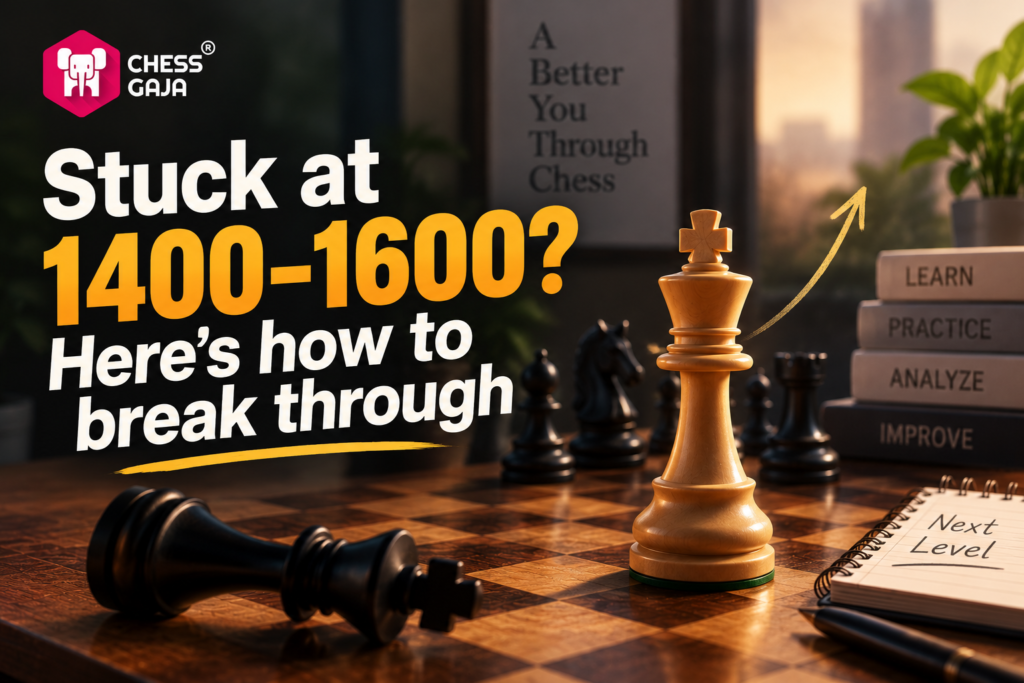
Adult learners often hit a wall around 1400–1600 rating because they lack a clear roadmap. Without structured guidance, improvement becomes random and frustrating.
At Chess Gaja, we’ve worked with thousands of adult players who discovered that the right system transforms stalled progress into steady growth. This blog shows you exactly how.
Why Adult Chess Players Plateau
Adult learners plateau because they confuse activity with progress. Playing hundreds of blitz games feels productive, but it builds poor habits faster than skill. Research shows that slow, deliberate play predicts rating growth more reliably than any other factor. Time controls with increments—like 15+10, 25+10, or 30+30—force you to think deeply, apply strategic principles, and recognize patterns without fear of flag-racing. Fast time controls reward impulse without giving you mental space to understand why moves work.
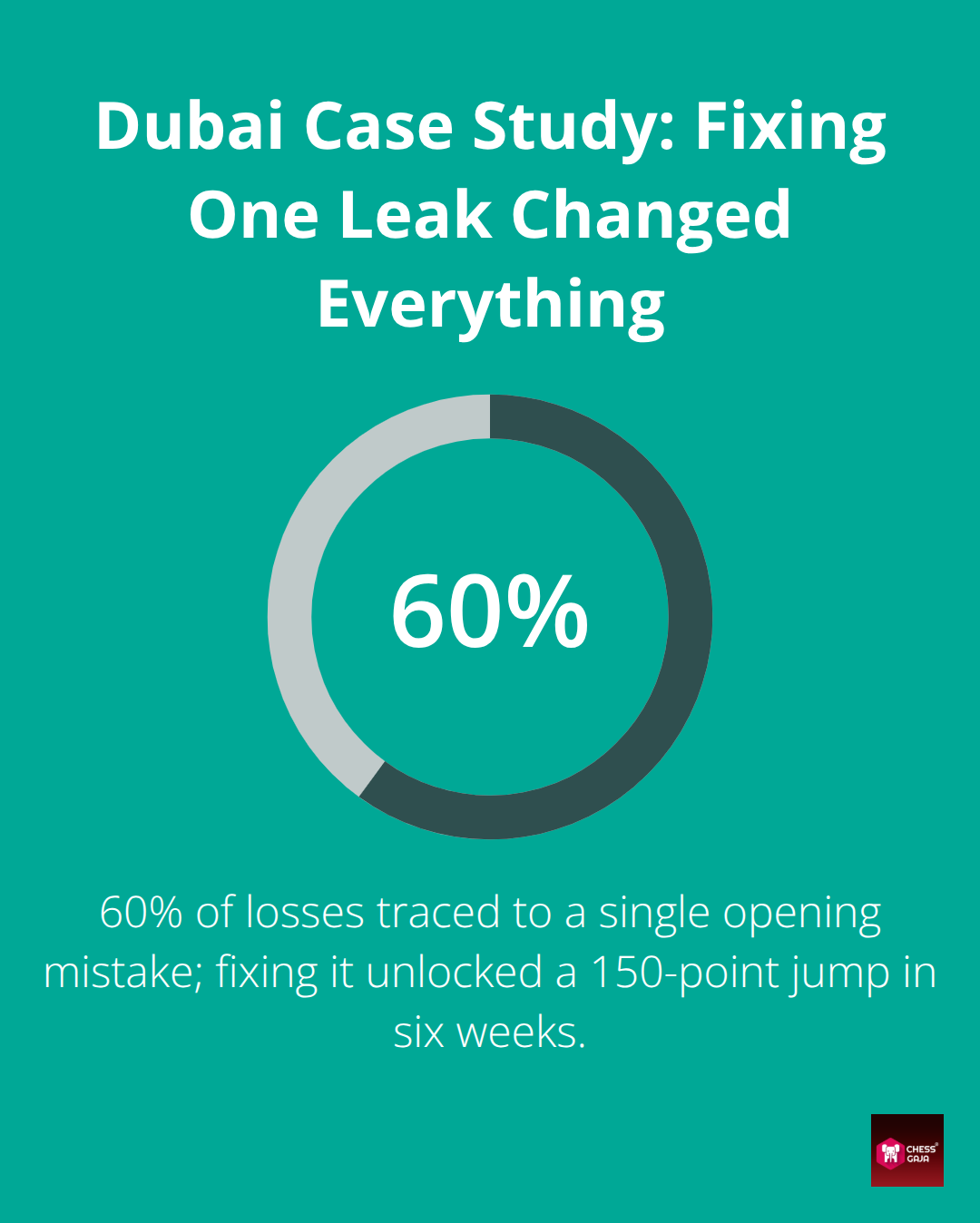
Most adults stuck between 1400 and 1600 log thousands of fast games but analyze fewer than fifty of their own losses. That ratio is backwards. The fastest improvers prioritize game analysis—especially losses—over play volume. An effective workflow is simple: analyze without an engine first, verify with an engine second, and fix the recurring mistake. One Dubai player realized through game review that most losses stemmed from poor piece coordination in a single opening. Resolving that single weakness laid the foundation for a 150-point rating jump.
Consistency Matters More Than Time
Most adults claim they lack time for chess improvement, but the real problem is inconsistency. A player who studies tactics for two hours on Sunday, then plays nothing for ten days, learns nothing. A player who spends fifteen focused minutes daily on tactical patterns, thirty minutes analyzing a game weekly, and plays two 25+10 games weekly will outpace the weekend warrior every single time.
Tactics training boosts adult ratings most effectively when it focuses on patterns and feedback rather than fatigue. Short, focused sessions outperform long grinding sessions, and interactive exercises reinforce motifs without burnout. The difference between improvers and those on a skill plateaus comes down to consistency. One Singapore adult committed to a simple routine: Monday tactics, Wednesday game review, and Saturday tournament play. After four months, his rating moved from 1480 to 1620.
Opening Study Without a Plan Wastes Months
Without a clear roadmap, adult learners study opening theory because it feels important, neglect endgames because they seem boring, and skip game analysis because they don’t know where to start. Opening theory without a plan is noise. Adults should favor simple, practical opening systems over memorizing deep theory-choose openings with clear plans and avoid heavy theoretical variation. Study model games rather than deep engine analysis to understand practical plans and principles. Endgames offer outsized improvement returns with a small, core set of knowledge. Core endgames to master include essential king-and-pawn concepts (opposition and key squares), fundamental rook theoretical positions (the Lucena and Philidor positions), and basic minor-piece checkmates. Most adults waste months on obscure positions they’ll never face instead of mastering the endgames that appear most frequently in their games.
Feedback Transforms Guesswork Into Progress
Without feedback, adults don’t know which mistakes matter most. Checklists help reduce common adult blunders by prompting questions about last-move changes, unprotected pieces, major threats, and king safety. A structured study plan tells you exactly what to work on each week, eliminates guesswork, and creates measurable progress. Adults who follow a personalized development plan improve three to four times faster than those who self-study without direction. The next step is building that plan-assessing where you stand, setting realistic goals, and creating a weekly schedule that actually fits your life.
How to Build a Development Plan That Actually Works
Assess Your Current Position
The gap between wanting to improve and having a concrete plan is where momentum dies. A personalized development plan removes guesswork and transforms vague ambitions into measurable progress. Start by auditing your current games. Your rating shows where you stand, but your playing style reveals your actual gaps. A 1500 player who loses to tactical blunders needs a completely different approach than one who throws away winning endgames.
Spend one week reviewing your last twenty games on Lichess or Chess.com. Note where losses happen: opening, middlegame, or endgames. Check whether errors stem from calculation, positional setup, or time pressure. This 90-minute audit saves months of wasted effort. One Abu Dhabi adult discovered the majority of his losses were decided by move twelve due to early tactical oversights. Basic opening principles were his true bottleneck, not complex endgame theory.
Set Specific Rating Goals with Timelines
Rating goals must have timelines attached, or they remain wishes rather than targets. An adult aiming to reach 1800 without a deadline will study sporadically and plateau within months. Instead, set a specific target: reach 1650 within six months, then 1750 within twelve months. This breaks improvement into manageable phases. For adults playing slow classical chess with consistent practice, gaining 100–150 rating points annually is a solid, achievable trajectory up to the 1800 level. Adults who play blitz exclusively rarely see classical improvement because fast time controls prioritize rapid pattern-matching over deep, systematic calculation.
Design a Weekly Schedule You Will Actually Follow
Your weekly schedule determines whether you improve or stagnate. A sustainable routine for most adults looks like this: fifteen minutes of tactical patterns three times weekly, thirty minutes of game analysis once weekly, and two classical games at 25+10 or slower per week. This totals roughly 10–12 hours monthly (around 2.5 to 3 hours weekly) and generates measurable progress. Adults with less time should compress rather than abandon: ten minutes of tactics daily beats two-hour weekend grinding sessions. The schedule matters less than the consistency. One adult in Singapore committed to exactly this routine for sixteen weeks and improved from 1480 to 1640. An adult in Dubai following an identical schedule moved from 1520 to 1710 in twenty weeks. The variable was not talent or starting rating-it was adherence to the structure.
Build Plans Around What You Will Actually Do
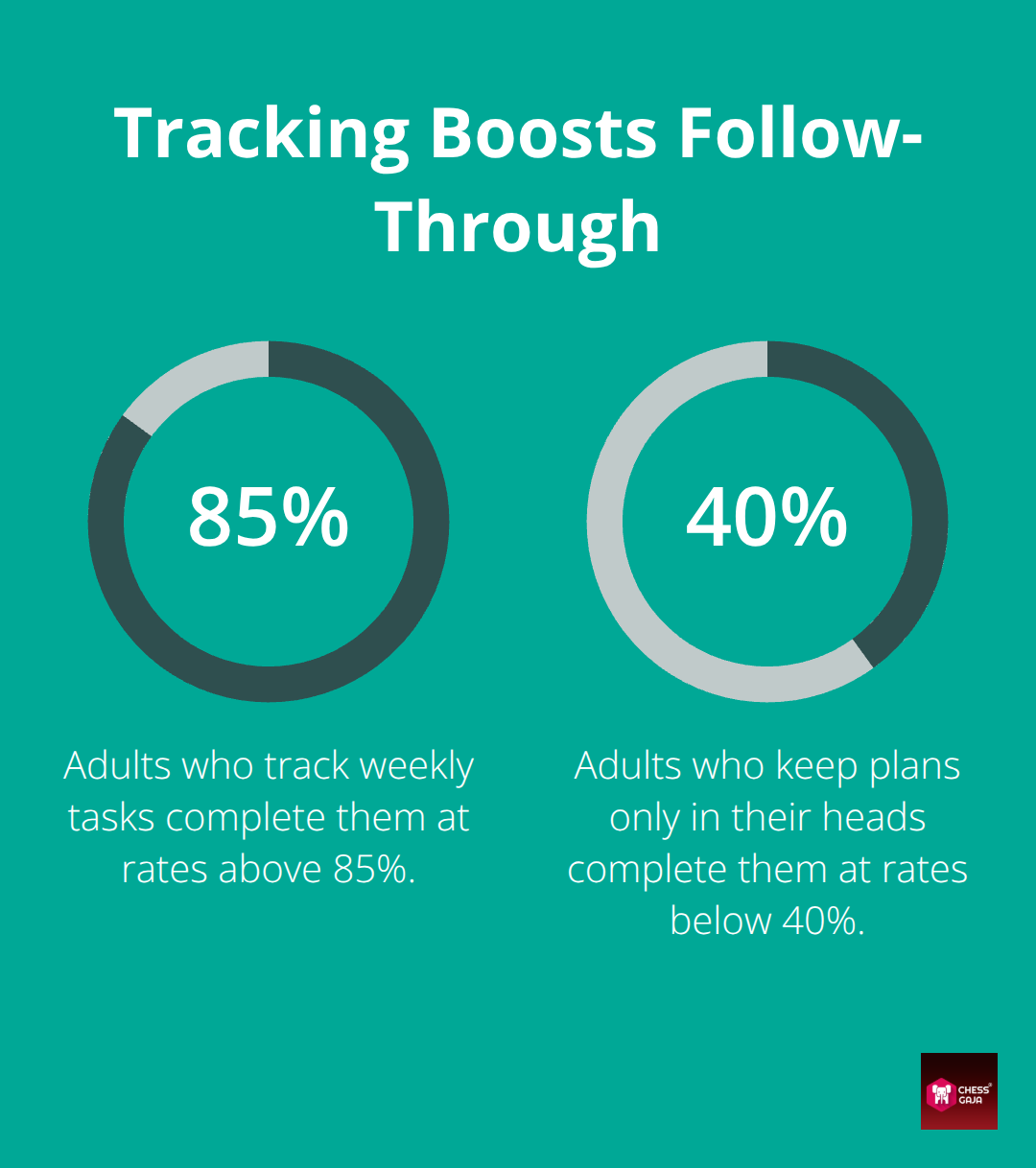
Many adults abandon plans because they set unrealistic daily commitments. A plan requiring ninety minutes daily fails the moment work gets busy. A plan requiring thirty focused minutes per day survives travel, illness, and life. Build your plan around what you will actually do, not what you wish you could do. Write your weekly schedule into a Google Sheet or calendar. Schedule specific tasks on specific days: Monday tactics, Wednesday game review, Friday and Sunday classical games. Treat these commitments like work meetings. Adults who track their weekly tasks finish them at vastly higher rates than those who rely solely on memory. Keeping plans in your head almost always leads to missed study sessions.
The structure you create now determines whether you reach your rating target or stagnate. Once you have your plan in place, the next step is learning which specific openings, endgames, and tactical patterns will move your rating fastest.
Reaching Competitive Play: The Three Foundations That Matter
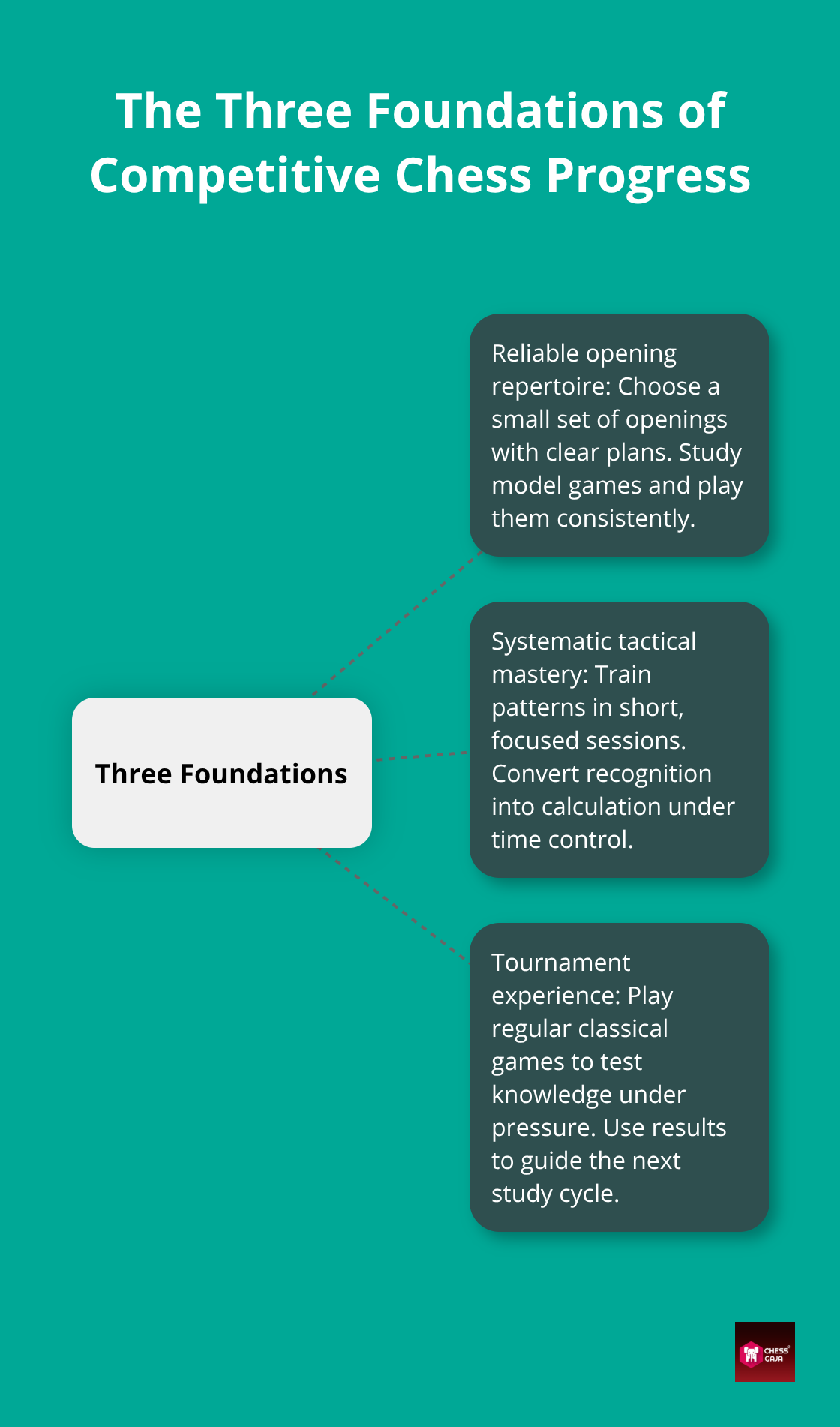
The jump from 1600 to 1800 rating requires abandoning the scattered approach that got you this far. Adults who stall at this level typically blame time constraints when the real problem is they have not yet built the three foundations that separate casual players from competitive ones: a reliable opening repertoire, systematic tactical mastery, and actual tournament experience. Each foundation demands specificity, not breadth.
Depth Beats Variety in Opening Repertoire
An adult in the UAE committed to two openings with clear plans, studied model games from titled players, and played ten classical games using only those systems. His rating jumped 120 points in eight weeks. The lesson is direct: depth beats variety at every rating level. Most adults waste months memorizing theoretical variations they will never reach in real games. Instead, you need openings that yield comfortable, transparent middlegame pawn structures, endgames that stem naturally from those structures, and clear strategic plans you can execute under tournament pressure.
Favor opening repertoires built around clear pawn structures and predictable piece placement. Avoid complex, line-heavy move memorization.
Studying model games played by titled players will teach you typical plans and piece placement far better than memorizing 20-move engine lines. This approach transforms opening study from a theoretical exercise into a practical weapon you can deploy in real competition.
Tournament Play Accelerates Progress Faster Than Solo Study
Tournament play accelerates adult improvement faster than any amount of solo study because it forces calculation, exposes weak spots, and creates emotional investment in results. Adults who play two long-rapid or classical games weekly (25+10 or slower) alongside structured study improve three to four times faster than those who only analyze without playing.
A Singapore player reached 1640 in sixteen weeks by playing two structured tournament games weekly. Similarly, an Abu Dhabi student hit 1710 in twenty weeks while playing three classical games per week. This pattern remains consistent: classical tournament play combined with deliberate game analysis drives measurable progress.
When you play structured, rated matches through platforms like Lichess or compete in local over-the-board tournaments, you face opponents who exploit every gap in your knowledge. This exposure is invaluable. You discover whether your opening plans actually work, whether your tactical training translates under pressure, and whether your endgame knowledge holds up when points matter. Most importantly, you learn to manage time and emotions in ways that solo puzzle training cannot teach.
Building Your Tactical Foundation Under Pressure
Tactical patterns that work in a quiet study session often collapse under tournament conditions. Your nervous system responds differently when a real opponent sits across from you (or waits on the other side of a screen). Adults who train tactics in isolation without tournament play often find their calculation fails precisely when it matters most.
Short, focused tactics sessions of about fifteen minutes reinforce essential tactical motifs without burnout. Interactive pattern-training exercises build recognition speed. Applying these principles in tournament play connects study to performance. You instinctively spot tactical red flags and calculate candidate moves accurately. This cycle—study, play, analyze, repeat—transforms calculation from guessing into structured intuition.
The Infrastructure That Transforms 1600 Players Into 1800 Competitors
The combination of two reliable openings, a focused endgame toolkit, systematic tactical training, and regular tournament play creates the infrastructure that transforms 1600-rated players into 1800-rated competitors. Each element supports the others. Your opening study shapes familiar middlegame pawn structures, while systematic tactical training sharpens calculation discipline across all phases. Regular tournament play tests everything and reveals what needs work. Post-game analysis then identifies the specific weaknesses to address in your next study cycle.
Adults who assemble these three foundations (opening depth, tactical mastery, tournament experience) stop stalling and start climbing. The adults in the UAE, Singapore, and Abu Dhabi who reached 1700+ ratings all followed this pattern. They did not study harder than their peers who remained stuck at 1600. They studied smarter and played more strategically.
Final Thoughts
The adults in Dubai, Abu Dhabi, and Singapore who broke through to 1700+ ratings did not achieve this alone. They combined personal discipline with professional guidance, and this combination accelerates adult learners chess growth far beyond what solo study produces. A structured plan works, but a plan reviewed and adjusted by someone who has trained national champions works faster and removes months of trial and error.
GM-led coaching identifies the exact gaps holding you back. A coach reviews your games, spots invisible patterns, and tells you which openings, endgames, and tactical themes will raise your rating fastest.
At Chess Gaja, our FIDE-rated coaches have trained seven national champions and taught 5,000+ students across 40+ countries. When an expert analyzes your play, personalized guidance eliminates the paralysis that stops most adults from improving.
Tracking progress through consistent measurement keeps you accountable and reveals whether your tactical training translates into rating gains. Monthly reviews show whether your opening study works and whether your tournament play improves, and when progress stalls, your coach adjusts the plan immediately rather than letting you waste weeks on ineffective study. Chess Gaja combines personalized study plans, Grandmaster-curated feedback, and monthly progress reviews from coaches who understand competitive chess at the highest level. Book a Paid Starter Class today for a professional skill evaluation and a personalized roadmap to your next rating milestone.