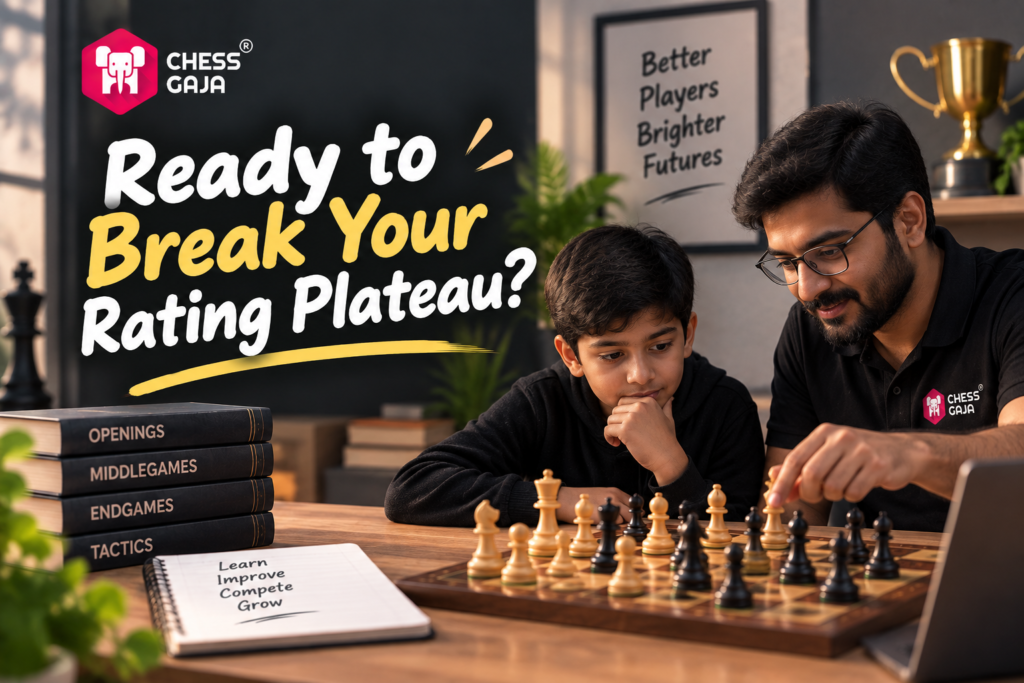
You’ve been grinding chess for months, maybe years. Your rating climbs a bit, then stalls. You’re not sure what’s holding you back.
The difference between players who break through and those who plateau isn’t talent-it’s structure. Structured coach-led development gives you personalized feedback, clear direction, and accountability that self-study simply can’t match. At Chess Gaja, we’ve seen this approach transform hundreds of young players across the USA, UAE, and Singapore into competitive athletes with consistent rating growth.
Why Young Players Stop Improving
The plateau happens faster than most parents realize. Whether a student stalls at 1200 due to tactical oversights or hits a wall at 1600 due to complex middlegame planning, the climb suddenly stops. They solve puzzles daily, watch YouTube videos, and play online games, but their rating flatlines for months. The problem isn’t effort. The problem is that self-directed study lacks targeted diagnosis.
Personalized Feedback Transforms Practice
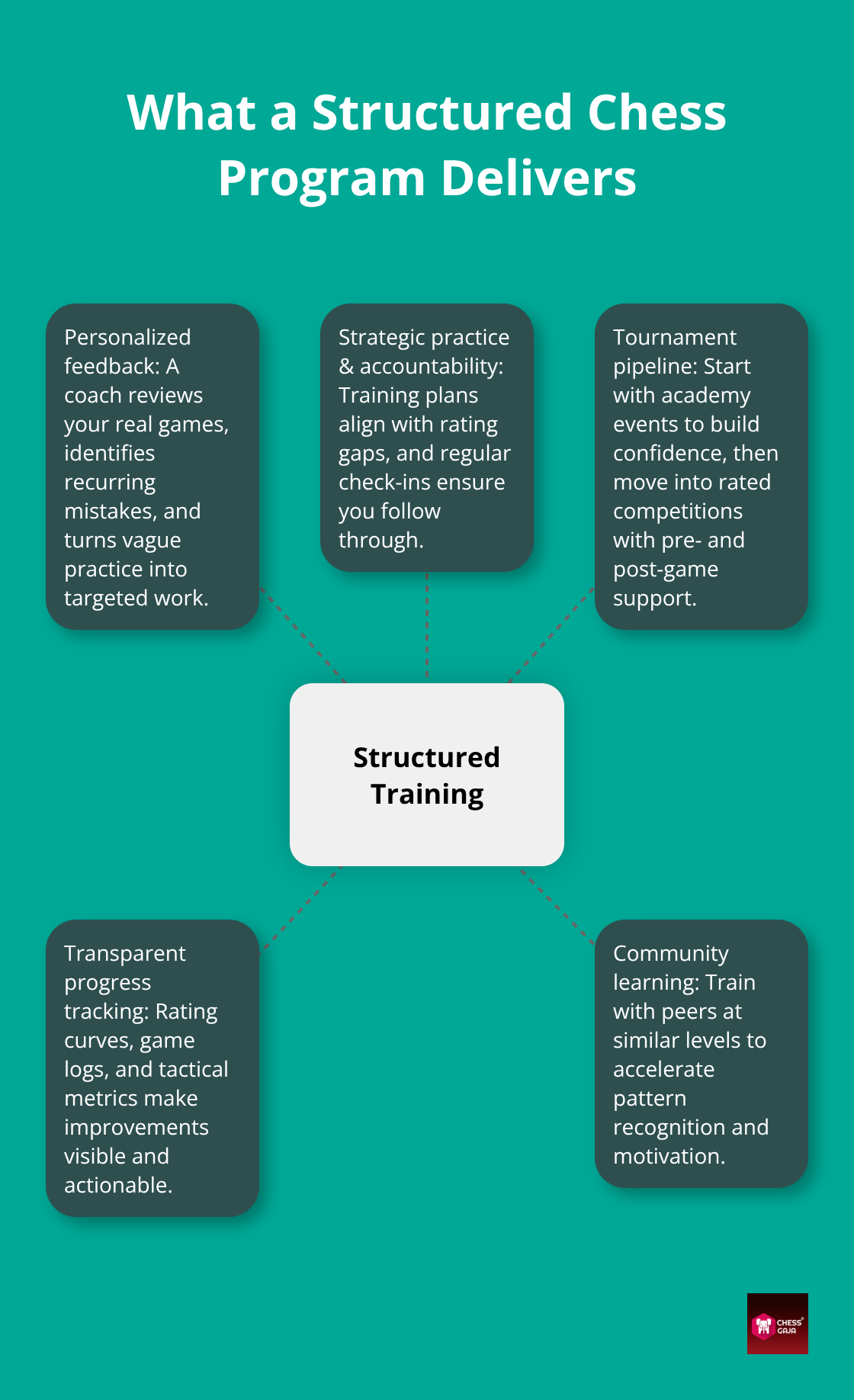
Without personalized feedback, students repeat the same mistakes. A player might struggle with weak square creation in the middlegame or consistently mismanage time in competitive formats, but without someone analyzing their actual games, they never identify the pattern. They practice, but they practice wrong. A coach watches your games and pinpoints exactly where you leak rating points—whether it’s a structural opening flaw, tactical oversight in complex positions, or endgame conversion failures. That specificity transforms practice from general grinding into targeted work.
Strategic Practice Beats Random Volume
Many young players confuse activity with progress. They solve 50 random puzzles a day without understanding the underlying strategic patterns, or they spend weeks memorizing deep opening lines instead of mastering basic endgame techniques. They play 20 rapid or blitz games weekly but never analyze a single loss. Structure changes this.
A structured program aligns puzzle training with your tactical gaps, integrates opening systems with corresponding middlegame plans, schedules tournament play at key preparation milestones, and most importantly, creates accountability. When you know a coach reviews your games and tracks your progress monthly, you practice differently.
Taking notes and reflecting on games becomes natural, allowing you to seamlessly apply lessons from one session to the next. Structured learners also benefit from transparent progress tracking—such as rating curves, game analysis logs, and tactical improvement metrics—making it clear what works and what requires adjustment.
Tournament Experience Requires Its Own Training
Here’s what self-study misses entirely: tournament experience is its own skill. Playing a casual online game teaches nothing about handling classical time controls, managing nerves in a room full of competitors, or recovering mentally after a loss when you still have rounds to play. Many young players in the USA, UAE, and Singapore have access to tournaments but no framework for preparing for them or learning from them. A structured coach-led program builds this bridge. Students compete in academy tournaments first-lower-pressure environments where they test skills against peers-then progress to rated events with coaching support before and after. This creates a development pipeline rather than random tournament entries, and the next section shows how this pipeline accelerates your rating growth.
How Structured Programs Accelerate Rating Growth
Personalized Curriculum Targets Your Specific Weaknesses
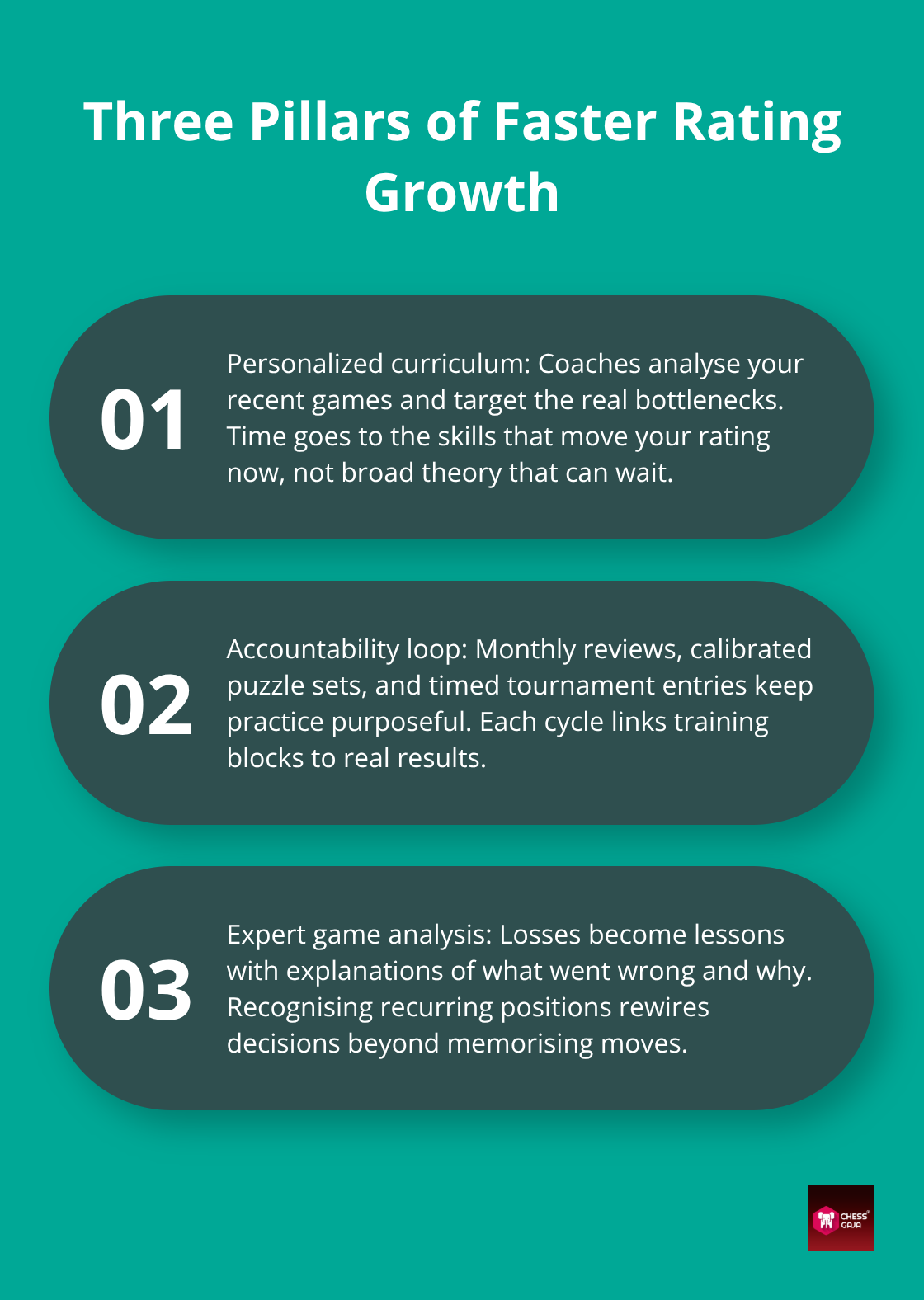
A coach builds your plan around real growth needs rather than impressive theory. First, we analyze recent games, identify loss patterns, and set tailored milestones. Unassisted players often spend weeks on deep opening lines when their true bottleneck is basic rook endgames. A coach spots this instantly and redirects focus where it counts.
Personalized training accelerates progress and replaces guesswork with tactical clarity. Difficulty scales with skill level. A 1400-rated player works on appropriate positions, gradually tackling complex ideas as pattern recognition sharpens. This prevents frustration from over-matched puzzles while avoiding wasted effort on overly basic drills.
Accountability Creates Consistent Progress
Accountability transforms everything. When a coach reviews your games monthly, tracks your tactical accuracy, and monitors your tournament results, you practice with purpose. Players without structure often solve 100 random puzzles and feel productive; players in structured programs solve 20 carefully selected puzzles aligned to their specific tactical vulnerabilities and endgame gaps, then analyze how those patterns appeared in their last tournament game.
Students receive personalized study schedules with recommended books, tools, and puzzle sets calibrated to their rating and goals. Coaches also schedule tournament entries strategically after specific training blocks. For instance, after four weeks of targeted middlegame prep, a student tests those ideas in competition. Post-tournament analysis then adjusts the next training cycle, connecting every practice session directly to performance.
Expert Game Analysis Transforms Losses Into Learning
Expert game analysis is the final piece—your coach reviews your losses in detail, identifying critical decision errors, miscalculations, and missed positional cues. This transforms losses from frustrating setbacks into learning accelerators. Your coach also identifies recurring structural mistakes in your games and builds targeted training around them. When you understand the root cause of your errors, you refine your decision-making process rather than simply memorizing computer lines.
The next section shows how this structured approach extends beyond individual training into the competitive environment where real chess growth happens.
Building Momentum Through Community and Competition
Academy tournaments separate players who understand chess from those who merely study it. Far from random events where you simply hope for the best, structured competitions serve as deliberate milestones in your training cycle.
Monthly academy events offer students a low-pressure environment to test new skills before entering rated competitions. For example, a student who spends four weeks strengthening endgame conversions can apply those lessons against peers at similar ratings. That tournament becomes a real-world laboratory for managing time pressure and uncovering subtle gaps. Following the event, your coach analyzes every game to highlight key tactical wins and structural weaknesses, driving far faster growth than isolated puzzle training.
Structured learners benefit from tournament play at the ideal challenge level. Coaches guide progression carefully. We avoid events where opponents are overwhelming or too weak to offer valuable lessons.
Strategic event entry helps students outpace self-study players. It builds steady rating growth alongside competitive discipline. Over time, live tournament play develops mental toughness, clock management, and emotional recovery—skills no online puzzle solver can replicate.
Peer Learning Accelerates Pattern Recognition
Solo study limits you to your own board. In a structured community, you absorb insights from dozens of games at once. Interacting with peers near your rating creates natural competitive motivation.
Facing a peer who just trained in the Caro-Kann tests your response to 1.e4 under pressure. After a loss, active questioning reveals your oversight. Following a victory, explaining your thought process deepens understanding. This peer dialogue accelerates pattern recognition far faster than quiet individual study.
Monthly student spotlights highlight progress stories directly from your community. Rather than generic motivational posts, these feature specific case studies showing real rating jumps, tournament results, and the exact training methods used. Seeing a peer with a similar starting rating achieve a breakthrough proves that similar success is well within reach.
Shared community environments build accountability and natural consistency. Research on coaching effectiveness confirms that interactive settings increase student engagement. Players in academy groups attend sessions more regularly, practice with greater focus, and follow training plans far more closely than isolated learners.
Peer competition also prevents the self-deception that plagues solo study. If you practice alone, overconfidence is only corrected through painful tournament losses. Within an active academy community, honest feedback arrives early from peers who have already conquered those higher rating tiers.
Progress Recognition Sustains Long-Term Motivation
Rating growth is the ultimate metric, but it’s not the only one that matters for sustaining effort. Structured progress recognition programs track multiple dimensions of improvement that rating alone misses. Your coach monitors tactical accuracy metrics, endgame conversion rates, time management across formats, and game-to-game decision consistency. A student might not gain 50 rating points in a single month, but they might elevate their precision in key endgame structures or significantly reduce time-pressure blunders in classical games. These intermediate metrics matter because they demonstrate genuine skill progression even during rating plateaus.
Recognizing student spotlights publicly helps reinforce productive practice habits. Highlighting a student for exceptional puzzle accuracy or an academy tournament win keeps both players and parents motivated.
Weekly chronicles and custom puzzle sets maintain high drive through natural chess plateaus. Grinding for six weeks without rating movement can feel discouraging. However, seeing tactical accuracy climb and tournament experience grow keeps players firmly committed to long-term success.
Sustained effort over years, rather than months, is the core of real chess growth. Implementing structured progress recognition maintains that commitment even when your rating temporarily stalls. By transforming potential plateaus into periods of multidimensional development, students stay deeply engaged and continuously move forward.
Final Thoughts
Self-study players spend months grinding puzzles and watching videos, only to hit rating plateaus that feel impossible to break. Repeating mistakes happens naturally without game analysis, while unguided practice fails to prepare you for real tournaments. Lacking a clear pipeline makes competition sporadic and causes progress to stall.
Adopting coach-led training transforms this trajectory entirely. Personalized curricula target your actual weaknesses, monthly progress tracking keeps you focused, and strategic tournament entries ensure every training block leads to visible rating growth.
Students in structured programs build sustainable skill because practice connects directly to real results. Guided game analysis reveals hidden tactical blind spots, while academy events build confidence before official tournaments. Ultimately, the gap between players who break through and those who stagnate comes down to structure.
At Chess Gaja, I founded a structured development ecosystem serving thousands of students globally. Our FIDE-rated coaches design custom study plans, run monthly academy tournaments, and deliver game analysis that turns losses into learning. Book a Paid Starter Class with Chess Gaja for a professional skill evaluation to diagnose your current level, isolate key weaknesses, and build your personalized path forward.