


Rook and bishop tactics separate strong players from beginners. However, most players treat these pieces independently. As a result, they miss the devastating combinations that emerge when these pieces work together.
At Chess Gaja, Founder and Grandmaster Priyadharshan Kannappan has helped thousands of students unlock rapid rating growth. Therefore, this guide shows you step-by-step how to coordinate your pieces and dominate your next tournament game.
How Rooks and Bishops Create Unstoppable Attacks Together
The Power of Coordinated Piece Play
In the midgame, beginners often treat rooks and bishops separately. This is a big mistake.
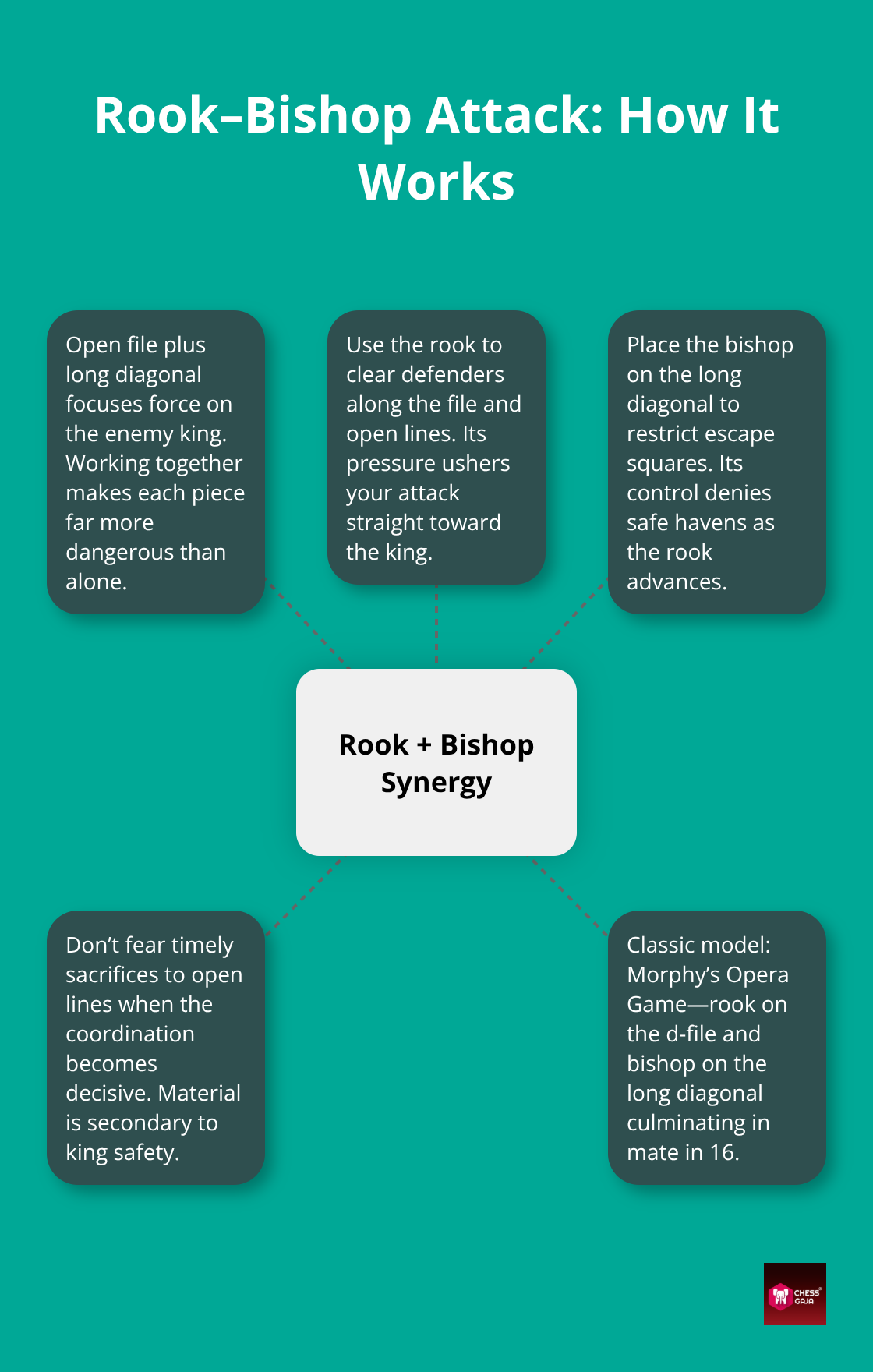
A rook on an open file combined with a bishop on a long diagonal forms a lethal attacking machine. Together, they are far more dangerous than either piece on its own.
Paul Morphy’s 1858 Opera Game shows this power clearly. Morphy sacrificed his queen to deflect a defending knight. Then, his rook delivered checkmate on the open d-file: 17.Rd8#.
The lesson is simple. Morphy’s pieces worked in harmony. They cleared defenders and cut off escape squares to deliver checkmate on move 17.
How This Pattern Repeats Across Strong Chess
This pattern repeats across centuries of grandmaster chess. Rooks invade open files while bishops control long diagonals. Soon, weak squares around the enemy king become fatal.
Look for positions where your rook advances down an open file while your bishop targets the enemy king. If your opponent weakens their kingside with early pawn moves, strike quickly. A rook on the e-file combined with a bishop on a long diagonal creates immediate winning threats.
Recognizing Coordinated Attacks in Your Games
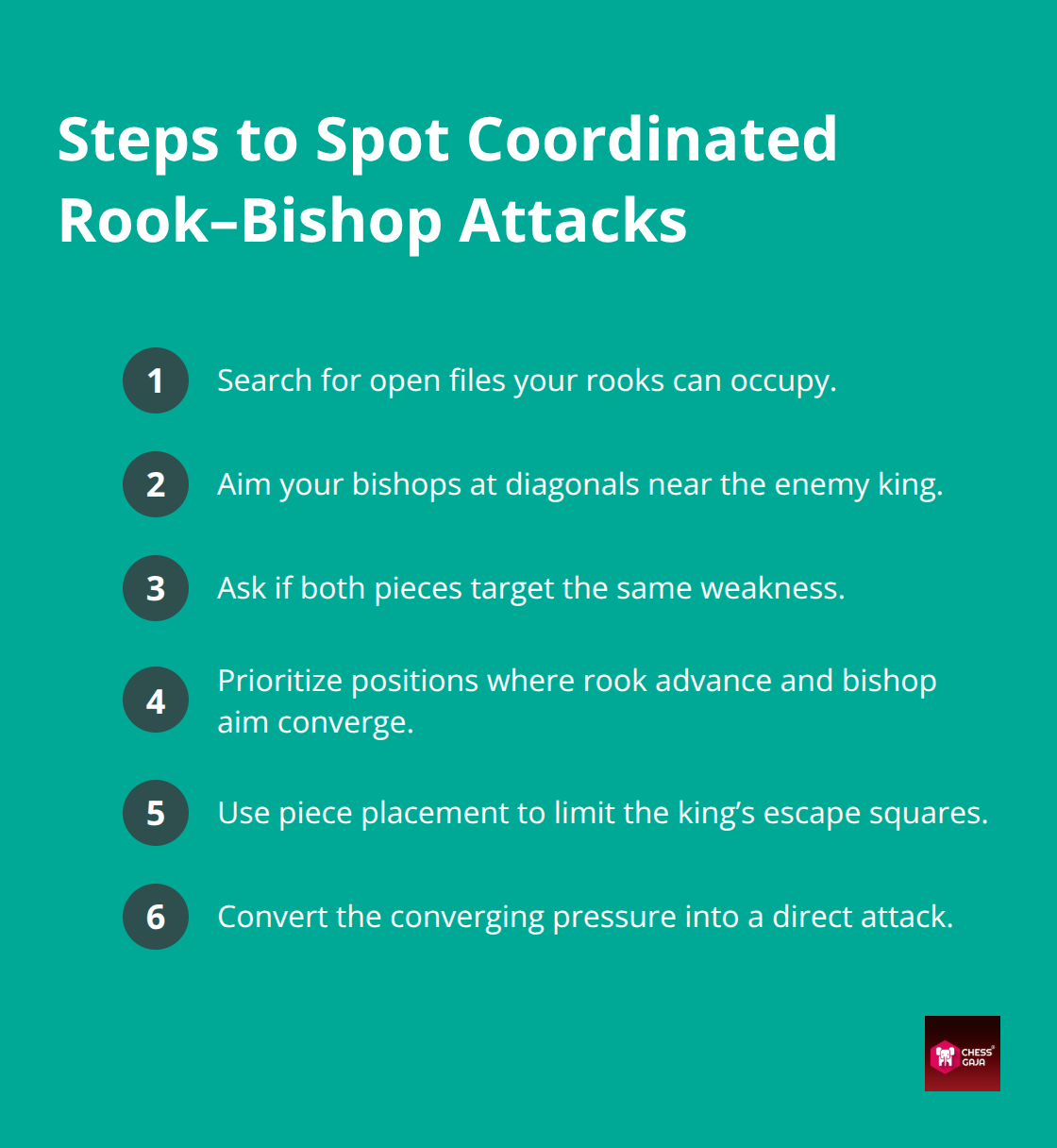
You must actively spot opportunities to create coordinated attacks. Avoid aimless moves.
Kasparov’s 1999 victory over Topalov is a prime example. His legendary rook sacrifice with 24.Rxd4!! opened critical files, while his bishop later delivered a decisive blow (36.Bf1!!) to lock down escape squares around the king.
In your midgame, ask two simple questions:
- Which files can your rooks occupy?
- Which diagonals can your bishops control?
If your rook reaches d5 and your bishop sits on c4, both pieces target f7. This combined pressure quickly turns a slight advantage into a winning attack.
Building the Habit of Piece Coordination
Pause before each move and check if your pieces work together.
In fact, the difference between a 1400 and an 1800 player comes down to this habit. Stronger players coordinate pieces toward common targets. In contrast, weaker players move pieces in isolation.
Therefore, in your next tournament game, focus on finding squares where your rook and bishop attack together. Consequently, that coordination creates winning tactical breakthroughs.
Endgame Patterns That Win Games
The Back Rank Mate and Bishop Defense
The back rank mate happens frequently in real tournament games. Bishops are often your only defense.
When your king sits on the back rank with limited escape squares, an enemy rook delivers mate. You must position your bishop early to cover back-rank entry squares or interpose along the back rank before the threat arrives.
In a 2024 Singapore tournament, a student lost a winning endgame by leaving their bishop passive. Moving the bishop to defend two moves earlier would have saved the game
Cutting Off the King With Rook and Bishop
Cutting off the king is a practical weapon you can deploy immediately.
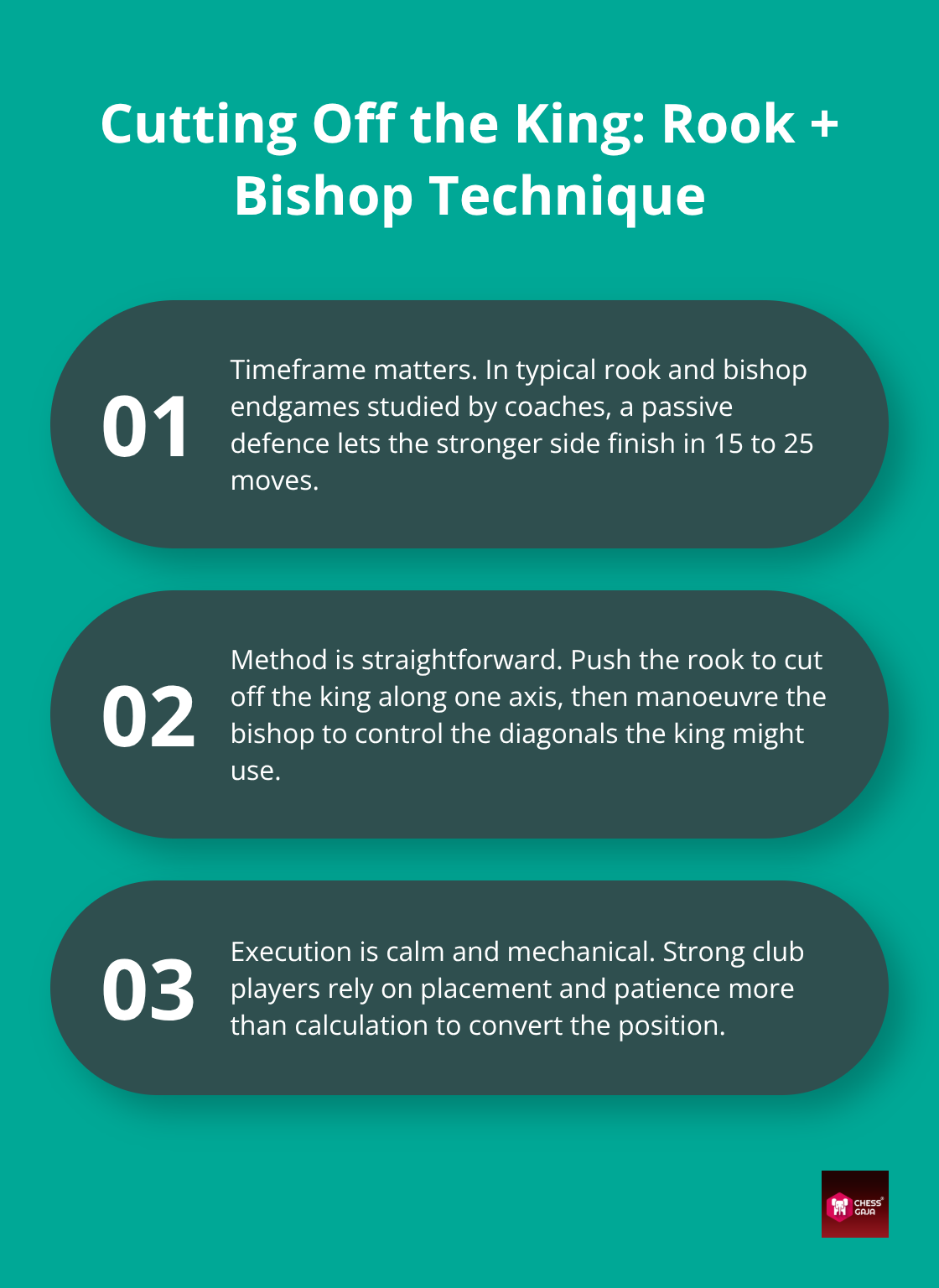
Place a rook on the fifth rank to stop forward progress. Then, place a bishop on a nearby diagonal to block sideways escape. This traps the enemy king in a shrinking box.
FIDE coaches note that this technique concludes games within 15 to 25 moves. Stronger players use this pattern instinctively because it relies on simple piece placement and patience.
Converting Advantage Into Checkmate
Trapping the enemy king makes conversion straightforward. Your rook advances step by step while your bishop seals off escape routes.
Most players fail here by playing impatiently and giving up counterplay.
The correct approach is advancing methodically. Check the king only when necessary and keep your bishop controlling key diagonals. Within a few moves checkmate is inevitable.
Building Pattern Recognition Through Practice
Strong players succeed because they have seen these setups hundreds of times. They recognize the patterns instantly.
Practice five to ten positions where you cut off the king and deliver mate. After three weeks of practice, these patterns become automatic.
The pattern never changes: your rook cuts off the king, your bishop controls the diagonals, and the enemy king runs out of moves.
Practical Tactics You Can Use in Your Games
Sacrificing Material to Expose the King
The goal of chess is checkmate, not counting material. A 1200-rated player hoards pieces. A 1800-rated player willingly trades material to expose the enemy king.
In tournaments across the USA, UAE, and Singapore, winning often requires a brave sacrifice.
Classic tactical history proves this concept: trading a pawn or piece to clear a line allows a rook to seize an open file while a bishop cuts off escape diagonals.
When your opponent’s king lacks defenders, check if a sacrifice opens lines for your rook and bishop to strike directly.
- Beginners count immediate piece loss and hesitate.
- Strong players calculate the setup. They see how a sacrifice lets the rook seize the file while the bishop controls key escape squares.
That forward-looking calculation is what creates tournament winners.
How Bishops Lock Down Escape Routes
After a sacrifice exposes the king, your bishop acts as a gatekeeper. For example, a bishop on c5 controls d6, e7, and f8 all at once along the a3–f8 diagonal.
The enemy king cannot flee toward the center. Your bishop doesn’t even need to capture anything. Its sheer presence on a key diagonal paralyzes the enemy position.
When you open lines, place your bishop on a diagonal controlling the most escape squares. For instance, if the enemy king is trapped on h8, a dark-squared bishop placed on f6 locks down the vital g7 escape square, while a light-squared bishop on c5 cuts off f8 across the board.
This forces your opponent into total defense. Within three to five moves, you will land checkmate or win major material.
Converting Advantage Into Checkmate
After opening lines, convert your advantage before your opponent finds counterplay. Patience matters more than aggression.
Advance your rook toward the king. Check only when it forces the king into the corner or removes a defender.
Never check too early. That lets the king escape to the center. Instead, improve your piece placement step by step until the king has no legal moves left.
Calm players win these endgames. Impatient players check randomly and lose their advantage. Practice these positions regularly to master these winning patterns.
Final Thoughts
The tactics in this guide appear in tournament games every week across the USA, UAE, and Singapore. For example, a student in Dubai won a scholastic tournament by applying these exact mating patterns. Likewise, another player in Singapore advanced to nationals after mastering piece coordination. Therefore, these outcomes reflect deliberate training, not luck.
At Chess Gaja, Grandmaster Priyadharshan Kannappan leads a team of FIDE-rated coaches serving 5,000+ students in 40+ countries. Instead of guessing through trial and error, our students study patterns systematically with grandmaster guidance. Consequently, they win more games in competition.
The next step is simple. Book a Paid Starter Class with Chess Gaja for a skill evaluation. A coach will assess your piece play and create a roadmap for your rating growth.