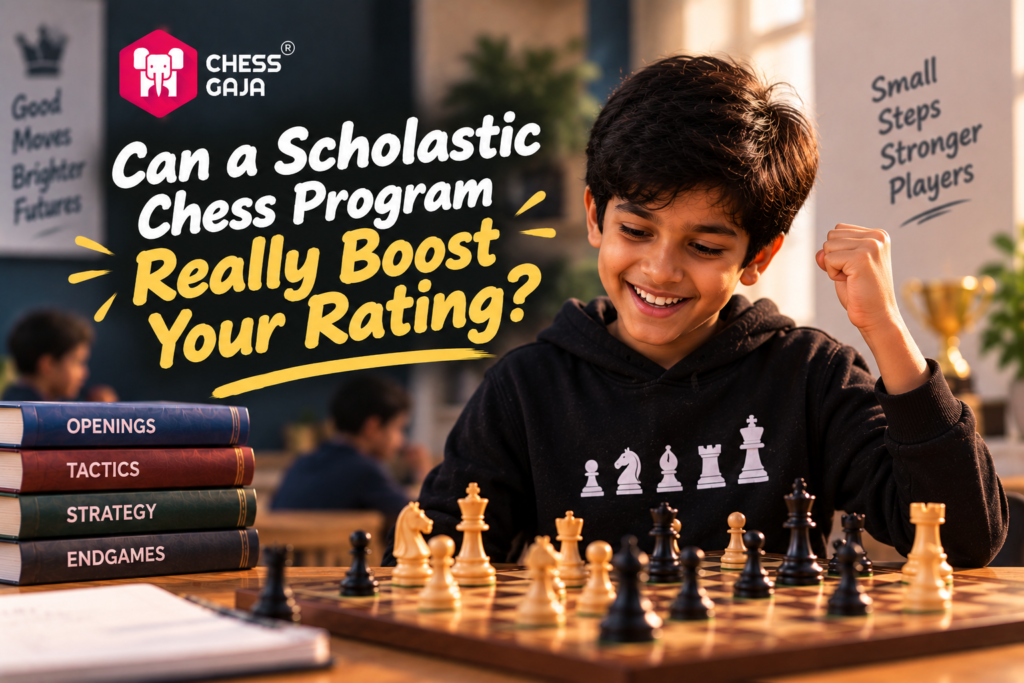
A student in Singapore just earned their first rating after joining a scholastic chess program. Within six months, they improved 200 points and qualified for nationals.
This isn’t luck. At Chess Gaja, we’ve seen structured scholastic chess programs transform young players across the USA, UAE, and Singapore by combining expert coaching, consistent practice, and tournament experience.
Why Structured Coaching Delivers Real Rating Gains
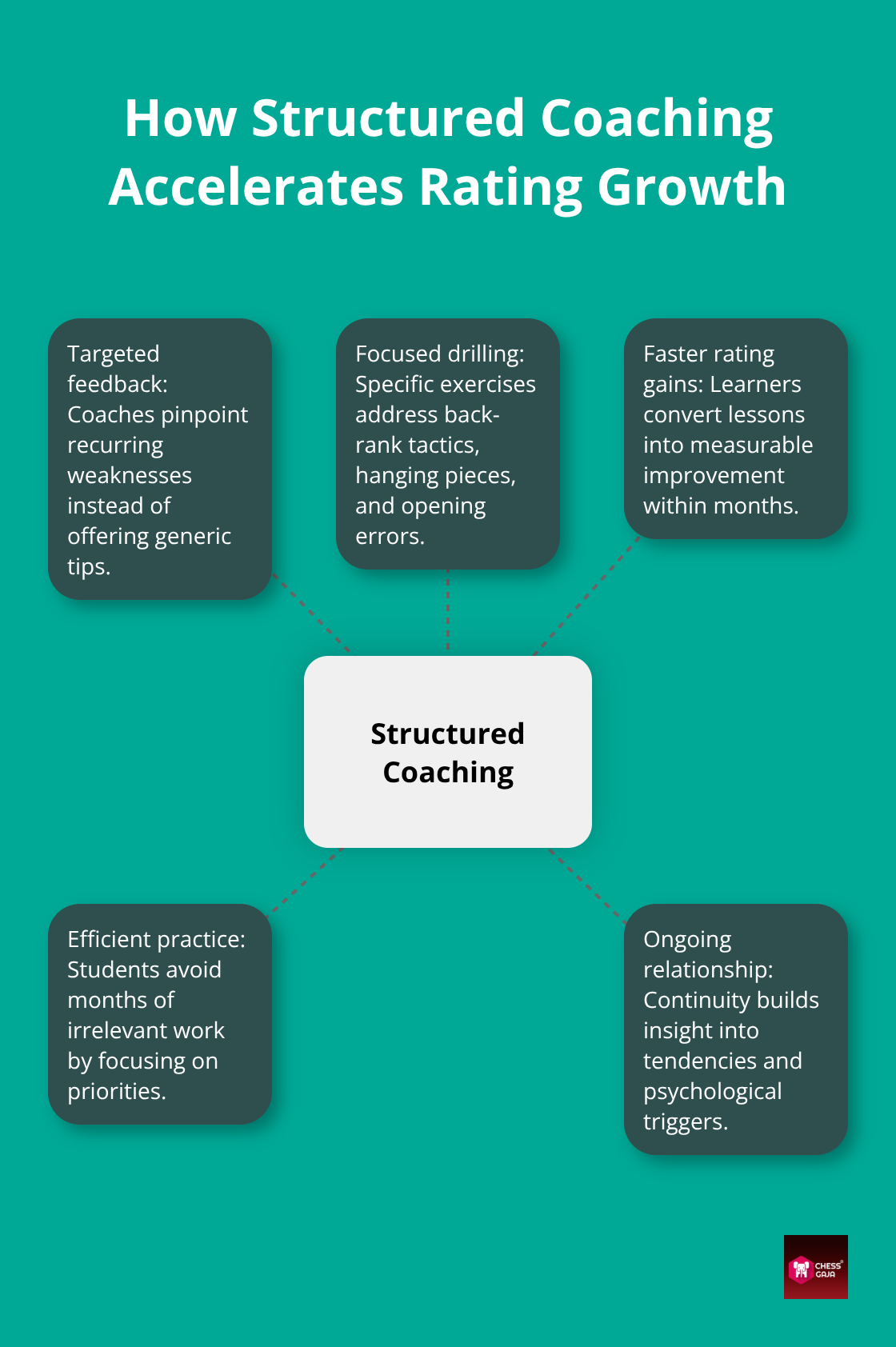
Guided coaching produces an average 120-point rating gain over six months, compared with roughly 45 points for self-taught learners. Regular tournament competition adds an additional 40 to 60 points on top of that baseline training progress. Students who commit to structured programs with continuous coaching relationships advance faster because they receive targeted feedback on their weaknesses, not generic instruction.
A coach identifies whether a student suffers from back-rank weaknesses, misses hanging pieces, or misplays opening structures—then designs specific drills to correct those tactical gaps. Self-taught players waste months on irrelevant practice.
Tournament experience accelerates this process further. When a young player competes against unfamiliar opponents with a clock, they face new positions. Consequently, they make mistakes under pressure. Through these losses, they learn genuine resilience. Students in scholastic programs with monthly tournaments show measurable confidence gains and tactical improvement within three to four months. This isn’t theoretical-tournament results provide objective feedback. A rating point doesn’t lie. If a student jumps from 950 to 1050 in four months, their pattern recognition, calculation speed, and decision-making under time pressure have genuinely improved.
Coaching Continuity Transforms Development Into Partnership
Many programs rotate coaches or assign students to whoever is available. Your coach in your first starter class should remain your coach throughout your journey. This continuity matters because your coach learns your tendencies, your weak squares, your opening preferences, and your psychological triggers. After six sessions, your coach knows whether you play too passively or too aggressively, whether you struggle with endgames or midgame tactics. A new coach would restart this learning curve.
Consistent coach-student relationships correlate with higher retention and faster skill development. Your coach becomes invested in your journey, not just your next lesson payment. They celebrate your tournament wins and analyze your losses with you. This relationship transforms coaching from transactional instruction into long-term development partnership.
Monthly Tournaments Build Skills Faster Than Practice Alone
Practice at home teaches positions. Tournaments teach decision-making under pressure. A student can solve 100 tactics puzzles and still blunder a piece in round three of a scholastic tournament because the emotional stakes are different. Monthly academy tournaments in a supportive environment let young players build competitive experience without overwhelming pressure. They play peers at similar ratings, see varied playing styles they haven’t encountered in training, and collect data on their performance.
Tournament results reveal whether improvements in training transfer to real games. A student might dominate puzzles but struggle with time management in tournaments-actionable feedback no puzzle app provides. Players who compete monthly across six months typically show 40-60 point rating gains beyond their training improvements because they’ve internalized pressure management and tactical execution under time constraints.
How Personalized Study Plans Accelerate Progress
A coach who knows your weaknesses designs a study plan tailored to your specific gaps. One student might need endgame drills; another needs opening preparation. This targeted approach (rather than generic curriculum) means every hour of practice counts. Your coach recommends specific chess books, software tools, and puzzle sets calibrated to your rating and goals. They track your progress through structured homework and game review between sessions. Learning doesn’t stop when the class ends—it continues through customized homework assignments and engine-verified game reviews curated by your coach to reinforce key tactical themes.
This combination of live coaching, tournament play, and structured practice between sessions creates the conditions for rapid improvement. The next section explores how to select a scholastic program that delivers these elements consistently.
What Makes a Scholastic Program Worth Your Time and Money
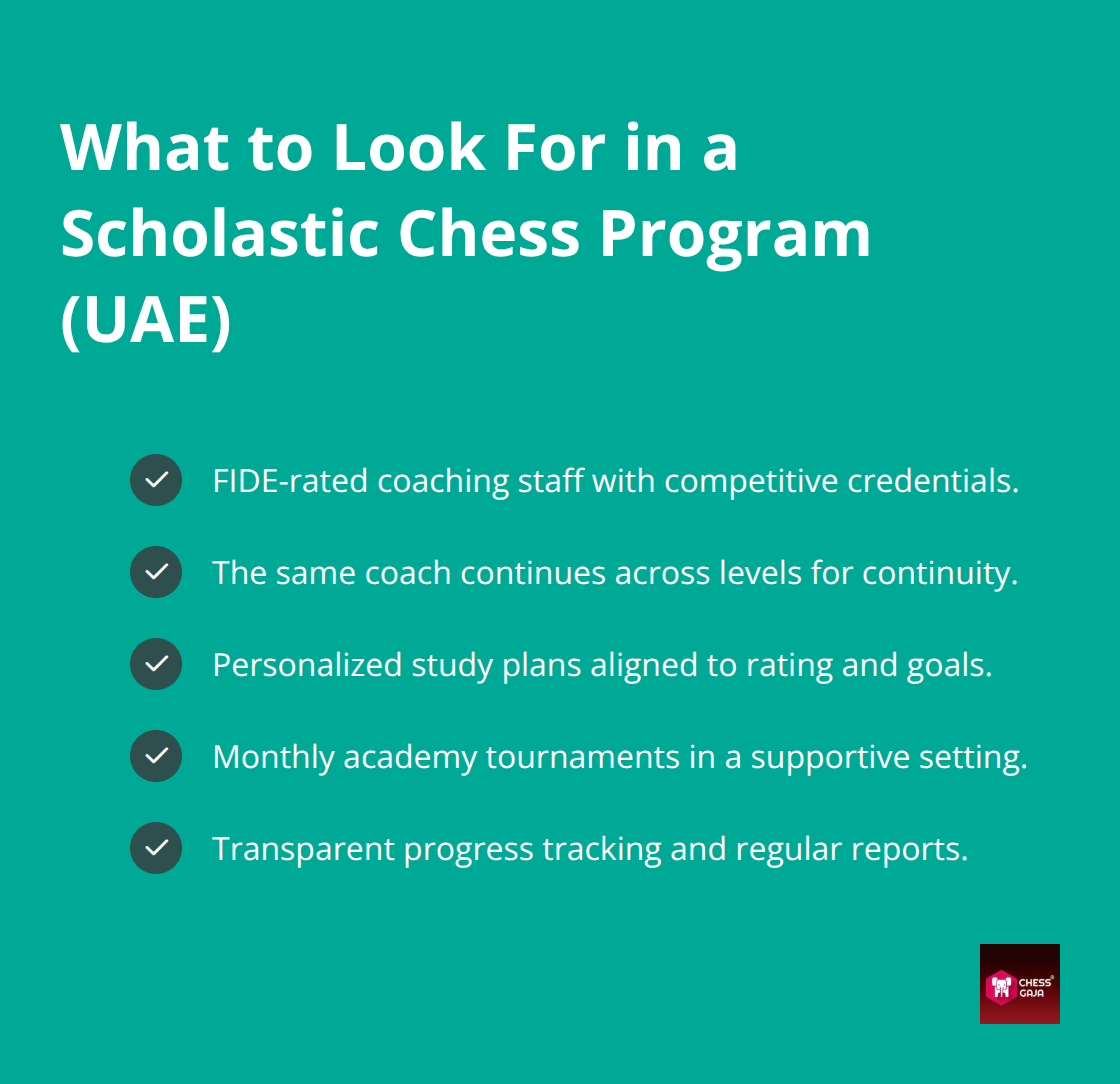
Selecting a scholastic chess program requires more than finding the cheapest option or the one with the best marketing. You need to identify a program with coaches who hold competitive credentials, a track record of developing players systematically, and a commitment to your child’s long-term progress rather than transaction-based instruction.
FIDE-Rated Coaches Deliver Credible Instruction
FIDE-rated coaches reflect actual competitive performance. A coach holding an official FIDE rating or title has demonstrated competitive mastery and tactical rigor that translates directly into teaching credibility. At Chess Gaja, we operate exclusively with FIDE-rated coaches—ensuring every student receives instruction grounded in grandmaster-level preparation and proven competitive standards. Credentials alone don’t guarantee results, which is why verifying that your student receives dedicated long-term guidance from the same FIDE-rated instructor ensures maximum progression.
Personalized Study Plans Separate Effective Programs From Generic Ones
Ask a program directly: Will my child receive a tailored study schedule based on their rating and weaknesses? Will they get recommended chess books, software, and puzzle sets specific to their level? Will progress get tracked and shared transparently? Your program should provide post-lesson summaries, homework assignments calibrated to your child’s gaps, and regular progress reports you can review. If a program offers generic lessons without personalized feedback or study plans, move on.
Building Early Competitive Experience In-House
Monthly academy tournaments within the program itself build competitive experience in a supportive environment before pushing your student into high-stakes external competitions. This staged tournament exposure develops confidence and decision-making skills systematically. Request specific data: How many students rated 1000+ does the program produce annually? What percentage of their students achieve an average 120-point rating gain within six months? Transparent programs will answer these questions. Programs that dodge them are hiding weak results.
The next section explores how to structure your child’s tournament calendar to accelerate skill development beyond the classroom.
How Tournament Play Reveals What Training Cannot
Real Opponents Expose Hidden Weaknesses
Within your first three academy tournaments, your child faces something no puzzle app can replicate: real opponents with unpredictable styles, time pressure that forces faster decisions, and the emotional weight of actual results. A student rated 900 who solves tactics puzzles with high accuracy often plays differently under a clock with a stranger across the board. For example, their calculation speed slows down significantly, leading them to second-guess sound tactical choices. Consequently, they make blunders under pressure that they would never make during practice sessions.
This gap between puzzle performance and tournament performance is where real improvement happens, because tournament play exposes weaknesses that isolated practice cannot identify.
Structured Monthly Tournaments Build Confidence Systematically
Academy tournaments start with low-pressure internal events where students play peers at similar ratings in a supportive environment before advancing to external scholastic competitions. Structured monthly tournaments build confidence systematically by giving players consistent exposure to real clock conditions, diverse playing styles, and low-stakes competition. After competing in two or three internal academy tournaments, a student is naturally equipped and eager to take on external events hosted by the United States Chess Federation or local regional associations. However, parents should choose their child’s first external tournament carefully. It is best to select beginner-friendly sections with standard time controls. This gives young players enough time to record algebraic notation without feeling rushed, ensuring their games can be analyzed post-event with their coach. Notation and clock pressure are introduced progressively, not all at once.
Tournament Data Proves What Training Alone Cannot
Students who compete in structured monthly tournaments show measurable rating gains beyond their training improvements within four to six months. Tournament results provide objective feedback that coaching alone cannot deliver: a rating point is absolute. When a player consistently gains ground over a few months of active competition, it proves that their calculation speed and decision-making under pressure have transferred from training puzzles into practical board vision. Students who play monthly tournaments and receive targeted coaching advance 40 to 60 rating points faster than non-competing peers. This happens because they internalize calculation speed and psychological resilience simultaneously.
Post-Tournament Analysis Transforms Results Into Skill
Your coach should review each tournament game with your student within one week, analyzing critical positions, missed tactics, and decision points under time pressure. This post-tournament analysis is where tournament experience transforms into concrete skill development. Without review, tournaments become just results. With structured analysis, they become accelerators.
Final Thoughts
Structured scholastic chess programs deliver what isolated practice cannot: measurable rating gains, genuine confidence, and a clear pathway to competitive play. For example, the data proves that students who commit to guided coaching with consistent relationships gain 120 rating points in six months. In contrast, self-taught learners gain roughly 45 points over the same period. Furthermore, adding monthly tournaments helps students internalize both tactical execution and psychological resilience. As a result, they advance 40 to 60 points faster than non-competing peers.
For instance, the Singapore student who improved 200 points in six months succeeded because their program combined three non-negotiable elements. First, they received continuous instruction from a dedicated FIDE-rated coach. Second, their training included study plans tailored to their specific weaknesses.
Finally, structured monthly tournaments exposed critical gaps that isolated practice could never reveal. Therefore, this combination creates the ideal conditions for rapid improvement. Ultimately, your child’s chess development depends less on their starting rating and more on the quality of the program surrounding them.
Your next step is clear. Book a Paid Starter Class with Chess Gaja for a professional skill evaluation. Because our coaches thoroughly assess your child’s current level, they can identify specific gaps and design a personalized development plan that transforms potential into results.