


Young chess players in Dubai often jump straight into complex openings before mastering the fundamentals. This approach leads to confusion during games and slows down your rating growth.
At Chess Gaja, we’ve coached thousands of beginners across 40+ countries, and we’ve seen firsthand how a focused opening repertoire transforms performance. This guide gives you the exact openings for beginners in Dubai that work, with practical steps to execute them confidently in your next tournament.
Why Dubai Players Need a Focused Opening Strategy
Junior players in Dubai who focus on 2–3 core openings improve 40–60 rating points faster than those memorizing dozens of systems.
Local UAE chess clubs host monthly tournaments where the same structures appear constantly. In fact, the Italian Game, London System, Caro-Kann Defense, and Queen’s Gambit Declined dominate most junior and club-level games. Focusing on these four openings stops mental fatigue and builds winning pattern recognition fast.
As a result, most junior players stagnate around 1200–1300. Specifically, this happens because they switch openings every few weeks instead of mastering one system.
The Real Cost of Jumping Between Openings
Switching openings constantly creates two major problems:
- Loss of Middlegame Plans: You forget key ideas over time. When returning to an opening after a long break, you play weaker
- Rote Memorization: You memorize moves rather than understanding positions. You collapse when opponents play unexpected moves.
One Abu Dhabi student we coached had studied eight Black defenses. Yet, he lost consistently due to unfamiliar move orders. After streamlining to just the Caro-Kann against 1.e4 and the Queen’s Gambit Declined against 1.d4, his rating jumped from 1180 to 1340 in four months. Focus made the difference.
What Consistent Practice Actually Looks Like
Dubai players reaching 1600+ ratings typically spend 6–12 weeks on their core four openings before expanding.
First, target playing 20–30 games with each White opening. Next, play 15–20 games with each Black defense. Afterwards, review each game to see where your plans succeeded. Focus strictly on the first 8–10 moves and their core strategic ideas.
Repeated play develops strong pattern recognition for transpositions and opponent responses. This skill separates strong club players from beginners. A simple 15-minute daily routine studying these openings and solving five puzzles yields measurable results within three weeks.
Building Your Foundation Before Tournament Play
Ultimately, your opening choices will shape your development for the next year.
For White, the Italian Game and London System work extremely well. In fact, both offer clear plans without deep theory.
Against 1.e4, the Caro-Kann Defense gives you a solid pawn structure with few complications. Against 1.d4, the Queen’s Gambit Declined offers safe piece setup and clear endgames. Together, these four openings cover most games you will face in local club events.

Once you master these core lines, you will have the confidence and pattern recognition to handle unexpected variations without panic. The next section shows you exactly which openings to study and how to execute them in your games.
Which White Openings Should You Play First
Two White openings dominate early tournament play in Dubai. They are the Italian Game and London System Neither demands deep theory. Both give clear plans by move 10.
The Italian Game (1.e4 e5 2.Nf3 Nc6 3.Bc4) attacks Black’s center. It also develops your pieces fast.
The London System (1.d4, 2.Bf4, 3.Nf3, 4.e3, 5.c3, 6.Bd3, and 7.Nbd2) forms a safe setup. Focus on simple development and central control.
Overall, both openings are staples in UAE junior chess events. Therefore, choose the Italian for dynamic piece play, or select the London for systematic, predictable setups.
Why the Italian Game Gives You Real Winning Chances
Choose the Italian Game to attack Black’s weaknesses immediately and create early winning chances.
After 1.e4 e5 2.Nf3 Nc6 3.Bc4, you target the weak f7-pawn while controlling central squares. Your plan is clear: develop minor pieces, castle kingside, and prepare pawn breaks like d4 or c3-d4.
If Black plays 3…Bc5, respond with 4.d3 (the Giuoco Pianissimo). Next, play c3, O-O, Nbd2, and h3 (preparing Bb3 if attacked). This forms a solid, flexible setup before expanding in the center.
Around moves 10–12, after completing your piece development, decide whether to break open the center with d4 or maintain a quiet positional game.
Why the London System Works Every Single Game
Choose the London System for a setup that works against any Black response and eliminates opening stress.
Play 1.d4, followed by 2.Bf4, 3.Nf3, 4.e3, 5.c3, 6.Bd3, and 7.Nbd2 against standard 1…d5 setups. Black cannot prevent you from reaching a comfortable position with active pieces and a clear plan.
Once established, break open the center with c4 or launch a kingside push with f4 depending on Black’s piece placement. One Abu Dhabi player won 13 of 18 consecutive games after switching to the London System simply because he focused on position plans over complex theory.
How to Execute Your Chosen Opening in Real Games
Commit to one opening for at least 20 games before switching.
Write the first 8–10 moves on a study card and review it for two minutes before each game. Focus on the core purpose behind each move rather than playing blindly on autopilot.
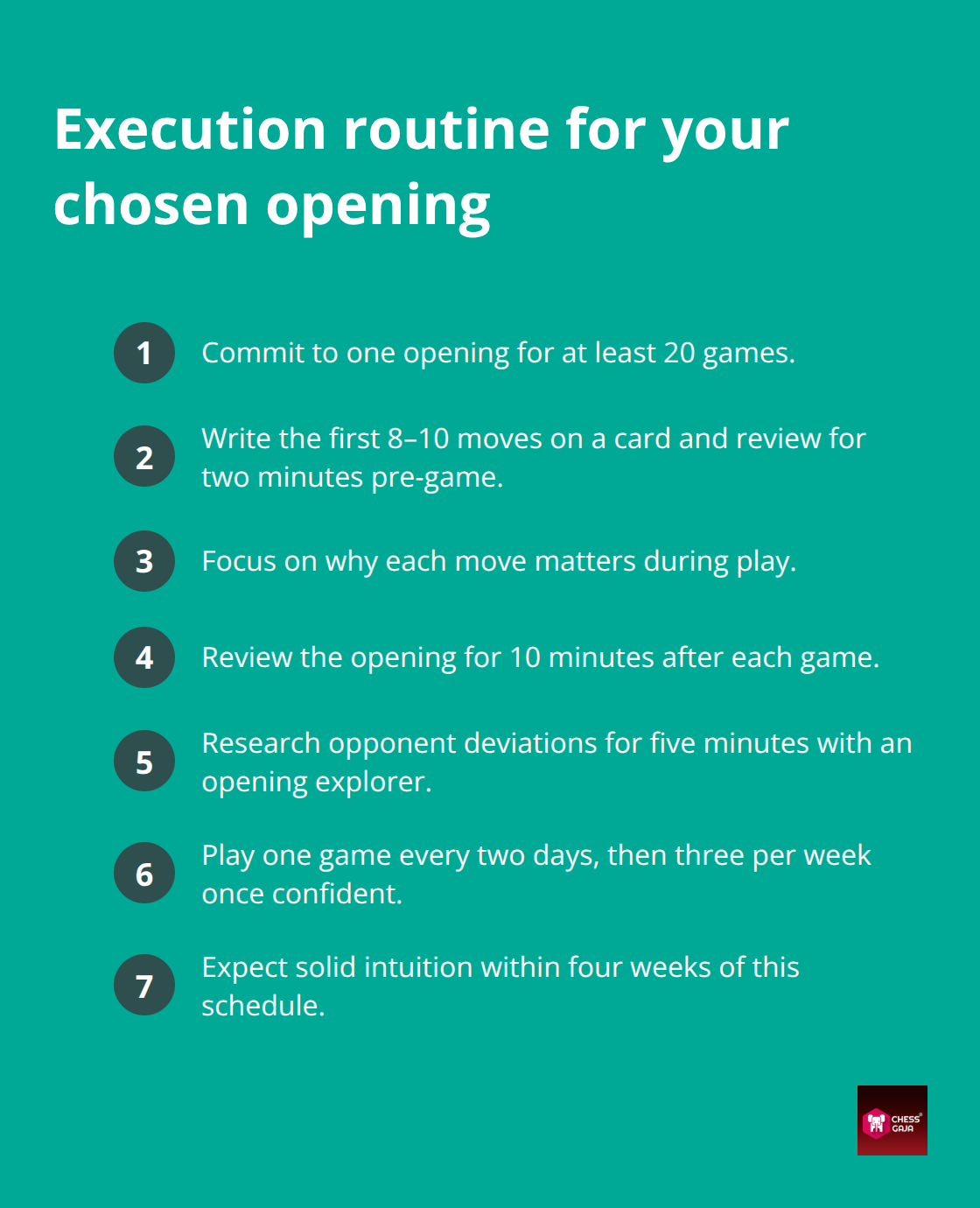
Spend 10 minutes after each game reviewing your opening. Did you reach expected setups? Did your opponent deviate early?
If Black deviates, log the move. Then, review it on Chess.com or Lichess for five minutes. This targeted method focuses on real local lines.
Play one game every two days during your first month. Later, increase to three games weekly. This routine builds confidence and leaves time to fix errors.
Your White opening now sits in place. The next step is to build your Black repertoire with equal care and commitment-because your defense against 1.e4 and 1.d4 will determine whether you survive the opening with a playable position or find yourself struggling from move 12 onwards.
Building Your Black Repertoire Against 1.e4 and 1.d4
Tournament success depends equally on handling Black effectively.
Many beginners fall into the trap of playing the Sicilian Defense early. However, it requires 30+ hours of theoretical preparation. Beginners collapse against aggressive variations they haven’t studied. Focus that study time on core middlegame concepts instead.
Why the Caro-Kann Defense Solves Your 1.e4 Problem
We recommend the Caro-Kann Defense against 1.e4 for a rock-solid pawn structure with d5 and c6.
After 1.e4 c6 2.d4 d5, you secure a stable center with zero weaknesses. White cannot break your position through brute force, giving you time to develop smoothly.
After 3.Nc3 (or 3.Nd2), play 3…dxe4! 4.Nxe4 Bf5 5.Ng3 Bg6. When White plays 6.h4, answer with 6…h6! to give your bishop an escape square on h7, then proceed with …e6, …Nf6, and …Nbd7. Equalize first, then generate queenside counterplay with moves like …a6 and …c5 once White commits.
How the Queen’s Gambit Declined Handles 1.d4
Against 1.d4 d5 2.c4, play 2…e6 The Queen’s Gambit Declined to solidly reinforce your d5-pawn. This holds a strong center. Thus, you avoid early theoretical risks. This defense remains a favorite because it ensures a safe setup.
In addition, it shares the same ideas as the Caro-Kann. First, you ease central pressure. Next, you develop your pieces smoothly. Later, you counter in the center with …c5. This solid structure turns patient play into wins.
Building Confidence in Your Black Defenses
First, play 15–20 games with the Caro-Kann before adding the Queen’s Gambit Declined. Thus, you build confidence in one defense at a time.
For example, one Dubai student switched from the Sicilian to the Caro-Kann. Consequently, her rating climbed from 1165 to 1280 within three weeks.
Against flank openings like 1.Nf3 or 1.c4, start with 1…e6 before playing …d5. This controls d5 safely and transposes the game into familiar Queen’s Gambit Declined structures.
Ultimately, you are not memorizing raw move sequences. Instead, you are internalizing strategic ideas behind your pawn structure. As a result, you can handle unexpected variations without panic.
In addition, apply the exact same review habit for Black. First, log your games after playing. Next, check where deviations occurred using Chess.com or Lichess. Finally, focus strictly on the top responses you actually encounter over the board.
Handling Unexpected Openings with Solid Principles
Mastering these two defenses covers most of tournament games.
Safe pawn chains like d5-c6 and d5-e6 keep your position solid. Focus on key squares, active pieces, and simple plans.
To build this habit, play one game every two days during your first month. After that, increase to three games weekly as your confidence grows.
Final Thoughts on Your Opening Journey
Test your four openings in 30–40 casual games before playing tournaments. Always focus on reaching familiar setups rather than winning at all costs.
Spend 10 minutes reviewing the opening phase of each game. Identify where preparation ended and middlegame understanding took over. This habit builds steady confidence over time.
However, most junior players expand their repertoire prematurely.
Wait until you play 50 tournament games before adding new lines. By then, you will know which positions need work. For example, one student played these four lines for 12 weeks and reached 1450. He expanded only when ready.
Professional coaching accelerates this growth significantly.
Our FIDE-rated coaches at Chess Gaja review your play and spot opening gaps. They build a clear 8–12 week study plan. Book a Paid Starter Class today to build a strong foundation with expert coaching.