


Your opening choice shapes your entire game. Whether you’re a beginner learning your first moves or an advanced player refining your strategy, the most effective openings in chess offer proven paths to success.
At Chess Gaja, we’ve guided thousands of players through opening selection based on their skill level and playing style. This guide breaks down the openings that work, from foundational systems to grandmaster-level complexity.
At Chess Gaja, new players often feel lost with so many opening names.
As a Grandmaster, I tell my students that top openings are not just trends. They last because they win games for both casual players and World Champions.
In this guide, I make things simple. You will learn why players love these setups and how to pick the best one for your style.
Which Are the Most Popular Chess Openings for Beginners?
The Italian Game: Learning Through Principles
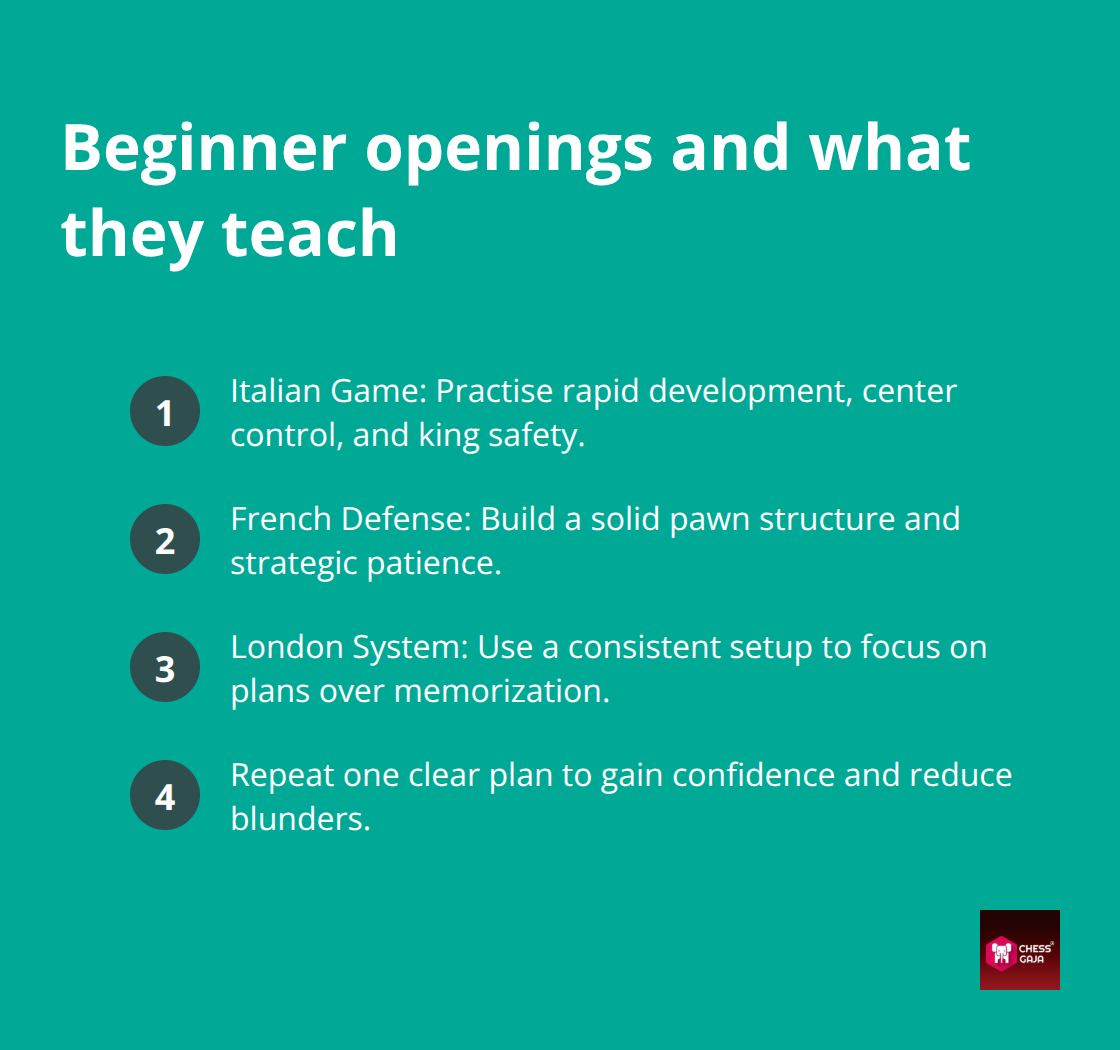
Beginners need openings that teach key ideas rather than memorized moves. The Italian Game focuses on three simple goals:
After 1.e4 e5 2.Nf3 Nc6 3.Bc4, White’s pieces move toward the center with a purpose.
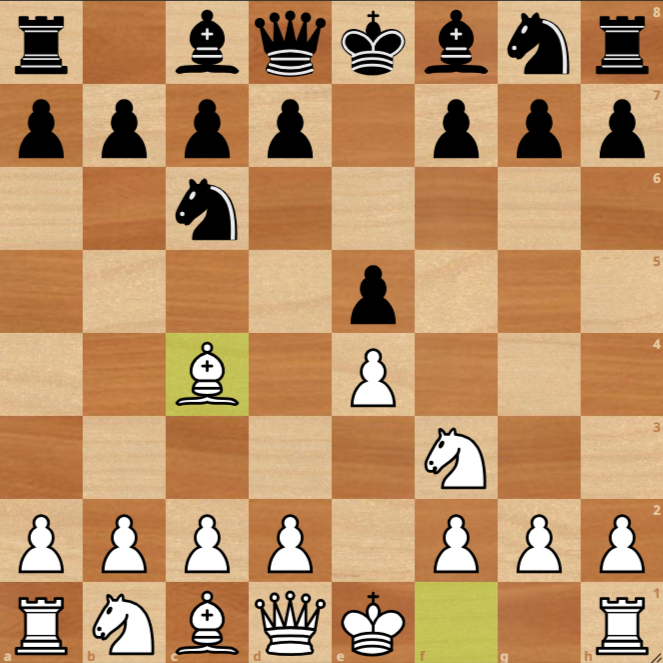
This setup values good understanding over memorization. It stays clear and skips heavy theory. So, you do not need to learn endless long move lines. Unlike the Ruy Lopez (1.e4 e5 2.Nf3 Nc6 3.Bb5), it demands no long move chains.
Solid Defenses for Black Players
For Black, the French Defense (1.e4 e6) forms a strong wall against early attacks. Specifically, it teaches patience rather than risky moves.
Meanwhile, for White, the London System gives you a simple choice. It uses a set pawn framework on d4, e3, and c3 with an active bishop on f4. Thus, beginners can focus on one basic plan instead of learning endless moves.
Real Results from Consistent Opening Play
Real progress happens when beginners see their chosen opening work repeatedly.
For instance, Kanav joined us in late 2024. As a result, he gained 260 points and won the Singapore U11 title in 2025. Similarly, Aurik earned Bronze at that same event.
Neither player learned long move lists or traps. Instead, they mastered core ideas and played them well.
How Beginner Openings Shape Middlegame Plans
The Italian Game emphasizes active piece placement with Bc4, e4, and Nf3. As a result, these moves translate directly into clear middlegame plans. Similarly, the French Defense teaches how a solid pawn center supports long-term piece activity. In contrast, the London System shows that pawn structure matters more than flashy tactics at the beginner level.
Each opening gives a beginner permission to stop worrying about whether they’re prepared enough and start focusing on understanding the position. As players advance beyond these foundational systems, intermediate-level openings demand more tactical awareness and deeper preparation-a natural progression that builds on the principles beginners already know.
Most Popular Chess Openings for Intermediate Players
Intermediate players face a big choice. Basic openings can hold back your progress. Upgrading to the Sicilian Defense or Ruy Lopez gives better results.
The Sicilian is Black’s most aggressive reply to 1.e4. It leads to sharp games. Quick tactics bring wins. This extra edge helps active players in the UAE and Singapore gain 50 to 100 rating points fast.
Intermediate Black players often switch from the French or Caro-Kann to the Sicilian. As a result, they enter positions where quick tactics win games.
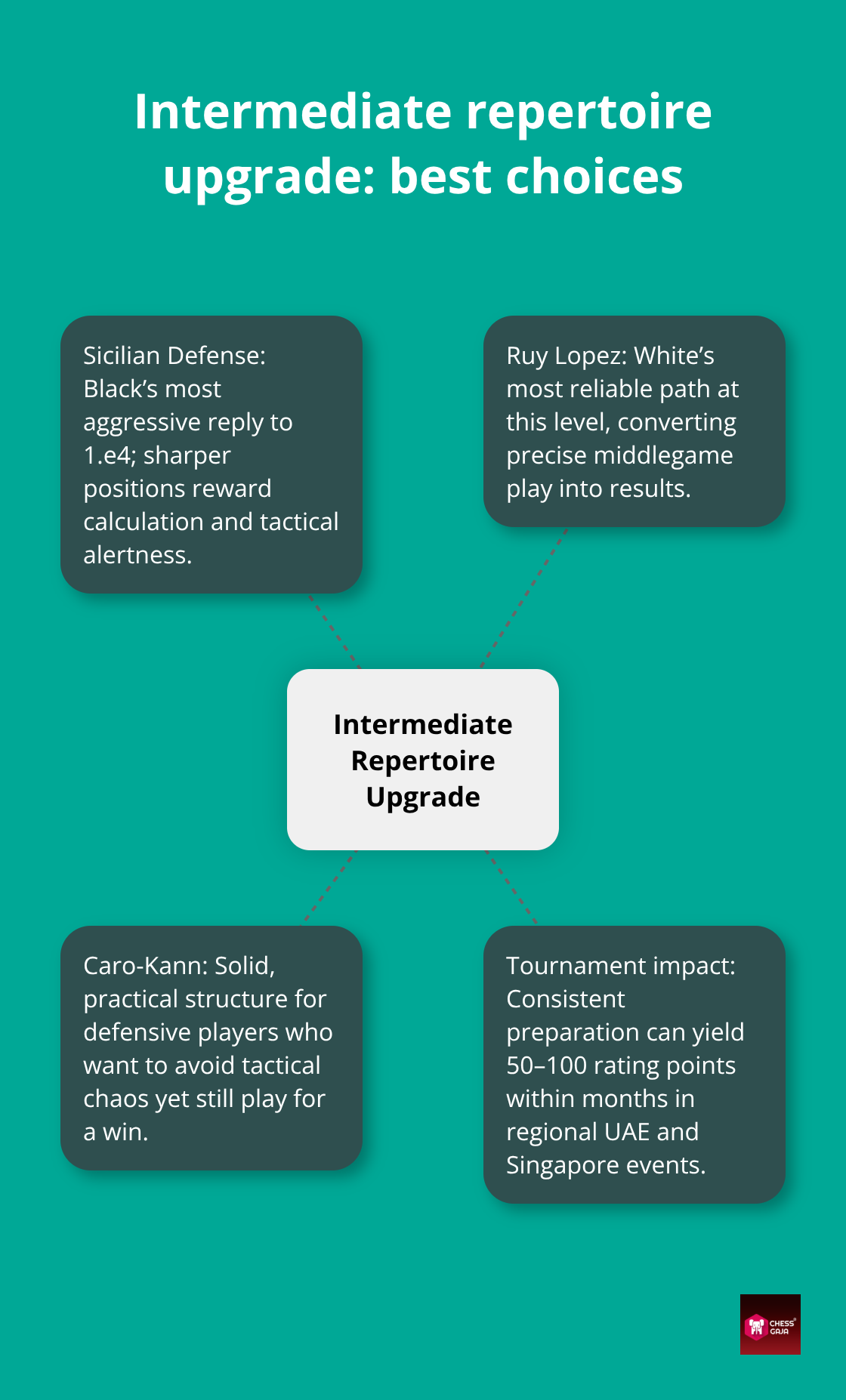
In addition, the Ruy Lopez is White’s most reliable weapon for intermediate play. It consistently outperforms basic setups in thousands of real games.
Abinav scored 3 out of 5 at a big event. He switched to a solid Ruy Lopez plan and gained 63 rating points in one event.
The Caro-Kann Defense remains solid even against aggressive White setups, making it the practical choice for defensive players who want to avoid the tactical chaos of the Sicilian but still play for a win.
Sicilian Variations: Choose One Line and Master It
Many players think they must learn every line after 1.e4 c5. That is a mistake. Instead, pick one main setup like the Najdorf, Dragon, or Classical. Then, learn simple answers to basic setups like the Closed Sicilian or Alapin.
Key takeaway: Focus 80% of your study on lines you face in real games. Prepare three solid ideas against White’s main moves. Always test new lines in blitz or rapid before classical events.
Ruy Lopez: One of the Most Popular Chess Openings for Technique
The Ruy Lopez teaches a key skill: keeping winning chances in even games. Club players should learn main plans rather than memorize 25 moves of theory.
After 1.e4 e5 2.Nf3 Nc6 3.Bb5, learn how to build central pressure and coordinate your pieces.
For example, our student Priyansh grew from 1325 USCF to 2260 USCF (National Master) by building his repertoire around core Ruy Lopez ideas.
For Black, the Caro-Kann Defense offers a solid alternative that sidesteps the Ruy Lopez entirely. Black controls d5, develops systematically, and creates strong counterplay.
The Transition Point: When to Shift Your Repertoire
Players reach a turning point around 1600–1800 rating. At this level, opponents punish small mistakes fast. They also attack weak pawn structures. Simple setups like the Italian Game still work, but they no longer give you a big edge.
Opponents learn how to stop simple lines. So, you need setups that offer real winning chances. Moving to the Sicilian, Ruy Lopez, or Caro-Kann shows you are ready to level up. These lines force you to think on your feet.
The next section explores how advanced players select openings that reflect their individual style and competitive ambitions.
Most Popular Chess Openings for Advanced Players
Advanced players stop looking for easy setups. Instead, they pick lines that reward sharp tactics and deep study.
The Najdorf Sicilian, Berlin Defense, and Marshall Attack offer three strong ways to fight for a win, mastering these systems helps separate club players from competitive tournament regulars.
At this level, opening choice reflects not just playing strength but also psychological readiness for specific types of positions. Yugan from Singapore finished in the top 10 at the 2025 National K-12 Grade Championship after mastering advanced variations that demand hours of preparation before each tournament.
How Advanced Players Prepare Differently
Advanced players study openings to win, not just to avoid mistakes. They aim to put pressure on opponents under time limits. However, Black must rely on sharp tactics and deep positional knowledge.
White cannot rely on basic development rules here. Instead, White must know specific move orders and pawn breaks to keep any edge.
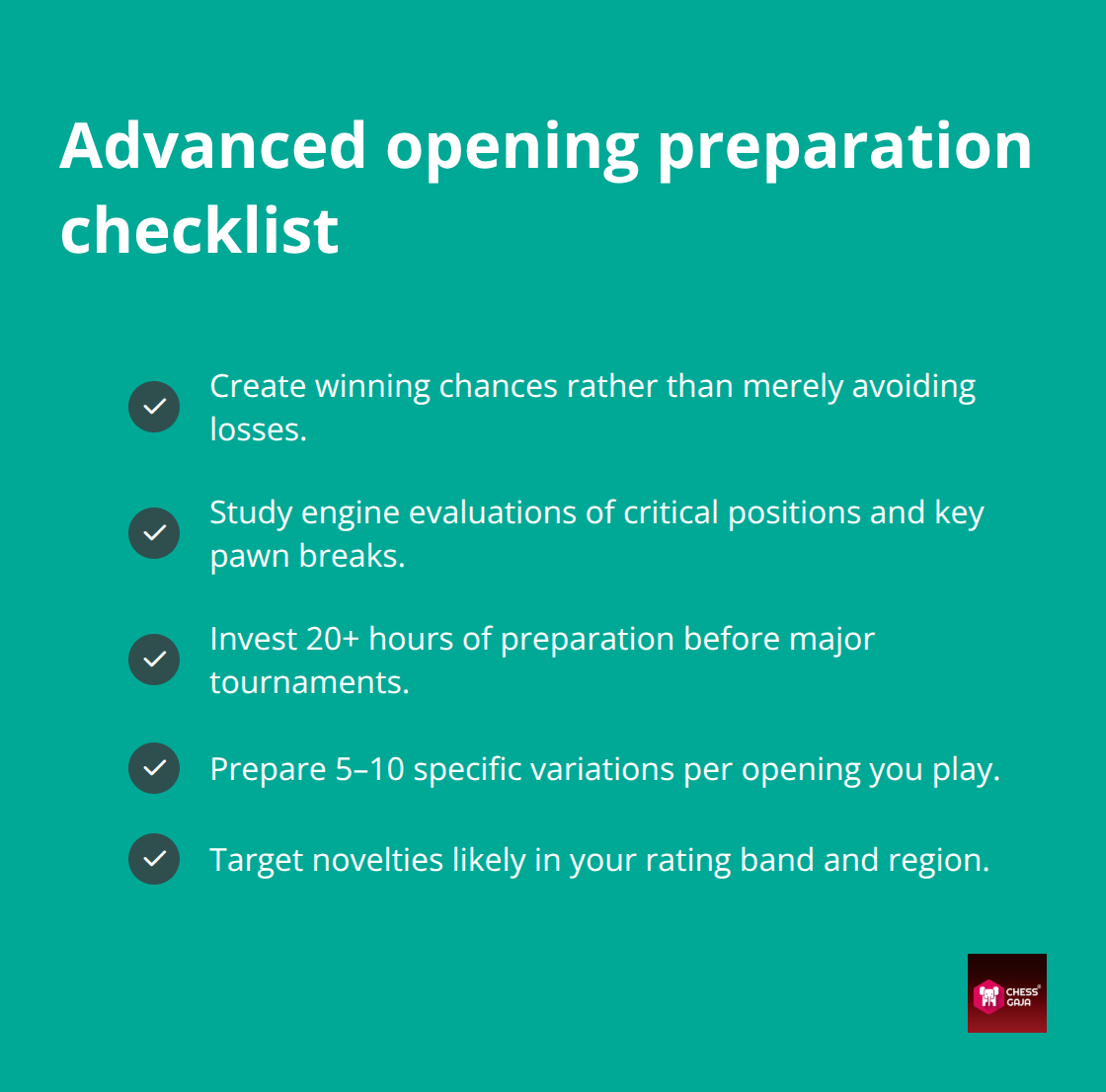
Advanced openings require structured study. For instance, the Najdorf requires checking exact engine lines in sharp positions, not just main ideas. Therefore, serious players spend 20+ hours preparing before major events. They focus on key moves and prepare 5 to 10 lines per opening.
The Najdorf Sicilian: Tactical Complexity Meets Counterplay
Advanced Black players who commit to the Najdorf gain access to positions where they generate practical winning chances even against higher-rated opposition. The Najdorf Sicilian (1.e4 c5 2.Nf3 d6 3.d4 cxd4 4.Nxd4 Nf6 5.Nc3 a6) creates positions where Black gains strong counterplay
The resulting positions reward those who calculate accurately and recognize tactical patterns that emerge from the pawn structure. The Najdorf requires exact move orders. One weak move can ruin Black’s position instantly.
Successful players study both the early moves and key middle plans. Because each variation needs exact move choices, one small mistake can ruin the position fast. Thus, players who master this line invest time in learning both the opening and the plans that follow.
The Berlin Defense: Simplification and Endgame Mastery
The Berlin Defense (1.e4 e5 2.Nf3 Nc6 3.Bb5 Nf6) stops White’s edge completely. It forces easy trades into an endgame where Black stays safe or even plays to win.
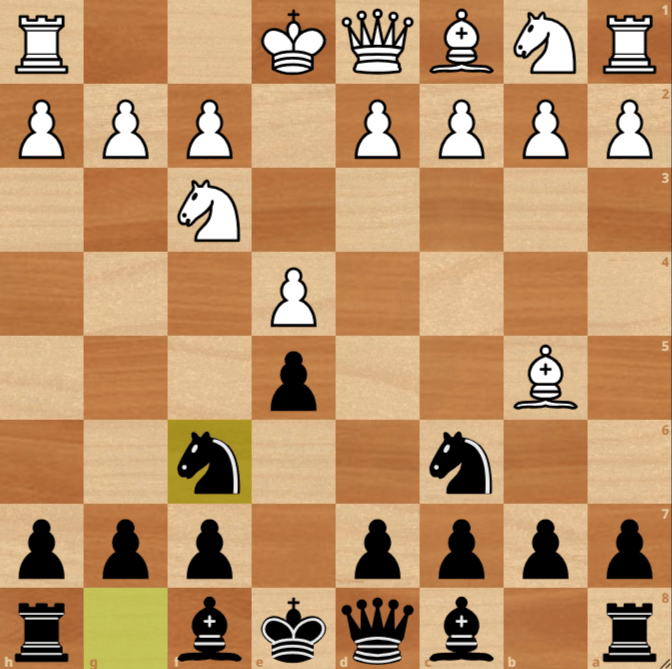
The Berlin Defense requires strong endgame skills. Black trades queens early and accepts a weak pawn setup to get two strong bishops. The game then turns into a deep endgame where exact piece placement wins the day.
The Marshall Attack: Aggression Through Sacrifice
The Marshall Attack (1.e4 e5 2.Nf3 Nc6 3.Bb5 a6 4.Ba4 Nf6 5.O-O Be7 6.Re1 b5 7.Bb3 O-O 8.c3 d5!) offers a dynamic central pawn sacrifice. In return, Black gets strong, long-term attacking chances.
This opening rewards tactical pattern recognition over simple memorization. Advanced players study classic games to see where the attack succeeds. They learn exactly when White’s initiative holds or fails.
Advanced Black players use the Marshall to gain strong attacking chances. When White miscalculates, Black wins quickly. White must defend accurately while holding the extra pawn. As a result, this line suits players who love active tactics over quiet defense.
Choosing the Most Popular Chess Openings for Tournaments
Advanced players recognize that opening selection at this level depends on tournament context.
In fast rapid games, a player might pick the Berlin. Its solid style leads to safe play under tight time controls. In long classical games, a player might choose the Najdorf. Its deep positions reward hard preparation and long calculation.
Furthermore, the Marshall Attack suits players who want to seize the initiative immediately with Black. It forces White to show precise theoretical knowledge to survive Black’s piece activity.
These openings separate serious players from casual ones because they require regular updates as top grandmasters test new ideas.
Final Thoughts
Your opening choice depends on your style, rating, and goals.
Beginners do best with simple setups like the Italian Game or London System because they teach core ideas.
Intermediate players see big rating gains when they move to the Sicilian Defense or Ruy Lopez, where sharper tactics and deeper plans take over.
Advanced players rely on strong setups like the Najdorf, Berlin, and Marshall Attack. These lines reward sharp tactics and deep board sight gained through tournament play.
Your opening choices match your chess growth. You cannot skip steps. A beginner trying the Najdorf wastes time memorizing moves. An intermediate player who stays with basic openings stops their rating growth. Match your setup to your level, and you will see steady progress.
Top chess openings work because players test them every day. Your task is simple. Pick an opening for your current rating, learn the key ideas, and move up when you are ready.
At Chess Gaja, we guide your progress with 1-on-1 coaching made for your level.
Our FIDE-rated coaches and Grandmaster-led courses across 40+ countries help players pick the right setups. As a result, you build confidence and avoid confusion. Book a Paid Starter Class today. We will check your game, find the best lines for your style, and help you gain rating points fast.