

Your opening repertoire is the foundation of your chess game. It determines how you start every single match. Also, it shapes the positions you will face for the next 15–20 moves.
Many beginners waste months studying openings that do not fit their style. Then, they abandon them after a few losses. At Chess Gaja, we have seen this pattern countless times with students across the USA, UAE, and Singapore.
Because of this, this guide shows you how to build opening repertoire basics. So, you can pick systems that actually work for your level and playing style.
Why Your Opening Choices Shape Your Results
How Opening Selection Controls Your Middlegame
Your opening repertoire controls which middlegames you face. A beginner who plays 1.e4 faces four main responses: 1…e5, the Sicilian Defense (1…c5), the French Defense (1…e6), and the Caro-Kann (1…c6). As a result, they must navigate completely different strategic worlds.
However, another beginner who plays 1.d4 enters different positions. Central pawn tension lasts longer. Because of this, piece coordination takes priority before tactical fireworks. Your opening choices are not abstract. Instead, they show whether a position fits your strengths or exposes your weaknesses.
The Isolation Trap: Why Memorization Fails
Most beginners make one critical mistake: they study openings in isolation. So, they memorize long sequences without understanding the resulting positions. A student might spend weeks studying the Najdorf Sicilian. However, after move 12, they often have no idea what their pieces should do next.
Because of this, the students who improve fastest are not those who memorize the most lines. Instead, they are the ones who choose openings that lead to positions they can actually play.
Matching Your Repertoire to Your Playing Style
For instance, if you naturally think in concrete tactics, choose systems with sharp sequences. However, if you prefer long-term planning, select strategic openings. Choose lines where piece placement and pawn structure matter more than calculation.
Because of this, Your repertoire must match how your brain works, not how someone else’s brain works. When your opening choices align with your style, you stop losing in the first 15 moves. Then, you start winning in the middlegame where real growth happens.
Building Confidence Through Repetition
Confidence at the board comes directly from repetition. Because studying the same opening structure 20 times helps you recognize patterns, you play with certainty. Conversely, jumping between five different openings leads to constant hesitation.
Tournament results prove this: consistent repertoires produce better results than varied ones. So, top youth players master 2–3 core systems deeply rather than dabble in 10 openings. Also, your brain needs to see the same pawn structures repeatedly. Because this regular repetition builds deep intuition, it leads to faster thinking, fewer blunders, and better results.
With your opening philosophy now clear, the next step involves building the actual systems you’ll play as White-starting with how you respond to Black’s most common first moves.
Building Your White Opening System
Choose Your Foundation: 1.e4 or 1.d4
As White, your first move sets the tone. So, choose between 1.e4 and 1.d4. Each path leads to very different middlegames. Because committed players stay consistent, they always do better than those who switch setups.
In fact, playing 1.e4 means facing 1…e5 and the Sicilian Defense most of the time, alongside the French Defense and Caro-Kann. Therefore, focus your study time on these primary replies.
Solid Systems Against 1…e5 and the Sicilian
Against 1…e5, try the Italian Game (1.e4 e5 2.Nf3 Nc6 3.Bc4). It gives you solid positions where active piece play matters more than memorizing moves. Later on, the Ruy Lopez (3.Bb5) makes a great alternative.
Against 1…c5, the Open Sicilian forces sharp positions. However, it requires heavy study. If sharp play exhausts you, choose the Closed Sicilian with 1.e4 c5 2.Nc3 instead.
Handling the French and Caro-Kann
Keep things simple against the French and Caro-Kann. Against the French Defense (1.e4 e6 2.d4 d5), play 3.Nc3 to meet Black’s central challenge directly. Because of this, you keep a space advantage and active piece play.
Against the Caro-Kann (1.e4 c6 2.d4 d5), play 3.Nc3 or 3.Nd2. After Black captures with 3…dxe4, White replies 4.Nxe4, entering positions where piece structure and endgame technique matter more than raw memorization.
The 1.d4 Alternative
On the other hand, if you prefer 1.d4, your planning gets simpler. The Queen’s Gambit (1.d4 d5 2.c4) is your best foundation. So, prepare clear setups against both the Accepted (2…dxc4) and Declined (2…e6).
Against Indian Defenses (1.d4 Nf6), pick one system. A Fianchetto setup with g3 and Bg2 works great. Because of this, you get a clear plan without memorizing 30 moves of theory.
Build Your Practical Repertoire
Don’t try to cover every possible Black defense in your first year. Choose your main opening against 1…e5 or 1…d5 (whichever applies to your chosen first move), then choose one solid backup against the other Black responses. A 15-year-old student committed to the Italian Game as their primary weapon against 1…e5. They chose the Ruy Lopez as a secondary option. Their rating improved by 180 points in nine months. They stopped switching systems and began recognizing key patterns.
Practical preparation means maintaining a study log to record your results. Track which openings produce wins and which produce losses. This data reveals whether your opening choices actually suit your playing style. However, most beginners spend their first six months studying openings from YouTube videos, then abandon them after two tournament losses without understanding why they lost. Instead, play 10–15 serious training games in your chosen opening. Next, analyze them with a coach or database like Chess.com or Lichess. Only then should you decide whether to keep the opening.
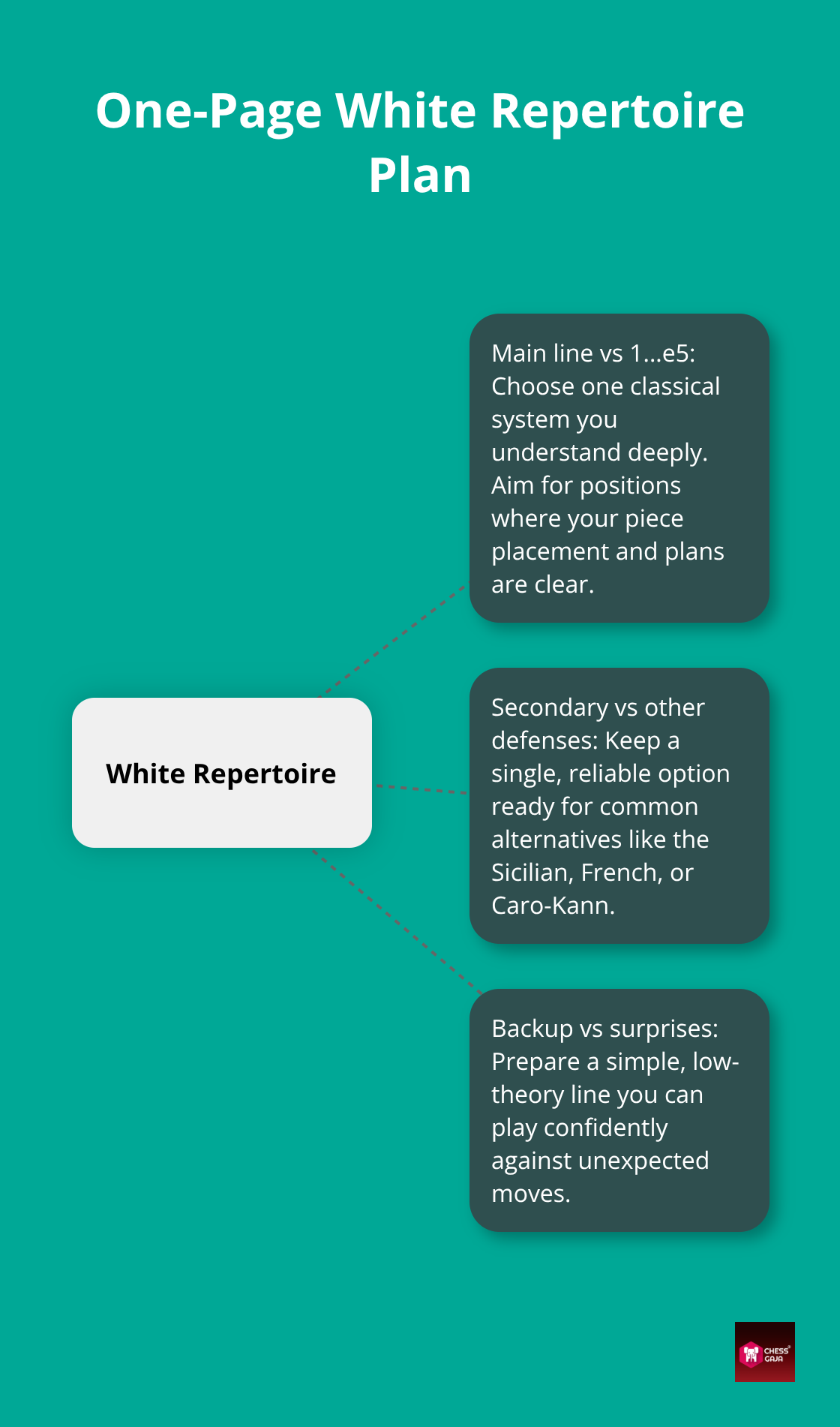
Keep your White repertoire on a single page: a main line against 1…e5, a solid response to other major defenses, and a backup plan for odd moves. That simplicity is your strength. By reviewing these lines often, you will spot key ideas instantly and play with real confidence. With your White system now established, the next step involves building equally solid responses as Black-starting with how you handle White’s most aggressive first move.
Building Your Black Repertoire
Playing Black demands a different mindset than White. You do not control the opening. Instead, you respond to it. Therefore, your Black repertoire must handle White’s choices while giving you positions you play with confidence.
The Breadth Trap: Why Scattered Preparation Fails
Many students build a Black repertoire that is too broad. Trying to learn separate responses to 1.e4, 1.d4, 1.c4, and 1.Nf3 all at once spreads your focus too thin.
The fastest-improving players pick one main defense to 1.e4 and one to 1.d4. They add one simple setup for rare first moves. This focused setup builds confidence much faster.
Handling 1.e4: The Sicilian Question
Against 1.e4, the Sicilian Defense remains the most popular choice at competitive levels. However, it demands serious preparation. Don’t want to memorize 20 variations? Try the Caro-Kann or French Defense instead. Both offer clear positions where basic plans matter more than exact moves.
The Sicilian is one of Black’s most frequent choices against 1.e4. Therefore, you need a concrete plan. The Najdorf Variation (1.e4 c5 2.Nf3 d6 3.d4 cxd4 4.Nxd4 Nf6 5.Nc3 a6) remains one of its most popular branches.
Many beginners choose the Najdorf because it looks sharp. However, after move 15, they lack a clear plan. Instead, pick lines matching your favorite middlegames. Tactical players prefer opposite-side castling lines. Strategic players should choose the Scheveningen or Classical instead.
Your choice matters immensely. You face the same position structure repeatedly. That repetition builds your intuition.
Responding to 1.d4: The Indian Defense Path
Against 1.d4, Indian Defenses (1…Nf6 followed by 2…e6 or 2…g6) give Black active piece play without memorizing 25 moves of theory. The King’s Indian Defense (1.d4 Nf6 2.c4 g6 3.Nc3 Bg7) leads to very consistent positions you can master over time.
You will play identical pawn structures and reach familiar setups in every game. One student played the King’s Indian in 12 consecutive games and analyzed each match. Within 10 games, they recognized patterns instantly, played faster, and gained 95 rating points.
In addition, the Queen’s Gambit Declined (1.d4 d5 2.c4 e6) is another solid option if you prefer closed positions and long-term strategic play.
Preparing for Rare First Moves
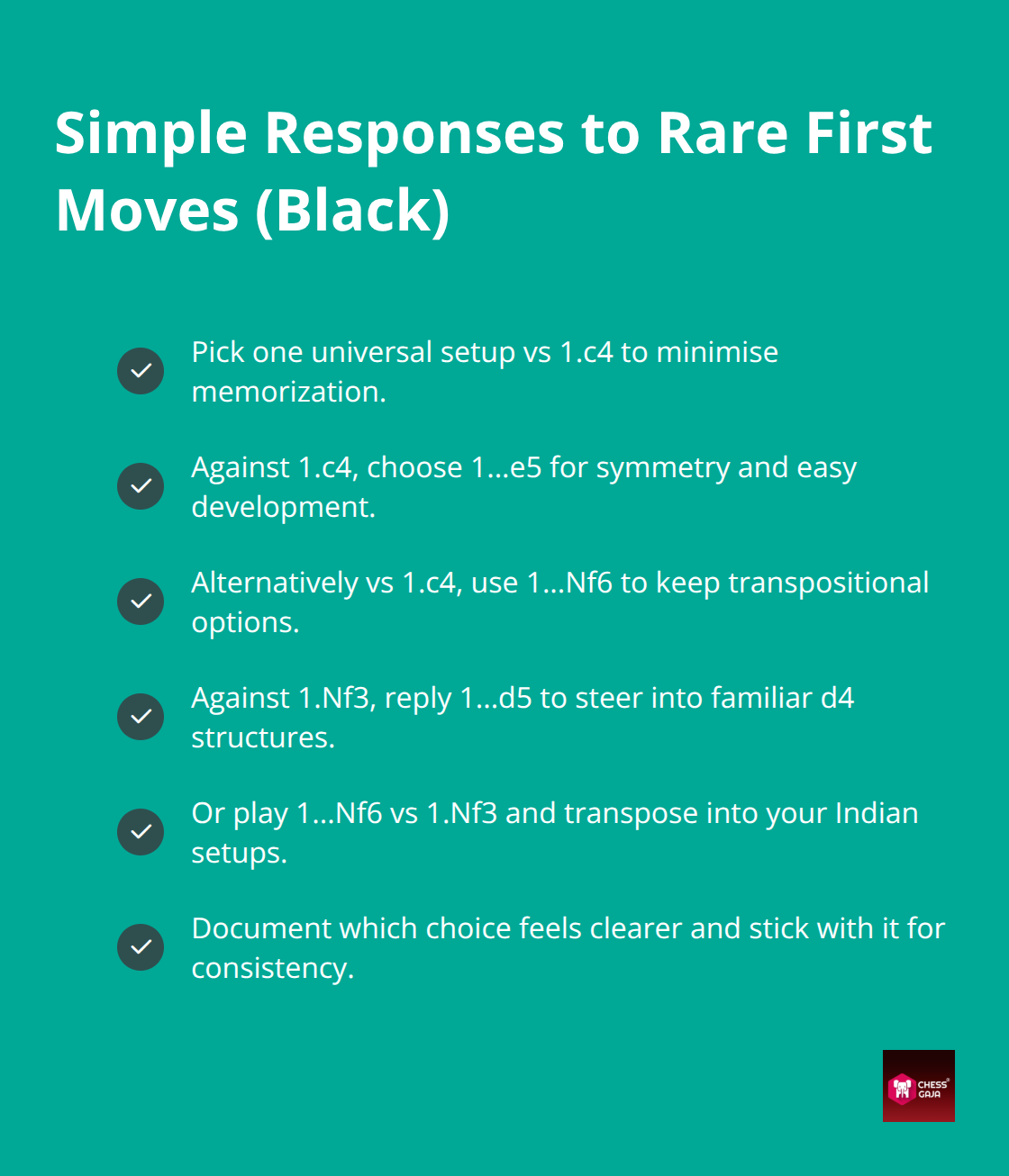
Against 1.c4 or 1.Nf3, prepare one flexible setup. Playing 1…e5 against 1.c4 gives active play. Playing 1…Nf6 against either move allows you to transpose back into your main Indian Defenses whenever White plays an early d4. This keeps you away from unfamiliar pawn setups.
This approach saves precious study time so you don’t waste hours on rare openings. Keep your Black repertoire slim. Reviewing the same setups repeatedly builds total certainty at the board.
Final Thoughts
Your opening repertoire basics determine your tournament confidence. For example, the students who improve fastest commit to a small number of systems. They study them repeatedly and recognize patterns instantly. One 15-year-old student spent six months jumping between five openings with minimal progress. Then, they committed to the Italian Game as White and the King’s Indian as Black. Their rating climbed 120 points in four months. They stopped wasting mental energy on unfamiliar positions.
Consistent study adds up over time. Playing the same opening setup 20 times teaches your brain to spot key plans faster. Focused repertoires always beat scattered preparation.
At Chess Gaja, our GM-led curriculum helps students across 40+ countries build clear opening plans.
Book a Paid Starter Class for a full evaluation. Our FIDE-rated coaches will assess your play and design a focused repertoire just for you.